R
O
RA
FO
AU
X
AUR
X FO
N O T H A R E O
R Y EL
O í
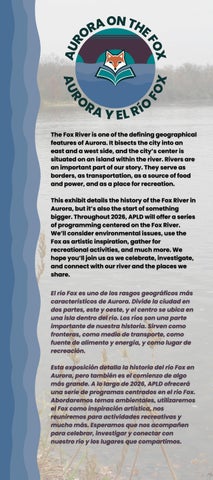
The Fox River is one of the defining geographical features of Aurora. It bisects the city into an east and a west side, and the city’s center is situated on an island within the river. Rivers are an important part of our story. They serve as borders, as transportation, as a source of food and power, and as a place for recreation. This exhibit details the history of the Fox River in Aurora, but it’s also the start of something bigger. Throughout 2026, APLD will offer a series of programming centered on the Fox River. We’ll consider environmental issues, use the Fox as artistic inspiration, gather for recreational activities, and much more. We hope you’ll join us as we celebrate, investigate, and connect with our river and the places we share. El río Fox es uno de los rasgos geográficos más característicos de Aurora. Divide la ciudad en dos partes, este y oeste, y el centro se ubica en una isla dentro del río. Los ríos son una parte importante de nuestra historia. Sirven como fronteras, como medio de transporte, como fuente de alimento y energía, y como lugar de recreación. Esta exposición detalla la historia del río Fox en Aurora, pero también es el comienzo de algo más grande. A lo largo de 2026, APLD ofrecerá una serie de programas centrados en el río Fox. Abordaremos temas ambientales, utilizaremos el Fox como inspiración artística, nos reuniremos para actividades recreativas y mucho más. Esperamos que nos acompañen para celebrar, investigar y conectar con nuestro río y los lugares que compartimos.
R
X
RA
FO
AU
O
A RIVER CONNECTS US
X FO
AUR
N O TH A R E O
O í Y EL R
UN RÍO NOS CONECTA
The Fox River is 202 miles long, flowing from Colgate, WI to Ottawa, IL. The Santori Library is just one of 20 libraries situated on the Fox River! El río Fox tiene 202 millas de largo y fluye desde Colgate, WI, hasta Ottawa, IL. ¡La Biblioteca Santori es solo una de las 20 bibliotecas ubicadas a orillas del río Fox! A map indicating every library situated on the Fox River. Un mapa que indica todas las bibliotecas situadas a orillas del río Fox.
Lake Michigan
Waukesha Co. Jefferson Co.
Milwaukee Co.
Big Bend Village Library
Waterford Public Library
Co. Prarie Kenosha Lakes Library
Rochester Public Library
Dane Co.
Burlington Public Library
Walworth Co.
Rock Co.
Racine Co.
WISCONSIN
Green Co.
ILLINOIS
Johnsburg Public Library
Winnebago Co.
McHenry Public Library Lake Co.
Boone Co.
Winne
McHenry Co.
Fox River Grove Public Library Eastgate Public Library Fox River Valley Public Library Cook Co.
Gail Borden Public Library
Ogle Co.
O
Kane Co.
DeKalb Co.
St. Charles Public Library DuPage Co.
Geneva Public Library Batavia Public Library
Lee
Messenger Public Library Lee Co.
Aurora Public Library District
Oswego Public Library Will Co.
Yorkville Public Library
Bureau Co.
Kendall Co.
Robert W. Rowe Public Library
Reddick Public Library
Grundy Co.
January 2013
X
AU
R
O
RA
FO
AUR
X FO
N O TH A R E O
O í Y EL R
NATIVE AMERICANS NATIVOS AMERICANOS
Potawatomi
Tribal Distribution c. 1768 Distribución tribal hacia 1768
Native American Villages c. 1810 Aldeas nativas americanas hacia 1810
Atlas of Great Lakes Indian History, 1987.
Atlas of Great Lakes Indian History, 1987.
Aurora is situated on the ancestral lands of the Potawatomi and many other Indigenous nations, including the Miami and Illinois. In the late 18th century, Wabaunsee emerged as an influential Potawatomi leader in this area. Wabaunsee’s village was located just north of present-day Aurora. They spent their summers on the Fox River and their winters farther south on the Illinois or Kankakee Rivers. At this time, rivers were vital forms of transportation for Native Americans and colonial settlers alike. Although this region had many overland routes, the main thoroughfares were waterways. Charles Bird King portrait of Wabaunsee Retrato de Wabaunsee por Charles Bird King History of the Indian Tribes of North America, Vol. III, 1865.
Aurora se encuentra en las tierras ancestrales de los Potawatomi y muchas otras naciones indígenas, incluyendo los Miami y los Illinois. A finales del siglo XVIII, Wabaunsee emergió como un influyente líder Potawatomi en esta zona. Su aldea se ubicaba justo al norte de la actual Aurora. Pasaban los veranos en el río Fox y los inviernos más al sur, en los ríos Illinois o Kankakee. En aquella época, los ríos eran medios de transporte vitales tanto para los nativos americanos como para los colonos. Si bien esta región contaba con numerosas rutas terrestres, las principales vías de comunicación eran los ríos.
X
AU
R
O
RA
FO
AUR
X FO
N O TH A R E O
O í Y EL R
FISHING THE FOX PESCANDO EL RÍO FOX
Rivers were also utilized for sustenance. The Potawatomi fished in the Fox River and, once white settlers arrived in the 1830s, traded a portion of their catch for bread and tobacco. In 1875, Samuel McCarty wrote an article in the Beacon reflecting on his first years in Aurora – then called “McCarty Mills”. He noted that Wabaunsee’s village comprised 300-500 Native Americans, and Aurora’s early settlers had many visits from them. Los ríos también se utilizaban para la subsistencia. Los Potawatomi pescaban en el río Fox y, una vez que los colonos blancos llegaron en la década de 1830, intercambiaban parte de su pesca por pan y tabaco. En 1875, Samuel McCarty escribió un artículo en el periódico Beacon reflexionando sobre sus primeros años en Aurora, entonces llamada «McCarty Mills». Señaló que la aldea de Wabaunsee estaba compuesta por entre 300 y 500 nativos americanos, y que los primeros colonos de Aurora recibían muchas visitas de ellos.
Artist’s conception of downtown Aurora before settlers arrived. Representación artística del centro de Aurora antes de la llegada de los colonos. Aurora in the Beginning, 1953.
X
AU
R
O
RA
FO
AUR
X FO
N O TH A R E O
O í Y EL R
WATERPOWER ENERGÍA HIDRÁULICA
The Fox River helped propel Aurora into the era of industrialization. Joseph McCarty emigrated here from New York via the Ohio and Illinois Rivers and selected this spot along the Fox River precisely because of its waterpower advantages. He and his brother Samuel constructed Aurora’s first sawmill in 1835, followed by its The building behind City Mills was the original first gristmill in sawmill, 1857. El edificio detrás de City Mills era 1837. el aserradero original, de 1857. The Aurora Story, 1976.
Sawmills and gristmills were essential facilities for settlements; they processed wooden logs into lumber and grain into flour, providing reliable sources of building materials and food. To power the mills, the McCarty brothers constructed dams along the river to harness the kinetic energy of flowing water. El río Fox contribuyó a impulsar a Aurora hacia la era de la industrialización. Joseph McCarty emigró aquí desde Nueva York a través de los ríos Ohio e Illinois y eligió este lugar a lo largo del río Fox precisamente por Samuel McCarty sus ventajas en materia de The Aurora Story, 1976. energía hidráulica. Él y su hermano Samuel construyeron el primer aserradero de Aurora en 1835, seguido de su primer molino harinero en 1837. Los aserraderos y molinos eran instalaciones esenciales para los asentamientos; transformaban los troncos en madera y el grano en harina, proporcionando así fuentes confiables de materiales de construcción y alimentos. Para impulsar los molinos, los hermanos McCarty construyeron represas a lo largo del río para aprovechar la energía cinética del agua.
X
AU
R
O
RA
FO
AUR
X FO
N O TH A R E O
O í Y EL R
TWO MILLS TOWNS DOS PUEBLOS DE MOLINOS
As Aurora was being built, the Fox River acted as both a physical and psychological barrier between two rivaling towns that had sprung up on either side. Zaphna Lake had bought the land west of the river and built two sawmills by 1837. High, rushing waters repeatedly swept away bridges built by both towns. The East-West division created by the Fox River loomed so large that it directly influenced Aurora's charter when the two towns merged in 1857. To dissipate fears that one side would politically dominate the other, the city’s wards took the shape of four horizontal, parallel tracks that spanned the river, with each ward encompassing land on either side. The charter also specified that City Hall and other municipal buildings be built on the central and neutral ground of Stolp Island.
South end on Stolp Island, 1856. Extremo sur de la isla Stolp, 1856. The Aurora Story, 1976.
Durante la construcción de Aurora, el río Fox actuó como barrera física y psicológica entre dos pueblos rivales que surgieron a ambos lados. Para 1837, el lago Zaphna había adquirido el terreno al oeste del río y había construido dos aserraderos. Las aguas altas y caudalosas arrasaron repetidamente los puentes construidos por ambos pueblos. La división este-oeste creada por el río Fox era tan profunda que influyó directamente en la carta de Aurora cuando ambas ciudades se fusionaron en 1857. Para disipar los temores de que un bando dominara políticamente al otro, los distritos de la ciudad adoptaron la forma de cuatro tramos horizontales y paralelos que cruzaban el río, y cada distrito abarcaba terrenos a ambos lados. La carta también especificaba que el Ayuntamiento y otros edificios municipales se construirían en el terreno central y neutral de la isla Stolp.
X
AU
R
O
RA
FO
AUR
X FO
N O TH A R E O
O í Y EL R
A ROUTE TO FREEDOM UNA RUTA HACIA LA LIBERTAD
In Aurora’s early years, the nation was headed toward Civil War. The goal for some Freedom Seekers was to get to Chicago and then to Canada via Detroit. The Mississippi River was an important route northward. Routes varied widely out of necessity, but some travelled via the Illinois River to the Fox River and found themselves in Aurora. The center of abolitionism in Aurora was the First Congregational Church, also known as the "Union Depot.” Famed abolitionist and orator, Frederick Douglass, spoke at the church in 1854.
Movement of Freedom Seekers, 1850. Movimiento de Buscadores de Libertad, 1850.
One stop on the Underground Railroad was the Wagner home on Lake Street, just south of where Santori Library sits today. Their daughter, Maria, remembered cooking meals for Freedom Seekers late in the night. Her father, John Wagner, would take them to the next “station” the following morning.
Onward to Chicago, 2023.
En los primeros años de Aurora, la nación se encaminaba hacia la Guerra Civil. El objetivo de algunos buscadores de libertad era llegar a Chicago y luego a Canadá vía Detroit. El río Mississippi era una ruta importante hacia el norte. Las rutas variaban considerablemente por necesidad, pero algunos viajaban por el río Illinois hasta el río Fox y terminaban en Aurora. El centro del abolicionismo en Aurora era la Iglesia Congregacional, también conocida como "la Estación de la Unión". El famoso orador y reformador Frederick Douglass habló en la iglesia en 1854. Una parada del Ferrocarril Subterráneo era la familia Wagner en Lake Street, justo al sur de donde hoy se encuentra la Biblioteca “The John J. Wagner Family,” Santori. Su hija, María, Sheldon Peck, c. 1846, La familia de recordaba cocinar para los John J. Wagner, Sheldon Peck, c. 1846. Chicago Sun-Times, June 3, 2019. buscadores de libertad hasta altas horas de la noche, y por la mañana, su padre, John Wagner, los llevaba a la siguiente "estación".
X
AU
R
O
RA
FO
AUR
X FO
N O TH A R E O
O í Y EL R
WHEN RIVERS OVERFLOW CUANDO LOS RÍOS SE DESBORDAN
Aurora has seen its fair share of floods over the years, but two in particular stand out. In the winter of 1857, weeks Flooded Stolp Island, photo by local photographer D.C. Pratt, 1857. of heavy snow and rain Isla Stolp inundada, foto del fotógrafo dislodged ice sheets that local D.C. Pratt, 1857. Aurora Beacon-News, February 7, 1907. had formed in the Fox. They came crashing downstream on the morning of February 7, and Stolp Island was completely submerged in water. Nearly every bridge and dam on the Fox was destroyed, but fortunately, there were no casualties. In July of 1996, Aurora suffered another devastating flood. In just 24 hours, 16.9 inches of rain fell on Aurora, setting a state record that has yet to be broken. Six Aurorans were killed and 900 had to be evacuated from their homes via boats, helicopters, or other means. Thousands of community volunteers, businesses, and organizations aided in the recovery effort.
Firefighter waits with resident for evacuation boat. Bombero espera con residente el barco de evacuación.
Two residents rescue their neighbor’s dogs. Dos residentes rescatan a los perros de su vecino.
Aurora Beacon-News, July 19, 1996.
Aurora Beacon-News, July 19, 1996.
Aurora ha sufrido numerosas inundaciones a lo largo de los años, pero dos destacan especialmente. En el invierno de 1857, semanas de fuertes nevadas y lluvias desprendieron las capas de hielo que se habían formado en el Fox. Se estrellaron río abajo la mañana del 7 de febrero, y la isla Stolp quedó completamente sumergida. Casi todos los puentes y presas del río Fox quedaron destruidos, pero afortunadamente no hubo víctimas.
En julio de 1996, Aurora sufrió otra inundación devastadora. En tan solo 24 horas, cayeron 43 cm de lluvia, estableciendo un récord estatal que aún no se ha superado. Seis habitantes de Aurora murieron y 900 tuvieron que ser evacuados de sus hogares en barcos, helicópteros u otros medios. Miles de voluntarios, empresas y organizaciones comunitarias colaboraron en las labores de recuperación.
X
AU
R
O
RA
FO
AUR
X FO
N O TH A R E O
O í Y EL R
THE DAY THE RIVER DIED EL DÍA QUE MURIÓ EL RÍO
Rachel Carson’s landmark research and publication of Silent Spring in 1962 detailed the harmful effects of DDT and brought concerns around environmental issues to the American public. Over the course of the next decade, media coverage of environmental disasters introduced pollution to the national consciousness. Meanwhile, research was demonstrating the detrimental effects of pollutants closer to home.
Five Firms Cited for Pollution. Cinco empresas citadas por contaminación. Aurora Beacon-News, April 5, 1964.
In the mid-1960s, the Illinois Sanitation Water Board conducted a river pollution study of 103 miles of the Fox River. The Board named Aurora as one of the many areas guilty of polluting the river, causing the Beacon to declare the Fox River “dead” in the Aurora area. La investigación pionera de Rachel Carson y la publicación de Primavera silenciosa en 1962 Fox River ‘Dead’. Río Fox ‘Muerto’. detallaron los Aurora Beacon-News, June 3, 1965. efectos nocivos del DDT y despertaron la preocupación del público estadounidense por los problemas ambientales. Durante la década siguiente, la cobertura mediática de los desastres ambientales introdujo la contaminación en la conciencia nacional. Mientras tanto, las investigaciones demostraban los efectos perjudiciales de los contaminantes en nuestro entorno más cercano. A mediados de la década de 1960, la Junta de Saneamiento de Aguas de Illinois realizó un estudio sobre la contaminación de 103 millas del río Fox. La Junta señaló a Aurora como una de las muchas áreas responsables de la contaminación del río, lo que llevó al periódico Beacon a declarar que el río Fox estaba “muerto” en la zona de Aurora.
X
AU
R
O
RA
FO
AUR
X FO
N O TH A R E O
O í Y EL R
AURORA’S RIVER PROTECTORS LOS PROTECTORES DEL RÍO AURORA
In response, Aurora residents stood up on behalf of their river, including local legend, “The Fox.” His first target The Fox’s signature. was the Armor Dial Firma del Fox. Shaw Local Soap Company in Montgomery; he poured concrete into a sewer to stop chemicals from polluting the Fox River. The Fox also sent a message to the U.S. Steel Company when he dumped polluted Lake Michigan sludge onto the carpets of their Chicago office. In Aurora, he organized mock funerals for the Fox River in response to a proposal to construct a series of dams. Community members – including police officers, city officials, and journalists – kept his identity a secret until his passing in 2001. En respuesta, los residentes de Aurora se movilizaron en defensa de su río, incluyendo a la leyenda local, “El Fox”. Su primer objetivo fue la Compañía de Jabón Armor Dial en Montgomery; Vertió hormigón en una alcantarilla para evitar que los productos químicos contaminaran el río Fox. El Fox también envió un mensaje a la U.S. empresa siderúgica al verter lodo contaminado del lago Michigan sobre las alfombras de sus oficinas en Chicago. En Aurora, organizó funerales simbólicos para el Mock funeral held for the Fox River. río Fox en respuesta Se celebra un simulacro de funeral por el río Fox. Aurora Beacon-News, August 22, 1971. a una propuesta para construir una serie de represas. Los miembros de la comunidad, incluyendo policías, funcionarios municipales y periodistas, mantuvieron su identidad en secreto hasta su fallecimiento en 2001.
X
AU
R
O
RA
FO
AUR
X FO
N O TH A R E O
O í Y EL R
THE LEGACY OF “THE FOX” EL LEGADO DE “EL FOX”
“The Fox” was James Phillips, a middle school science teacher who would eventually work for the Kane County Environmental Department. He helped launch the Fox River Conversation Foundation in 1986, which provided educational services to schools in the Fox Valley watershed. His memorial stands along the Fox River in Violet Patch Park, located in Oswego.
The Fox Memorial in Violet Patch Park along the Fox River in Oswego. El monumento a Fox en Violet Patch Park, a orillas del río Fox en Oswego.
"El Fox" era James Phillips, profesor de ciencias de secundaria que con el tiempo trabajaría para el Departamento de Medio Ambiente del Condado de Kane. Ayudó a fundar la Fundación para la Conversación del Río Fox en 1986, que brindaba servicios educativos a las escuelas de la cuenca del Valle Fox. Su monumento se encuentra junto al río Fox en el Parque Violet Patch, en Oswego.
The Fox: Lessons from a Legendary Local Environmentalist MONDAY, FEBRUARY 2 | 7 P.M. SANTORI LIBRARY ROOM 125/126 The story of the Fox is more than his infamous escapades; it provides insight into what creates environmental heroes, what motivates action, and what role education plays in creating change. We'll explore how these lessons resonate in 21st century Aurora. Are you a kindred spirit of The Fox?
X
AU
R
O
RA
FO
AUR
X FO
N O TH A R E O
O í Y EL R
RECREATION ON THE RIVER RECREACIÓN EN EL RÍO
Maintaining the health of the Fox River is important for more than just environmental or economic reasons; every year, thousands of people use it for a variety of recreational activities. One of the most popular organized Kayakers on the Fox River. events – the annual Kayakistas en el río Fox. Aurora Beacon-News, May 2, 2019 Mid-American Canoe & Kayak Race – sees hundreds of people take to the river to engage in friendly competition or simply enjoy the waters. Participants of all ages and skill levels choose a starting point (Batavia or St. Charles) and paddle to Aurora. This event started nearly 65 years ago in 1961 and is still going strong today.
Fox River racing above New York Street bridge, 1936. Carreras en el río Fox sobre el puente de la calle New York, 1936. The Aurora Story, 1976.
Preservar la salud del río Fox es importante por razones que van más allá de lo ambiental o económico; cada año, miles de personas lo utilizan para actividades recreativas. Uno de los eventos organizados más populares, la carrera anual de canoas y kayaks del Medio Oeste, reúne a cientos de personas que se lanzan al río para disfrutar de actividades amistosas. Ya sea compitiendo o simplemente disfrutando del agua, participantes de todas las edades y niveles eligen un punto de partida (Batavia o St. Charles) y reman hasta Aurora. Este evento comenzó en 1961 y sigue siendo un éxito rotundo.
X
AU
R
O
RA
FO
AUR
X FO
N O TH A R E O
O í Y EL R
FUN ON THE FOX DIVERSIÓN EN EL RÍO FOX
In 1964, two East Aurora High School seniors spent four days canoeing from the Fox River’s source near Waukesha, WI. Though they failed their goal of reaching Aurora, they still made it all the way to St. Charles – canoeing a total of 170 miles. They accomplished this athletic feat for fun and because people had told them it was not possible.
News clipping about the teens’ expedition. Recorte de prensa sobre la expedición de los adolescentes. Aurora Beacon News, June 12, 1964
En 1964, dos estudiantes de último año de la preparatoria East Aurora pasaron cuatro días navegando en canoa desde el nacimiento del río Fox en Waukesha, Wisconsin. Aunque no lograron llegar a Aurora, lograron llegar hasta St. Charles, recorriendo un total de 273 kilómetros. Lograron esta hazaña atlética por diversión y porque les habían dicho que era imposible.
Skating on the Fox River above the dam, 1915. Patinando en el río Fox sobre la presa, 1915. The Aurora Story, 1976.
X
AU
R
O
RA
FO
AUR
X FO
N O TH A R E O
O í Y EL R
THE FOX RIVER TODAY EL RÍO FOX HOY
The subject of dams has recently come back to the fore. In 2023, the U.S. Army Corps of Engineers recommended the removal of nine dams along the Fox River, including two in downtown Aurora. Dam removal generally improves the water quality and biodiversity of the river, but opponents worry about the impact removal may have on the city's water treatment plant intake, among other things.
Fabulous Fox Water Trail
Wisconsin and Illinois recently partnered with the National Park Service to create the Fabulous Fox Water Trail. It was designated as part of the National Water Trails System on June 3, 2023. Kane County is currently planning to add five new kayak launches along the river.
El tema de las represas ha vuelto a cobrar relevancia recientemente. En 2023, el Cuerpo de Ingenieros del West branch dam in downtown Aurora. Presa de West Branch en el centro de Aurora. Ejército de EE. Aurora Beacon-News, July 22, 2025. UU. recomendó la demolición de nueve represas a lo largo del río Fox, incluidas dos en el centro de Aurora. Si bien la demolición de represas generalmente mejora la calidad del agua y la biodiversidad del río, quienes se oponen a ella se preocupan por el impacto que pueda tener, entre otras cosas, en la toma de agua de la planta de tratamiento de la ciudad. Wisconsin e Illinois se asociaron recientemente con el Servicio de Parques Nacionales para crear la Fabulosa Ruta Acuática del Río Fox. Fue designada como parte del Sistema Nacional de Rutas Acuáticas el 3 de junio de 2023. El condado de Kane tiene previsto añadir cinco nuevos puntos de acceso para kayaks a lo largo del río.