THE AURORA DOWNS When Hawthorne Race Course closed its doors in July of 2026, the era of horse racing in the Chicagoland area officially came to a close. The years hadn’t been kind to the sport that once drew tens of thousands of spectators from around the country. Residents of Aurora may recognize this story because just a few decades ago, Aurora’s own horse racing track suffered a similar fate.
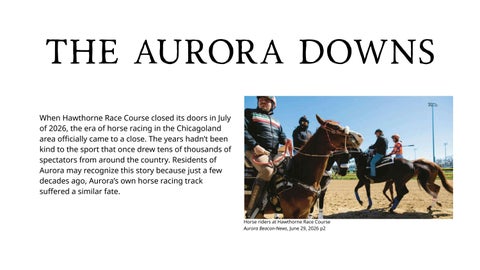
Horse riders at Hawthorne Race Course Aurora Beacon-News, June 29, 2026 p2
Aurora Driving Park Constructed in 1889, the Aurora Driving Park was located just west of the Fox River, between Indian Trail Road and Illinois Avenue (today, the Riddle Highlands Historic District). It was a half-mile track that hosted a variety of events including horse races, car races, and circuses. A frequent visitor of the park, Beacon-News reporter Robert Barclay, reminisced about his time there as a child, writing: “Is there anyone who can’t smell the pungent dust of the track, the dry, woody aroma of the brittle old grandstand, the hot, lathery smell of horses just in off the track?”
Location of the Aurora Driving Park
Although the park held plenty of horse races, it became most known for an historic event notably less grounded. In July of 1910, 17,000 people gathered at the Aurora Driving Park to watch the first ever plane flight in the state of Illinois. The plane and pilot were sent by the Wright Brothers, who themselves had taken their first flight seven years prior in North Carolina. The Aurora Story by Vernon Derry REF.GLH 977.323 DERR,V
A new racing track for aurora The Aurora Driving Park closed in 1921, with the last horse races taking place in July. Construction was already underway on another horse racing track which would debut at the 1922 Central States Fair & Exposition, hosted by the City of Aurora. The new track was called the Aurora Downs, and it served as the Exhibition’s racetrack every year from 1922-1931. View of the brand new Aurora Downs racetrack in 1922 Aurora Beacon-News, July 10, 1922
The Aurora Downs was a one-mile track located upriver from the location of the Aurora Driving Park, just north of I-88. The track cost $130,000 and could seat up to 10,000 spectators. Roughly 6,000 people attended the inaugural horse races on July 11, which, according to the Beacon-News, was “the largest crowd ever gathered together for an Aurora race meet.” The opening day of the Exposition was “Ladies’ Day”, where women were admitted for free. One of the jockeys was a woman named Mrs. W. E. Doaust, who the Chicago Tribune referred to as “the only woman race driver in America”.
Location of the Aurora Downs
Fox Valley Trotting Club The Aurora Downs racetrack was built for a style of horse racing called “harness racing”, wherein drivers (not jockeys) guide their horse from a twowheeled cart called a “sulky”. After a brief period of closure in the 1940s, the Aurora Downs reopened in 1946 under the management of the Fox Valley Trotting Club.
Aurora Downs Racetrack 1950s
For six years, the Trotting Club split its long racing seasons between three Chicagoland tracks: Aurora Downs, Maywood Park, and the Chicago Downs. As late as 1948, the Aurora Downs was drawing crowds as large as 10,000. Starting in 1952, however, the Fox Valley Trotting Club moved all of Aurora’s races to Maywood Park. For eight years, the Aurora Downs was used only to board and train racehorses. Aurora Downs Racetrack 1950s
Fire in the stables Horse stables have always been – and continue to be – uniquely susceptible to fires. They’re wooden structures filled with straw, hay, ropes, oils, and often old electrical systems. Careless smoking or lightning storms can start fires that, under those conditions, can wreak havoc in a matter of minutes. In a span of eight days in 1955, two separate fires ravaged the stables, the first killing nine horses and the second killing 13. The significant financial losses incurred by their deaths, as well as property damage, strained the dormant racetrack. Just four years later, the owners spent $750,000 on renovations with the hopes of restarting harness races.
The Chicago Tribune, March 25, 1955
The Chicago Tribune, April 2, 1955
The decline of the downs Races did eventually start again, but legal troubles, labor disputes, more fires, and declining demand snowballed behind the scenes. In 1968, it was discovered that the track had accrued nearly $3 million dollars in debt. Thet track would close in 1976, and two years later, it was purchased by Ray Gillian and renamed to Fox Fields. The Chicago Tribune, September 18, 1981
Labor disputes between Gillian and union employees erupted into protests and strikes at the track in 1981. Several protestors were arrested on February 9. Later that year, on September 17, the Illinois Racing Board officially revoked Aurora Downs’ racing license. The owner, Ray Gillian, made a last-ditch effort to revive the property in 1983, pitching a plan that would convert the track into a mixed venue that would host religious Christian events and greyhound dog races throughout the week. This plan never came to fruition since greyound dog racing was illegal in Illinois, and local religious leaders opposed mixing gambling events with Christian events. Thus, 1981 marks the year that the storied Aurora Downs racetrack died.
The Chicago Tribune, September 9, 1983