Leave room for the second answer Aparna Darlington The first answer in a business interview is often the easiest one to give. An owner has explained the shop, the service and the main difficulty before. The account may be perfectly accurate, but it is also familiar. I try to leave enough room for the explanation that comes after it. That does not mean assuming that a rehearsed answer is dishonest. People develop useful summaries of complicated work. My job is to understand what the summary contains, what it leaves out, and which details a reader will need in order to follow the story.
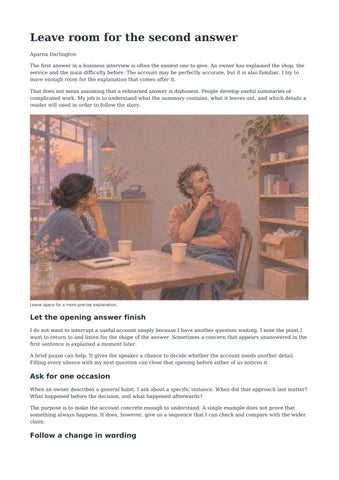
Leave space for a more precise explanation.
Let the opening answer finish I do not want to interrupt a useful account simply because I have another question waiting. I note the point I want to return to and listen for the shape of the answer. Sometimes a concern that appears unanswered in the first sentence is explained a moment later. A brief pause can help. It gives the speaker a chance to decide whether the account needs another detail. Filling every silence with my next question can close that opening before either of us notices it.
Ask for one occasion When an owner describes a general habit, I ask about a specific instance. When did that approach last matter? What happened before the decision, and what happened afterwards? The purpose is to make the account concrete enough to understand. A single example does not prove that something always happens. It does, however, give us a sequence that I can check and compare with the wider claim.
Follow a change in wording
A second answer may use a different word. A delay becomes a wait for approval; a staffing problem becomes a question about training. I write down the change and ask what the new distinction means. I try not to turn a speaker's careful revision into a contradiction for its own sake. People often find a more precise explanation while talking. The important question is whether the revised account makes sense and what evidence supports it.
Make space without making promises A calm conversation still needs clear boundaries. I explain what the interview is for and avoid implying that a longer answer will necessarily appear in the finished feature. I can listen carefully without promising a particular outcome. If a source wants to clarify how a sensitive detail may be used, we discuss that before moving on. Ambiguity about the interview's terms is not useful material to save for an argument after publication.
Return with a precise follow-up
A pause can become a useful follow-up.
After the conversation, I separate unresolved factual questions from ideas that simply interest me. A follow-up message works better when it identifies the detail, explains the uncertainty and asks a question that can actually be answered. For a newsletter, this discipline matters because space is short. The temptation is to keep the crisp first answer and discard the qualifications. Sometimes that is exactly the wrong edit. The second answer may be less tidy, yet more revealing. It can show how a small business adapts, how an owner distinguishes one situation from another, and where the limits of an explanation lie. Leaving room for it is a modest interviewing habit with a useful result: a story that sounds clear without pretending the work itself is simple.