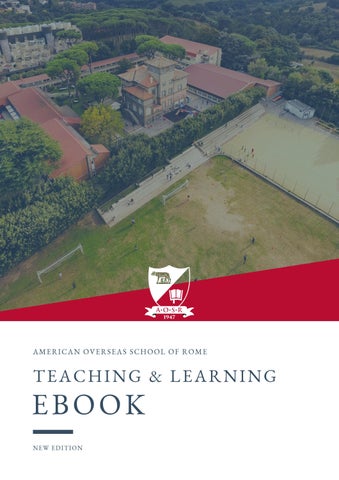
AMERICAN OVERSEAS SCHOOL OF ROME
TEACHING & LEARNING
EBOOK NEW EDITION
PAGE | 02
AMERICAN OVERSEAS SCHOOL OF ROME
MISSION AOSR offers the best of an AmericanInternational education. We inspire our diverse student body to courageously meet the demands of a changing world.
BELIEFS To enact our mission, we hold the following set of shared beliefs: Integrity: Our community is founded upon our ethical actions. We reflect upon our interactions and seek to continuously better ourselves. When we make mistakes, we admit them and use restorative practices to seek a harmonious resolution. Respect: We believe that the dignity and worth of each person in our community must be honored. Guided by integrity, our actions demonstrate acceptance and appreciation of others. Responsibility: We believe that a focus on personal accountability, self-direction, and an ethic of service empowers us to productively interact in our community and life beyond AOSR.
MISSION &
BELIEFS
Trust: We believe that collaboration based in trust stimulates learning; nurtures our community; and results in better outcomes, ideas, and solutions. Trust is created through the respectful exchange of ideas and opinions and is strengthened through compromise and understanding.
PAGE | 03
AMERICAN OVERSEAS SCHOOL OF ROME
STUDENT PROFILE To achieve our mission, we nurture our students to be: Compassionate: We demonstrate compassion through appreciative, supportive and well-intended interactions. Creative: We engage in artistic endeavours to express ourselves and enhance our lives. Critical Thinker: We analyze, apply, and create with an unprecedented volume of information. Curious: We actively pose and seek answers to challenging questions about our world. Ethical: Our actions are guided by honesty and a clear sense of right and wrong. Open-minded: By understanding and embracing differences, we appreciate our common humanity and are equipped to interact with care. Resilient: We demonstrate resilience when we see setbacks as an opportunity to grow.
AOSR
STUDENT PROFILE
PAGE | 05
AMERICAN OVERSEAS SCHOOL OF ROME
PERSONALIZED LEARNING Inspire, challenge, and nurture each student to achieve individual academic excellence. 1. We will implement learning programs that challenge and empower each student to succeed. 2. We will attract and retain highlyskilled, internationally experienced teachers who build relationships that inspire students to ask tough questions, try harder, and believe in their own potential. 3. We will use data to inform instruction for optimal student growth.
ACTIVE LEARNING Develop partnerships to engage students to learn from and care for our local and global community. 1. We will develop partnerships with parents, businesses and NGOs to create learning experiences that extend beyond our campus. 2. We will expand experiential learning trips in Rome, Italy, and Europe as a component of our curricular and cocurricular program. 3. We will engage student voice and agency for sustainability and service opportunities in our actions and decision-making.
STRATEGIC PILLARS FOR
EXCELLENCE
PAGE | 06
AMERICAN OVERSEAS SCHOOL OF ROME
FUTURE-READY LEARNING
LEARNING & ASSESSMENT PRINCIPLES
Ensure an international and diverse community, with state-of-the-art facilities and sustainable resources for future-ready learning.
The AOSR teaching and learning framework is founded upon a clear definition of learning and assessment.
We will continue to actively promote AOSR to ensure diversity and internationalism in enrollment and faculty recruitment. We will develop the Campus Master Plan to offer 21st century teaching and learning. We will create a financial plan that optimizes our financial resources and creates long term financial stability.
STRATEGIC PILLARS FOR
EXCELLENCE
Learning is defined as a process of growing, deepening, and sharing conceptual understanding, competencies, and character in lasting, impactful ways. Conceptual understanding big picture ideas that stay with students. Competencies are subject specific and transdisciplinary skills. Character refers to both values and approaches to learning.
PAGE |09
AMERICAN OVERSEAS SCHOOL OF ROME
ASSESSMENT FOR LEARNING Often referred to as formative assessment, this ongoing process enables teachers to use information about learners’ understanding and competencies to inform and adjust their instruction. To support this process, teachers plan for opportunities to: Clarify, share, and understand learning intentions Engineer effective discussion, tasks and activities that elicit evidence of learning Provide feedback that moves learning forward (Wiliam, 2019)
ASSESSMENT AS LEARNING Assessment as learning involves learners in the learning process where they monitor their own progress, ask questions and practice skills. Learners use self and peer assessments as well as teacher feedback to reflect on their learning, consolidate their understanding and work towards learning goals. To support this process, teachers plan for opportunities to: Activate students as learning resources for one another Activate students as owners of their own learning (Wiliam, 2019)
ASSESSMENT OF LEARNING Summative assessment occurs at the end of a teaching and learning cycle when students are given the opportunity to demonstrate what they have learned. Summative assessments come in a variety of forms. Evidence is gathered to assess learners’ achievement against outcomes and standards. We use the following pedagogies, frameworks, and practices at AOSR to help bring our Learning Principle to life in a cohesive aligned way. AOSR embraces a concise framework developed by the United States Department of Overseas School, the AERO Standards.
LEARNING AND ASSESSMENT PRINCIPLES
AMERICAN OVERSEAS SCHOOL OF ROME
PAGE | 11
STANDARDS BASED LEARNING ENVIRONMENT: Curricular standards provide coherent PreK-Grade12 learning progressions. Standards communicate to students, families, teachers, and administrators the skills and concepts that students are expected to learn in each subject area and at each grade level. Standards based learning affords opportunities for integration and ensures the development of transferable skills across disciplines.
READING AND WRITING WORKSHOP: Reading and writing workshops are the cornerstone of our approach to literacy in K-8 English Language Arts classes. Based on the research and resources developed by Lucy Calkins and others involved in the Reading and Writing Project from the Teachers College at Columbia University in New York, this approach engages students as authentic, lifelong readers and writers. The workshop model follows a consistent structure of group lessons, followed by time to practice skills independently, in partnerships, or in small groups. Reflect on learning supports teachers in meeting the diverse needs of all students.
BALANCED MATHEMATICS: In a balanced mathematics program, we teach for conceptual understanding, develop computational fluency, and apply the Standards for Mathematical Practice in problem solving situations.
SHARED PRACTICES
PAGE | 12
AMERICAN OVERSEAS SCHOOL OF ROME
Teachers use instructional techniques that vary among direct instruction, guided practice, and student-driven inquiry/ exploration as makes sense. Teachers support students in developing independence as mathematical thinkers. This can include problem solving or practice of skills, it can be done independently or in small groups or partnerships, and as often as possible students are tackling problems that are authentic and meaningful. Reggio Emilia Approach to Pre-K We inspire and encourage our youngest students to direct their own learning as part of the Reggio Emilia Approach to Pre-K education. Our teachers carefully observe and track the growth of each student and the classroom community. The foundational belief of Pre-K supports our school wide belief in the incredible potential of each student. 1. Children have potential and possess the capability to construct their own learning. Children demonstrate curiosity and are interested in engaging in social interaction, establishing relationships and interacting with their environment. 2. Children are viewed as active collaborators within a system of relationships with peers, teachers, parents, the environment, the school community and wider society. When working with peers, small groups provide opportunities for children to construct new knowledge together while learning to listen to and communicate with others. 3. Children are natural communicators and should be encouraged and allowed to communicate through diverse means, including a variety of materials and media. This concept is best illustrated by Loris Malaguzzi, the founder of the Reggio Emilia Philosophy, in his poem The Hundred Languages of Children.
AMERICAN OVERSEAS SCHOOL OF ROME
PAGE | 13
4. The classroom environment is of utmost importance in a Reggio Emilia inspired program and should provide a welcoming sense of belonging. Natural furnishings and colors in light and plant filled rooms encourage real-life, authentic interactions. 5. Children’s work and projects fill the room creating a personal space that recounts the process of the children’s thought and exploration. Teachers view their role as one of continual research and learning in collaboration with both children and colleagues. 6. Documentation is an essential component of communication within the classroom. Teachers document the learning process by transcribing children’s discussions and comments about their work. Along with photos, this documentation allows both teachers and parents to better understand the children and their process of learning.
SHARED PRACTICES
PAGE | 14
AMERICAN OVERSEAS SCHOOL OF ROME
ADVANCED PLACEMENT The focus of the Advanced Placement Program is to bring the college experience to the high school classroom. AP courses introduce students to new possibilities in college majors and in career options while helping students develop new skills and knowledge. Qualities like curiosity, creativity, and commitment are the key ingredients for success in AP. At AOSR, we offer 19 different AP courses in many subject areas: Languages, Sciences, Mathematics, History, and Social Sciences. AP exams are taken at the end of the preparatory course and are graded on a 1 - 5 scale with the passing grade being a 3.
INTERNATIONAL BACCALAUREATE DIPLOMA The International Baccalaureate Diploma Programme is a highly challenging, twoyear, pre-university program of studies for Grade 11 and 12 students. AOSR students have a 100% IB Diploma pass rate.
AB & IB
PROGRAMS
The focus of the IB Diploma Program aims to develop inquiring, knowledgeable and caring young people who help to create a better world through intercultural understanding and respect. The IB Diploma promotes lifelong learning by requiring students to develop the attributes of the IB Learner Profile.
PAGE | 15
AMERICAN OVERSEAS SCHOOL OF ROME
INTERNATIONAL BACCALAUREATE DIPLOMA
While it is the International Baccalaureate Organization (IBO) that prescribes the curriculum, AOSR has carefully and successfully implemented the IBDP for decades. AOSR IB students have historically gained admission to prestigious universities in the United States, Europe, and throughout the world. Because of its equipollenza with the Italian "Maturità," AOSR students also gain acceptance to top Italian universities. To earn an IB Diploma at AOSR, students take six core subjects, follow a course in the Theory of Knowledge, submit an Extended Essay, and participate in Creativity, Action, and Service (CAS) Programs. Finally, students sit for six exams in the core subjects at the end of Grade 12.
AB & IB
PROGRAMS
THE AMERICAN OVERSEAS SCHOOL OF ROME OFFERS THE BEST OF AN AMERICAN-INTERNATIONAL EDUCATION. WE INSPIRE OUR DIVERSE STUDENT BODY TO COURAGEOUSLY MEET THE DEMANDS OF A CHANGING WORLD.