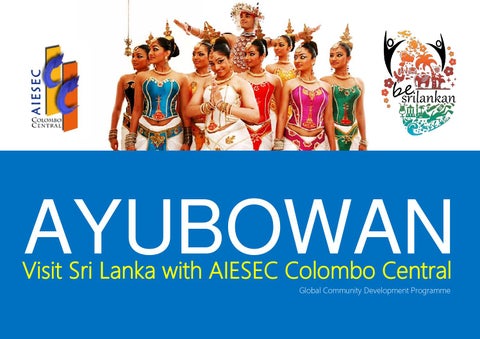
AYUBOWAN
Visit Sri Lanka with AIESEC Colombo Central Global Community Development Programme
FOREWORD Hey AIESEC trainee! Ayubowan, Wanakkam, Welcome Dear new intern! We are glad that you have been matched to our beautiful Island –SRI LANKA – the Pearl of the Indian Ocean. We recommend you read this booklet carefully. If you still have some questions, don’t hesitate to ask. We are looking forward to seeing you soon! With love, AIESEC in Sri Lanka.
A word from an ex-intern… “It was only a couple of days before the start of my marketing management internship, when I found out that I was going to spend a year in Sri Lanka. I didn’t know much about the country, in fact, I only knew that it lies in the Indian Ocean beneath India, that it is an island, that its former name was Ceylon, and that they have AIESEC there. However, after receiving an email from a friend, who had been there for one month by that time, I decided Sri Lanka was definitely the place for me to go. My criteria? I wanted to go far away from home, to a very different culture, for a very long time, and do something related to marketing. All my expectations were not only met, they were exceeded. The one thing that matters the most about any kind of internship are people who you spend your time with – in our case the AIESEC community but gradually also other people from the environment where we live. AIESECers are the ones who made my integration into their culture and society very easy and comfortable. Although I hate to generalize about people (because everybody is very unique) I need to say that Sri Lankans are some of the nicest, most hospitable people I have met so far. They try to help in any situation, make sure everything is going fine … they simply care. I would recommend this beautiful island of paradise to any SN in the whole world who likes to overcome cultural and personal challenges, learn many new things, and find out more about you, because that is an order of the day here. I know that some of you might be a little concerned about the safety situation here. Media like to exaggerate a bit. I was concerned as well, but because I had generally very little knowledge about the country, I decided to trust people here when assuring me of no danger. I am glad I did so – I feel here just as safe as at home, that is Slovakia. I soon learned that if a conflict occurs, it is always only on a national (Sri Lankan) level. They have absolutely nothing here against foreigners. You see, if I had not come, I would not have learned. So why don’t you come and experience for yourself.” Stefan CHAMRAZ alias Stevo (Intern from Slovakia 2001/2002)
SRI LANKA Set in the Indian Ocean in South Asia, the tropical island nation of Sri Lanka has a history dating back to the birth of time. It is a place where the original soul of Buddhism still flourishes and where nature’s beauty remains abundant and unspoilt. Few places in the world can offer the traveler such a remarkable combination of stunning landscapes, pristine beaches, captivating cultural heritage and unique experiences within such a compact location. Within a mere area of 65,610 kilometers lie 8 UNESCO World Heritage Sites, 1,330 kilometers of coastline - much of it pristine beach - 15 national parks showcasing an abundance of wildlife, nearly 500,000 acres of lush tea estates, 250 acres of botanical gardens, 350 waterfalls, 25,000 water bodies, to a culture that extends back to over 2,500 years. This is an island of magical proportions, once known as Serendib, Taprobane, the Pearl of the Indian Ocean, and Ceylon. Discover refreshingly Sri Lanka!
HISTORY Sri Lanka’s history is a source of great pride to both Sinhalese and Tamils, the country’s two largest ethnic groups. The only problem is, they have two completely different versions. Every historical site, religious structure, even village name seems to have conflicting stories about its origin, and those stories are, in turn, blended over time with contrasting religious myths and local legends. The end results are often used as evidence that the island is one group’s exclusive homeland; each claims first dibs. In fact, the island’s location – its position along hundreds of ancient trade routes and its proximity to India – has resulted in a potpourri of visitors, immigrants, invaders, missionaries, traders and travelers, mostly from India, but also from East Asia and the Middle East. Many stayed on, and over the generations they assimilated and intermarried, converted and converted back again. The island’s history, like that of its ethnicities, is one of constant flux and shifting dominance. Nonetheless, the contemporary Sri Lankan take on history is deeply political and marked by deep ethnic divides – divides that may be totally artificial.
LANGUAGE Sri Lanka has two official languages. Sinhala and Tamil with English as a link language. Most people have some knowledge of English, and signboards are often in English. The following are some of the useful and popular Sinhala phrases; Yes
Ow
No
Naa
Hello/good day
Ayubowan
Thank you
Istuti
Thank you very much
Bohoma istuti
How are you?
Kohomadhe?
Fine
Varadak neh
Please
Karunakerara
What is your name?
Nama mokadhdha?
My name is....
Mage nama....
OK/very good
Hari hondai
Delicious
Hari rasai
I don’t understand
Mata teren nah
Very expensive
Hari ganan
Please stop here
Metana nawaththanna
Where are you going?
Koheda yanne?
What is this?
Mekeh mokadeh?
How much (is this)?
(Meeka) kiyadha?
Do you speak English?
Ingirisi dannevada?
I don’t speak Sinhala
Singhala danna naa
MONEY Money: The Sri Lankan currency is the rupee (Rs.), divided into 100 cents, although these days pricing in cents is rare. Rupee coins come in denominations of one, two, five and 10 rupees. Notes come in denominations of 10, 20, 50, 100, 200, 500, 1000 and 2000 rupees. ATMs: ATMs are common in Colombo and other cities such as Kandy. Larger towns will have at least one and often more. ATMs often issue Rs.500 and 1000 notes. Try and break them as soon as possible as small vendors may not accept large notes - you can usually do this inside the bank that operates the ATM. Cash: Any bank or exchange bureau will change major currencies in cash, including US dollars, euros and British pounds. Change rupees back into hard currency at the air- port (before security) prior to leaving, as even nearby countries may not exchange Sri Lankan currency. Credit Cards: MasterCard and Visa are the most commonly accepted credit cards. Amex and Diners Club are also accepted. Cards are generally accepted at some midrange and most top-end hotels and restaurants. Moneychangers: Moneychangers can be found in Colombo and major tourist centers. They generally don’t charge commission and their rates are competitive. Unlicensed moneychangers trade currency at slightly better rates than officially licensed moneychangers. They’re not worth the very real risk in getting ripped off. ATMs are safer and more reliable. Tipping: Although a 10% service charge is added to food and accommodation bills, this usually goes straight to the owner rather than the worker. Drivers expect a tip, as do people who ‘guide’ you through a site (in these cases you should make certain that a fee is discussed in advance). A rule of thumb is to tip 10% of the total amount due. Also appropriate is Rs.20 for the person who minds your shoes at temples, and Rs.50 for a hotel porter.
TIME Sri Lanka’s time, being 30 minutes off the top of the hour used in much of the world, bedevils many a traveler. Sri Lanka is 5 and a half hours ahead of GMT (the same as India), 4and a half hours behind Australian EST and 10 and a half hours ahead of American EST. The working week in offices, including post offices, is usually from 8.30am to 4.30pm Monday to Friday. Some businesses also open until about 1pm on Saturday. Shops normally open from 10am to about 7pm weekdays, and until 3pm on Saturday. Businesses run by Muslims may take an extended lunch break on Friday so staff can attend Friday prayers. Banks are generally open from 9am to 3pm on weekdays, although some banks are open on Saturday. Tourist restaurants are generally open between 8am and 11pm.
WEATHER Sri Lanka is tropical, with distinct dry and wet seasons. The seasons are slightly complicated by having two monsoons. From May to August the Yala monsoon brings rain to the island’s southwestern half, while the dry season here lasts from December to March. The southwest has the highest rainfall – up to 4000mm a year. The Maha monsoon blows from October to January, bringing rain to the North and East, while the dry season is from May to September. The North and East are comparatively dry, with around 1000mm of rain annually. There is also an inter-monsoonal period in October and November when rain can occur in many parts of the island. Colombo and the low-lying coastal regions have an average temperature of 27°C. At Kandy (altitude 500m), the average temperature is 20°C, while Nuwara Eliya (at 1889m) has a temperate 16°C average. The sea stays at around 27°C all year.
TRAVELLING BY BUS Bus routes cover about 80% of the nation’s 90,000km of roads. There are two kinds of bus in Sri Lanka: Central Transport Board (CTB) buses; these are the default buses and usually lack air-con, they ply most long-distance and local routes. You’ll also see buses with a Sri Lanka Transport Board (SLTB) logo. Private buses Independent bus companies have vehicles ranging from late-model Japanese coaches used on intercity-express runs to ancient minibuses on short runs between towns and villages. Private air-con intercity buses cover some major routes. For long-distance travel they are far more comfortable and faster than other bus services. Note that completion of the Southern Expressway has sparked the introduction of new express services in fully modern air-con coaches. Expect more of these services as roads are completed. Bus travel in Sri Lanka can be interesting and entertaining. Most locals speak at least some English, so you may have some enjoyable interactions. Vendors board to sell snacks, books and gifts on long-distance routes. Note, however, that women travelling alone may be hassled. Costs In most cases, private bus companies run services parallel to CTB services. Intercity expresses charge about twice as much as CTB buses, but are more than twice as comfortable and usually faster. Fares for CTB buses and ordinary private buses are very cheap.
BUS ROUTES IN COLOMBO
TRAVELLING BY TRAIN Sri Lanka’s railways are a great way to cross the country. Although they are slow, there are few overnight or all-day ordeals to contend with. A train ride is almost always more relaxed than a bus ride. Costs are in line with buses: even 1st class doesn’t exceed Rs.1000. The Sri Lankan Railways (www.railway.gov.lk) website has a useful trip planner. Classes There are three classes on Sri Lankan trains: » 1st Class Comes in three varieties: coaches, sleeping berths and observation saloons (with large windows). The latter are used on the line east from Colombo and are the preferred means of travelling this scenic line. Some have large rearfacing windows and vintage interiors. Reserve 1st-class seats in advance. » 2nd Class Seats have pad- ding and there are fans. On many trains these seats can be reserved in advance. » 3rd Class Seats have little padding and there are no reservations. The cars accommodate as many as can squeeze in and conditions can be grim. In
addition
private
companies
have
begun running
comfortable train cars, which are attached to regular trains (Colombo–Kandy is the first route, fares average US$12). Although the 1st-class observation cars are more charming – and cheaper – these private cars offer air-con, snacks and may have seats available when regular trains are already fully booked.
TOP 10 THINGS TO DO IN COLOMBO 1. Enjoy a City Tour: Hop on board the exciting open deck double decker of the Colombo City Tour to witness the charm of Colombo www.colombocitytours.com 2. Eat Some Seafood on Mt Lavinia Beach: Mt Lavinia is one of Colombo’s more laidback suburbs filled with great seafood restaurants on the golden beach and is named after Lavinia, the gypsy dancing girl who had a secret romance with one of Sri Lanka’s governors. 3. Do Some Last Minute Shopping: One of Sri Lanka’s best kept secrets is the shopping opportunities in Colombo –sleek department stores and cool shopping malls are filled with designer clothing, shoes and handbags, plus handicrafts, home furnishings and more. 4. Take In Some Art: The Colombo National Museum has some terrific examples of ancient paintings, sculptures and sketches dating back to the 4th century BC, while if it’s something contemporary you want, the city has a thriving arts scene, with many creative painters exhibiting in local galleries. 5. Visit a Temple: The Gangarama Vihara is one of the most venerable temples in the country, decorated with wonderful brass work, stone carvings, and other Buddhist art. Also a place of learning, it houses a museum, complete with residential hall. 6. Visit Dehiwala Zoological Garden: Beautifully landscaped 30 acres in which a rich collection of mammals, birds, reptiles and fishes live in harmony with Nature. 7. Get Wet and Wild at Leisure World: Sri Lanka’s first amusement and water park features log flumes, roller coasters, and many other thrilling rides for kids and adults. www.leisureworld.lk 8. The Nightlife: Colombo has a buzzing scene, with chill-out bars, casinos if you want to try your hand at roulette or baccarat, or cool clubs where you can party until dawn. 9. Eat Some Kothu Rotti: The quintessential Sri Lankan snack consists of sliced-up bits of rotti, expertly blended with your choice of chicken, beef, egg, onions, tomatoes and green chillies. Unmissable. 10. Go for A Ride in a Trishaw: These motorized three-wheeled chariots are the backbone of Sri Lankan transport – just remember to check the meter and hang on for dear life!
TRAVEL TIPS What to Wear: Cotton clothes are useful at any time of the year but you will need light woolens for the hills and waterproof clothing or an umbrella. Modest dress for women is advisable especially off the beach and when visiting religious sites. Don't forget comfortable shoes, sandals or trainers and cotton socks. If you are planning to trek and climb go prepared with suitable gear. Public Places: You may sometimes be overwhelmed by crowds of people in public places (railway stations, markets, bus stands, temples or simply busy streets). "Touts" and hawkers may jostle and push and clamor to show you a hotel and sell you things. Taxis and three - wheelers are often there when you do not need them. Safety: In general the threats to personal security for travelers in Sri Lanka are remarkably small. It is more pleasant to travel with a companion as it is advised not to travel alone especially after dark. The island including the North and East is safe to visit. If you have anything stolen, report it to the tourist Police, (a special tourist police set up to look after the needs of the tourists. Contact tel. number + 94 11 2382209) Photography, Restrictions & Permits: Sri Lanka is a tremendously photogenic island, so it’s hardly surprising that most tourists bring a camera of some kind when they visit the country. The stunning landscapes, the captivating fauna and lush flora, and the stupendous archaeological remains provide great opportunities: a bonus is that Sri Lankans love to be captured on film. So it’s easy to capture the traditional rural lifestyle. You’ll find villagers, farmers, fishermen and tea pluckers will readily stand in front of your viewfinder. Your subjects will often ask to have a copy of picture sent to them. This may be laborious, but it is a reasonable courtesy as many may never have seen a picture of themselves. It is also understandable that many will also expect a token recompense for allowing themselves to be photographed. Restrictions: There are some important restrictions that apply to photography regarding Buddhist imagery. When you visit a temple or other religious site, remember that photography should not be carried out in a manner causing disrespect. For instance, it is strictly forbidden to be photographed in front of or beside any statues and murals. Note that flash photography can damage old murals.
REMEMBER “Forests, water and ancient sites…they are our past, our present, our future. They are sacred. Treat them as such!” DO NOT LITTER. Take ALL Your Garbage Home Keep a ‘shopping bag’ with you and put ALL your litter (including bio-degradable garbage) in it. At the end of the day, dispose of it in your guest house, or take it home DON’T leave YOUR garbage all along the road, where you had a picnic and bath. Leave it ONLY in your garbage bag, or in YOUR pocket. Be Respectful, Be Civilized In a place of worship, in a forest, in a village, in an ancient place…behave with respect. A civilized person is sensitive to others in terms of noise, words, behavior, and dress. Insensitivity is a sign of an uncivilized person Don’t smoke or consume liquor in PUBLIC SPACES If you cannot do without alcohol and smoking, do it privately in your guesthouse or room. NOT in public places. CONSUMING ALCOHOL AND SMOKING IN PUBLIC PLACES IS PUNISHABLE BY LAW.
CONTACT shifan.mihilar@aiesec.net Shifan Mihilar Vice President Incoming Exchanges Global Community Development Programme AIESEC Colombo Central AIESEC Sri Lanka
kaneru.godagama@aiesec.net Kaneru Godagama Vice President Incoming Exchanges Global Community Development Programme AIESEC Colombo Central AIESEC Sri Lanka