12 August, 2026
industry trends
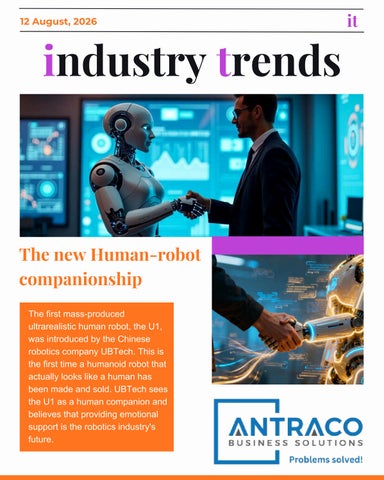
The new Human-robot companionship The first mass-produced ultrarealistic human robot, the U1, was introduced by the Chinese robotics company UBTech. This is the first time a humanoid robot that actually looks like a human has been made and sold. UBTech sees the U1 as a human companion and believes that providing emotional support is the robotics industry's future.
it
The human-robot companionship economy, according to the company's chief brand officer Michael Tam, is "the first essential scenario in human history with unlimited emotional value, boundless companionship, and full-lifecycle coverage." The company stated in a press release that 90 million people in China live alone and mentioned speculative applications such as elder care, hospitality and reception, and "premium domestic service applications" (whatever that means). The company touted the robot's capacity for conversation and eye contact at the launch on Tuesday of last year in Shenzhen. It still has a lot of flaws—no one is actually mistaking this for a person —but think of it as Blade Runner's Version 0.1 of the replicants, which is a big step forward for embodied artificial intelligence in the future.
BIG TECH’S POWER PROBLEM The "fair share" of electricity costs is not paid by data centers. This is why Putting a price on electricity is simple in theory but hard to do in practice. Many major tech companies have pledged to pay their fair share of the costs associated with generating and
a transmitting more electricity to serve large data centers. But ratepayers across the United States are worried about the potential costs they might have to bear. This is as a result of the uncertainty surrounding the method by which the energy costs of data centers will be determined. Price increases are likely only beginning to have an impact, and their full impact may not be felt for years. For instance, an organization that monitors the PJM market recently concluded in a report that anticipated power demand from data centers was the primary reason for $23 billion in customer price increases that will last until at least the end of 2028. This area includes all or part of 14 states in the mid-Atlantic and Midwest.
it
Google CEO Sundar Pichai’s strategy to position Gemini as the dominant AI platform: ● Overcoming the "ChatGPT Shock": Although blindsided by OpenAI’s launch of ChatGPT in 2022, Pichai treated it as a "Code Red" emergency. He restructured Google's AI efforts, notably merging the separate Google Brain and DeepMind divisions into a single cohesive unit (Google DeepMind) to transition from pure research to rapid product deployment. ● The Long-Term Vision: Dismissing concerns of an immediate AI bubble, Pichai maintains a decade-long view. His ultimate goal remains the one he set in 2015: transforming Gemini into an omnipresent, indispensable digital assistant built securely into everyday life.
● The Gemini 3 Breakthrough: After early missteps with its rushed "Bard" chatbot and buggy AI search summaries, Google hit its stride with Gemini 3 (Pro, Flash, and Deep Think). Released in late 2025, the model outperformed rivals on standard benchmarks, driving massive user growth and helping Alphabet achieve a $4 trillion market cap following a landmark partnership with Apple to power Siri. ● Leveraging Structural Strengths: Google is capitalizing on core structural advantages that newer startups lack. This includes integration across its massive product ecosystem (Search, Maps, YouTube, Workspace, and Waymo), custom-designed Tensor Processing Unit (TPU) chips, and a highly profitable advertising business to fund massive capital expenditures— such as a $185 billion budget for 2026.
it
● A Disciplined Business Model: While OpenAI burns billions and experiments with disruptive pop-up ads inside ChatGPT, Google is taking a calculated approach. It uses its vast inventory to naturally place commerce links and ads within features like "AI Mode," allowing it to monetize AI without alienating users.
it
FTI: The World’s Most Innovative Companies of 2026 Fast Company’s annual ranking includes the World’s 20 Most Innovative Companies
Breakthrough Launch
Nvidia
Breakthrough Launch
Shopify
Transformativ e Tech
Artificial Intelligence
Computers, Technology, Internet, and Consumer Electronics
Public GOOGL
Mountain View, CA
Computing
Computers, Technology, Internet, and Consumer Electronics
Public NVDA
Santa Clara, CA
Retail
Business and Productivity Software
Public SHOP
Ottawa, Canada
it
FTI: The World’s Most Innovative Companies of 2026 Artificial Intelligence
Computers, Technology, Internet, and Consumer Electronics
Private
San Francisco, CA
Ramp
Product Reimagination
Finance and Personal Finance
Financial Services (Banking, Investments, Insurance)
Private
New York, NY
Yield Giving
Social Impact
Not-forProfit
Non-Profit
Nonprofit
Seattle, WA
Adidas
Audience Engagement
Advertising and Marketing
Apparel
Public ADDYY
Herzogena urach, Bavaria
North America
Computers, Technology, Internet, and Consumer Electronics
Private
San Francisco, CA
Anthropic
Databricks
Breakthrough Launch
Transformativ e Tech
it
FTI: The World’s Most Innovative Companies of 2026 Walmart
Operational Excellence
Retail
Other
Public WMT
Bentonville, AR
Proximity Media
Audience Engagement
Film and Television
Entertainment (TV, Film, Music, ETC)
Private
Burbank, CA
Gilead Sciences
Breakthrough Launch
Medicines, Therapeutics, and Pharmaceuticals
Science and Research & Development
Public GILD
Foster City, CA
Audience Engagement
Social Media
Media and Communication s
Public RDDT
San Francisco, CA
Consumer Electronics
Computers, Technology, Internet, and Consumer Electronics
Public AMD
Austin, TX
AMD
Transformativ e Tech
it
FTI: The World’s Most Innovative Companies of 2026 Redwood Materials
Social Impact
Energy
Energy
Private
Sparks, NV
Tubi
Audience Engagement
Video
Media and Communicatio ns
Public FOX
San Francisco, CA
BYD
Product Reimagination
Design
Automotive
Private
Pasadena, CA
North America
Computers, Technology, Internet, and Consumer Electronics
Private
San Francisco, CA
Harvey
Product Reimagination
it
FTI: The World’s Most Innovative Companies of 2026
Starbucks
Customer Experience
Abridge
Product Artificial Reimaginati Intelligence on
DoorDash
Customer Experience
Design
Restaurants, Dining, and Food Services
Food
Public SBUX
Seattle, WA
Healthcare and Medical
Private
San Francisco, CA
Computers, Technology, Internet, and Consumer Electronics
Public DASH
San Francisco, CA
it