21
AN ANTON MEDIA GROUP SPECIAL
Healthy Living APRIL 8 - 14, 2020
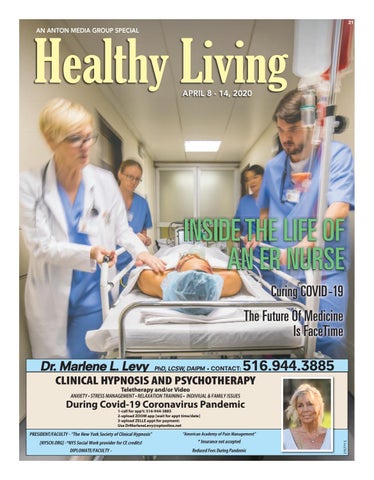
INSIDE THE LIFE OF AN ER NURSE Curing COVID-19 The Future Of Medicine Is FaceTime Dr. Marlene L. Levy
PhD, LCSW, DAIPM • CONTACT:
516.944.3885
CLINICAL HYPNOSIS AND PSYCHOTHERAPY Teletherapy and/or Video
ANXIETY • STRESS MANAGEMENT • RELAXATION TRAINING • INDIVIUAL & FAMILY ISSUES
During Covid-19 Coronavirus Pandemic PRESIDENT/FACULTY - “The New York Society of Clinical Hypnosis”
“American Academy of Pain Management”
[NYSCH.ORG] -*NYS Social Work provider for CE credits! DIPLOMATE/FACULTY -
* Insurance not accepted Reduced Fees During Pandemic
215771 S
1-call for app’t: 516-944-3885 2-upload ZOOM app [wait for appt time/date] 3-upload ZELLE appt for payment: Use DrMarleneLevy@optonline.net
22 APRIL 8 - 14, 2020 • HEALTHY LIVING
FULL RUN
GET ANSWERS YOU CAN TRUST WITHOUT LEAVING HOME. With so many questions about COVID-19, it’s hard to know where to turn for answers you can trust. If you or a loved one is feeling sick, use Mount Sinai NOW to access all of our virtual care options. TM
All of us, throughout New York City, Long Island and the entire tri-state area, are here for you.
MOUNTSINAI.ORG/NOW
FULL RUN
HEALTHY LIVING • APRIL 8 - 14, 2020
A Day In The Life Of An ER Nurse Inside NYU Winthrop Hospital’s Department of Emergency Medicine BY CYNDI ZAWESKI
czaweski@antonmediagroup.com
B
reathe. Emergency nurse Lila V. Hageman-Sheehan reminds herself to do this as she steps inside the doors of Massapequa General. It’s 1988 and Hageman-Sheehan, having recently earned her RN in a specialized nursing program through her high school, is walking into her shift at 7 p.m. The overnight shift is unpredictable, as are all shifts at the bustling ER, but the twilight hours are welcomed by Hageman-Sheehan. A young mother of four, her children hardly notice her absence. Her three-nights on, four-nights off schedule ensures HagemanSheehan’s is there for little league games and PTA, she even served as the school nurse for a time. Back on the floor, it is gearing up to be a busy night, HagemanSheehan learns from the nurse who she’s replacing for the night. The beds are full, and it wouldn’t be unusual for her to have 18 patients within the 12 hours on the clock. Hageman-Sheehan gets the run down from the outgoing nurse before making the rounds, introducing herself to her patients for the evening. The visits begin with a smile and a quick hello, but they’re more than beats eye. “They are mini-assessments,” she explained. “You’re introducing yourself, but you’re also prioritizing which patients need immediate attention. You’re noticing things like how they’re breathing and the way they’re acting. The entire shift is an ongoing assessment.” The outgoing nurse shares one last nuisance before heading home, the elderly woman in room No. 8 will not leave her ailing husband’s side while he’s hooked to machines as doctors rush to find a diagnosis. Hageman-Sheehan makes a mental
Like for many nurses, Hagemannote to get her a recliner. Sheehan views the job as more of For Hageman-Sheehan and her a calling. It is in her DNA. Growing fellow nurses, patient comfort is a up she watched as her mother critical component of patient care. stud- ied to become a nurse, Remembering names of family inspiring her own love for members and showing up caring for people. It’s a with a tray of food while trait she’s passed down. they wait uncertainly All of her children, now for their loved one’s grown, are involved prognosis, is a lesser in the medicine field known responsibilin some capacity. ity of an ER nurse, Hageman-Sheean but a vivial one all Nurses are worked the overthe same. a team. Like one night shift, 7 p.m. “We make to 7 a.m., for 18 sure they have big family. years. She started what they need,” — Lila V. out at the now-deHageman-Sheehan Hageman-Sheehan funct Massapequa said. “These are the General before things that nurses earning her RN pass along to each in 1988, a bacheother at the end lor’s degree in 1994 and joining of a shift. We’ll get to know if they prefer the lights dim or if they think Winthrop Hospital in 1999, where she has remained for more than it’s too loud, we’ll get them ear 20 years. Practicing medicine plugs. It’s those personal touches requires continual learning. Today, that make the difference.”
‘‘
’’
Hageman-Sheehan has a number of certifications next to her name: Lila V. Hageman-Sheehan BSN, RN,CEN,NYSAFE. She is currently earning her master’s degree in nursing administration and holds the job title of nurse manager of the emergency department at NYU Winthrop Hospital in Mineola. Though she is no longer a bedside nurse, Hageman-Sheehan role centers on patient care at one of the most fast paced hospitals in the region. NYU Winthrop Hospital’s Department of Emergency Medicine treats more than 81,000 patients each year (roughly 300 every day). It is considered one of the busiest on Long Island for people with acute illnesses and victims of accidents and violence. Because a visit to the ER can be a stressful experience and despite a high volume, Hageman-Sheehan and her staff of 353 are continually making efforts to deliver compassionate care to patients when they need it most. The administrative work includes mentorship of the young ER nurses. A natural teacher, it’s a beloved part of the job. Though Hageman-Sheehan’s schedule is more traditional now, she is known to work from 6 a.m. to 6:30 p.m. from time-to-time to help transport patients or sort through resumes to make a new hire. “It is hard to walk away,” she said. “You have bad nights. You have sad nights. We see happiness, too. I always tell the staff that they are touching people’s lives and that is rewarding.” The staff encounters a wide spec trum of patients and symptoms. As a Level 1 Trauma Center, they are trained to handle the most critical emergencies. In fact, it’s Nassau County’s only trauma center with
see ER NURSE on page 24
23
24 APRIL 8 - 14, 2020 • HEALTHY LIVING
FULL RUN
ER NURSE from page 23
they need to care for patients and its Department of Social Work has full adult and pediatric capabilities been available to assist the staff with a dedicated 10 bed unit with and has scheduling tele-sessions specially trained nursing and for emotional support. Hagemansupport staff to care for the special Sheehan said the overwhelming needs of children. support from the community is There are eight districts within the helping the staff make it through the ER alone to deal with specific types hardest shifts. of patient care. For example, a nurse “If we were to take a deep breath can be assigned to critical care one every time faced with stress, day (helping those suffering from under the current circumstances, cardiac arrest or a stroke) and the we would be hyperventilating,” next day be assigned to pediatrics. Hageman-Sheehan said. “In all seCases can be as minor as a sprained riousness, the staff remains focused ankle or as serious as an overdose or at the tasks at hand and getting the gunshot wounds. job done. But what has really been Now, in the midst of the carrying the staff through their shift COVID-19 pandemic, the nursing is the outpouring of support from team is forced to adapt once again the community. This is providing in unprecedented and unpredictrespite to the workforce during their able times. shifts, the generosity we have expe“It is both emotionally and rienced has been unbelievable.” physically exhausting for all the During this time, nurses, techs, staff,” Hageman-Sheehan said. “The clerical support and supply chain ‘normal day’ in the ED is nonexishave signed up for extra shifts tent. Frontline staff are experiencing voluntarily. The leaders, including a large volume of critically ill people Hageman-Sheehan, are there seven all at once. Textbooks and drills days a week supporting the efforts provide you with the knowledge of medical workers. needed to provide care, but nothing “Countless staff have called and prepares you emotionally.” asked what else they can do to help,” The hospital has made provisions she said “They are all superheroes!” to make sure the staff has what As Hageman-Sheehan, and all
the context of forensic evidence collection. “You never know what your shift will be like,” Hageman-Sheehan said. “Nurses have to be prepared, resilient and be able to change their plan of care on a dime.” 15.6 percent of all nurses described having feelings of burnout, according to a recently published National Nursing Engagement report. ER nurses also seemed to be at a higher risk for burnout, with 20 percent of ER nurses reporting feeling unengaged, according to the poll. As an administrator and a The ER staff works on a “Boom” that mentor to young nurses, Hagemanhas an oxygen monitor, opthalmoscope, audoscope, suction and more. Sheehan is diligent about keeping her nurses refreshed and ready to treat patients. ER nurses, know first hand, some “I have never been a proponent of incidents have a lasting impact. One 12-hour shifts and it is so importunforgettable shift was the horrific case of a gang member who sexually ant for nurses to take a break in assaulted a female toddler, who was between shifts to clear their minds,” she said. “I am all about taking a treated at Winthrop. The incident was undoubtedly heartbreaking for breath and pausing. I have been that nurse where you feel like you’re the staff, but prompted the soonoverwhelmed, but there is a lot to-be implemented Sexual Assault Forensic Examiner (SAFE) Program of camaraderie. There are a lot of at the hospital. SAFE provides com- distractions, but there are also a lot prehensive training to facilitate best of resources. Every nurse has their practice medical and psychological own assignments, but no one is ever alone. Nurses are a team. Like one care for the treatment of survivors big family.” of sexual assault, performed in
Trust Your Face to the Specialists
440 Northern Boulevard Great Neck, New York 11021
(516) 773-4646
630 Park Avenue New York, New York 10065
(212) 570-2500
215722 S
FULL RUN
HEALTHY LIVING • APRIL 8 - 14, 2020
25
Your Plan, Your Way Partners Health Plan (PHP) is a person-centered healthcare and services plan created to specifically support people who have intellectual and developmental disabilities. Existing Medicaid and Medicare benefits are provided through an integrated benefit design that includes a dedicated Care Coordination team to address each individual’s medical, behavioral, long-term services and social needs.
PHP’S GOAL IS TO PROVIDE MEMBERS WITH: • Quality healthcare and the long-term services and support our members need, such as respite, employment and residential care • Improved quality of life that helps our members achieve their goals • The respect our members deserve • Excellent customer service
TO JOIN THE PLAN, AN INDIVIDUAL MUST: • Be over the age of 21 • Have Medicaid and Medicare (parts A & B) • Be eligible for NY State OPWDD waiver services - 1915 (c) • Live within one of the following counties: Nassau, Suffolk, Richmond, Kings, Queens, Bronx, NY/Manhattan, Westchester or Rockland
The State of New York has created a Participant Ombudsman Program called the Independent Consumer Advocacy Network (ICAN) to provide participants free, confidential assistance on any services offered by Partners Health Plan. ICAN may be reached toll-free at 844-614-8800 (TTY users call 711, then follow the prompts to dial 844-614-8800) or online at icannys.org. PHP Care Complete FIDA-IDD (Medicare-Medicaid) Plan is a managed care plan that contracts with Medicare and the New York State Department of Health (Medicaid) tow provide benefits to Participants through the Fully Integrated Duals Advantage for Individuals with Intellectual and Developmental Disabilities (FIDA-IDD) Demonstration.
215739 S
For more information visit phpcares.org or call 855-747-5483/TTY 711 • 7 days a week, 8am - 8pm
26 APRIL 8 - 14, 2020 • HEALTHY LIVING
FULL RUN
Hope For Treating COVID-19
C
OVID-19 has affected our way of life and everyone has the same high-level questions, how long will this continue and why aren’t there medications to treat this virus? As a health care provider and researcher, I cannot answer the first question other than to say that the longer we cheat and do not practice true social distancing, the longer this virus will be around. I would like to spend some time on the second question. COVID-19 was first identified in December 2019. We are in April. It takes time to develop, test and implement new treatments. It is for this reason that we are seeing the utilization and testing of previously available medications. These drugs are being used and tested because they make sense that they could be effective. This is the hope. We, the medical community, and only the medical community, need to ensure that we offer hope, not false hope or false promises. To start the discussion, there is no standard of care or medical consensus on the treatment of COVID-19 other than to treat the symptoms of fever and cough with drinking plenty of fluids, rest, acetaminophen and cough syrups.
THE SPECIALIST David Bernstein, MD
There is a feeling that the use of hydroxychloroquine, an outdated anti-malarial drug now used to treat rheumatoid arthritis may be effective and this “sense” has led to its widespread use. But what is the data supporting its use? A single, non-randomized study of 36 patients in France suggested that hydroxychloroquine lowered coronavirus levels in the blood as compared to untreated controls. Just the other day, another small but randomized study out of China reported that hydroxychloroquine showed no benefit in treating COVID-19 infection. With limited data, and one large clinical study just starting in the US to determine if this drug will be safe and effective, the FDA approved its use for COVID-19 infection. I hope they are right in this decision and not offering false hope.
We need more data. Similarly, there are scattered reports on the use of the combination of hydroxychloroquine and azithromycin, tocilizumab (an IL-6 receptor antibody), vitamin C and even famotidine to treat COVID-19 infection. Once again, there is no evidence-based data to support the use of these products and the concept that they may be effective is speculative at best at this point. We need more data. It appears that there are two phases of COVID-19 infection, an early phase and a later phase characterized by a surge in pro-inflammatory cytokines, a part of our immune system, which leads to severe lung inflammation and poor outcomes in a small minority of COVID infected patients. Research to develop treatments for COVID-19 is therefore based on intervening both early and late. The good news is that there are well conceived, randomized, double-blind, placebo control trials currently underway which are rapidly enrolling patients with COVID-19 infection. The medications being tested fall into two broad categories, drugs that are directly anti-viral and drugs that suppress this cytokine storm overreaction to COVID-19. The direct anti-viral
currently be tested, Remdesivir, works by preventing the virus from replicating. The immune modulator, sarilumab, is an IL-6 receptor inhibitor that theoretically decreases the inflammatory response in the lungs which is triggered by the virus. There is tremendous hope that these therapies will be effective but since they randomized, placebo-controlled trials, we will not know if they are effective for several months. While they are being given with the intention of helping, only time will tell if they are effective, ineffective and most importantly, safe. Medical science is feverishly working to develop and test treatments for COVID-19, but these treatments need to be assessed through well-designed clinical trials that will provide answers as to their effectiveness and safety. We must rely on evidence-based medicine to give us these answers, not speculation or emotions or non-scientifically backed statements which may provide false hope and potentially do more harm than good. We will get through this together, but we need to remain vigilant in our social distancing, wash our hands frequently and use common sense to flatten to curve and contain the virus. Please stay safe and act smart.
NYU Langone Expands Telemedicine Doctors available for virtual visits during COVID-19 outbreak BY CYNDI ZAWESKI
czaweski@antonmediagroup.com
O
ur normal way of life has come to a crawl. Officials have called on more than 250 million Americans to stay at home to curtail the spread of COVID-19. But staying at home doesn’t necessarily mean that people should skip routine doctors’ appointments. The concept of telemedicine—the practice of caring for patients remotely through phone conversations or real time streaming video applications, most commonly FaceTime—has been emerging in the healthcare industry. Dr. Collin Brathwaite, who specializes in general and bariatric surgery at NYU Langone Health, first became interested in the idea three years ago after learning about telemedicine at a healthcare industry conference. The service allows patients to connect with doctors from home, and also gives doctors the option to administer care from home or from the office.
“It allows doctors to have access from anywhere, especially at this point in time with limited travel and people being told to stay home,” Brathwaite said. “We have also developed different schedules for staff as far as when they come into the hospital so that everyone is not there every day. This means doctors can see patients in the office or through virtual visits.” NYU Langone Health, like many healthcare systems in the state and around the country, have been slowly laying the groundwork to make telemedicine a reality. One reason NYU Langone has been able to swiftly implement these changes to expand telemedicine is because the hospital system has been growing digital health care, spending tens of millions of dollars on its telemedicine platform prior to the outbreak. In light of COVID-19, NYU Langone Health accelerated its capabilities to become one of the largest integrated providers on the east coast to offer
video visits to patients. NYU Langone Health has seen an increase in patient visits to their telemedicine platforms over the last few weeks, and the volume of patient appointments via video visit is only predicted to increase in the coming weeks, as self-isolation continues. To meet the need, NYU Langone added 1,300 doctors and care providers to its telemedicine platform. Prior to the COVID-19 outbreak, NYU Langone conducted approximately telemedicine calls per day. Now, that number is closer to 4,000 daily, Brathwaite explained. Virtual Urgent Care has played a key role in the midst of this pandemic, allowing patients who have flu-like symptoms and other medical concerns to be seen remotely, including patients who have used the service to help identify symptoms of COVID-19. Virtual Urgent Care now takes more than 200 different types of insurance, including Medicare. The service is being employed by all
departments, including bariatrics. “Bariatric surgeries require pre-op work ups,” Brathwaite said. “We’re able to continue to meet with patients telemedicially to prepare them for their surgeries.” Brathwaite said the use of telemedicine will continue even after the pandemic has subsided. “Patients come to see me from all over, from the East End to the other side of Brooklyn,” Brathwaite said. “It hurts me when I have a patient from Upstate New York driving an hour and a half to visit me for a half hour appointment. Then, they have to make the trek back. With telemedicine, they don’t need to be on the highway stuck in traffic.” Virtual Urgent Care is now a service offered 24/7. NYU Langone locations are still open to see nonCOVID patients who also need care, and cannot be seen remotely. Patients can visit www.nyulangone.org to book appointments online.
WE ARE OPEN! CALL FOR HOURS. FULL RUN
HEARING AID SERVICE WE ARE OPEN! CALL FOR HOURS. All Makes And Models
HEALTHY LIVING • APRIL 8 - 14, 2020
27
HEARING AID SERVICE FREEAllREPAIR ESTIMATES Makes And Models Lab On Premises • Walk-In Service See Our 250 Plus...5 Star Google Reviews FREE REPAIR ESTIMATES
Lab On Premises • Walk-In Service
A MEMO FROM THE250 DIRECTOR TO OUR PATIENTS AND PROSPECTIVE PATIENTS See Our Plus...5 Star Google Reviews
We are all aware of the dangers of the Corona virus. We at Long Island Hearing would like to share with you what we are doing to protect our patients and staff.
A MEMO FROM THE DIRECTOR TO OUR PATIENTS AND PROSPECTIVE PATIENTS
We have always practiced and taken extra effort in protecting everyone who enters our facilities. We are aware of the theour Corona virus. We at Long Island Hearing would like totimes share A number of all weeks ago wedangers steppedofup effort in sanitizing our waiting room multiple with you what we are doing to protect our patients and staff. during the day. Our consultation rooms are sanitized between each patient. Now in current time, Weelevated have always and taken effort in finer protecting who enters our facilities. we have ourpracticed sanitizing yet to aextra higher and level.everyone Door knobs, arm chairs, clip boards A number of weeks ago we stepped up our effort in sanitizing our waiting room multiple times and, yes, pens are being sanitized for your and our protection. Additionally, we have altered our duringof the day. Ourso consultation rooms arethree sanitized between each patient. in current scheduling patients that no more than (3) patients will be in theNow waiting roomtime, together. we have elevated our sanitizing yet to a higher and finer level. Door knobs, arm chairs, clip boards We Guarantee It. and, yes, pens are being sanitized for your and our protection. Additionally, we have altered our
scheduling of patients so that no more than three (3) in the waiting roomin together. Also, for those who might be health compromised, or patients are justwill notbe comfortable being space We Guarantee It. other than your home, we now offer basic service and cleanings of hearing instruments as a drive up service. Stay in your come out to you. or Call fornot appointment and details about how Also, for those who car... might we’ll be health compromised, areus just comfortable being in space other than yourWe’re home,‘hear’ we now this service works. to offer help.basic service and cleanings of hearing instruments as a drive up service. Stay in your car... we’ll come out to you. Call us for appointment and details about how
Long Island Hearing is working hard keep everyone “Safe in Our Space.” During this time, walk this service works. We’re ‘hear’ to to help. in patients (without appointments) may experience longer wait times. Appointments for all servLong Island Hearing is working hard to keep everyone “Safe in Our Space.” During this time, walk ices (except supply sales, batteries, accessories), is strongly suggested. in patients (without appointments) may experience longer wait times. Appointments for all servTogether will make difficult timeaccessories), a thing of the past. Call us at 1.800.698.5200. We are open. iceswe (except supplythis sales, batteries, is strongly suggested. we will make this support, difficult time a thing of the past. Call us at 1.800.698.5200. We are open. Thank Together you for your continued WilliamThank A. Kent, BC-HIS you for your continued support, William A. Kent, BC-HIS Director Director
Need Aid? Try TryUs! Us! NeedA ANew NewHearing Hearing Aid?
All Makes All Makes And Models
Walk In Service
Walk In Service
And Models
CALL FOR HOURS
CALL FOR HOURS
LongIsland Island Hearing, Hearing, Inc. Long Inc. TM
“Our commitment to you will be life-changing”® 1985 “Our commitment to you will be life-changing”® Since Since 1985
1.800.698.5200 1.800.698.5200 OPEN 6 DAYS • Nassau • Suffolk • SINCE 1985
OPEN 6 DAYS • Nassau • Suffolk • SINCE 1985
TM
215768 S
TH OUROUR 35TH35ANNIVERSARY GO ANYWHERE ANYWHEREELSE? ELSE? ANNIVERSARY••WHY WHY GO