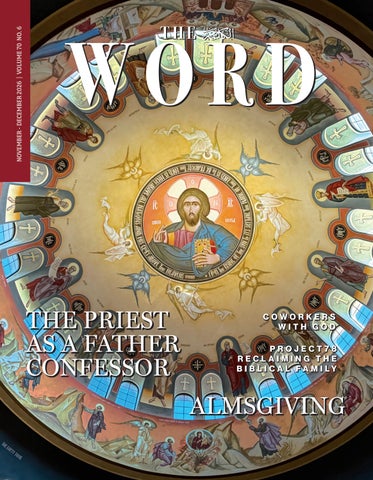
NOVEMBER - DECEMBER 2026 | VOLUME 70 NO. 6
WORD THE
THE PRIEST AS A FATHER CONFESSOR
COWORKERS WITH GOD PROJECT78 RECLAIMING THE B I B L I C A L FA M I LY
ALMSGIVING The Word 1
CONTENTS.
Volume 70 No. 6 November - December 2026
2 November - December 2026
03
COWORKERS WITH GOD by Arch. Jeremy Davis
05
THE PRIEST AS A FATHER CONFESSOR by His Eminence Met. SABA
10
SACRIFICE, SERVICE, & SELFLESSNESS by Sheryl VanderWagen
13
SHE CAME TO BE WELL by Fr. Joseph Huneycutt
15
AN AUTHENTIC CONFESSION by Fr. Peter Kavanaugh
18
THE DEPARTMENT OF MISSIONS by Fr. James Purdie
21
PROJECT78 by Fr. Christopher Salamy
26
ALMSGIVING by Andrew Geleres
32
ARCHDIOCESAN OFFICE
34
ARCHDIOCESAN NEWS
C OV E R: The Dome at St. George Church of Fishers, IN.
EDITORIAL
COWORKERS WITH GOD
T
he time has come: your mailboxes (physical and virtual) are about to fill up with requests for donations. One of these will likely come from your parish, asking you to complete a pledge form or otherwise make your financial commitment for the coming year. Yet it would be a mistake to think of this as just another charitable solicitation or, even worse, as a dues bill, to maintain your membership—as if the church were like a gym or a country club. No, this request is something quite different: an invitation into a relationship. Why should we give to the church? Some will answer that it takes money to pay the mortgage, keep the lights on, heat the building, support
Archimandrite Jeremy Davis
the priest, etc. All this is true from our practical, worldly point of view. But theologically, it is more complicated. We believe in a God who can accomplish all these things without our help. He is all powerful. He rained down the bread of heaven in the desert, provided water from the rock, and fed thousands of people from a few loaves and fish. He doesn’t need our help. Nevertheless, somehow, He desires our help. He gives us a chance to participate in the good works He wants to do in the world. Recently, I saw my neighbor under his car, fixing something. His eight-year-old son was beside him, under the car; his 15-year-old was standing by with a toolbox. Over the next hour,
The The Word Word 3
The Disciples were first called Christians in Antioch. Acts 11:26 Editorial Board: The Most Reverend Assistant to Editor Metropolitan SABA Fr. Greg Abdalah Editor-in-Chief Bishop JOHN
Assistant Editor John Abud
Archimandrite Jeremy (Davis)
Design Director Dn. Ephraim Awad
Archimandrite Calinic (Berger) Archimandrite Nicholas (Belcher) Fr. Michael Shanbour Fr. Luke Toumi Fr. Peter Kavanaugh Editorial Office: The WORD 2 Lydia’s Path, Westborough, MA 01581-1841 wordmag@aol.com Subscription Office: 358 Mountain Road Englewood, NJ 07631-5238 theword@antiochian.org Submissions for “Communities in Action” must be approved by the local pastor. Both may be edited for purposes of clarity and space. All submissions must be emailed and provided as a Microsoft Word text or editable PDF. Please do not embed artwork into the Word documents. All artwork must be high resolution: at least 300 dpi. Article contributions should be sent to: frjpa@aol.com For Donations:
For Subscriptions:
The WORD (USPS626-260) is published in September, November, January, March, and May, by the Antiochian Orthodox Christian Archdiocese of North America at 358 Mountain Road, periodicals postage paid at Englewood, New Jersey 07631-5238 and at additional mailing offices. Postmaster send address changes to The WORD, 358 Mountain Road, Englewood, NJ 07631-5238 ISSN 0043-7964
www.antiochian.org.
Canada Post Publication Agreement No. 40043404 Return Canada address to American International Mail, STN A – BOX 697, Windsor ON N9A 6N4, Canada
4 November - December 2026
he patiently worked with them, explaining the situation, asking them to bring him a tool or help him tighten a nut. No doubt, he could have finished the repair in half the time or less by himself, but he involved his sons because of the bond it would create between them and him, the learning opportunity it would be for them, and the sense of significance it would give them. Some of you may remember the old TV commercial: “Mama made Shake ’n Bake, and I helped!” All of us can remember a time when a parent or another adult made us feel special by involving us in his or her work. We have the same opportunity in the Church, yet on an incomparably grander scale. We are being asked by God to help Him save the world. Someone might object that it was Christ who saved the world. True, but the Church is the Body of Christ, and we have been gathered into it by Christ in order to continue the work of Christ, guided and empowered by His Spirit. We are invited to be a part of that mission. We have a chance to work side by side, in a practical intimacy, with the Son of God, taking His yoke upon us. It is up to us to take advantage of this opportunity, to open our hearts and our hands to Him. Will we consider that stewardship letter from our parish as an invitation to be coworkers with God? Will we give joyfully and generously, grateful for the opportunity? Or will we just do the minimum we can get away with, or worse yet, ignore it altogether? The Lord is working salvation in the midst of the earth, and He wants us right beside Him.
PA S T O R A L
The Priest as a Father Confessor His Eminence Metropolitan SABA
The Creation of Man and His Fall
G
od created man by an act of love. He created him in His image and likeness.
The image of God denotes the powers with which man is endowed by God from the first moment of his existence; the likeness of God is not an endowment which man possesses from the start, but a goal at which he must aim, something which he can only acquire by degrees. After the fall of Adam, man had inherited sin. His one being was divided. His powers ceased to work in harmony. Confusion existed between his body and his soul. Man became subject to mental anguish and to the surrounding conditions. The relation between man and God on the one hand, and between man and man on the other, as well as between man and his own soul, was cut and obscured. The nature of man became corruptible.
through the corruption of disobedience and thus the passions entered into it. Just as when the root of a plant is injured, all the young shoots that come from it must wither. In brief, we can say, man became a slave to his passions.
What Are Passions “Passion” is derived from the Greek verb pascho: to suffer, indicates inner sickness. According to Philotheos of Sinai, “Passion, in the strict sense, is defined as that which lurks impassionately in the soul over a long period.”
St. Cyril of Alexandria says: After Adam fell by sin and sank into corruption, at once impure pleasures rushed in, and the law of the jungle sprang up in our members. So, nature became sick with sin through the disobedience of one, Adam. Then the many became sinners, not as fellow transgressors with Adam, for they did not even exist, but as being of that nature which had fallen under the law of sin. Human nature in Adam became sick The Word 5
PA STO R A L A R T I C L E S
Christ himself directed attention to the soul of man, his inner being. “From within, out of the heart of man, come evil thoughts, fornication, theft, murder, adultery, coveting, wickedness, deceit, licentiousness, envy, slander, pride, foolishness. All these evil things come from within and they defile a man” (Mark 7:21–23).
Passion Passion is the “movement which takes place in the soul,” while sinful practice is “that which is manifested in the body.” At the same time, when a sin is repeated often and lurks in our soul for a long time, it is called a passion. In speaking about the passions we should point out more precisely what they are. Are they forces which enter our soul and which we should root out, or are they natural powers of the soul which have been corrupted by sin and by our withdrawal from God? The whole biblical-patristic tradition believes the latter. So we need to talk a little about the soul of man.
6 November November - December December 2026
The Soul and Passions The Holy Fathers divide the soul of man into three parts. It is tripartite. According to St. Dorotheos of Gaza, “It has the appetitive, incisive, and intellectual powers. The intellectual part of fallen man is dominated by pride, the appetitive part of the soul is chiefly perversions of the flesh, and the incisive part is dominated by the passions of hatred, anger and rancor.” The passions are a perversion of the powers of the soul. God didn’t form man with the passions of dishonor, as St. John of the Ladder says, “Evil or passion is not something naturally implanted in things. God is not the creator of passions. On the other hand, there are many natural virtues that have come to us from him.” The presence of virtues is the natural state of man, while the passions are the unnatural condition. We have altered and perverted the energies of the soul and steered them from their natural state to the unnatural state.
T H E P R I E ST A S A FAT H E R C O N F E S S O R
According to St. John of the Ladder, God neither caused nor created evil. “We have taken natural attributes of our own and turned them into passions.” The same saint gives several examples to make this clear. He says: The seed for childbearing is natural in us, but we pervert it for fornication. The anger which God gave us against the serpent, to wage war against the devil, is natural, but we have used it against our neighbor. We have a natural urge to excel in virtue, but instead we excel in evil. Nature stirs within us the desire to compete for glory, but that glory is of a heavenly kind, for the joy of heavenly blessing. It is natural for us to be arrogant against the demons. Joy is ours by nature, but it should be joy on account of the Lord and for the sake of doing good to our neighbor. Nature has given us resentment, but that ought to be against the enemies of our souls. We have a natural desire for food, and not for profligacy. St. Maximos the Confessor says, “It is not food that is evil, but gluttony, not the begetting of children, but unchastity, not material things, but avarice, not esteem but selfesteem.” Then sin (sickness) is the misuse of the powers of the soul. Vice, according to St. Dorotheos, is “a sickness of the soul depriving it of its own natural health, which is virtue.” Thus we can speak of man’s fall or man’s sickness, which must be healed. In ontological words, we can summarize the condition of man after the fall according to C. Yamaras follows: 7 Septemberas - October 2025 The road, then remains open after the fall for the person of man to become once more a hypostasis of life, no longer of a biological life, corruptible and temporary,
but of an incorruptible and immortal life. This new existential possibility God inaugurates himself with his Incarnation, becoming the beginning of salvation and renewal of the human race.
Christ Is the Savior (Healer) We believe that God was incarnated to save man. God became man so that man may become God. What is the meaning of this? What is salvation? We notice many “medical” words in the New Testament, which denotes that Christ came to heal man, to restore him to the “first image.” Let us read some of these verses: “Those who are well have no need of a physician, but those who are sick” (Matt. 9:12). “...healing all kinds of sickness and all kinds of disease among the people” (Matt. 4:23). “When you thus sin against the brethren, and wound their weak conscience, you sin against Christ” (1 Cor. 8:12). “On the other side of the river was the tree of life … and the leaves of the tree were for the healing of the nations” (Rev. 22:2). In the parable of the Good Samaritan, the Lord showed us several truths. As soon as the Samaritan saw the man who had fallen among thieves, who had been wounded and left half dead, he “had compassion on him and went to him and bandaged his wounds, pouring on oil and wine; and he sat him on his own animal, brought him to an inn and took care of him” (Luke 10:33 ff.). Christ treated the wounded man and brought him to the inn, the hospital, which is the Church. Here Christ is present as a physician who heals man’s illness, and the Church is his hospital. The Word 7
PA STO R A L A R T I C L E S
The Church’s Work The Church, in the same way as her Master, is to heal the people. The membership of the Church includes sick people and beginners in the spiritual life, it is to be expected that some of them understand Christianity as a religion, as a system of life, as a charity organization. The church is more than these. The Church is a hospital where the people can be healed and enter into the kingdom of God. It is the place where man can be saved, and come back to his lost joy. The healing of the sick people is the Church’s work. This healing can be made through purification. Christianity without purification is utopia. “If any one among you thinks he is religious, and does not bridle his tongue but deceives his own heart, this one’s religion is useless. Pure and undefiled religion before God the Father is this; to visit the orphans and widows in their trouble, and to keep oneself unspotted from the world” ( James 1:26–27).
The Priest’s Work If the church is a hospital, the priest should be the physician. From this point, the priest is not only he who enables the people to take part in the Holy Sacraments, and not only he who prays to God, so their labors may be blessed, and not only he who works as a social worker to take care of children, teens, etc., not only he who is a leader of special groups who has special spirituality and ethics. All of these works would be done to allow the priest to play his main role, which is the healing (salvation) of the people. He has to be a spiritual physician who cures people’s sickness. For such a work we call him “Father” because he begets us in Christ. Worship and sacraments must be placed within the therapeutic method and treatment. 8 November - December 2026
In this context, Confession is not only a formal absolution. It is something more. St. John of the Ladder says, “Those of us who wish to get away from Egypt and Pharaoh need an intermediary with God to stand between praxis and theoria and stretch out his arms to God that those led by him may cross the sea of sin and put to flight the Amalek of the passions.” St. Simeon the New Theologian says that the priest is a Moses who leads his spiritual children, and a scientist and sympathetic physician. St. John Chrysostom says, “The work of the priesthood is done on earth, but it is ranked among heavenly ordinances.” For this reason, the degrees of priesthood (deacon, priest, bishop) are closely connected with the three basic degrees of the spiritual life (purification, illumination, deification.) This means that as a man progresses in healing he ascends the spiritual ladder of priestly grace and blessing.
How the Priest Treats the Sick People I am certain that one of the messages the Orthodox Church should be offering to the contemporary, stumbling world is the message of its sickness and at the same time, of its healing. 1. Self-knowledge How can man be saved if he does not confess his sins? How can man reveal his sickness to the physician if he does not feel pain? The first step is the knowledge of ourselves. The Desert Fathers used to say, “In the beginning, let us return to ourselves.” Self-knowledge is one of the great tasks which the priest faces in our contemporary society. How can a priest help people
T H E P R I E ST A S A FAT H E R C O N F E S S O R
to know themselves, to be aware of sin, to feel the pain of their transgressions, and then to confess? Confession is not “general” only, but revelation (revealing) of sins. One must name his sins. A priest has to explain the spiritual life, to talk about the lives of the saints, to interpret the Gospel on the spiritual, personal level. He would be very aware of the sins, passions, temptations, etc. The feeling of holiness should exist and grow among the faithful people. He should help his people to understand Christianity as a spiritual battle against the devils. 2. Repentance We are not struggling simply to become good people, adjudged to society. The aim of confession is not to make people sociable and to be an anthropocentric exercise, but forgiveness of their sins, to guide them to communion with God. So God does not become a fire that consumes, but a light which illuminates. Repentance means to be changed, it means man should know to “put off the old man with his deeds, and to put on the new man who is renewed.” For a man to have true repentance, he needs an experienced Father Confessor, who can lead him
to the new life. A priest can help in this field by his advice, instruction, and his sympathy with a penitent. People need to know that repentance is not mere compunction and sorrow, but it is joy and happiness, it is a new condition. Confession is not just a mention of sins, but is consolation and forgiveness. 3. Transformation of the Passions The priest should help people to transform their passions, to restore them as they were before the fall. In this field, Orthodoxy can offer unique help to our Christian people. We need not be without passions, but should put them in their right place. This work needs great experience. St. John of the Ladder says, “He is pure who expels love with love and who has extinguished the material fire by the immaterial fire.” 4. Synergy of God and Man Priests should be aware that the healing of the passions is done by God’s grace, not by their own understanding and the giving of advice. The right confession is done by cooperation of God and man, with the help of the priest. The divine grace is offered through the Holy Sacraments. The purification of man, which is healing, takes place by the energy of Christ that is offered through the whole spiritual life which the Christian lives within the Orthodox Church. To struggle, to continue to fight, is the work of man. Here, the priest can offer great help to the penitent by his guidance. When he reminds the penitent of his main passion, he attracts his attention to the hidden passion. How the priest teaches him to face his temptations, what exercises he has to do. When the priest insists on the fear of God, and when he directs the penitent to the sonship of God.
9 March - April 2026
The Word 9
SPIRITUAL LIFE
Sacrifice,
Service,
& Selflessness Sheryl VanderWagen Antiochian Women North American Board President
T
his past summer in West Michigan where I live, we experienced one of the driest and hottest summers in recent memory. The entire mid-section of the “Mitten State” suffered from severe drought conditions and relentless heat. This is not so unusual in other parts of the country, but it certainly was not the norm here, where typical summers are temperate and pleasant. This physical reality often parallels our spiritual reality. We experience times in our lives when everything is going great. Then suddenly, we are slammed with that time of drought; we find it difficult to pray, we have a sense that God has deserted us, and we struggle to maintain the rhythm of our daily prayer life and even our daily activities. We find ourselves sinking under the oppressive heat of a spiritual drought. Rather than give up, this is the time to increase 10 November - December 2026
St. Theodora of Vasta
our prayer to God, the Theotokos, and the saints, asking for their intercessions. St. Theodora of Vasta was born in the 10th century. In short, to save her family and particularly, her father, she disguised herself as a boy named Theodore and enlisted as a soldier in the Byzantine Empire. As it happened, a young woman fell in love with “Theodore” and accused “him” of making her pregnant. Theodore was commanded to marry the girl or be condemned to death. Not wanting to expose herself and her family, especially her father, to her deception, she did nothing to defend her innocence, thus choosing execution. She prayed this prayer prior to her execution, “Let my body become a church, my blood a river, and my hair the forest.”
S AC R I F I C E , S E R V I C E , & S E L F L E S S N E S S
Today there is a small church dating from the 11th or 12th century on the site of her execution. The site is beautiful and green. A clear river flows under the church. Seventeen trees grow out of the roof with no visible roots, no cracks in the church walls and no damage to the roof. The site has also survived severe wildfires on several occasions. This is a great contrast to the physical drought of this past summer that I described at the beginning of this article. The same may be said about overcoming drought in our spiritual lives. What do we offer to God to overcome our spiritual dryness? In the spirit of St. Theodora and as Antiochian Women, we offer ourselves in sacrifice, selflessness, service, and love to God, our church, and to those around us.
The miraculous church of St. Theodora of Vasta
First, PRAY! Pray even when you don’t feel like it, even when life becomes overwhelming. In those times, simply praying, “Lord Jesus Christ, have mercy,” or “Most Holy Theotokos, save us,” can be like a balm to our parched souls. Pray the Psalms, memorize a few of your favorite verses and most importantly, pray for those around you, your family, your friends, strangers you meet, your community. Take the focus off yourself, focus on the needs of others. Second, offer HOSPITALITY! It is more than inviting people to your home, although that is certainly a good thing. We can give hospitality in many ways. Offering an encouraging smile or greeting to someone you meet can make a difference in someone’s day, especially to that mom in the grocery store struggling with her children, or the waitress at the local restaurant, the gas station attendant, and others who need that encouragement. Make a meal for that young family next door or down the street who may not know where their next meal is coming from. Buy someone’s groceries in the checkout line at the store or pay for the person behind you at the drive-up window. And be kind when you interact with others on social media platforms, encourage rather than discourage, praise instead of criticize, be positive in the face of negativity and hostility. Hospitality requires us to be present with those around us; to be present with them in the day-today activities of life, letting those we meet know you see them. Finally, offer SERVICE! That means offering your time. The Antiochian Women’s motto is “A sisterhood serving Christ through serving others.” Time is precious to all of us but just as we offer our financial tithe to the church, offer a tithe of The Word 11
S P I R I T UA L L I F E A R T I C L E S
your time in service to others. Our churches and communities offer many opportunities to serve others and there is a great need for volunteers. Volunteer at your local food pantry for a few hours, offer to babysit your neighbor’s kids for a couple of hours to give that frustrated mom a break. Visit someone who is homebound and lonely. Volunteer for church events. Give someone a ride to an appointment or to the grocery store. Life presents us many opportunities to serve others; we just need to open our eyes. This year the Antiochian Women have many opportunities to offer care and service as a sisterhood in addition to the local opportunities. In the area of prayer, we have partnered with Faithtree Resources and in the new version of The Encounter prayer app you will find an Antiochian Women section in the “Pray with Your Group” feature. There you will find our Antiochian Women Prayer along with daily prayers for Monday–Saturday to pray with our sisterhood. The app also features a version of the Antiochian Women Spiritual Aids in the Psalms section. In the area of giving our resources, we are in the final year of fundraising for our beloved widowed clergy wives and the new Widowed Clergy Wives Endowment Fund. We are very thankful for the support we have received the last two years from our Antiochian Women chapters, individuals, the Orthodox Vision Foundation, and the Archdiocese, and we look forward to growing the fund even more in this final year of fundraising. The annual Shared Act of Mercy for our sisterhood is Casa Cuna, the infant orphanage at Project Mexico and St. Innocent Orphanage for another year. There is always a need for financial support which can be made through the
12 November - December 2026
Antiochian Women portal on their website and for baby supplies from their Amazon Wishlist. The details for all these efforts can be found on our website at antiochianwomen.antiochian.org. In the end, our periods of spiritual drought will be rained out as we focus on the needs of those around us, feeding both souls and bodies. At the same time, our own souls and bodies will be nourished by those good works. Like St. Theodora, let us pray that our sacrifice becomes the source of life to those to whom we offer aid. May God bless all our Antiochian Women as they serve in the garden of the Lord. May God multiply the fruits of our labors.
SPIRITUAL LIFE
She Came to Be Well Fr. Joseph Huneycutt Department of Missions
A
clergy gathering of the Antiochian Evangelical Orthodox Mission (AEOM) at St. Ignatius Church, Franklin, Tennessee, was my sole encounter with Fr. John Namie. But, as seems widely the case with him, it was unforgettable. One of the sessions during the AEOM retreat was on time management. Business planners (calendar notebooks) were all the rage in the early 1990s. After a presentation on how to prioritize daily events in the planner—Plan, Prioritize, Perform—the speaker moved on to body language, positioning, movements, etc., that would help to economize time spent with visitors and parishioners. The gathered clergy engaged in lively sharing of “tricks of the trade” during the Q&A that
followed. Until a deep booming voice said: “I’m appalled! I’m appalled!” All eyes turned toward the big man standing in the back, leaning on a walker. He continued, “People don’t come to church to be managed! People come to church because they’re hurting. It’s not your job to manage them, but to help them find healing. That’s why they come to you! Not to be managed.” This God-pleasing admonishment was well received, in large part because of the source. Although I had never met the man, he commanded great respect from the assembled clergy. Sure, we learned some good time management skills that day. Yet the words that stuck with me most, those which I struggle to adhere to (and often convict me), came from Archimandrite John Namie: People come to church because they’re hurting. They want to be healed. The Gospels and lives of the saints are stories of human beings encountering God: some casually, some desperately, some unexpectedly. All of them, just like us: afflicted, wounded, burdened. We all need healing.
Fr. John Namie
Take, for instance, a woman whose life was a mess: a host of broken relationships, living in sin and shame. This woman of Samaria, St. Photini came to the well, in the heat of the day, to draw The Word 13
S P I R I T UA L L I F E A R T I C L E S
water. There, she encountered the Well of Living Water. Her dialogue with Our Lord ( John 4:7– 28) seems to indicate that she definitely did not come to be managed! A parishioner once told me how he prays before the icon of St. Photini every day: “Lord, show me who I am that I might know who You are.” That is, it was when Christ revealed He knew who the Samaritan woman was, warts and all, that she recognized Him as the Messiah. St. Augustine writes in his Confessions, “You have made us for yourself, O Lord, and our hearts are restless until they rest in You.” Submitting to the love of Christ so that we might be healed is not easy because of all of the temptations of the flesh and the darkness in our hearts.
14 November November - December December 2026
St. Photini not only found redemption and healing; she led many of her townspeople to the Physician of souls. Following their encounter at the well, Our Lord said to His disciples: “I tell you, lift up your eyes, and see how the fields are already white for harvest” ( John 4:35). Time is of the essence. Seeing ourselves as we truly are, devoid of the love and mercy of God, is an unbearable darkness. We’re all bound by time. We all need the same thing. Whatever reasons we may attribute to those coming to our parishes—inquirers and old timers, alike—they are not coming to be managed. All are coming to be made well.
SPIRITUAL LIFE
An Authentic Confession
M
any times have I promised to repent and proved myself a liar by not fulfilling my promise. You have picked me up many times already, but every time I freely chose to fall again … How many times have You enlightened my darkened mind; yet every time I return again to my evil thoughts … How shall I recount all the gifts of Your grace, O Lord, that I, the pitiful one, have received? Yet I have reduced them all to nothing by my lack of concern, and I continue on in this manner.
Fr. Peter Kavanaugh
A thick smell of salt and fish blew in the breeze. Beads of sweat poured down his face, as he watched the fishermen haul in their nets. What has happened! Turmoil filled his heart, as St. Peter realized who stood before him. This was not just any rabbi. This was the Logos who separated the heavens from the earth with His hands; who walked in Eden, and breathed life into man. This was the Son of God. “Go away from me, Lord, for I am a sinful man!” (Ἔξελθε ἀπ’ ἐµοῦ, ὅτι ἀνὴρ ἁµαρτωλός εἰµι, Κύριε).
You contain a sea of longsuffering and an abyss of kindness, do not allow me to be felled as a fruitless fig tree. Do not let me be burned without having ripened on the field of life … Freely turn me away from the sin that abides in me and save me.” Prayer by St. Ephraim of Syria Sin is an unwelcome word. Sin stirs up feelings of guilt, shame, and embarrassment. Sin does not sound nice. It is old-fashioned, outdated, and stuffy. Is this our reaction? Suppose, for an instant, that all these feelings are nonsense. Be still, for one moment, and ponder another possibility. Imagine that the word “sin” may be unpleasant and unsettling, but also sweet, refreshing, and healing. “Go away from me, Lord, for I am a sinful man!” (Luke 5:8).
The Word 15
S P I R I T UA L L I F E A R T I C L E S
Leave me. Step away from me. Abandon me, because I am dust. I am vanity. I am a fake. I am impure. I am a sinner, Lord. A common pattern runs through the Scriptures, when a man encounters God. “Woe is me, for I am ruined! My eyes have seen the King!” Isaiah declared in his heavenly vision (Isa. 6:5). “Now my eye sees You; therefore I retract, and I repent in dust and ashes,” Job mourns ( Job 42:5–6). “When I saw Him, I fell at His feet like a dead man,” the beloved apostle recalls in his Revelation (1:17). Something moved in St. Peter’s breast, when he fell on his knees on that sandy beach. What was it? We can only imagine. There is nothing religious about his words. They are too brusk, too informal and unplanned. He lacks a script. Each and every one of these saints, upon seeing God face to face, reacted in the same way—no pretension, no religious obeisance, no pretend. Kahlil Gibran, an American-Lebanese poet, once wrote a poem called “Song of the Soul.” “In the depth of my soul there is a wordless song - a song that lives in the seed of my heart. It refuses to melt with ink on Parchment … It is a song composed by contemplation, and published by silence, and shunned by clamor … hidden by awakening, and sung by the soul.” Religious people use a lot of words. Our prayers are charged with “thee”s and “thou”s and elaborate decor. Underneath all of it, beneath the ritual, beneath our pretense, there is an authentic soul. We cannot find words to express what we really feel. 16 November - December 2026
Yet, every once in a while something gushes out of us, a realization, a confession from our gut. This is what happened when St. Peter fell before Christ: “Go away from me, Lord, for I am a sinful man!” What has happened? How will we feel when we stand before God Almighty on Judgment Day? In some mystical manner, this is precisely what St. Peter felt on the shores of Lake Gennesaret. He looked up at Christ. Pretension melted. His reason crumbled. He looked up at God and saw himself for who he really was: a sinner. All his life, Peter had caved in to sin. It does not matter what kind of sin. Our human categories dissolve at a moment of honesty. White fibs, selfishness, irritation, greed, bitterness, haughtiness, Judgment”. Our justifications all fall flat at a moment of authentic honesty. The way we might marvel before a sunset or the Grand Canyon, St. Peter marvelled before God: Lord, You are so huge and I am so small. Lord, You are so beautiful. I am ugly. Lord … Lord … All this is implied in St. Peter’s confession: “ἁµαρτωλός εἰµι”; “I am a sinner.” Now, heaven stoops down: “Do not be afraid; from now on you will be catching people” (Luke 5:10). A climax, a breaking point; everything turns upside down. God neither denies St. Peter’s confession, nor condemns him. He reaches down. He touches St. Peter. He embraces, heals, and commissions the sinner. “Have mercy upon me, O God, according to Thy lovingkindness: according unto the multitude of Thy
A N AU T H E N T I C C O N F E S S I O N
tender mercies blot out my transgressions. Wash me thoroughly from mine iniquity, and cleanse me from my sin. For I acknowledge my transgressions: and my sin is ever before me. Against Thee, Thee only, have I sinned, and done this evil in Thy sight … Purge me with hyssop, and I shall be clean: wash me, and I shall be whiter than snow” (Ps. 50:1–7).
selfishness and egoism, and fall down in existential repentance, we reach a point when everything falls apart, like a dead man, “Woe is me, for I am ruined!” When we finally stop lying and call upwards, all at once, something overpowering happens. Nothing remains except for one thing: God’s enormous and wonderful love.
A strange thing occurs when we recognize our sin for what it is, and cry out to God. A mysterious transformation begins. When we stop justifying, stop excusing, stop comparing ourselves to others; when we acknowledge the truth about our
Perhaps, “sin” is not a bad word after all. Perhaps, “sin” is a helpful word. Perhaps, “sin” is simply a mirror to free us to recognize how profoundly we depend on God, our God, the one God, who offers all repentant sinners infinite love and hope.
The Word 17
H E A LT H Y PA R I S H
The Department of Missions & Evangelism and How New Churches Start
R
ecently, I have begun creating social media posts for the Department of Missions and Evangelism. These are designed to spread awareness among the demographic which has been learning about Orthodoxy online. Here I’d like to present some of the same information in written form so as to reach as wide an audience as possible. Namely, I’d like to briefly share what the Department of Missions and Evangelism does and how Churches begin. The Department of Missions and Evangelism works directly under the Metropolitan and follows his instructions. Presently, the Department is reviewing and updating the protocols and procedures to create and implement a structure to address the unprecedented growth the Archdiocese is experiencing, so as to foster unity, anticipate future developments, and ensure transparency. In the meantime, the Department facilitates and assists Churches as they establish new missions. To that end, Department members visit, guide, and provide liturgical services for our mission communities. We assess and strategize with missions. Our idea is to build a consensus with the local clergy, the vicars and bishops, and the Archdiocese to
18 November - December 2026
Fr. James Purdie Chairman, Dept. of Missions & Evangelism
develop these emerging communities into healthy Orthodox Churches. At the same time, the Department is creating material, hosting retreats, and leading monastery trips for newly baptized Orthodox Christians, so as to further their life in Christ after having been received into the Church. The Department also St. Thekla Mission in Richmond, TX
T H E D E PA R T M E N T O F M I S S I O N S
Ss. Joachim & Anna Mission in Goldendale, WA
have mature and committed lay leadership; people who are willing to struggle, commit themselves, and put in their time, treasure, and talent. Lastly, mission communities work with the Archdiocese, its Department of Missions and Evangelism, the bishops or vicars, as well as local clergy. Missions succeed with cooperative, not individual efforts. These efforts can take several forms. For example, a Church may discern God’s call to give birth to a daughter Church. When that happens, they work together with their priest, the bishop, and the Department of Missions and Evangelism to seed this daughter mission. In time, that mission grows into a Church of her own. A second possibility is when a mature group of Orthodox find themselves living in an area without a church. These folks reach out to the Department of Missions and Evangelism, and together we assess the situation, loop in the region’s bishop or vicar, and other clergy, to see if it is reasonable to establish a mission.
St. David the Prophet and King in Cumberland, MD
hopes to begin training and developing Orthodox men and women equipped to serve as missionaries, evangelists, and Church planters for service within our Archdiocese. Hopefully, this provides a brief overview of the work of the Department, and we can shift to looking at how Churches start. To begin, there are a few essentials that should be considered if a new mission is going to form. Missions ought to begin for the right reasons. The motivation should be godly, formed and informed by the Holy Spirit. It must be discerned that God is leading the action. This discernment requires prayer, planning, and patience. Then, God willing, the Holy Spirit will provide the rest. Secondly, a mission must
Lastly, there are cases of non-Orthodox Christians who approach the Archdiocese and the Department of Missions and Evangelism asking for their community to be received into the Orthodox Church. In these situations, the Department coordinates with the Archdiocese in developing an appropriate plan to teach, form, and receive these communities into the fold. Having described the Department’s responsibilities and the scenarios in which a new mission comes about, it’s time to examine the stages in the life of the mission.1 Generally speaking, a community goes through three different stages prior to becoming a full Church. 1 These are working definitions and categories currently used by the Department of Missions and Evangelism. They are subject to review and change. The Word 19
H E A LT H Y PA R I S H
The first stage is that of an “outpost.” This can be considered a handful of Orthodox Christians meeting for Bible study, prayer, or fellowship in someone’s living room. They’re just beginning to explore the possibility of becoming a mission. They are on the radar of their priest and the Department, but the outpost is not yet ready to progress into a chapel. A “chapel” is the second stage. This community is larger than an outpost, but still less than 25 families. A chapel is guided by a priest who is serving Divine Liturgy once a month, having a weekly bible study, catechism class, a weekly Vespers service, or a combination thereof. A chapel is also beginning to form the necessary leadership and ministry structures to become a mission. This stage often takes the most time and can be the most challenging phase of the mission process. Nevertheless, with patience and devotion, a chapel matures to become a “mission.” A mission has 25
20 November November - December December 2026
committed families or more, a dedicated worship space with two or more Liturgies per month, and has formed the necessary structures and ministries to become a Church. When that happens, the chapel works with the Department and seeks the Metropolitan’s blessing to become a mission and receive a patronal name. Over time, the number of families in a mission grows to the point where it can support a full-time priest and become a church. If you or your church is considering starting a mission, please be in touch with the Department of Missions and Evangelism. Together we can discern God’s will and develop a coordinated plan to bring the community to fruition. In the meantime, please pray for all our missions and those who serve them in faith. Fr. James Purdie can be reached at frjamesp@antiochian.org St. Raphael Mission in Fuquay-Varina, NC
H E A LT H Y PA R I S H
PROJECT78
Reclaiming the Biblical Family Fr. Christopher Salamy
The following article is part one of a two-part modified version of the introduction from the forthcoming book Project78: Reclaiming the Biblical Family by V. Rev. Fr. Dr. Christopher Salamy
T
Under Siege
Let’s be honest about what’s happening
he biblical family is not declining. It’s not facing challenges. It’s under siege. Something in decline will fade slowly on its own. Something in the midst of challenge struggles against difficulty. Something under siege faces a coordinated and sustained attack from an enemy that knows exactly what it’s doing.
is corrupt. Reality television, like “This Is Poly” celebrates polyamory as an alternative version of family. Don’t misunderstand: I’ve done laundry and my bride drives just fine. I’m just asking you to notice a systematic undoing of what we’ve known. None of this is accidental. For new generations, the biblical family—that which Orthodox Christians have known—is not an idea that’s been rejected. It’s lost knowledge. It’s a family system these generations haven’t seen or heard of.
That’s where we find ourselves.
The voice of culture is peddling a distorted image of family. Tide detergent commercials show Dad doing laundry. Chevy commercials show Mom driving the family while Dad sits meekly in the passenger seat. Worse, in movies Dad is at best a bumbling fool or a tyrant to overcome. Motherhood, for all its ancient and irreplaceable glory, is treated as a lesser calling, something women apologize for. Marriages are disposable. Children are drowning in mental health crises. The content we consume The The Word Word 21
H E A LT H Y PA R I S H
What We Are Fighting For We are fighting for families that are whole. For strong men who conquer and provide. For women who are fierce and nurturing. For marriages that are electric and sacrificial. Healthy children, not just in body but in mind and in soul. We desperately need financial stability in a world escaping at a rate faster than we can keep up. And above all, we fight for families that are faithful to God, living what I call crucifixional lives. But understand we are not just fighting for functional households. A household can function without resembling God. What we are fighting for is an icon. We are fighting for the family as a living, breathing image of how the Holy Trinity functions in the world. That is the biblical family. That’s what’s been stolen. That’s what we must reclaim.
We’ve Tried We’ve tried to reclaim the biblical family. Better communication, parenting books, different schools, more activities, fewer activities, individual therapy, couples therapy, family therapy. We’ve held conferences and retreats and worked hard to develop strong youth groups. Much of this is good. Yet here we are, still watching families in decline. I think the reason is simple: each of these approaches treats the symptoms. None of them attacks the problem at its roots.
What I Saw in the Pews Project78 was born from what I saw in front of me. Parents and grandparents, sick and dying, estranged from the families they spent their lives building. Thirty-year-old boys living in their 22 November - December 2026
mothers’ basements playing video games, watching porn with no job, no wife, no future, no hope. They carry so much anger because no one ever told them they could have purpose. Women crushed under the weight of poor decisions made in younger years, unaware of the majesty and strength they possess. Marriages that look perfectly healthy on the outside teetering on the edge of collapse on the inside. Children suffering from depression and anxiety. They struggle with identity, gender, purpose, their place in the world. These weren’t people across town. These were the people in my pews. People I baptized, married, buried. It got worse when the data came in. I discovered the assault against the biblical family being fought on five different fronts.
P R O J ECT 7 8
Five Fronts of the Assault 1. Fatherhood Fatherhood is under attack and not just metaphorically. The role of fathers is being systematically usurped. On television, fathers are weak, soft, or tyrannical. In real life, it’s much of the same, if they’re even present. According to the recent U.S. Census, one in three homes—18 million children—are being raised without a father present. Those children are four times more likely to end up in poverty, two and a half times more likely to drop out of high school, and eight times more likely to become teen mothers. The data may vary depending on where you look, but the point doesn’t. That’s not a statistic. That’s a catastrophe. 2. Motherhood Motherhood is ridiculed. The question “What do you do?” is answered with “I’m just a mom.” Wait, what?!?! “Just a mom?” What is more powerful, beautiful, or glorious than giving life? What calling reaches deeper into the mystery of God’s own creativity than motherhood? The mother’s womb is the seat of life and mercy, and we have allowed the voice of culture to treat it as a consolation prize. Some mothers return to the workforce out of genuine necessity. But others return because they have absorbed the lie that motherhood is insufficient for a full life. The tragedy isn’t going to work, rather the false shame around the choice not to. 3. Marriage Marriage is now considered optional. Divorce rates recently dropped from 50 to 40 percent. At first glance that seems positive until we realize it’s not because marriages are stronger, but because people are choosing not to marry. Cohabitation is an equally acceptable option to marriage. It’s no longer taboo to have children born outside 23 March - April 2026
of wedlock. Twenty-three percent of American children live with a single parent, 80% of whom are single mothers. All the while, our young people who are ready for the next chapter of life can’t find each other. The women are strong and ready. Too many of the men are not. They haven’t been built for it. And so both wait, and age, and the window narrows. 4. Economic Constraints The economics of family formation have become untenable. Housing costs outpace income while inflation outpaces wage increase. Childcare costs $10K to $20K a year, per child. Student loans, consumer debt, and credit cards hold us under their oppressive thumb. We work jobs we hate to buy things we don’t need, with money we don’t have, to impress people we don’t even like. 5. The Wrong Teachers The formation of our children has been given to the wrong teachers. I’m not only talking about classrooms. I am talking about screens. Cell phones, social media, and AI. They heed the voices of selfdescribed influencers whose only qualification is a large following. Parents have abdicated the table, and the world has been delighted to fill the vacancy. The result is a measurable decline in reading and mathematical ability in the most blessed nation in human history. There is no reason that should be possible. Yet here we are.
I Couldn’t Unsee It Recognizing the Sitz im Leben does not imply submission nor preclude action. Project78 is the act. Though we didn’t start the fire, we fight because St. Paul is clear: “ … we are not contending against flesh and blood, but against the principalities, against the powers, against the world rulers of this present darkness, against the spiritual hosts The Word 23
H E A LT H Y PA R I S H
of wickedness in the heavenly places” (Eph. 6:12). The culture is not the enemy, it’s a symptom. The government is not the enemy, nor is the other political party. Your screens are not the enemy. The real assault on the biblical family is deeper than any of that. We are fighting against an evil that hates the family because it hates what the family resembles: the function of the Trinity in the world. Scripture makes clear God the Father is creator and giver of life. He is the sole authority whose commandments lead to life. Throughout the biblical epic, mankind rejected His will, leading to death. God the Son, our Lord and Savior Jesus Christ, shows us the path to salvation goes through the Cross. It is through death, not comfort, that He goes through death into an empty tomb. And God the Spirit transmits the power of biblical instruction through his prophets and apostles. In each transmission of the Gospel the Spirit’s voice is present as its own Pentecostal event. This is God’s story carried across the ages.
Three Strategies Against God Assault Against the Father— Denigration of Authority To disrupt this story, the devil first confronts authority because it stands between you and the total freedom of self. My friend Kory Warr described the confrontation with devastating precision: “In a culture in which the highest value is absolute personal autonomy, nothing is more odious than an external authority, as nothing presents a more genuine threat to the unfettered excesses of the self. For the self to triumph, the authority of both the human father and God the Father must be usurped decisively and permanently. The human father must be made to look like a fool or a tyrant or both, while God must be made to look like a hateful fantasy 24 November - December 2026
or, worse, a willing co-conspirator in whatever sin a person might devise. Only in this way can the fundamental delusion of rebellion against authority be perpetuated: You will be like God. (cf. Gen. 3:5)” Assault Against the Son— Glorification of Comfort Our Lord Jesus Christ did not live a life of comfort. His end was certainly not comfortable. And that was precisely the point. His willingness to take the Cross, to choose what Adam would not, restored paradise. In Eden, the first man chose his will over God’s commandment and went to death. Our Lord, in His garden, chose the Father’s will over His own, “ … not as I wilt, but as Thou wilt”. (Matt 26:39) and went through death into an empty tomb. That’s the power moment. But the world has decided nothing should cost that much. Instead, we seek comfort at every turn. The constant pursuit of comfort has led to a crisis which not only affects the individual; it infects marriages as well. Marriage should be easy. If it becomes costly, you bail. If sacrifice is required, you can leave. Assault Against the Holy Spirit— Rejection of Instruction Throughout Scripture, the Holy Spirit descends to send someone to speak. Ezekiel is carried by the Spirit to the midst of the exiles to pronounce God’s Judgment. On Pentecost, the Spirit descends in a mighty wind and the Twelve are immediately sent forth to preach the Gospel to the nations. The Spirit instigates transmission. He takes the message and propels it forward. Family is to do likewise to the next generation. The third assault prevents that handoff. Children use screens instead of the table, AI instead of catechism. We say “let them figure it out for themselves” instead of sitting with our children and teaching what we
P R O J ECT 7 8
believe, what is right, and what is true. Silence is its own kind of apostasy.
Psalm 78: God’s Prescription Are we doomed to have the family script rewritten by a power that seeks collapse? Absolutely not! But I’m wise enough to know that my effort alone will not get it done. It requires nothing short of God’s power to reclaim the biblical family. I asked God for direction. He told me where to look. He didn’t speak in a mystical vision, nor with a booming voice from heaven, but He spoke as He always does, in Holy Scripture. Psalm 78 jumped off the page: Give ear, O my people, to my teaching; incline your ears to the words of my mouth! I will open my mouth in a parable; I will utter dark sayings from of old, things that we have heard and known, that our fathers have told us. We will not hide them from their children, but tell to the coming generation the glorious deeds of the LORD, and his might, and the wonders which he has wrought. He established a testimony in Jacob, and appointed a law in Israel, which he commanded our fathers to teach to their children; that the next generation might know them, the children yet unborn, and arise and tell them to their children, so that they should set their hope in God, and not forget the works of God, but keep his commandments. (Psalm 78:1–7)
of God, hearken to His will, and then pass it on. Family is called to look back upon the teaching rooted with our fathers, continue that teaching by raising ourselves and our households to live crucifixional lives, finally repeating the process by teaching the next generation. The family is not just a household. In the biblical vision, the family is the vehicle that carries God’s story across the ages. To this point, we’ve felt the challenges that family faces. It seems daunting but we are not a people without hope. Our God is a man of war,1 the Lord is strong and mighty,2 and he will not let the powers of death prevail!3 In the second half of this article, we’ll explore the arc of Project78 and how following that arc helps reclaim the biblical family. We’ll see three movements that correspond to the movements of the Most Holy Trinity in the world. Those movements establish our roots, raise up strong men and women, and repeat the process with the next generation. 1
Exod. 15:3
3
Matt. 16:18
2
Ps. 24
The Epiphany I’ve read Psalm 78 many times, assuming it recounted Israel’s wickedness. But this time was my moment on the Damascus Road. Judgment against Israel is certainly present, but Psalm 78 is actually about something more. It’s a psalm of transmission. It is about the act of passing something to the next generation. We are supposed to hear the voice The Word 25
PA S T O R A L
Almsgiving
H
ave you ever been in love? Have you ever had a crush on someone? Do you remember how much you longed to be with them? Perhaps you could reflect on these experiences as you consider the following quotation from St. John Chrysostom: “No lover, even if he be violently mad, is so inflamed with his loved one as is God in his desire for the salvation of our souls. God wishes to unite with us more than any lover with his beloved.” Such astonishing truth cries out for extended meditation. Chrysostom’s description of God’s intense desire for us may feel uncomfortable for many of us. It may disturb our sense of decorum because we often think of God as somewhat distant, enthroned far up in heaven, worshiped by multitudes of angels. We may know intellectually that He deeply loves us, but it is altogether a different matter to believe this “in our bones.” This is because we often forget that in addition to describing His infinite grandeur, the Scriptures also portray God’s amazing humility. His incarnation as a baby born to poor parents in a stable is one example of His humility. Another example is His teaching that He dwells among the neediest of human beings: the hungry, thirsty, naked, stranger, sick, and imprisoned (Matt. 25:35– 36). The Apostle Paul had no trouble simultaneously holding together thoughts of both God’s greatness and humility when he wrote: “Christ Jesus being in the form of God … made Himself of no reputation 26 November - December 2026
Andrew Geleres
… He humbled Himself ” (Phil 2:6–8). God is both infinitely exalted and infinitely humble. And one of the most amazing elements of His humility is that He deeply longs for a relationship with each one of us, “more than any lover with His beloved.” Apprehending God’s enormous love for us is crucial for fulfilling His two great commandments: to love Him and our neighbor. This is because,
ALMSGIVING
according to the Apostle John, “We love because He first loved us” (1 John 4:19). A profound experience of God’s love, not just an intellectual assent to it, is therefore foundational for beginning to live the Christian life. The reason some of us struggle so hard to love God and to have meaningful interpersonal relationships is that we have a deficient or distorted understanding of how deeply God loves us. “We love because He first loved us.” When Chrysostom says that God longs for our salvation, we need to understand that he means salvation in the Orthodox sense. Many Western Christians, including many Orthodox, tend to think of salvation as a matter of whether we go to heaven or hell after we die. The Orthodox tradition contains a far broader understanding of salvation. 1 Consider, for example, how the Old Testament uses the word “salvation”. The book of Exodus describes the serious crisis the people of God faced as they fled the slavery they suffered in Egypt. Pharaoh’s army aggressively pursued them from behind while the Red Sea blocked their escape. They were trapped! It is at this point that the scripture says: “Then Moses said to the people, ’Be of good courage. Stand still, and see the Lord’s salvation, which He will accomplish for you today.’” (Exod. 14:13). The Hebrew word translated here as salvation is yeshua. In English, the word is Jesus. Indeed, the English word translated as “salvation” in the Old Testament is often yeshua. Thus, the salvation described in the Old Testament often has nothing to do with heaven and hell. It has to do with rescue from the very practical existential problems of daily life. And the salvation they sought was Jesus. Similarly, the most common New Testament Greek words translated as “salvation,” soteria and 1 Josiah B. Trenham, Marriage and Virginity According to St. John Chrysostom, 152–153.
sozo, not only refer to one’s eternal destiny but to a general present state of physical, emotional, relational, and spiritual health. Pursuing the Orthodox understanding of salvation even one step further, hear how Jesus defined the term “salvation,” or what we often call eternal life. In His great High Priestly Prayer, Jesus said, “Now this is eternal life: that they know you, the only true God, and Jesus Christ, whom you have sent” ( John 17:3). Salvation means knowing God and knowing Jesus. As in the Old Testament, salvation is Jesus. The Church has gifted us three life-giving spiritual disciplines to enable us to grow in our actual experience of the sublime love that Chrysostom describes and that the scriptures testify to. They are prayer, fasting, and almsgiving. The subject of this article is the third of these disciplines, almsgiving. Unfortunately, this is a topic that we only rarely discuss in our churches. What discussions we do have typically take the form of gentle requests from parish leaders to prayerfully consider contributing to worthy causes, such as the annual church budget, repairs to a leaky roof, scholarships for young people to attend camp, or helping the poor. Many priests legitimately fear that in our highly materialistic culture financial discussions might be easily misinterpreted by the faithful as covert fundraising efforts. They therefore avoid this topic to ensure we know they care more about the welfare of our souls than about our donations. Priests, therefore, talk far more about topics like love, forgiveness, prayer, faith, and humility than they do about money. You may, therefore, be surprised to learn that Jesus talks more about money than any other single topic except the Kingdom of God. According to Biola Professor of Theology Wesley Wilmer: “Scripture is saturated with teaching on The Word 27
PA STO R A L
possessions … In terms of the number of verses on possessions, this topic is mentioned in Scripture more than any other: three times more than love, seven times more than prayer, and eight times more than (faith).”2 The reason Jesus talked so much about money was that He wanted us to experience the relational unity with God for which He so desperately longs. As Jesus taught in the Sermon on the Mount: “Where your treasure is there will your heart be also” (Matt. 6:21). How we spend our money determines whether our hearts are weighed down with worldly concerns or are transformed in a way that draws us closer to God. This is not magic. It is simply a spiritual fact about the universe. If we throw a ball up in the air, it will come down because of the law of gravity. And if we prioritize loving God in our finances, we will move our hearts toward God. This is because: “Where your treasure is there will your heart be also.” That is the purpose of the spiritual discipline of almsgiving. Every one of the many financial discussions Jesus had in the Gospels always focused on the significance of money for the souls of the people with whom He spoke. For example, in his encounter with the rich young ruler, Jesus did not tell him to give away all his money to the poor for the sake of helping needy people; it was for the sake of helping him find eternal life. For Jesus, financial discussions were never about fundraising: they were always about “soul raising!” This is true always and without exception! Another reason we often neglect the topic of almsgiving in our churches is that the word “alms” is largely foreign to our contemporary American ears. In English, “alms” is an antiquated word that we rarely use outside discussions with fellow parishioners. We tend to think of alms as giving a 2 Wesley K. Wilmer, ed., A Revolution in Generosity: Transforming Stewards to Be Rich toward God, 26–27. 28 November - December 2026
few dollars to a homeless person by the roadside or to a Lenten collection for the poor. Such an understanding is woefully incomplete. The word “alms” derives its meaning from the Greek word eleos, which is also translated as mercy. A footnote in the Orthodox Study Bible for Sirach 40:24 states this explicitly: “Almsgiving can be translated ’merciful giving.’” Technically, therefore, the words “alms” and “mercy” and the terms “almsgiving” and “mercy giving” can be used interchangeably. This interchangeability reveals a stunning vista of the extraordinarily prominent “hidden in plain sight” place that almsgiving actually occupies in Orthodox worship and prayer. We Orthodox faithful pray, “Lord, have mercy,” far more than any other prayer during most of our liturgical services. It should now be clear that we could just as properly render this petition as “Lord, give alms.” We also frequently supplicate God to “have mercy,” or “give alms,” in the Trisagion Hymn when we say, “Holy God, Holy Mighty, Holy Immortal have mercy on us.” We frequently pray for God’s mercy in our private morning, evening, and pre-communion prayers. Indeed, an appeal for God’s mercy or, as I have just explained, his alms constitutes the essence of the most frequent prayer on the lips and in the hearts of the vast majority of Orthodox Christians—the Jesus Prayer. Thus, our Orthodox tradition clearly demonstrates that almsgiving occupies a crucial place in Orthodox life. Western Christians are often accustomed to thinking of mercy in juridical and forensic terms. We acknowledge our sins to God at Confession and through the power vested in our priest, He mercifully absolves us. We then depart, grateful for His forgiveness. But when we consider the phrase “Lord, give alms” as a complement to the phrase “Lord, have mercy”, we begin to experience a much more active and robust sense of what we are saying
ALMSGIVING
to God when we ask for His mercy. This truth is illustrated by a brief consideration of all five events in the Gospels where someone asks Jesus for mercy. In Mark 10:46-48, we read: “As He ( Jesus) went out of Jericho with His disciples and a great multitude, blind Bartimaeus, the son of Timaeus, sat by the road begging. And when he heard that it was Jesus of Nazareth, he began to cry out and say, ’Jesus, Son of David, have mercy on me!’ Then many warned him to be quiet; but he cried out all the more, ’Son of David, have mercy on me!’” This same story is also told in Luke 18. By repeatedly asking Jesus for mercy, Bartimaeus was not asking for forgiveness of sins. He was asking God for alms, for healing of his blindness.
Considering our previous discussion of Orthodox theological terminology, we might even say that he was asking for salvation. Mark 9:27 tells the story of two blind men who also cry out to Jesus, “Have mercy on us, Son of David.” Matthew 15:22 tells of a Syrophoenician woman who says to Jesus, “Have mercy on me, O Lord, Son of David: my daughter is severely oppressed by a demon.” In Matthew 17:15, the father of a demon possessed boy comes to Jesus and says, “Have mercy on us and help us.” Luke 17:13 tells of ten lepers who come to Jesus and say: “Jesus, Master, have mercy on us.” In all these incidents, none of these people asked for forgiveness of sins. They asked for healing. I would suggest that, likewise, when we ask God for mercy, we are asking him for healing: healing of our bodies, healing of our relationships, and healing of the passions that afflict our souls. We are asking Him for salvation in a comprehensive sense. Jesus dramatically illustrated the connection between almsgiving and eternal life in the story he told about the sheep and the goats in Matthew 25. This Gospel reading is so important that we read it every year two Sundays before the start of Great Lent on the Sunday of the Last Judgment”. This teaching contains a revelation that how God answers our lifetime of frequent prayers for mercy, for alms, for salvation, for healing largely depends on how mercifully we ourselves act toward other people. “Then the King will say to those on his right hand, ’Come, you blessed of my Father, inherit the kingdom prepared for you from the foundation of the world: for I was hungry and you gave me food; I was thirsty and you gave me drink; I was a stranger and you took me in; I was naked and you clothed me; I was sick and you visited me; I was in prison and you came to me’” (Mt 25.34–36). The Word 29
PA STO R A L
It would be a serious mistake, however, to conclude that almsgiving somehow saves us because it shows God what good people we are. Absolutely not. Pharisees think this way. The way almsgiving saves us is by increasing our hearts’ capacity to experience the love God already has for us. God’s love for us is infinite, whether we love him or not. Long before any of us had the slightest inkling of even having a desire to start repenting, God already manifested this immeasurable love. As Paul wrote to the Romans: “God demonstrates his own love toward us, in that while we were still sinners, Christ died for us” (5.8). There is nothing more Christ can do to either show us how much he loves us or work on behalf of our salvation than what he has already done. His work on our behalf “is finished” ( John 19:30). Almsgiving, therefore, does not change God’s heart toward us; it changes our hearts toward him. It does not cause God to love us more; it expands the capacity of our hearts to experience the love that he already has for us. The story of the sheep and goats, therefore, isn’t a call to social action. It is a description of how we become the kind of people who increasingly grow in our experience of God’s love. Elevating the spiritual pillar of almsgiving to its rightful place alongside prayer and fasting does not diminish the value of these other two disciplines: all three work together. The prophet Isaiah proclaims God’s response to a lament by the people of God that He does not seem to be responding to their prayers and fasts. “’Why have we fasted,’ they say, ’and You have not seen?’ Is this not the fast that I have chosen: to loose the bonds of wickedness, to undo the heavy burdens, to let the oppressed go free, and that you break every yoke? Is it not to share your bread with the hungry, and that you bring to your house the poor who are cast out; when you see the naked, that you cover him (Isa. 58:3,5–6).” 30 November - December 2026
St. Cyprian, the third-century bishop of Carthage, wrote, “Our prayers and fasts have less efficacy, if they are not aided by corporal works of mercy … Our prayers alone are of little avail for obtaining our petitions, if they are not accompanied by an abundance of deeds.” 3 In his first homily on 2 Timothy, St. John Chrysostom emphasized the importance of almsgiving for effective prayer: “For this cause the poor stand before the doors [of the church], that no one may enter empty, but each may do alms at his entrance. You enter to implore mercy (from God). First show mercy … Make God your debtor, and then offer your prayers. Lend to him, and then ask a return, and you shall receive it with usury. God wills this, and does not retract. If you ask with alms, he holds himself obliged. If you ask with alms, you lend and receive interest. Yes, I beseech you! It is not for 3 Cyprian of Carthage, “De opera et eleemosynis.” Quoted in Downs, Alms, 96n25.
ALMSGIVING
stretching out your hands (to God) you shall be heard! Stretch forth your hands, not to heaven, but to the poor. If you stretch forth your hand to the hands of the poor, you have reached the very summit of heaven. For he who sits there receives your alms. But if you lift them up without a gift, you gain nothing.” 4 There are two important ways we can practice almsgiving/mercy-giving: through finances and personal relationships. When it comes to financial almsgiving, one of the best ways to grow in our ability to hear the prompting of the Holy Spirit is to ask God to bring people in need of financial help into our daily lives. One point that needs to be emphasized is that it is not the amount of money we give that changes our hearts, moves our hearts from earth to heaven, and helps make us a sheep rather than a goat; it is the amount of lifestyle we give. Jesus clearly taught this in his commentary on the story of the poor widow who gave two small coins to the Temple treasury. Jesus said that, in the eyes of God, she had given more than all the wealthy people standing around who had given large amounts. A wealthy person will have to give much more money than a poor person to make an equivalent gift of his lifestyle. Therefore, those of us currently struggling financially only perhaps just one dollar, for God to greatly bless our gift. But be careful! You may begin to feel so much godly joy in doing this that you may even become addicted to giving away money. Almsgiving can also be practiced relationally. I mentioned earlier that one of the biggest impediments to some people’s ability to love God and have healthy interpersonal relationships is a lack of an experience of the magnitude of God’s love for them. I have a suggestion for how we can help heal that deficiency in other people. 4 John Chrysostom, Homilies on 2 Timothy 1 (NPNF1 13:479). Minor stylistic changes made to update the language for modern audiences.
We often think that the highest form of love is agape love, which we define as sacrificial love for another person. An example of agape love is Jesus dying on the Cross for us. I would like to suggest, however, that there is an even higher form of love than agape love. It is the kind of love that Chrysostom described that God has for us that motivated His agape love on our behalf. According to Hebrews 12:2, the reason Jesus endured the cross was “for the joy set before him.” What was that joy? It was the desire for a relationship with you and me. In other words, He didn’t go to the cross so that we could go to heaven. He died on the cross because he values each of us so highly that He desperately wants to commune with us. As ardently as we desire to commune with God in the Holy Mysteries, His desire to commune with us is far greater. After we become overwhelmed by the knowledge and experience of this truth, we can then begin to similarly incarnate God’s great desire for a relationship with other people. We seek to love them not because they need it, but because, like God, we highly esteem the value of their love for us. I want to conclude with what may initially seem like a strange request. Many of us easily become so preoccupied with the effort required to pursue our personal ascetic journey that we easily forget that the main purpose of this journey is to satisfy God’s infinite longing for union with us. He longs for us far more than we long for Him. Let us, therefore, set aside for a moment concern about whether we fast well or poorly, pray often or rarely, or keep the commandments as well as we should. Perhaps we could even stop worrying for a moment about whether we are going to heaven or hell. Instead, let us strive with all our might to satisfy the great longing of our infinitely glorious and humble God for relationship with us. One of the most powerful ways we can do this is through almsgiving (Matt. 6:21). The Word 31
ARCHDIOCESAN OFFICE ORDAINED DAVIS, Justian to the holy diaconate by Bishop ANTHONY on Aug. 30, 2026, at Holy Transfiguration Church in Meridian, ID, where he is assigned. DIBS, Dn. John to the holy priesthood by Bishop ANTHONY on July 4, 2026, at the Parish Life Conference in San Diego, CA. DORVIN, Stephen to the holy diaconate by Bishop ANTHONY on Aug. 29, 2026, at Holy Transfiguration Church in Meridian, ID, where he is assigned. GAMMO, Peter to the holy diaconate by Bishop ANTHONY on Sept. 6, 2026, at Sts. Peter and Paul Church, Salt Lake City, UT, where he is assigned. HANNA, Dn. Spyridon to the holy priesthood by Metropolitan SABA on Sept. 6, 2026, at St. Mary Church in Palos Heights, IL NEEL, Dn. Andrew to the holy priesthood by Bishop JOHN on Oct. 10, 2026, at St. George Church in Fishers, IN.
32 September November -- December October 2026 2026 32 November - December 2026
NG, John (Derek) to the holy diaconate by Metropolitan SABA on Sept. 27, 2026, at Nativity of the Theotokos Church in Hunt Valley, MD. NICHOLS, Lazarus ( Jeffrey) to the holy diaconate by Metropolitan SABA on Sept. 6, 2026, at St. Mary Church in Palos Heights, IL. OLMSTED, Dn. Justin to the holy priesthood by Bishop ANTHONY on Aug. 23, 2026, at St. Ignatius Church in Mesa, AZ. QUILICI, Nektarios (David) to the holy diaconate by Metropolitan SABA on Aug. 30, 2026, at St. George Church in New Kensington, PA. RASK, Dn. Timothy to the holy priesthood by Metropolitan SABA on Sept. 1, 2026 at Ss. Peter and Paul Chapel at the Antiochian Village Conference and Retreat Center, PA. STOKICH, Christopher to the holy diaconate by Metropolitan SABA on Sept. 20, 2026, at St. Nicholas Cathedral in Brooklyn, NY. TABBAL, Alexander to the holy diaconate by Metropolitan SABA on Sept. 6, 2026, at Sts. Peter and Paul Chapel at the
Antiochian Village Conference and Retreat Center, PA. VANDE, Ross Martin to the holy diaconate by His Grace Bishop JOHN on Sept. 5, 2026, at Holy Cross Church, Grand Rapids, MI, where he is attached. WHITESIDE, Dn. John to the holy priesthood by Metropolitan SABA on Sept. 20, 2026, at St. Nicholas Cathedral in Brooklyn, NY. ZEIGLER, Michael to the holy diaconate by Bishop THOMAS on Aug. 22, 2026, at the Church of St. John the Theologian in Jackson, MO, where he is assigned.
ELEVATED YAZGE, Fr. Anthony to the rank and dignity of archimandrite by Bishop JOHN on Oct. 10, 2026, at St. George Church in Fishers, IN. Fr. Anthony serves as pastor at St. George Church. ABERNATHY, Fr. Paul to the dignity of the rank of archpriest by Bishop THOMAS on Sept. 6, 2026, at the Church of St. Moses the Black in Pittsburgh, PA, where he is assigned.
ARCHDIOCESAN OFFICE GHANTOUS, Fr. Habib to the dignity of the rank of archpriest by Bishop JOHN on Oct. 10, 2026, at St. George Church in Fishers, IN. Fr. Habib serves at St. George Church in Terre Haute, IN.
JACOBS, Fr. David to the dignity of the rank of archpriest by Bishop THOMAS on Sept. 27, 2026, at the Church of St. Mary in Chambersburg, PA, where he is assigned.
MORTON, Fr. Daniel to the dignity and rank of archpriest by Bishop THOMAS on Aug. 22, 2026, at the Church of St. John the Theologian in Jackson, MO, where he is assigned.
Statement of Ownership, Management, and Circulation
The Word 33 The Word 33
ARCHDIOCESAN NEWS
a new introductory video, and METROPOLITAN SABA VISITS theThekeysiteareasfeatures of The Order’s outreach: clergy and support, Archdiocese development METROPOLITAN TIKHON IN seminarian and growth, youth camping programs, and The Order’s charitable and philanthropic work. WASHINGTON, D.C. The website also features homepage links for becoming a member or upgrading an existing membership, and the latest news and photos from The Order around the Archdiocese. The menu includes ”About Us” and “History,” providing helpful introduction material to newcomers unfamiliar with the Order’s extensive outreach. Visitors to the site may also sign up to receive daily reflections. Visit it today!
On Monday, September 28, 2026, His Eminence Metropolitan SABA paid a fraternal visit to His Beatitude Metropolitan TIKHON, primate of the Orthodox Church in America (OCA), at St. Nicholas Cathedral in Washington, D.C. His Beatitude gave His Eminence a tour of his primatial cathedral. Their visit continued with conversation on a number of topics pertinent to Orthodoxy.
THE ORDER OF ST. IGNATIUS LAUNCHES NEW WEBSITE The new website for The Order of St. Ignatius of Antioch is now live at orderofstignatius.org! Explore The Order’s history, mission, and the many ministries—and discover new ways to stay connected. 34 November - December 2026
The Order of St. Ignatius of Antioch is the philanthropic arm of the Antiochian Orthodox Christian Archdiocese of North America. Through the generosity of its nearly 3,000 members, The Order provides camping scholarships, clergy assistance, and facilitates charitable projects on the local, national, and international levels.
ARCHDIOCESAN NEWS
ARCHDIOCESE RELEASES RESULTS OF 2025 EXTERNAL FINANCIAL AUDIT
W I D OW E D C LE RGY WIVE S ENDOWMENT SURPASSES $2 MILLION
With the blessing of His Eminence Metropolitan SABA, clergy, and laity of our Godprotected Archdiocese can now request a copy of the results of the Archdiocese’s 2025 external financial audit, a step that reflects commitment to good stewardship and open-hearted trust.
A fund of love and gratitude, built by the Antiochian Women, blessed by His Eminence, and carefully invested—an enduring promise to the women who gave their lives to the Church.
External audits are a gift of clarity that serve as independent reviews of financial practices. They help ensure that resources are cared for prudently, that processes are sound, and that the parishes and faithful who give so generously can flourish with confidence and peace of mind. If parishes wish to undertake their own external audits, the Archdiocese’s Department of Finance is ready to assist in outlining the process and offering guidance. To receive a copy of the Archdiocese’s 2025 external audit report, contact the Archdiocese.
Behind every priest who has served the Antiochian Archdiocese stands a faithful companion, a khouriye who shared his ministry, his sacrifices, and his labors in the vineyard of our Lord Jesus Christ. When these devoted husbands fall asleep in the Lord, their widows often face the years ahead with limited means. The Widowed Clergy Wives Endowment Fund exists to make certain that they never face those years alone. What began as a heartfelt project has today become a lasting source of security and dignity for these mothers of our parishes. We are humbled and overjoyed to announce that, through the generosity of the faithful and sound, conservative stewardship, the fund has now surpassed $2 million, and it continues to grow.
How It Began In 2023, with the blessing, direction, and encouragement of His Eminence Metropolitan SABA, the Antiochian Women dedicated their signature service project to building an endowment for the widowed clergy wives of our Archdiocese. In recognition of these women’s sacrifices, His Eminence asked that the effort be
The Word 35
ARCHDIOCESAN NEWS
strengthened, so the Antiochian Women could reach their goal more swiftly. The response was extraordinary. Over the past three years, the Antiochian Women of our parishes have poured themselves into this cause with tireless dedication, raising more than $639,000 through bake sales, dinners, and countless parish events. Their remarkable efforts answered a series of matching-grant challenges from the Orthodox Vision Foundation, which generously provided $530,000 in matching funds over the three years ($200,000, $180,000, and $150,000). Together with a transfer of Archdiocese funds initiated by His Eminence Metropolitan SABA, these gifts carried the endowment past its initial $1 million goal. It stands as one of the most successful NAB Project fundraising efforts in the 52-year history of the Antiochian Women. Generous benefactors soon followed, most notably the extraordinary generosity of an anonymous donor, whose substantial gifts, including two gifts in 2025 and 2026 totaling $600,000, propelled the fund past $1.8 million.
Thanks to this generosity, together with prudent investment, the endowment has now crossed the $2 million mark.
An Enduring Promise This endowment was designed not for a single season, but for generations. The principal remains fully invested, carefully managed to preserve capital and generate steady, dependable income. In its first year (2024), 10% of the funds raised was set aside and distributed directly to our widowed clergy wives. In the years since, and going forward, distributions are made solely from the fund’s investment income, administered by the Antiochian Women, who lovingly manage the giving to the women they know and serve. This is why growing the endowment matters so profoundly: the larger the fund, the greater its yearly income, and the more support that can reach every widowed khouriye. It is precisely this that makes reaching our $5 million goal so critically important to the women who depend on us.
From a blessing in 2023 to more than $2 million today and climbing toward $5 million.
36 November - December 2026
ARCHDIOCESAN NEWS
In practical terms, this means real help at the moments it is needed most, assistance with rent, medicine, and the ordinary necessities of daily life. Already, tens of thousands of dollars have been placed directly into the hands of our khouriyehs, delivered with the affection and respect they have so richly earned. As the fund grows, so too will the support each woman receives.
FAITHFULLY BESIDE THEIR
A New Chapter and a Continuing
RETURN.
THESE WOMEN STOOD HUSBANDS IN MINISTRY AND OUR ARCHDIOCESE STANDS BESIDE THEM IN
Commitment
Because this endowment now stands on such firm footing, His Eminence Metropolitan SABA has blessed the Antiochian Women to turn their fundraising energies toward a new project in service to the Church. This is a testament to how much has been accomplished and it changes nothing about our promise to the widowed clergy wives. The Widowed Clergy Wives Endowment Fund will remain invested and continue to serve, year after year, for as long as there are women who need it. And so we warmly invite you to keep this sacred cause close to your heart. Gifts to the endowment are always welcome and deeply needed. Every contribution is invested for the long term, multiplying its impact and extending the reach of your generosity far beyond a single year. To give is to join a lasting work of mercy, one that will bless these women, and honor the priests they loved, for years to come.
Faithful Stewardship for the Future The Archdiocese Department of Finance is honored to steward this fund. Our commitment is to manage it conservatively and prudently,
protecting the principal while pursuing steady growth. With the continued generosity of the faithful, we look forward to guiding this endowment toward its next milestone, a goal of $5 million within the coming years, so that it may stand as a permanent pillar of support for our widowed clergy wives. This is more than a fund. It is a living expression of our Archdiocese’s love, gratitude, and faithfulness, a promise, kept, to those who gave so much. Please prayerfully consider joining us in this holy work. If you would like to give, a donation of any amount is welcome and deeply appreciated. Please send your gift to the Archdiocese, earmarked for the Widowed Clergy Wives Endowment Fund. For additional information, please contact Sheryl VanderWagen, President of the Antiochian Women, at svanderwagen5164@gmail.com, or Salim Abboud, Chief Financial Officer at sabboud@antiochian.org. “These women stood faithfully beside their husbands in ministry and our Archdiocese stands beside them in return.”
The Word 37
THE WORD 358 Mountain Road Englewood, NJ 07631-5238
A POCKET PRAYER BOOK-NEW EDITION
AVAILABLE A V A I L A B L E NOW NOW AT THE ANTIOCHIAN VILLAGE BOOKSTORE Website: store.antiochianvillage.org Website: store.antiochianvillage.org Phone: Phone: (724) (724) 238-3677 238-3677