anthroposophy.org
personal and cultural renewal in the 21st century
a quarterly publication of the Anthroposophical Society in America – summer issue 2013

Creating a House for Peace
To Enkindle the Soul of Another Music as a Threshold Experience
100 Years of the Goetheanum
The Blue Star of Individuality
Rudolf Steiner & the Atom
Sacred Economics
“Coney Island” (egg tempera, detail)
by Douglas Safranek
Research . . . in practice at Threefold Educational Center
August 14–18, 2013
September 19–22, 2013
The Challenge of Objectivity in Spiritual Research
2013 Living Questions Research Symposium
Are there ways of objectively investigating the world of soul and spirit? Dive into this question with speakers and workshop leaders Michael D’Aleo, Laura Summer, Gerald Karnow, Anneliese Davidson, Hans Shumm, Gary Lamb, and Laurie Portocarrero. Ample time for conversation and sharing
www.threefold.org/research
Starting October 19, 2013
The Art of Acting: Drama as a Path of Inner Development
A One-Year Course
Led by Laurie Portocarrero with David Anderson, Laura Geilen and Barbara Renold
Explore the wellsprings of human emotion using the most universal instrument of all: the human body and voice. Ten weekend workshops from October to June.

www.threefold.org/artofacting
The Souls’ Awakening: Taking Responsibility for Destiny
2013 Mystery Drama Conference
Featuring two performances of Rudolf Steiner’s fourth mystery drama, plus talks by John Alexandra, Matthew Dexter, Daniel Hafner, Herbert O. Hagens, Laurie Portocarrero, Barbara Renold, Stephen Usher, and Sherry Wildfeuer, conversation groups, acting workshops, and more.
www.threefold.org/awakening
August 8–17, 2014
From the Portal of Initiation to the Souls’ Awakening
2014 Mystery Drama Conference
The Threefold Mystery Drama Group will perform Rudolf Steiner’s four Mystery Dramas, the first time all four have been presented together, in English, outside of Dornach. The performances will be embedded in a conference that will explore the dramas in relation to the future of the anthroposophical movement.
www.threefold.org
June 24–28, 2014
InPower
An Event for Young Adults
November 10–16, 2013
Reflections, Refractions, Reversals
Painting course with Deborah Lothrop
When we explore and pursue the most primal activities of light and darkness, we inevitably arrive at the mysteries of reflection, refraction and reversal. In this course, we will conduct a few simple experiments to apply what we observe in painting.
www.threefold.org/events
Ages 18–36
Can we strengthen that place that speaks from inner authority, that stands strong in its heartfelt convictions? We will work together to strengthen our own voices, inwardly and outwardly, through presentations, artistic work and conversation.
www.inpower2014.eventbrite.com
EDUCATIONAL CENTER
Hungry Hollow Rd. Chestnut Ridge, NY 10977 845-352-5020
260
info@threefold.org
I believe that miso belongs to the highest class of medicines, those which help prevent disease and strengthen the body through continued usage. . . Some people speak of miso as a condiment, but miso brings out the flavor and nutritional value in all foods and helps the body to digest and assimilate whatever we eat. . .


 —Dr. Shinichiro Akizuki, Director, St Francis Hospital, Nagasaki


We are a Rudolf Steiner inspired residential community for and with adults with developmental challenges. Living in four extended-family households, forty people, some more challenged than others, share their lives, work and recreation within a context of care.

Daily contact with nature and the arts, meaningful and productive work in our homes, gardens and craft studios, and the many cultural and recreational activities provided, create a rich and full life.

For information regarding placement possibilities, staff, apprentice or volunteer positions available, or if you wish to support our work, please contact us at:

WOOD-FIRED HAND-CRAFTED MISO Nourishing Life for the Human Spirit since 1979 unpasteurized probiotic certified organic SOUTH RIVER MISO COMPANY C onway , M assa C husetts 01341 • (413) 369-4057
www.southrivermiso.com
PO Box 137 • Temple,
•
603-878-4796 • e-mail: lukas@monad.net lukascommunity.org
residential community for adults with developmental challenges • COMMUNITY SPIRIT • • THE ARTS • • MEANINGFUL WORK • • RECREATION •
NH
03084
A
Job Opening – Development Director

The Anthroposophical Society in America is seeking a Development Director who will assist with the growth and further development of the Society. In the past year, the Society has held a colloquium involving leaders in the anthroposophical movement, as well as intensive meetings with the Council of Anthroposophical Organizations, the Collegium of the School for Spiritual Science in North America, and the Youth Section. We have been a sponsor for last fall’s conference of the Biodynamic Association and cosponsored a conference with the Association of Waldorf Schools in North America. We are currently planning co-sponsorship with other anthroposophical organizations. It is a time for initiative and growth and we are looking to professionalize our work and truly become a heart organ serving Anthroposophia. The first step in this movement toward professionalization is the hiring of a Development Director who is enthusiastic about this mission. A full description of the position and its responsibilities may be found here:


www.anthroposophy.org/development.html
Please share this information with others who may be interested.

Immerse Yourself in the Depth of Waldorf Education RUDOLF STEINER COLLEGE A Center for Waldorf Teacher Education, Transformative Learning, and the Arts www.steinercollege.edu/lilipoh 916-INFO-RSC•Fair Oaks and San Francisco, CA Full-time, two-year imersion program steeped in arts and anthroposophy Part-time, weekend, summer courses, MA option Programs in Early Childhood, Grades and High School Beautiful California Campus with Dorms and Biodynamic Farm Master teachers with a wealth of experience See Christ Differently The
more at thechristiancommunity.org Part-Time & Full-Time Training Educational Training Public Courses and More Eurythmy Spring Valley 260 Hungry Hollow Road, Chestnut Ridge, NY 10977 845-352-5020, ext. 13 info@eurythmy.org www.eurythmy.org Consider a Career in Eurythmy
Christian
Community is a world-wide movement for religious renewal that seeks to open the path to the living, healing presence of Christ in the age of the free individual. Learn

Contents Features 16 initiative! 16 Creating a House for Peace, by Lori Barian 21 To Enkinde the Soul of Another, by Laurie Clark & Joan Treadaway 24 A Search for the Medical Understanding of Autism, by Basil Williams, MD 25 Raoul Goldberg’s Addictive Behavior, review by Meg Spencer Gorman 26 Enter Light—Voices from Prison, review by Robert Black 28 A New Impulse in Drama for the Anthroposophic Arts, by Marke Levene 30 arts & ideas 30 Music as a Threshold Experience, by Frederick Amrine 34 The Goetheanum 1913-2013 38 Frank Chester: Imagining a Goetheanum-West, by John Beck 39 Peter Stebbing’s The Goetheanum Cupola Motifs of Rudolf Steiner, review by David Adams 42 The Blue Star of Individuality, by C.T. Roszell 47 news for members & friends 47 The Society’s Rudolf Steiner Library, an Evolving Story 49 Anne Mendenhall, 1930-2013 50 David Spear Mitchell, 1945-2012 51 Lotte K. Emde, 1916-2013 52 Alicia Stewart Busser, 1916-2013 52 Members Who Have Died – New Members 53 An Important Reformation and Its Consequences for a Renaissance, by Nathaniel Williams 60 Rudolf Steiner Library New Book Annotations
eviews 7 being human digest 12 Charles Eisenstein’s Sacred Economics, review by Christopher Schaefer 14 Keith Francis’s Rudolf Steiner & the Atom, review by Frederick J. Dennehy 15 Frank John Ninivaggi’s Biomental Child Development, review by K. David Schultz
Notes, r
The Anthroposophical Society in America
General Council Members
Torin Finser (General Secretary)
Virginia McWilliam (at large)
Carla Beebe Comey (at large)
John Michael (at large, Treasurer)
Regional Council Representatives
Ann Finucane (Eastern Region)
Dennis Dietzel (Central Region)
Joan Treadaway (Western Region)
Marian León, Director of Administration & Member Services
being human
is published four times a year by the Anthroposophical Society in America
1923 Geddes Avenue
Ann Arbor, MI 48104-1797
Tel. 734.662.9355
Fax 734.662.1727
www.anthroposophy.org

Editor: John H. Beck
Associate Editors:
Judith Soleil, Fred Dennehy
Cover design: Seiko Semones (S2 Design)
Layout: John Beck, Seiko Semones
Please send submissions, questions, and comments to: editor@anthroposophy.org or to the postal address above, for our Fall 2013 issue by 9/1/2013.

©2013 The Anthroposophical Society in America. Responsibility for the content of articles is the authors’.

from the editors
What Human Beings Do
Our cover is from a painting-in-progress by New York City artist Douglas Safranek, who works in the very lively but painstaking medium of egg tempera. It’s a summer image, Brooklyn’s famous Coney Island, and in summer Earth breathes out and we work with growing things or “vacate” a bit. Real enjoyment is not trivial. At an old amusement park human beings engaged the foundational body senses: balance, movement in space, well-being. Behind this lighter side of human experience is also a touch of the mysterious and magical folk memories of the ancient mystery schools where, according to Rudolf Steiner’s research, a youthful humanity was being trained to meet the physical world and its experiences. Now, with wild rides and laughter, are we trying to get free of the physical?
Sections. In our third year as being human, we’re organizing our content with a new look to guide you through sections. In the Spring issue several articles came together as an initiative! section. This time we add arts & ideas The words note our three fields of consciousness: we think, we take action, we feel and express ourselves—toward ideals of truth, goodness, beauty. Without false optimism, Rudolf Steiner and anthroposophy embrace a fundamental confidence in the human being. This stands in contrast to a view of humanity as horribly muddled if not malignant—a picture justified by a century of enormities from 1914 forward. Do our misdeeds prove that we are bad? Steiner pointed toward freedom as essential now for human development. And freedom means that we can fall as far as we can rise. The falls have been steep. To choose to rise is more and more essential. Even dreadful current events give strong images of humanity rising. After the shootings at a Connecticut school late last year a special-ed teacher was found covering and hugging a child; both were dead. Yet the mother was comforted because her child, touched by autism, only felt really safe when held tight. In her own last moments this teacher thought to be sure that this small boy felt safe. We are left this image alongside that of the lost young man who took their lives. Articles in this issue touch on these questions. We are not yet fully human, said Dr. Steiner, in one of his thousands of lectures. We must conceive of something higher, and exert ourselves to become that something higher. And people do, in tragic brief “moments of truth” and in long lives of service. Both sections speak to our aspirations. Our third main section is now more clearly named “News for Members and Friends of the Anthroposophical Society in America.” There you’ll find
How to:
receive being human, contribute, and advertise
Copies of being human are free to members of the Anthroposophical Society in America (visit anthroposophy.org/membership.html or call 734.662.9355).
Sample copies are also sent to friends who contact us (address below).
To contribute articles or art please email editor@anthroposophy.org or write Editor, 1923 Geddes Avenue, Ann Arbor, MI 48104.
To advertise contact Margaret Wessel Walker at 734-662-9355 or email advertising@anthroposophy.org
6 • being human
being human digest
reports of life and activity in the Society, along with special essays. This issue includes a considered assessment by Nathaniel Williams on page 53: “An Important Reformation and its Consequences for a Renaissance.”
John Beck
Each of the three books reviewed for the library in some way explores the relation of Rudolf Steiner’s work to other contemporary disciplines.
K. David Schultz reviews Biomental Child Development: Perspectives on Psychology and Parenting, by Frank Ninivaggi, M.D., a Yale psychiatrist and longtime student of Rudolf Steiner. Dr. Schultz looks at this integrated perspective on the details of child development and parenting in light of three modern classics, von Bertalanffy’s General System Theory, Karl Ernst Schaefer’s Toward a Man-Centered Medical Science, and Martin Buber’s I and Thou. The reviewer finds that current scientific understanding of child development should be grasped first on its own terms, and then integrated into the general anthroposophical world view.
Christopher Schaefer discusses Charles Eisenstein’s Sacred Economics: Money, Gift and Society in the Age of Transition, focusing on the author’s radically nontraditional approach and comparing it favorably with other contemporary economic critiques, such as David Korten’s When Corporations Rule the World. Dr. Schaefer urges us to study Eisenstein’s book not only for its analytical incisiveness, but as a program for the future. Some of the ideas in Sacred Economics are developed further in overtly anthroposophical works such as Martin Large’s Commonwealth, Christopher Houghton Budd’s Finance at the Threshold, Gary Lamb’s Associative Economics, and Steiner’s far-reaching World Economy.
My review of Rudolf Steiner and the Atom, by Keith Francis, explores the fascinating relationship between anthroposophy and the quantum revolution, which began in earnest in 1925, the year of Steiner’s death. While Mr. Francis discerns no direct relationship between quantum physics and the anthroposophical approach to reality, in view of the steadfast resistance of the quantum sciences to determinism and reductionism he leaves open the possibility of a pathway that may eventually lead, through the efforts of others, to a science of the spirit.
Frederick J. Dennehy
“being human digest” briefly notes news and ideas from a wide range of holistic and human-centered cultural initiatives. Send suggestions to editor@anthroposophy. org or “Editor, being human, 1923 Geddes Avenue, Ann Arbor, MI, 48104.”
Resea R ch
More Living Questions

Spring and fall, two events have become staples of the research culture of the anthroposophical life in America. SteinerBooks Spiritual Research Seminar dealt with basics this past March, and the event at New York University was stronger than ever. In September Threefold Educational Center in Chestnut Ridge, NY, continues its Living Questions Research Symposium, this year with keynotes from Michael D’Aleo of the Saratoga Experiential Natural Science Research Institute (SENSRI) and the Waldorf School of Saratoga Springs, NY; Gerald Karnow, MD of the Fellowship Community and the Otto Specht School, Chestnut Ridge, NY; and Laura Summer, artist, author, and co-founder of Free Columbia, Hillsdale, NY.
Link: www.threefold.org/research
summer issue 2013 • 7
BDA-ad-being-human-sept-2012:Layout 1 9/27/12 10:18 AM Page
being human digest
Wa Ldo R f e ducation
aWsna conference, new torin finser Book
In June in Austin, Texas, the Anthroposophical Society in America co-sponsored the AWSNA summer conference, always a rich event. General Secretary Torin Finser is a writer and educator of educators who is well-known to the Waldorf community. He participated throughout the conference and brought a new book from AWSNA Publications: Finding Your Self: Exercises and Suggestions to Support the Inner Life of the Teacher. The table of contents is thought-provoking in itself:
Silence: The Gift of the Gods
From Nature to the Human Soul and Back Again
The Importance of Not Knowing Place
Morning and Evening
Finding Our Inner Observer

The Two Teacher Meditations
Membership in the Anthroposophical Society
Time Can Heal Wounds
The Human Being as Fulcrum in the Midst of Contending Forces
Waldorf Education
Judgments
Youth
Appendix: Calendar of the Soul: A Commentary by Karl König


A short statement from the back of the book suggests the spirit of what To rin brought to the conference: Society demands so much of our teachers today. Schools are expected to deal with a host of social needs, often without adequate funding and support. Many politicians think the solution is to raise standards through additional testing, common core curriculum, and increased scrutiny of teacher performance. The external pressures on teachers and schools are increasing each year, yet few ask the teachers, “What do you need?” Many studies have shown that the single most important factor in education is the teacher. In Waldorf schools, teachers are encouraged to grow professionally by cultivating inner resources. This book is intended to encourage teachers to take care of themselves, meditate, and become a source of inspiration for our students so that together we can address the urgent needs of our time. [emphasis added]
More than a few parents might be interested, and not just those who are using Waldorf ideas for homeschooling. Link: www.awsnabooks.org
aR ts: Music
an instrument “conceived out of silence”
The Lyre Association of North America just held a conference, “The Lyre & the Human Voice,” in Chapel Hill, North Carolina, and it seems like a good moment to introduce this wonderful instrument, which is not the lyre of ancient Greece.
In the nineteen twenties, when many innovative ideas made an impact on the culture of the day...away from


8 • being human
An art and painting school that is rooted in the foundations of spiritual science. www.neuekunstschule.ch Join us to tread new paths for painting and Anthroposophy. neue kunstschule (newartschool) Art that makes a difference! mail@neuekunstschule.ch to speak with nks alumni in the US please call: 704 243 50 78 neuekunstschule, Birsstrasse 16, 4052 Basel, Switzerland. Tel +41 (0)61 311 41 40
Waldorf Education. Redefining success in education and in life. Strength Through Collaboration • Social Renewal • Learning for Life © 2012
of North America (AWSNA). Waldorf, AWSNA, WhyWaldorf Works, are registered marks of the Association of Waldorf Schools of North America. Like us on facebook! facebook.com/WaldorfEducation www.whywaldorfworks.org Receives the child in reverence, educates the child in love, sends the child forth in freedom YFinding our Self Supporting the Inner Life of the Teacher by Torin M. Finser Finding Your Self: Torin M. Finser WS na ublications Schools of North America Publications Office Torin M. Finser, hD, is currently chair of the ducation Department at niversity ngland, having previously led the Waldorf Teacher education program for eighteen years. h also serves eneral Secretary of the nthroposophical Society in america and represents the u a in international gatherings in Switzerland. has given presentations at conferences all over the world and recognized as Finding Your Self School as Journey translated into many languages, School Renewal being translated into Spanish, and Organizational Integrity will soon join School as Journey hinese. Many parents and teachers around the world have found their way to Waldorf education through his books. Torin lives in n hampshire with his wife, Karine, and their twelveyear-old son, Ionas. Their five older children are college-age and beyond. Karine is an art therapist, teacher, and creator of the cover illustration for Society demands so much of our teachers today. Schools are expected to deal with host of social needs, often without adequate funding and support. Many politicians think the solution is to raise standards through additional testing, common core curriculum, and increased scrutiny of teacher performance. The external pressures on teachers and schools are increasing each year, yet few ask the teachers, “What do you need?” Many studies have shown that the single most important factor in education is the teacher. In Waldorf schools, teachers are encouraged to grow professionally by cultivating inner resources. This book is intended to encourage teachers to take care of themselves, meditate, and become source of inspiration for our students so that together we can address the urgent needs of our time.
The Association of Waldorf Schools of North America (AWSNA) creates one voice for Waldorf Education across North America.
Association of Waldorf Schools
being human digest
the bustling crowd of mainstream progress, two men were in the lonely pursuit of creating an instrument gentle to the child’s ear, yet challenging to the discriminating musician. The lyre was conceived and created out of silence.
The year was 1926 ... the place, Dornach, Switzerland. The men through whom the lyre was realized were Edmund Pracht, a musician, and Lothar Gärtner, a sculptor, both still in their twenties and students of anthroposophy as taught by the late Rudolf Steiner. Soon the simple chromatic string instrument, which borrowed only its name from the Greek predecessor, came to the notice of teachers, curative educators and therapists, as well as to the ear of musicians and performers seeking a new manifestation of tone. In 1928, at a conference in London, four different models of the lyre were displayed.... Currently, there there is a wide range of lyres and related instruments, varying in size from a child’s “kinderharp” and cantele to the classical soprano and alto lyre for solo and ensemble playing. Largest of all is the Choroi (stand-up) harp.
The freeing of the tone from the resonance of the actual instrument is what all types of lyres have in common. With a new awareness, musicians use lyres for researching future elements of melody, harmony and rhythm. The gentle stroke of the string produces a somewhat modest note that grows at once in tonal intensity within the space of the room or hall where it is played. This acoustic property has been employed by Choroi for developing other instruments in the woodwind and percussion sector. A completely transformed ensemble sound is created when the new instruments play together. These words from Christof-Andreas Lindenberg are at the LANA website along with much more information on events, teachers, and instruments.
Link: www.lyreamerica.net
e nvi R on M ent – Biodyna M ic ag R icu Ltu R e food safety,
food Rights
David Gumpert, author of Life, Liberty, and the Pursuit of Food Rights: The Escalating Battle Over Who Decides What We Eat, takes up this topic July 16 in Common Dreams. “Around the country, local farmers are selling meat, dairy products, and other dinner table staples directly to neighbors, who are increasingly flocking to the farms in search of wholesome food. This would seem to embody the USDA’s advisory, ‘Know your farmer, know your food,’ right? Not exactly.
“For the USDA and its sister food regulator, the FDA, there’s a problem: many of the farmers are distributing the food via private contracts like herd shares and leasing arrangements, which fall outside the regulatory system of state and local retail licenses and inspections that govern public food sales.
“In response, federal and state regulators are seeking legal sanctions against farmers in Maine, Pennsylvania, Wisconsin, Minnesota, and California, among others. These sanctions include injunctions, fines, and even prison sentences. Food sold by unlicensed and uninspected farmers is potentially dangerous say the regulators, since it can carry pathogens like salmonella, campylobacter, and E.coli O157:H7, leading to mild or even serious illness.
“Most recently, Wisconsin’s attorney general appointed a special prosecutor to file criminal misdemeanor charges against an Amish farmer for alleged failure to have retail and dairy licenses, and the proceedings turned into a high-profile jury trial in late May that highlighted the depth of conflict: following five days of intense proceedings, the 12-person jury acquitted the farmer, Vernon Hershberger, on all the licensing charges, while convicting him of violating a 2010 holding order on his food, which he had publicly admitted.
“Why are hard-working normally law-abiding farmers aligning with urban and suburban consumers to flout well-established food safety regulations and statutes? Why are parents, who want only the best for their children, seeking out food that regulators say could be dangerous? And, why are regulators and prosecutors feeling so threatened by this trend?
“Members of these private food groups often buy from local farmers because they want food from animals that are treated humanely, allowed to roam on pasture, and not treated with antibiotics. ‘I really want food that is full of nutrients and the animals to be happy and con-
summer issue 2013 • 9
being human digest
tent,’ says Jenny DeLoney, a Madison, WI, mother of three young children who buys from Hershberger.
“To these individuals, many of whom are parents, safety means not only food free of pathogens, but food free of pesticides, antibiotic residues, and excessive processing. It means food created the old-fashioned way— from animals allowed to eat grass instead of feed made from genetically modified (GMO) grains—and sold the old-fashioned way, privately by the farmer to the consumer, who is free to visit the farm and see the animals. Many of these consumers have viewed the secretly-made videos of downer cows being prodded into slaughterhouses and chickens so crammed into coops they can barely breathe.
“These consumers are clearly interpreting “safety” differently than the regulators. Some of these consumers are going further than claiming contract rights—they are pushing their towns and cities to legitimize private farmer-consumer arrangements. In Maine, residents of ten coastal towns have approved so-called “food sovereignty” ordinances that legalize unregulated food sales; towns in other states, including Massachusetts and Vermont, and as far away as Santa Cruz, CA, have passed similar ordinances.
“The new legal offensive isn’t going over well with regulators anywhere....” More online. [This aticle is licensed under a Creative Commons Attribution-Share Alike 3.0 License.]
Link: www.commondreams.org/view/2013/07/16-2
Medicine
the human heart: cardiology in anthroposophic Medicine
The annual conference of the anthroposophic medical movement, 12-15 September at the Goetheanum, is dedicated to the heart and seeks to understand the essential nature of this central human organ in three steps.
Study of the way that the heart has been viewed in the western history of ideas leads, to begin with, to the key points of Rudolf Steiner’s teaching about the heart. How can we grasp the heart as the center of human fulfilment? The heart is not just in the middle physiologically, it is also the organ of conscience through which destiny is formed.
In the second step, a pathology of the heart is developed on the basis of anthroposophic medicine which highlights ideas on healing in the major disease groups of
sclerosis, heart rhythm disorders and myocardial disease. Prevention stands at the beginning of any treatment— which should really start in youth and education already, and which has created an anthroposophical cultural impulse in cardiology in the form of the heart schools.
These subjects will be discussed in a varied and differentiated way in subject-specific and interdisciplinary working groups. That is why this invitation is not just addressed to cardiologists but also general practitioners, pharmacists, physiotherapists, art therapists, eurythmy therapists, nursing staff as well as psychotherapists, curative education teachers, social therapists and everyone interested in anthroposophic medicine.
Link: www.herz-des-menschen.org/en/
Pe R sona L gR o W th
“Keep fighting, stop struggling”
Jonathan Levin of Bloomfield Hills, Michigan, recently sent being human a letter, honors thesis, and a sermon. He wrote, “My children, Miles and Nina Levin, matriculated from first grade through the 8th grade of the Oakland Steiner School, Rochester Hills, Michigan. The arc of Miles life was and the arc of Nina’s life is deeply influenced by their Waldorf education, as evidenced by the enclosed literature...”
The sermon is for Yom Kippur; Rabbi Aaron Staff observes that “traditional Judaism rejects entirely the notion of randomness. Everything, from the lottery to the most profound, well, acts of God, are part of the divine plan. But, to the human eye, the facts on the ground seem to suggest otherwise.”
Nina Levin’s BA honors thesis is “Finding Wholeness: An Eco-criticism.” From the Abstract: “How are distinct experiences of education microcosmic renditions of a grand intellectual landscape? How have writers—including myself—expressed sensations of wholeness through language? Had a reverence of Nature and literature long been the alembic of the mystery of the Universe? This paper addresses these very questions. ... Through an exploration of Waldorf educational systems, mathematical laws of Nature called ‘Fractals,’ Transcendentalism, Twentieth Century Latin American literature, and Sufi poetry, this thesis aims to deliver a sense of wholeness by dissecting these subjects into their curious and unexpectedly related constituent.”
And from Miles Levin’s book (with commentary by
10 • being human
being human digest
Jon Levin), Keep Fighting, Stop Struggling : “November 22, 2006. ... The U.S. population hit 300 million last month. Cases of rhabdomyosarcoma in America annually: 350. How wild is that?! (On top of that, my presentation is extremely rare.) In such a situation there is only one thing to do: buy lottery tickets. I bought my first one last weekend. I’ll probably win. Here’s another little statistic. 516 days down, 12 to go! We have pushed on with poisoning after poisoning and I am now hitting my physically tolerable maximum. When I’m not doing chemo...I feel normal, though sometimes a little weak. However, my insides are war-torn. My bone marrow is exhausted (though I can’t really feel that). My immune system is wiped out. I would hate to be a cancer cell right about now. My body will almost fully recover with time, although there are some long-lasting side effects.... I’m feeling a hearty dose of nausea as I type this.” And from April 17, 2007: “I try to hold in mind that all you can do is work with what you’re given, and I pretty much made the most of it. ... Who knows? I believe through cancer I was able to rise, coming respectably close to self-actualization. Maybe I never would have gotten my act together otherwise. Into adulthood, I might have been scattered, eternally five minutes late to life. Maybe this has put my good where it will do the most. I can only hope so.”
Copies of the thesis are available from Jon Levin at Yoni11@comcast.net; the book is available at www.Levinstory.com

s ociety - e cono M ics
“a Brief call for transformation”
“In a world in which we have commodified labor, land, and all natural resources, and now capital as well, why should we be surprised that democracy is also for sale? Citizens United has proven this point in the extreme. What has been less noticed or documented is a longstanding stealth campaign to commoditize human identity—the human ego is in many ways the last frontier
of commerce. Anyone who doubts this intention should be aware of the following clarion call from the Art Directors Club Annual No. 34 of 1955: ‘It is now the business of advertising to manufacture customers in the comfort of their own homes.’
“We cannot seek the antidote to this invasion in social isolation. Self-reflection is an important tool of selfknowledge, but self-knowledge is meaningless without the reciprocal knowledge reflected back to each of us from the world. In some ways we serve each other as awakeners and sanity checkers, and hold each other to accounts so to speak. Another way of looking at this would be that each of us needs to be free in determining a destiny path and vocation, and at the same time find meaningful work in serving others’ material needs. The world of rights and agreements mediates this intersection of the individual and material world, and the collective activity itself is what we call economics—or how we meet human material needs out of compassionate interdependence. I might venture to say that understanding and transforming how we work in the world economy, even in its most local or regional expression, is itself a threshold to restoring, preserving, or furthering the development of consciousness.
“The experience of this transformation acts as preventive counterpoint to what is a kind of virtual identity theft. Money, with all its attendant issues, is nothing more than the barometric instrument of the collective we call world economy. Understand money and the current condition of humanity, and our ability to know ourselves and care for each other is visible in it, for better or worse. Truth is, unless one hews to and hides behind a protected right of privilege, the picture demands profound transformation that centers on the intersection of money and spirit. This is work that no one other than each of us can do for ourselves, and even better to be done in community so that we can support others as they support us. If we do not rise to this challenge, we risk the human birthright and inner work of spiritual freedom and step instead onto a path of slow tyranny.”
John Bloom, Senior Director, Organizational Culture, at RSF Social Finance
summer issue 2013 • 11
Link: rsfsocialfinance.org/2013/05/call-for-transformation/
rudolf steiner library newsletter: reviews
Sacred Economics: Money, Gift and Society in the Age of Transition
 By Charles Eisenstein; Evolver Editions, Berkeley, CA, 2011, 496 pgs.
Review by Christopher Schaefer, PhD
By Charles Eisenstein; Evolver Editions, Berkeley, CA, 2011, 496 pgs.
Review by Christopher Schaefer, PhD
This is a profound and moving book, full of insight and living examples. It is a book about money and our relationship to it, and how we can restore a sacred dimension to the world and to each other. As the author notes in his introduction, the book works at four levels: it shows what has gone wrong in our economic system; “it describes a more beautiful world based on a different kind of money and economy”; it moves to those collective actions and social changes required to shift our world from that of exploitation to sustainability and mutual service; and it ends with the individual changes of attitude and behavior that will contribute to a better world.
The argument is both simple and complex. Simple in the sense that Eisenstein, like Rudolf Steiner and Silvio Gesell, sees private land ownership and the interest-bearing nature of money as responsible for the gradual erosion of our shared heritage of the commons: of land, water, air, and natural abundance, and of a natural gift-economy that most ancient cultures experienced in word and deed. Complex because money and economic processes are so embedded in our everyday consciousness and so full of taken-for-granted assumptions that even to think differently about money today requires great effort. It seems as if our present economic and money system is surrounded by a magic spell that makes it difficult to even imagine alternatives to the exploitative nature of today’s market-driven global economy.
The great virtue of this book is that it deals with the fundamentals, as did Steiner in his World Economy. It goes deeper than, say, David Korten’s When
Corporations Rule the World or Agenda for a New Economy; or the work of Gar Alperowitz; or even that of William Greider’s The Soul of Capitalism. 1
By this I mean that each of these other studies accepts traditional notions of private land ownership rather than engaging concepts like leasing land and owning buildings and equipment. They don’t question the present approach to currency creation through central banks charging interest for the money created and pumped into the economy. Instead, they tend to argue about the balance between the private economy and government or public institutions, and the role of the latter two in taming or modifying the excesses of today’s market-economy. The three central chapters of Eisenstein’s analysis of present issues are called “The Trouble with Property,” “The Corpse of the Commons,” and “The Economics of Usury.” Each is compelling in its own right, and often poetic in imagery and tone. In the chapter on property Eisenstein states, “The urge to own grows as a natural response to an alienating ideology that severs felt connections and leaves us alone in the universe. When we exclude world from self, the tiny, lonely identity that remains has a voracious need to claim as much as possible of that lost beingness for its own sake. If all the world, all of life and earth is no longer me, I can at least compensate by making it mine. Other separate selves do the same, so we live in a world of competition and omnipresent anxiety.”2
In “The Corpse of the Commons” Eisenstein describes how we have commodified and privatized the four forms of capital that were at the heart of the “commons” we once shared as human beings: natural capital (the land and nature); social capital (community); cultural capital( books, songs, language, poetry); and spiritual capital (our consciousness and ability to create new realities). Each is now bought and sold so that the relentless logic of growth, of increasing wealth and GNP can be met.3
In the chapter on the economics of usury the author gets to the heart of his case: “the problem starts
1 David Korten, When Corporations Rule the World, 1995, & Agenda for a New Economy, 2009, both Berrett Koehler, San Francisco; Gar Alperowitz, America Beyond Capitalism: Reclaiming Our Wealth, Our Liberty, and Our Democracy, John Wiley & Sons, Hoboken, NJ, 2005; William Greider, The Soul of Capitalism: Opening Paths to a Moral Economy, Simon and Schuster, NY, 2003
2 Eisenstein, Sacred Economics, 50.
3 Ibid., 69–90.
12 • being human
with interest. Because interest-bearing debt accompanies all new money, at any given time, the amount of debt exceeds the amount of money in existence. The insufficiency of money drives us into competition with each other and consigns us to a constant, built-in state of scarcity. It is like a game of musical chairs, with never enough room for anyone to be secure. Debt-pressure is endemic to the system.”4 In an interest-based money system, income inequalities grow, especially when the commons have been privatized, and the likelihood of financial and economic crises grows as there is not enough demand to justify ever-expanding economic growth. The global financial crisis of 2007–9 and the decade-long recession in Japan are cases in point. This insight is also central to Robert Reich and others who have argued that there will be no economic recovery absent a concerted push to equalize wealth.5 No demand, no growth: no economic recovery and ongoing crises. While China and India as well as parts of Africa may still offer opportunities for economic expansion, developed economies are maxed out, with the result that wealthy corporations and individuals will cannibalize the economy to fulfill their expectations of financial return. Eisenstein summarizes by stating, “I think we will first experience persistent deflation, stagnation, and wealth polarization followed by social unrest, hyper-inflation, or currency collapse. At that point the alternatives we are exploring will come into their own….”.6 I agree.
The alternatives that Eisenstein—and a century ago, Steiner and Gesell—proposes are an economic system where money is publically created and carries a negative interest charge: spend it or it loses value; and a society that provides for the local and regional ownership of the commons—of land, currency, the air, mineral rights, water, cultural goods, and spiritual capital. It will be a zero-growth economy that balances wealth and fosters a simpler local and regional sense of community. It will replace the often insane race-to-the-bottom logic of the global economy with local economic and social activity. It will follow the pattern of nature, the law of return, and charge for all the environmental and social damages
4 Ibid. 102.
5 See Robert Reich, After-Shock: The Next Economy and America’s Future, Alfred Knopf, New York, 2010, 32–8.
6 Eisenstein, Sacred Economics,136.
caused by present production techniques, and it will promote simpler economic and social systems based on a sense of gratitude, of gift in return for what has been given. Eisenstein calls this the “Economics of Reunion” and points to many present initiatives that bear the hallmarks of these new economic and social relationships, from the land-trust movement to local and complementary currencies; from ethical investment and carbon and environmental taxes to the gift and mutual-exchange economy. Eisenstein proposes seven major steps: creating negative-interest currency; eliminating rents and interest; compensating for the depletion of the commons; internalizing all social and environmental costs; pushing for economic and monetary localization; realizing the social dividend and spreading it through a form of basic income; promoting de-growth and fostering a gift and people-topeople(P2P) economy.7
Part 3, “Living the New Economy,” describes what we as individuals can do to contribute to a more local, sustainable, and gift-based economy. While quite idealistic in tenor, these closing chapters do challenge us to rethink and to transform our relationship to money, work, possessions, and community, and offer us opportunities for growth and for sharing our gifts with others.
I wholeheartedly recommend Sacred Economics for its penetrating analysis and its hopeful image of our economic and social future. Savor it, and then add the following works to your reading list: Martin Large’s Commonwealth for a detailed picture of the contribution threefolding is making to society’s future; Christopher Houghton Budd’s Finance at the Threshold for its penetrating analysis of the international financial system and the problem of excess capital; Gary Lamb’s Associative Economics, because it makes visible the central role that associations among consumers, producers, and traders must play in a new economy; and Steiner’s World Economy, because, while difficult, it contains the most far-reaching discussion of labor, capital, land, and price that I know of.8 Together, these five books provide a basis for a
7 Ibid., 331–346.
8 Martin Large, Commonwealth: For a Free, Equal, Mutual and Sustainable Society, Hawthorn Press, Stroud, UK, 2010; Christopher Houghton Budd, Finance at the Threshold: Rethinking the Real and Financial Economics, Gower, London, 2011; Gary Lamb, Associative Economics: Spiritual Activity for the Common Good, ASWNA, Ghent, NY, 2011; Rudolf Steiner, World Economy: The
summer issue 2013 • 13
newsletter:
rudolf steiner library
reviews
new economics curriculum and a far reaching and possible new society.
Rudolf Steiner and the Atom
By Keith Francis. Adonis Press, Hillsdale, New York, 2012, 267 pgs.
Review by Frederick J. Dennehy
My disappointment after finishing Rudolf Steiner and the Atom was this: that I had not had the experience of having Keith Francis as a science teacher in school. Readers who, like me, have only a peripheral scientific background will be grateful for Mr. Francis’s ability to anticipate a reader’s questions and weave his responses into the book. The writing is so clear that even a reader without interest in anthroposophy will be excited by the history of the atom presented here, from the high days of ancient Greece; through the pioneer work of the 19th century leading to the development of the familiar Rutherford atomic model; to the imaginative daring of scientists such as Bohr, Einstein, Heisenberg, Born, Jordan, Dirac, and Schrödinger, who shaped and colored the quantum era. 9

What was Rudolf Steiner’s opinion of atomic theory? And what would that opinion have likely been following the anni mirabiles 1925–1930, immediately following his death? Although Mr. Francis pursues these questions throughout the book, he does not come to final judgment, because to produce a definitive answer would be to satisfy a need other than that for the truth. But the hunt itself is altogether worthwhile.
In his books and public lectures, Rudolf Steiner was emphatic in his opposition to atomic theories. He said that the atom was a mental construct, and accordingly
Formation of a Science of World Economics, Rudolf Steiner Press, London, 1949. 9 I found myself wishing that Mr. Francis had also dealt with David Bohm’s approach. But then, as he observes, this is not a “book about everything.”
extended beyond the domain of the perceived world. For Steiner, as for Goethe, scientific theory must be limited to the perceptible, and must seek its connections within the perceptible.
But in the lectures he gave for members of the Theosophical Society, and later, the Anthroposophical Society, Steiner referred to atoms as physical realities, and cautioned his listeners about the demonic (ahrimanic) consequences of endowing the atom with the characteristics of “coagulated electricity”—the “same substance of which thought itself is composed.” Someday, said Steiner, “a man standing here, let us say, will be able by pressing a button concealed in his pocket, to explode some object at a great distance—say in Hamburg!… What I have just indicated will be within man’s power when the occult truth that thought and atom consist of the same substance is put into practical application.”10
This raises two distinct questions. First, how does one reconcile Steiner’s public and private pronouncements? Second, what would Steiner say now about atomic theory, which today is less a “theory” than it is the standard vocabulary of science, accepted by virtually every physicist in the world?
Mr. Francis approaches the apparent contradiction between Steiner’s public position that the atom is a mere mental construct and his private reference to atoms as constituents of the physical world by reminding us that Steiner himself said more than once that anthroposophy was “difficult” and also “strange.”
It may be helpful to understand it this way. The image of the electronic atom that Bohr worked with is in fact an intellectual artifact that does not correspond to anything in the physical world. Yet it may be “real” because the worlds of soul and spirit have reality just as does the physical world. Steiner said repeatedly that a wrong thought can do real damage. Thus, while the physicist’s mental representation of the atom in Steiner’s time may never have existed in the physical world, it may nonetheless be real if it has penetrated the general thought environment and become a vehicle for conceptions “for the future of a humanity bound to the physical world and unconscious of the spirit.” While unfortunately Steiner did not address the apparent contradiction for us, his latterday readers, he surely was not engaging in “double think.”
We should not treat categorically Steiner’s 1904 state-
Electricity.” Berlin, December 23, 1904.
14 • being human
steiner library newsletter: reviews
rudolf
10 “The Work of Secret Societies in the World: The Atom as Coagulated
Dr. Christopher Schaefer is a lecturer, writer, researcher, and organizational development consultant, and co-director of the Center for Social Research at Hawthorne Valley (thecenterforsocialresearch.org)
ment that “thought is composed of electricity.” Haven’t many of our thoughts been degraded by beings whose function it is to take control of them, and who use the very energy of divine intelligence descending into human intelligence to do so? But we know that in the Michael age, “hearts begin to have thoughts.” We may be very confident that “heart thinking” is not an electrical composition.
Mr. Francis’s attempt to reconcile Steiner’s public and private expressions about the atom is not designed to produce satisfaction or relief. It succeeds powerfully, however, in calling attention to what we do not fully understand. And what we do not understand is a gate through which we can go further spiritually—what Georg Kühlewind called a “sacred gate.”
The second question is even more challenging: How would Steiner have viewed the quantum revolution that began in the year of his death? During Steiner’s lifetime, it had become “close to heretical” to question the notion that the atom, in something very close to the Rutherford/ Bohr model, existed independently. Atomic science was believed to provide an objective account of the world governed by deterministic laws. But following the quantum revolution, the border between subject and object had been blurred, determinism had fled before probability, and the Copenhagen Interpretation, initiated by Bohr, eventually won the field. According to his most brilliant pupil, Werner Heisenberg, Bohr’s own insights did not come from mathematical analysis or discursive reasoning, but from an observation of actual phenomena so open and unprejudiced that it was possible for him to sense relationships intuitively. Mr. Francis presents Bohr as a scientist with enormous spiritual patience, someone capable of remaining in the question and struggling to define it rather than answering it in a linear fashion. For Bohr, “the question and the answer grow together through the interplay of inner and outer.” His methodology was to grasp the outer world in a familiar way and then to penetrate further after learning inwardly to construct the purely mathematical aspect. His third step, in Steiner’s terms, would be “the entirely inner experience, like the mathematical experience but with the character of spiritual reality.”
So far, Bohr’s methodology might suggest a modern version of Goethean science. But the comparison can be taken only so far, because the experimental methodologies employed by the leaders of the quantum revolution were made by intrusions into the natural world clearly
antithetical to the Goethean spirit.
It cannot be sufficiently emphasized that for Bohr and Heisenberg, the scientific project was not to discover a reality behind the phenomenal world or to construct mental images of particles and waves to serve as substitute realities. The giants of the quantum era stand fast at the threshold, preventing the monster of all-embracing reductionism from sweeping the field. As Mr. Francis puts it, “modern psychology depends on physiology, physiology depends on biology, biology depends on chemistry, and chemistry depends on physics; and, deep down, the wonderful thing is that nobody understands physics.”
Perhaps Niels Bohr was not, as Mr. Francis poses the question, a Goethean physicist. Certainly, quantum physics is in no way a proto-anthroposophical approach to reality. The atomic theory that came to flourish immediately after Rudolf Steiner’s death was initiated by scientists who, in the main, gave everything—often to the point of mental breakdown—for what they perceived to be the truth. The result of their efforts stands fast against the overwhelming lust in our day for determinism and reductionism. Perhaps one day, in ways that are not now apparent, it will lead to a science of the spirit.
Biomental Child Development: Perspectives on Psychology and Parenting
By Frank John Ninivaggi, MD; Rowman & Littlefield, 2013, 512 pgs. Review by K. David Schultz, PhD, ABPP, FAACP
Dr. Frank J. Ninivaggi, assistant clinical professor of child psychiatry at the Yale University School of Medicine Child Study Center and medical director of the Devereaux Glenholme School in Washington, CT, provides a thorough review of human physical and psychological development from infancy through childhood and adolescence to adulthood, which he refers to as “biomental child development.” His approach is consistent with the perspective evident in von Bertalanffy, Schaefer, and Buber.
Utilizing an anthroposopher’s way of thinking without employing traditional anthroposophical language, Dr. Ninivaggi has crafted a comprehensive, professional survey of contemporary scientific developmental research expressed in modern, human-centered concepts. Remicontinued on page 62
summer issue 2013 • 15
steiner library newsletter: reviews
rudolf
initiative!
In Th
IS SecTIOn:
Whenever the idea of an initiative has come up, the House of Peace is likely to be mentioned. We’re delighted finally to share the story of Carrie and John Schuchardt. Some months ago a powerful but rather mysterious poem came in from Colorado teacher Laurie Clark. “Perhaps you could put this in context,” we said, and the resulting story, told with her longtime friend Joan Treadaway, leads us into a very difficult and beautiful place. A bonus is the brief reminder of the Grimms’ story “The Donkey Prince.”

Marke Levene is person of large initiatives like mystery drama productions and symphonic eurythmy tours. He and a group of gifted colleagues are taking on an even larger challenge now. They met in Greece this spring, at Delphi, to shape their plans.
Creating a House for Peace
by Lori Barian
Number One High Street, Ipswich, Massachusetts, manifests the reality of its name—The House of Peace—in manifold healing relationships. By bringing together refugees, individuals with developmental disabilities, veterans, social activists, anthroposophists and spiritual seekers of many faiths and beliefs in one home, founders Carrie and John Schuchardt create the opportunity for knowing to overcome fear and to become love, daily.

The House of Peace “is a therapeutic community serving victims of war in companionship with adults with disabilities, and offering education for peace and moral awakening.” Since it opened its doors in 1990, 23 years ago, hundreds of survivors of war have found refuge there for days, weeks, months and some for years. For all, there has been continuing presence and support for the painful challenges of recovering from violence and unspeakable loss.
Two grand white pillars flank the House of Peace entranceway, symbols, say John and Carrie, of the essential supporting pillars of the work: Trust and Gratitude. Others, including neighbors, the Anthroposophical Society of Cape Ann, the Christian Community, Waldorf school communities, Veterans for Peace, the North Shore Coalition for Peace and Justice, and monks of the Nipponzan Myohoji Japanese Buddhist order dedicated to nuclear abolition, may think of John and Carrie as the real pillars of this house that has a place for them all.
Truly, trust and gratitude have contributed much to this initiative’s ability to come into being and to serve so many so well. And just as truly, a rather magical coming together of Carrie and John, Camphill, and movements for peace and justice led to this unique healing community.
Carrie, who grew up outside of Boston, was greatly influenced by having an older sister with special needs. Then, in her teenage years, she found inspiration in the movement for social justice. After undergraduate and graduate degrees preparing her to work with those with disabilities, she and her husband at that time, George Riley, joined Camphill Glencraig in County Down, Northern Ireland in 1971-72, during the height of The Troubles. “I was living in a war zone,” Carrie said. “I experienced what it was like to be among people who live in fear. I heard bombs, witnessed carnage, saw the profound imprint of the violence on human beings—how fear takes hold.” In 1975, they joined Camphill Kimberton Hills in Pennsylvania with their little son, Colum. They had two more children: Kieran, and later a daughter, Ethna.
16 • being human
John grew up in rural Illinois, graduated from a Quaker college and University of Chicago Law School, and then, while on active duty in the U.S. Marine Corps, resigned his commission in 1965 when the U.S. began the unprecedented bombing and destruction of the defenseless agricultural societies of North and South Vietnam, Laos, and Cambodia. As an attorney, John recognized that this aggression was a violation of the Nuremburg Principles. John then served as Director of Orientation for The Experiment and its School for International Training, and later practiced law as the first public defender of Windham County, Vermont. Continuing a spiritual quest, John joined the Bruderhof community in Rifton, New York, in 1975. This confirmed his belief that he must take personal responsibility in confronting the genocidal technologies of the escalating nuclear arms race. In 1976 he joined Jonah House, a community committed to nonviolent resistance to illegal weapons and wars of aggression. On September 9, 1980, he and five men and two women courageously entered General Electric Plant #9 in King of Prussia, Pennsylvania to “beat swords into plowshares and spears into pruning hooks.” They poured their own blood on blueprints and files and used hammers to render harmless two Mark 12A nuclear warhead components, which were thus never to be used on Minuteman ICBM missiles. All 8 were imprisoned for long terms, including internationally known and revered Catholic priests, Revs. Philip and Daniel Berrigan. “We were focused on the reality of impending nuclear catastrophe,” John said. “We went in to disarm these horrendous technologies to awaken conscience.”
Carrie had met and been inspired by Daniel Berrigan, so when the Plowshares, as they were known, appeared in court, she was there as a citizen supporting the deed. She met John and John’s sister Ada Lorette for the first time then. During the course of those next 10 years, John and Ada visited Camphill occasionally. It was through Camphill that John first met and was deeply moved by
anthroposophy and Waldorf education.


The year 1980 was pivotal. “I became aware of a real call to welcome victims of war into my own family,” Carrie said. “The deeds and mantle of motherhood needed to stretch out over the globe.” Two Vietnamese boys, “boat refugees”, arrived in June 1980 and were foster sons through high school at Kimberton Waldorf School. Two brothers and a sister of one of them joined their family in 1986. She saw magic happen as adults in need of special care welcomed and cared for spiritually wounded and traumatized refugees. It was through these intimate experiences of motherhood, lived in a socially therapeutic community, that Carrie became convinced that “it is war that is the ultimate handicapping condition and that people, so often labeled handicapped, hold the key to healing.”
This led to the vision in 1989 to offer shelter to refugees and people with special needs: the vision for the House of Peace.
Carrie went in search of the right place for this to happen and found the historical Rogers Manse for sale in Ipswich, Massachusetts. After her first visit to this house, she called one of her friends and mentors at Kimberton Hills, Helen Zipperlen, who with her husband Hubert was one of the founders of Camphill Kimberton. She described to Helen this perfect site: The home was built in 1727 by the minister of the First Church of Ipswich for people fleeing religious persecution. Transcendentalists including Thoreau and Hawthorne had spent time there. It is

summer issue 2013 • 17
located an hour north of Boston, near the coast and the healing forces of the ocean, with 10 bedrooms, 5 baths, 4 acres of land, gardens, nature, a convenient walk to downtown, a room for a chapel, and a hall for festivals and lectures. “It was totally clear and totally impossible,” Helen said, because there was no money to buy it. Helen helped galvanize support from friends of the Camphill community. “I sent letters to everyone I could think of: ‘Send me $5; send anything you would like.’” And support came, Helen said. “Everyone who knew her knew that if Carrie was doing it, it was going to be unconventional, possibly dangerous, but it was certainly right and needed doing.”
On Veterans Day, November 11, 1990, John and Carrie joined thousands in the streets of Boston in an outcry against the impending bombing of Iraq. The next morning they were married in the House of Peace chapel. Once settled in, with two companions from Camphill, her two foster sons Hue and Xia, and Colum, Kieran, and Ethna, other human and financial support came.
The first eight years, Carrie and John worked with local agencies following UNHCR (the United Nations Refugee Agency) protocol to provide a temporary home to unaccompanied refugee minors, mostly boys, some of whom had seen parents assassinated. They came from Haiti, El Salvador, Vietnam, Cuba, Ethiopia and Eritrea. Later the House of Peace helped families from all factions of former Yugoslavia resettle in America, and then families from Afghanistan, Pakistan, Iraq, Somalia, Sudan and the Congo.

The most recent phase has been working in partnership with the Iraqi Children’s Project and Shriners Hospital in Boston, housing children and their parents while the children undergo surgery for burns and other severe injuries that have occurred as “collateral damage” from the U.S. invasion and pacification operation.

At the heart of this work with refugees is “the deep
companionship of friends with disabilities,” Carrie said. “We see that people in need of special care have the gift and responsibility to give special care.” She shared the story of Joseph, a beloved member of the household who recently passed away. Joseph was blind, mute, and brain injured at birth, yet refugees and guests gravitated to his warm heart forces; free of all antipathies, Joseph communicated trust and security to those most violated by violence. “The so-called handicapped are the hearth that the refugees go to first.”
This work housing and caring for refugees and living in companionship with people with developmental disabilities is embedded in a full anthroposophical community life and public social activism. From the beginning, Carrie and John have held an every-other-week study group at the Cape Ann Waldorf School working with Rudolf Steiner’s “basic books” and significant courses and lectures. In collaboration with the Anthroposophical Society of Cape Ann and the Cape Ann Waldorf School, many vibrant seasonal festivals are held and celebrated at the House of Peace and a summer lecture series is offered. Retreats for Christian Community confirmands, priests, and guest speakers have been part of the integration with the wider communities.
Joyce Reilly, who met Carrie in 1980 at a conference, has been on the House of Peace board for 20 years. Joyce described Carrie and John’s approach to life as a graceful balance of idealism and practicality, of seriousness and humor, of depth of study and intimacy of human relationships. “This balance keeps them so effective with people and accepting of themselves,” she said. “They are aware of and embracing of human frailty and seek creative ways to healing.
“John can talk to senators, make headlines, and build a chicken house in the driveway,” she said. “Carrie has an amazing ability to speak extemporaneously and an extraordinary sense of humor. She sees the beauty and holiness of things as well as the often inevitable humor. She’s down to earth.”
Dave Mansur, who serves as treasurer of the House of Peace Board and as a leader in the Anthroposophical Society of Cape Ann, remarked about anthro-
18 • being human initiative!
posophy being at the core of John and Carrie’s initiative. “We like anthroposophy because it is practical. This is a shining example of that practicality. For it to work, one needs that fundamental understanding of the human being as a noble individual. All this service becomes almost ordinary in that light. ‘Of course that’s how you would treat another human being !’”
In September of 2001, for example, Carrie and John had been negotiating for the children of a refugee family from Afghanistan, living at the House of Peace, to attend the Cape Ann Waldorf School, explained Dave, who was serving on the school’s board at the time. Then September 11 happened. “There was a lot of fear, “Dave said. “Carrie and John stood by their principles, saying ‘they have been victims of violence and cruelty and we can help.’ The children were enrolled in the school and their family has been contributing positively to the community ever since. It turned the experience of 9/11 into something with a thread of hope. This is what they do.”

The Cape Ann Waldorf School graciously welcomes children of refugee families as students from time to time, for the most part with full scholarship, said Jenny Helmick, who has had many roles at the school over the years. “It has been a wonderfully enriching experience. For the children to hear stories and learn to interact with each other is remarkable.”

Carrie and John’s willingness to fully immerse themselves in the physical demands and the sorrows and joys of the people they serve arises in part from a serious sense of urgency about the times we live in.
“Rudolf Steiner understood the catastrophe of war and he was passionately, urgently seeking to awaken human capacities to avoid the blind materialistic path heading to destruction,” said John. “Yet, this fervent plea Steiner is making to humanity has almost faded in people’s consciousness. Things have gotten worse and worse. Nuclear weapons are on alert every moment in seven nations, in all the most distrustful, conflicted regions.”
John also spoke of the karma of untruthfulness and the critical need for human beings to pursue truth in our time. “When assaulted by untruth from persons in author-
ity, our human capacity to think becomes dulled,” he warned. “In reality, we can see all around where Steiner’s contingent prophecy has become true: people have actually lost their capacity to think. Notice how many times you hear people say regarding uncomfortable untruths, ‘I don’t want to think about that.’ Rudolf Steiner saw outward events as symptoms. We need to understand the spiritual forces of untruthfulness and of karma holding us paralyzed and seemingly incapable of a full human response to the forces destructively at work!”
Untruth also divides us while truth unites us. Carrie shared that on Good Friday of this year, as the House of Peace presented “The Angel that Troubled the Waters” by Thornton Wilder, a play which refers to a scene in the St. John’s Gospel, Chapter 5, verses 12-14. In the play, a man with a palsied hand and a doctor with an inner wound both come to the well for healing. The angel troubles the water and the man with the ill hand is healed. The doctor asks for healing, but the angel says to him “Without your wound, where would your power be?”
Carrie said that there was a Muslim man from Iraq with them that night who saw the play. “There was truth in that,” he said to Carrie.
“That binds us together—the universality of truth,” she said. “It overcomes all things that divide us… Oneness does emerge.”
To help the next generation learn more about the needs and tasks of our time, the House of Peace also welcomes and offers experiential learning opportunities to young people involved in youth groups, fulfilling practicum requirements, working on master’s degrees, etc. “These are catastrophic times,” Carrie said. “Steiner has made very clear that we’re meant to be preparing the next epoch. We need to translate fear into hope.”
The Boston Marathon bombings created such an opportunity. At their regular study group gathering, they chose, said Carrie, to revisit the verse that has these words: “We must tear up by the roots—fear. It is essential to do what is right in the moment and leave the rest to the spiritual world.”
She went on to say, “We really work with people to understand that within each of us there slumber capaci-
summer issue 2013 • 19
ties to really make peace, and be at peace, and to create a culture of peace. We work at weaning people off of the media hype that fans the flames of fearfulness. We have people work to understand what their inner and outer environment really is. We speak about it in depth. Almost everyone who needs the House of Peace has posttraumatic stress disorder (PTSD). We’ll never remove the wounds of terrifying events or deaths or shrapnel, but we can become stronger to bear that pain. When the circle is formed and people can share their pain and suffering with each other, they gain a sense of how truth and goodness are bigger than all that.”
Dave Mansur shared this story illustrating Carrie’s words. On the day after the Boston Marathon bombings, a little boy, who had lived for many months with his father at the House of Peace while being treated at a hospital for terrible burns all over his face and body, called the House of Peace from Iraq to ask with his little voice, “Is Carrie all right?” And then he asked about each one in the house by name to be sure that they, too, were all right.
As Karl Pulkkinen, vice president of the House of Peace Board, said of the work: “We can help undo some of the damage done in this world and literally make the world a better place.” Karl wanted readers to know that financial donations and volunteer and practical support are always appreciated. Contact John or Carrie for more information and to get on the newsletter mailing list: 978-356-9395 or thehouseofpeace@yahoo.com. Ask for past newsletters, too. They are filled with stories and photos of beautiful lives touched and healed, wise words from the founders, inspirational quotes from others, and more.
Lori Barian is Director of Administration &

Enrichment
happens
an all-wise cosmic guidance. Our part is to do, in each moment as it comes, what is right— and to leave the rest to the future. That is indeed the lesson we have to learn in this time: to base our life on simple trust, without any security of existence, to have trust in the ever-present help of the spiritual world. That is the only way for us, if our courage is not to fail...
20 • being human initiative!
Adult
at the Great Lakes Waldorf Institute. She has BS and MA degrees in English, and a certificate in Waldorf education. A member of the Emmaus Branch, she served on the Anthroposophical Society in America’s General Council representing the Central Region.
We must tear up by the roots fear and shrinking in the face of what the future threatens to bring to man. The whole feeling we have about the future must be pervaded with calm and confidence.
Absolute equanimity in the face of whatever the future may bring—that is what man has to acquire, knowing as he does that everything that happens,
under
—Rudolf Steiner
To Enkindle the Soul of Another
by Laurie Clark & Joan Treadaway
…and something ignited my soul, Fever or unremembered wings. And I went my own way deciphering that burning fire, and suddenly I saw the heavens unfastened and open.
—Pablo Neruda
Five-year-old Jenna discreetly throws her crackers under the table at snack time. She has been hospitalized before with an eating disorder. David, who is six years old, wears thick glasses, has a speech impediment, and falls often as his balance system is compromised. Jonah was adopted by his uncle after it was discovered that there was abuse by his drug-addicted mother. Ten-year-old Keith whose subliminal animosity permeates his daily mood and underlies his expression of disdain and sarcastic responses, refuses to cooperate with most requests. And eight-year-old Evelyn, a silent introverted child, shoulders hunched, her body folding in upon itself, speaks in a gesture of longed-for protection, for invisibility, of “please hide me.”
These children bring questions, riddles from the spiritual world, expecting to meet a resonance when they come, and a welcoming gesture that leads them into a relationship of trust in finding their answers. Everywhere, simulated images on screens appear, giving the child a counterfeit shadowed picture of life. These images are a distorted reflection of the archetype the child is seeking. Standing in desperation before this “shattered mirror,” the children’s longing for that welcome often becomes a veil of aberrant behavior, masking a noble destiny. Often, these children bring an extraordinary strength of will and carry their pre-birth instructions and resolves they have made with utmost integrity. Yet the clarion call for each child today sometimes comes to us as obscured by fear, defiance, a fury of demands; and even cloaked in the “silent tears” of deepest sorrow springing from a ravaged soul. We may never hear their stories, but we are called to meet their essential Being with active compassion—called to respond not with “this poor child” but with “I feel him, and I actively join in with him.”
There is an increasing number of children today who have these difficulties and are struggling to penetrate fully into their body; their “I” being hovering instead of integrating through the typical developmental stages into the self. Often this presents itself in the child as a disturbance in the lower senses. Instability in the senses of touch, balance, and self-movement shakes the child’s very foundations and may result in a disorder in the sense of life, the sense of well-being. Confidence and assurance in existence are traumatized when searching—for the way into one’s body and in the world—does not “make sense.”
There remain other unique and unusual children who bring various challenges that require the teacher to navigate through uncharted regions of the soul, encounters with which she has previously had no experience. The teacher is in constant search of an inner soul map so that she can guide these children who are in her care.
Laurie Clark, a long time Waldorf educator, describes one of these remarkable children who was a six-year-old boy in her kindergarten class. He was adopted from a Russian orphanage at the age of two. His experience in the orphanage was horrifying and disorienting. His devoted adoptive parents did everything possible for him including choosing to live in a lovely home in the mountains so that he could experience nature as a healing element. In the classroom he was disruptive, often making loud noises and uncontrolled movements, and had a look of scorn on his countenance. It appeared as though he was fighting a battle within himself, struggling to find his way into his body, to find some grounding. What seemed to the onlooker as misbehavior, however, was the honorable struggle that he valiantly fought and took on as his challenge in this incarnation.
This child could not bear to be the one who was chosen in a game, to be in the center of the circle, or any other circumstance that would make him feel as though he were being exposed. At story time, after telling a fairy tale several times, the children love to dramatize the story or “play” it as the story is told. One day, much to every-
summer issue 2013 • 21
What seemed misbehavior was the honorable struggle he valiantly fought...
one’s astonishment, when the question “Who wants to be the donkey in the story?” was asked, this boy who never volunteered for a part in a play, shyly raised his hand. Laurie held her breath and handed him the donkey ears for the play.
This Grimm fairytale “The Donkey” is about a king and queen who have everything they want except for a child. When God grants them their wish and a child is born to them, he is not a human child, but a donkey. The queen wants to “throw him into the river and let the fishes devour him,” but the king insists that he will grow up and wear the kingly crown. The donkey loves music and learns to play the lute. One day, out walking, he sees his donkey form in the mirrored water of a well, and decides to leave his kingdom. He walks uphill and down and enters another kingdom where he sits at the gate and plays his lute until the gatekeeper opens the entrance and takes him in to the king. The king grows fond of the donkey and after some time, marries him to his beautiful daughter. When the donkey is alone with the princess, he takes off his donkey skin and reveals himself as a prince each night. Each morning, before he leaves the chamber, he puts his donkey skin back on. When a servant divulges this secret to the king, the king himself goes at night into the chamber of the princess and sees the donkey skin lying on the floor and the handsome youth asleep beside his daughter. He quietly takes the donkey skin that is lying on the ground and has it burnt to ashes. When the prince awakens and cannot find his donkey skin, he becomes full of anxiety and decides that he must escape. The king meets him at the door, however, and begs him to stay and to show himself as he truly is. He gives the prince half his kingdom and offers the other half after his death. The prince inherits his own father’s kingdom as well, “and lives in all magnificence.”
This boy recognized himself in the archetypal situations which “The Donkey” presented. He had such an intense desire to portray this inner reality that truly belonged to him, that he overcame his fear of exposing himself in order to have this living experience. The teacher, standing beside the child as witness to his experience, had an inner resounding of the significance this had for this boy. Through this recognition, a deep unspoken communion occurred in the relationship between the teacher and child. An inner condition of feeling the other within oneself transpired, a kind of “inside out” understanding in the soul of the teacher where the soul condition of the child became her own experience. A transformation in
the relationship arose out of this significant occurrence. After Laurie took this experience into her sleep, this poem came into being:
She gave me away
I opened my mouth for her milk
But she left and I swallowed the wound instead
That pierced through my body
It still runs through my blood like a fire
And I have to fight to still the pain
I become a hunter at sunset
Searching for my life
Have you seen it?
The wild animals that live inside me
Hold parts of me hostage
they seek me out
And I am the hunter and the hunted.
At night, I lay my skin down beside my bed
And am lifted and carried to the king
Meet me there at the gate
For this is where the wedding takes place
And you must be my forgiving guest at the feast
Always be my forgiving guest
There, each night
to inherit the kingdom of my life......meet me there......
This is the conversation we never had
This is the only conversation we must always live
—Laurie Clark
Henning Köhler, in his book Difficult Children: There Is No Such Thing, speaks about the awakened healing force that can arise between teacher and child when such thoughts are taken into sleep.
When the child goes to sleep, the finished world really does die, as a parent or teacher, one can confirm this process, as it were; one can allow the relationship-healing force that lives within it to become active by consciously engaging in it, paying particular attention to those children with whom one has a challenging time. Here it is important to find essential concepts that encompass in an image the inner aspect of the event. At night, the child withdraws into the space of innocence, the pure sphere of hope, where what matters is not what was, but only what we wish out of the force of love. For my part I practice breaking with what has been and orienting myself entirely toward what is yet to come; I do so by ensuring my love for the child for the day and the time to come. Assuming I do this, and assuming that in
22 • being human initiative!
sleep he hears what I am thinking and feeling, I place myself in a position to receive him the next day in such a way that I am a sounding board for what he brings along out of the night. Regular, conscious exertion in all tranquility, best combined with planning something specific to do with or for the child the next day that stands out as an offer to form a relationship, leads to success. By success I mean not making the child more partial to my intentions and expectations, but only deepening the relationship. Nothing else.
While the responsibility of the teacher is to attempt to help the child through these incarnational difficulties, it may not always be possible to find the way to do so. Perhaps a beginning is to remain open and stretch oneself to catch moments of recognition like the one described. The teacher, who is privileged to escort the child, has the opportunity to expand to a place of vulnerability and research (look back and explore) within oneself on behalf of the child. The capacity that the teacher is always trying to develop is to find ways to remain uncluttered in the soul attitude towards the children in their care. Judgments, labeling, and trying to tackle the behaviors of the child before understanding their inner condition can detour the teacher from the path to the true and accurate picture that the child is presenting. Any irritation that the teacher has with the child because of his behavior must be honestly faced and overcome before any progress can occur. Heiner Priess, a curative educator, speaks about the possibility of the transformation of an irritation similar to the process of an oyster that uses an irritant to make a pearl. An evolving attitude of radical astonishment and deep understanding must be the approach one takes with a child so that one can recognize and take hold when these mysterious opportunities arise that are truly an act of grace. How does one enkindle another fellow human being? The word enkindle is defined as “to make luminous,” “to make or cause to become.” Enkindle also means to start a fire. To enkindle warm loving interest in another is to create enthusiasm within them for their existence; one brings warmth and light to another human being just as the sun does to the earth so that life can flourish and grow. The child’s sense of well-being is enhanced and encouraged, the invitation to “move into one’s house,” into the body, and “make it a home” is created through such deep welcoming warmth. The word enkindle can also be used as a noun: an enkindler, one who warms another’s life, to become like a sun for another human being. Are we all not meant to be enkindlers of one another? In the situ-
ation of the child/teacher relationship, is it not a mutual awakening, a mutual enkindling? The potential for the spirit to think through the teacher with the child as the guide brings soul-redemptive possibilities on this journey.
Herbert Witzenmann describes the potential for “becoming the bearer of another individuality” in the book The Virtues, in the section of March 21 to April 21: In devotion is experienced the being of living thinking: we do not develop our own subjective thoughts; rather the spirit thinks through the thoughts which indwell our being. The spirit does not do this as our master, but in that we unite with it in free action which at the same time is perception. Through not thinking our subjective thoughts concerning others, but in surrender to their own thoughts, our own individuality becomes the bearer of another individuality. Through this thinking, when all superficiality is overcome, we lose ourselves in this other individual in order to find ourselves again within him. In this way, freedom turns into community for devotion. Thus this becomes force of sacrifice.
What inner schooling are we seeking in order to observe, hear, and listen, so that we don’t miss the opportunity to ask, “What ails thee?” This Parzival question leads us to see our own need for inner development as the child stands before us and we seek the healing power of the Grail. One of the ways that Rudolf Steiner describes the Holy Grail is that it represents a quest, a potential in every human being, “a spiritualization that we acquire through our own efforts” in connection to the Christ mystery.
“This highest imaginable ideal” takes great courage to contemplate as a path to journey upon, holding the hand of the child who is trying to find their way. Thus, it is the child, these very children, who demand the most from us and guide the teacher upon this path. Through the struggle to perceive the child’s question, something new can be born within the teacher. It is this striving for empathetic perceptions that hopefully can lead one towards the healing power of the Grail.
How do we bring this warmed will power into our inner life in order to meet the child? Is it perhaps with our will power enlivened by our meditative work, astute observation, and a humble asking of the Parzival question? Sometimes, when all attempts the teacher makes with a child fails and we have done everything that we know how to do, all that we have left is to wait patiently and
summer issue 2013 • 23
These very children demand the most and guide the teacher upon this path...
stand by the child developing this inner gesture of the “forgiving guest” during these trying behaviors. The teacher lives in hope, searching and waiting for an opening in the relationship for an opportunity to enkindle “the conversation we must live.” This requires the teacher to step into undefined territory on behalf of the child and to find a way to recognize his radiance, his true individuality. Through this recognition and development of authentic relationship an unveiling of the child’s true nature is revealed, and the potential to “live in all magnificence” with which the fairytale “The Donkey” ends becomes a tangible image that shines as a sun into the child’s future.
Laurie Clark (laurieclark525@comcast.net) has had the privilege of being a Waldorf Kindergarten teacher for more than three decades. Presently, she teaches at the Denver Waldorf School. She is a teacher trainer, workshop presenter, mentor, WECAN representative, and member of the Teacher Education Network. She has co-authored a book about therapeutic movement for young children entitled Movement Journeys and Circle Adventures with Nancy Blanning.
Joan Treadaway ( joanaway@msn.com) has a private practice, Childhood Consulting Services, in Prescott, Arizona, working as a Waldorf Remedial Therapist with children and families, calling on fifty years background in education. She consults and lectures widely on the needs of children today and is a member of the General Council of the Anthroposophical Society in America and its Western Regional Council, working with groups and branches in the west.
A Search for the Physical and Spiritual-Scientific Medical Understanding of Autism
by Basil Williams, MD
The causes of autistic spectrum disorder (ASD) or autism have remained a mystery, for the most part, in present day medical science. This lack of understanding of why and how children become autistic has hindered the ability to develop the best possible specialized therapies for ASD. I became interested in autism in my Anthroposophic Medicine practice while observing and caring for patients diagnosed with this disorder. A few years ago I began an extensive worldwide research to find more information on the subject. The traditional physical scientific medical knowledge had not provided a significant understanding of this disorder, so a quest for spiritualscientific medical knowledge of this subject was begun.
ASD was not described as a definite clinical syn-
drome until 1943. But after carefully studying Rudolf Steiner’s Curative Education Course given in 1924, I was able to find several cases resembling autism as found in our present day society. A search of the world literature was also made to find possible causes of ASD and available therapies.
It was soon clear to me that something drastic had occurred in our modern western culture that was causing a marked increase in this incidence of ASD. There were only a few cases present in the world when it was first described in 1943 by Dr. Leo Kanner. In 1980, the incidence of ASD was still at a low level of 1 in 5,000-10,000 individuals, but ASD has climbed drastically to a present incidence of 1 in every 50 children. What could possibly be causing such a significant rise?
There is some research pointing to a genetic predisposition for ASD, but this incidence has remained fairly constant over the years. Some researchers feel the rise in ASD is due primarily to environmental factors that have increased since the 1980‘s. There has been a higher exposure of unborn fetuses and young children to heavy metals, toxic chemicals, and pesticides during this time. Older mothers, multiple births, birth trauma, gestation less than 35 weeks, and nutritional intolerances are other factors. However, it is difficult in many cases to pin point to a specific substance or event as definitively causing ASD. There may be a combination of substances, events or stimuli that together contribute to this disorder in children. A 91-page booklet summarizing my research findings entitled A Study of Autism As A Lack of Normal Ego-organization Development in Children with probable Etiologies and Therapies can be obtained free of charge by email ( basilw7@earthlink.net).
New View magazine, edited by Tom Raines, has published a paper I wrote providing a limited overview of the different aspects of ASD or autism (“A Spiritual Scientific Understanding of Autism,” Spring 2013, Issue 67). This journal article discussed the importance of a normal, early Ego-organization development in the child at around two and a half to three a half years of age. This is when the child has first memories and says “I” to his or her self.
The idea of a lack of an early, progressive Ego-organization development in the growing child is the key to understanding the underlying causes and may lead to specific therapies for an ASD child. A severely handicapped child with ASD may never be able to say “I” to his or her self; the Aspergers disorder is the least restricting form of ASD, but the child may not be able to develop normal
24 • being human initiative!
social interactions with others.
Rudolf Steiner’s 1924 lectures from the Curative Education Course give us valuable information on the spiritual characteristics and therapies for children who have ASD. Sandroe, one of several children described by Steiner, had characteristics remarkably similar to some autistic children seen today. Steiner said the following about Sandroe: “We have to do here with hardening of the organism. When the boy wakes up (in the morning), the astral body and the I organization cannot dive down into the organism as they should.” Steiner was also speaking about Sandroe in the following remark: “Whereas in the boy before us, the bones of the skull have been pressed together by a blow to the head from outside (he had a very difficult delivery with a breach presentation requiring forceps). There will as I said be great difficulty in achieving any enlargement of the head; but some improvement might nevertheless have been attained.”
It can be postulated today that Sandroe might have benefited from Cranial Osteopathy that is available and given by a trained physician with reduction of the compression of his brain due to his narrowed cranium. Dr. Margaret Sorrell reported research on autistic children who had some form of brain compressions due to birth trauma and benefited with Cranial Osteopathy (March 2008 in The AAO Journal ). Sandroe’s overall mental ability improved with curative eurythmy therapy, speech and art therapies, anthroposophical remedies, and a pedagogical education. There is a need to avoid the known and probable causes of ASD so that normal Ego-organization development can occur in the growing child especially up to 2½ to 3½ years of age. Ultimately the Ego-organization while the child is developing must be able to convert, master, excrete, or make one’s own every foreign stimuli or substance that enters the body. If this is not possible, these foreign substances or stimuli may hinder normal Ego-organization development, and some form of ASD may occur.
The autistic child will need therapies that will help the the “core being or the Ego-organization that guides the soul (astral body), to incarnate into the life and physical bodies. An early diagnosis of ASD by a qualified physician is the best time to begin appropriate therapies for the child.

Different forms of therapies are discussed in my abovementioned paper. A child with ASD may have many gifts and abilities, but the care givers can help bring out even more of his or her inner potential for a more fruitful life.
Dr. Basil Williams has practiced medicine for more than forty years. He practiced Anthroposophic Medicine since l980 until retiring in 2002. He lives in the Harlemville, NY, area and works to encourage the development of anthroposophic institutions especially Anthroposophic Medicine, Biodynamic agriculture, and Waldorf education. He has traveled and lectured extensively.
Addictive Behavior in Children and Young Adults: the Struggle for Freedom, by
Raoul Goldberg, MD
review by Meg Spencer Gorman
This “book for every bookshelf” is important for anyone who has dealt with addiction, has family or friends involved in addictive behaviors, or is a professional in fields dealing with addiction. Using his lifetime of successful experience as a medical doctor and therapist, Dr. Goldberg approaches addiction as a process arising out of unsatisfied needs and gratification. Addiction develops when the gratification becomes too powerful to resist, and a person loses the self-determination to decide what is good for her or him. To some degree all humanity is caught up in some aspect of the addictive process. As Dr. Goldberg puts it, “We lay out a lifelong struggle between wanting to gratify our lower soul nature and controlling this with our higher human resources….This is the main game of human evolution, and it is within this life spectrum of dependency that addictive behavior needs to be understood.”
Dr. Goldberg then explores how addictions arise out of the unmet needs in a human biography especially out of our lives as young children. To be effective counselors or supporters in this area, we need to become excellent observers, which he calls “awakening to the deep experience” of the other. In the simplest terms this means observing an object, in this case the growing human being, as carefully and as consciously as possible.
In a process Goldberg characterizes as enter, exit, and behold, we work with an addicted individual by using conscious imitation so that we can slip into the skin of the other to feel how the individual perceives the world. Then we move away from this experience and observe the after image of it as best we can. This helps bring deep insight to the situation. It is important not to see a young person as helpless and ourselves as the solution. “This violates the
summer issue 2013 • 25
Rudolf Steiner drawing from the Curative Education Course
enshrined principle to respect and trust the child’s inner resources,” because a “child in his unborn nature, carries the innate guidance for his own life journey.”
However, it is crucial that we begin with ourselves and resolve our own issues in regard to addiction. Just as Rudolf Steiner reminds the readers of Knowledge of the Higher Worlds that one must take serious steps in one’s moral life in the pursuit of spiritual knowledge, Dr. Goldberg insists that managing addiction begins with the ethical principles of the team surrounding the human being who has addictive issues. As any serious anthroposophist knows, this demands a commitment to living an examined life.
Using accessible language, Dr. Goldberg addresses the three-fold human being of body, soul, and spirit in relationship to the core “I” of the human being. He describes the first three seven-year cycles (familiar to anthroposophists and the Waldorf community), and the kinds of gestures that one needs in one’s tool chest to be able meet the growing human being. This is a very wellwritten book filled with basic anthroposophical insights expressed in clear, simple language that any reader can easily grasp. One could almost call it a practical guide to Rudolf Steiner’s Study of Man.
Dr. Goldberg uses the same system to unravel every kind of addiction. The therapist must identify the unfulfilled primary need that creates the pain that wants to be blocked and manifests in the discomfort for which a substitute is found to ease the pain temporarily. This situation creates a secondary need for the substitute and, eventually, an addiction to it. In this process the health giver comes to an understanding of the individual’s “deeper needs and vulnerable nature.” Once an understanding partnership with the addictive person has been achieved, and the client can welcome rehabilitation, then a contract can be made and a multi-dimensional team of professionals put in place to support the individual. This includes “parents, teachers, community members, health practitioner, and therapists.” Once an appropriate detoxification program is in place, therapeutic interventions are determined based on the needs of the client. The healing program may incorporate everything from art and music therapies to gardening, from animal care and hippotherapy to Kung Fu and eurythmy.
Using thorough, current, exoteric research in the field, Dr. Goldberg explores a wide range of addictions from caffeine to alcohol, and from marijuana to harder drugs like LSD and heroin. One of his best chapters addresses addiction in relationship to media and screen time,
really a must-read for all parents. He also speaks of violence against others and the self, including the biological self-destructiveness of things like auto-immune illnesses. He then describes ways to ameliorate these activities.
In his final chapters, Dr. Goldberg moves to a deep and rich level. He reviews the different kinds of physical constitutions, the temperaments, and the seven character types, and indicates appropriate ways to work with them. Then he speaks of what he calls the “battle for the human soul” and the forces that are working against individual freedom and are the impediments to free will.
Young people today are, in a certain way, seduced by our culture to lose the sense of their true selves. It is up to us elders, as harbingers of wisdom, to help them let go of “the dependency that belongs to the past,” and to enable them to find the “freedom that strives toward the future.”
This is a book rich in insight and good, sound, common sense to help us support the next generation with compassion and successful intervention. In the opinion of this long-time high school teacher, the book should be on the shelf of anyone, especially parents, teachers, and therapists, helping young people find their essential selves.
Meg Gorman is a veteran Waldorf high school teacher of humanities and teacher education instructor. She is a member of the Section for the Social Science of the School for Spiritual Science.
Enter Light—Voices from Prison
Anthroposophical Prison Outreach receives poems and artwork from prisoners across the country every week. We wanted to share prisoners’ work in a different way and with a larger audience and planned an event around the idea of ‘what would you as a prisoner like to say—especially to our youth about your journey studying anthroposophy.’ Robert Black attended this performance and provided a review:
On 12/12/12, part way through teaching my annual History through Architecture block at the Rudolf Steiner School of Ann Arbor, several of my 12th grade students invited me to attend an unusual poetry and art event, to be presented that evening at the school by the Anthroposophical Prison Outreach. I was intrigued, but didn’t realize just how moved and inspired I would be by this community performance. With other students from the Ann Arbor area, each student was to take on the persona and become the voice of an incarcerated inmate from prisons around the US. They would take the stage and give voice to the innermost feelings, both dark and light, of people
26 • being human initiative!
who found themselves shut away from the mainstream of society due to a variety of criminal behaviors. Yet these inmates struggled, like all human beings, to understand themselves and to share with these youth on the outside the revelations that appear when one has time to look into one’s own dark struggles and reveal an inner light shining as a beacon to guide one’s life’s journey.
In my class, the students delve into the development of human consciousness as it has been represented in our Architectures across the sweep of history—and especially as it arrives in each of their lives in the present world. They look at how inner impulses shaped outer expressions for good and for ill. They then work through exercises and personal experiences in the class to draw out and give form to their own inner spirit.
What better way then, for these students, already living with these fundamental questions of human existence, to look into the inner life and plumb the depths of the feelings of these individuals who are not free in the outer sense of the word—and whose life is bound by the architectural confines of the walls of the prison. With this awareness, the students came to realize that we are all “prisoners” in one fashion or another, that we can be bound by non-physical barriers as well, that limit us from the truest and fullest expressions of our humanness.
I was impressed to hear every student who took the stage that night, one at a time, who stood with calm pause to state the name of the prisoner whose personage they represented. A childhood photograph of the author of the poem was projected on a screen and a brief biography was shared. Then followed a by-heart recitation of some of the most moving poetry I’ve ever heard. I was proud to hear my students stand and speak with maturity and respect for life that lived outside the boundaries of our classroom.


The universal qualities of human being came through the inmates’ words. RSSAA student Maria Hagen took the stage as 29-year-old inmate Alex Diaz and spoke poignantly of a “greedy, spiteful heart” that “took me prisoner” and “drowned me


in illusions.” Yet, through studying anthroposophy in prison, Alex came to see his former self as a “lost soul seeking assurance and acceptance in all the wrong places and people.” Maria spoke of his transformation and read a second poem, “A Past Worth Living For,” written to his brother as an encouragement to “press forward in life, and make each day of life count.” Maria’s voice to Alex’s words, “When you’re wounded, make a patch and forgive…” were deeply moving.
Noah Burns became Kenneth Foster, a former death row inmate who is today working for his full freedom. Soft, at-ease words like “Speak to the Earth, and it shall teach thee” became a mantra for Kenneth, and now, through Noah’s theatrical voice, teach the rest of us “how not to destroy ourselves so fast.” Sai Wei, gave voice to Dushaan Gillum, whose life began in “poverty and turmoil,” but through studying anthroposophy found insight: “The Truth Has Set Me Free.” Ilyanna Jaffee recited “Dear Mama” by J.W. Johnson, in a Northern California prison for life since his 23rd birthday in 2000. Madeline Bradford became Joseph Morgan, whose inner wisdom shone out to us with “I must first know myself before I can ever know society.” And Samuel McMullen made me believe he was really Ron “the Oz” Robinson, another lifer, whose “My Awakening” and “Shadows of the Bars” spoke to the realization he could find an inner freedom, even when he was bound by the prison on the outside.
The resonant and empathetic voices of the youth performers wove pain, despair, and ignorance into a rich tapestry of human understanding, empathy, and wholeness. I found myself transformed by the experience. Programs like the Anthroposophical Prison Outreach can serve as a profound catalyst for youth in the future as well as for the benefit of humanity and society overall.
summer issue 2013 • 27
Robert Black has been involved with Waldorf schools since 1988 as a parent, board member, architect and teacher.
eDITOr’S nOTe: Rudolf Steiner wrote four “mystery dramas” which were first performed in Munich, 1910-11-12-13. The original inspiration came from the hopes of a member who had died and from Goethe’s Tale of the Green Snake and the Beautiful Lily. Rudolf Steiner marked the first two plays as being “through Rudolf Steiner” and the second two as “by Rudolf Steiner.” He intended seven mystery dramas in all, and had made notes for the fifth drama; but in August 1914 the Great War had begun, and moreover work had also begun in Dornach on what became the first Goetheanum. In one of the lecture series that accompanied the four plays in Munich Rudolf Steiner pointed out that these plays were based on actual persons; so while his basic books must state general truths, the mystery dramas could show varieties of actual experience. This may help to account for how many thousands of people have taken in these very long works of art with steadily growing wonder and joy and let them resonate in inner life.
A New Impulse in Drama for the Anthroposophic Arts
by Marke Levene
I first met the mystery dramas of Rudolf Steiner in the summer of 1978 as a player in the production in Spring Valley, NY directed by Peter Mennaker under the watchful eye of Ruth Pusch. While living in England during my eurythmy training I went to see all four plays for the first time in Dornach in 1983.

During the holy nights of 1986-87 the impulse to produce the plays in English arose for me. Two aspects of my biography prepared me for this task: I grew up as a professional child character actor having roles in both tv and movies in Hollywood, and in England I established a company that produced wooden toys and musical instruments for children. This background gave me the understanding of both the artistic challenges and the practical implications of such an endeavor.
A process began that led to the creation of Portal Productions. This performing company toured all four plays from 1989 through 1995. The first two plays were performed in England, Scotland and Northern Ireland. The third play included performances in Dornach and in 1994/5 we toured the fourth play throughout Northern and Central Europe and in North America including Vancouver, San Francisco, Chicago, New York and Toronto. It had 51 performances to over 16,000 audience members. The touring company had an international constellation of 42 individuals. There were ideas about future productions but it was decided that the work had been completed and the company was closed down in 1995.
That same year, when the work of Portal Productions was completed, I was in my office in Kings Langley, England and knowing the few indications from Rudolf Steiner, in a moment which lasted maybe an hour, I could see the next play. I wrote a six page outline of what was crystal clear to me, describing the scenes, characters and events of a new play based upon the characters and events of the four dramas. While I could see the flow of events, the skill to write the actual dialogue was not where my strengths lie. I mentioned this to a few friends but realized this was not something that could be brought to life at that time and put the outline away. Having taken the initiative that led to the New World Symphony Tour in 2005-06, I thought I might still have the possibility and the energy for one more large scale project. I had discussed this with my wife Barbara Sophia but was not certain what it might look like as a project. In 2012 through a remarkable series of events, this long dormant idea of a new mystery drama surfaced again after a 17 year long pralaya
I shared the idea and the outline with artistic colleagues around the world that had been part of either Portal Productions or the symphony tour and discovered that now could be the time that this should be brought to life.
The new play is titled The Working of the Spirit. Michael Burton, a speech artist, author and playwright from New Zealand, was part of Portal Productions. In 1996, after the tours in the 80’s and 90’s, Michael wrote a play for me to tour in as Beethoven. When I sent him the outline of The Working of the Spirit, within a few days he was unable to sleep and had to start
28 • being human initiative!
writing. Along with everyone else that I have shared the play with, his reaction was that he now could inwardly see the next drama. My suggestion to Michael was to keep writing as long as he was inspired. He finished the first full draft in December of 2012.
The indication from Dr. Steiner was that the retrospective scenes into an earlier life time in the next play would have been in Delphi at the Castelli springs, the location of the Sybil (Oracle). Given the geographical locations of those concerned the cost differential to meet there as opposed to anywhere else was minimal. So we met in Delphi, Greece in April 2013. This was crucial for me to find out if those who have had a long and knowing connection to these dramas could stand behind this new impulse both spiritually and artistically.
We met from April 15-19. I think I can say for those in attendance that it seemed we were there for a very very long time. We worked our way through the play and discussed the whole conception of the tour in great detail. The result was an incredible experience of community renewal and a clear sense of mission.
The plan is to create festivals around the world highlighting the finest of what our performing arts can bring to the modern world. The company will tour in repertory with The Working of the Spirit, A Midsummer Night’s Dream and a Symphonic Eurythmy performance. This initiative appears to be coming at a crucial time. Today there are only twelve eurythmists and even fewer speech

artists in the entire world that can live as full time performing artists. This is not meant to diminish in any way the importance of teaching and healing, but to stay alive a performing art must be practiced in full performance. Those who were with us in Delphi were:
• Michael Burton, speech artist, playwright, therapist – New Zealand
• Beth Dunn-Foxx, eurythmist – USA
• Matthijs Dykstra (Matthew Dexter), speech artist, actor – UK
• Peter Jackson, lighter, stage manager – Switzerland
• Marke Levene, eurythmist, actor, entrepeneur –USA
• Adrian Locher, theatre and artistic director, speech artist – England
• Geoff Norris, speech artist, actor, director – UK

• Penelope Snowdon-Lait, speech artist, actress –New Zealand
• Kim Snyder-Vine, speech artist – USA
The current plan (still being developed) includes the following venues around the world 2015-16: San Francisco, Seattle, Ashland, Denver/Boulder, Chicago, Toronto, New York, Atlanta, Sao Paolo, Buenos Aires, Santiago, Wellington, Christchurch, Melbourne, Guangzhou, Beijing, Tokyo, Osaka, Seoul, London, Amsterdam, Berlin, Bochum, Dornach, Stockholm, Helsinki, Moscow, Tel Aviv, Johannesburg.
Our hope is that this project will open new doors to the future for our performing arts. The plan is large in scope but our hope is that we can transform the culture around our arts in anthroposophical circles and open up new vistas for those we meet along the way who have never experienced our performing arts in full performance.
At www.workingofthespirit.com you can keep abreast of developments with these projects and sign up to be informed as we go forward. If you are interested to discuss in more detail any aspect of the project or are particularly interested in the festival coming to your community, please let me know.
Over the next nine-to-twelve months we will fix the actual tour dates and locations.
summer issue 2013 • 29
Marke Levene can be reached at Lemniscate Arts, One International Blvd Suite 400, Mahwah, NJ 07495 845-671 1009 — marke@workingofthespirit.com
Marke Levene as Beethoven
From the Portal Productions performance of Rudolf Steiner’s The Souls’ Awakening
arts & ideas
In
Th IS SecTIOn:
We’re fortunate to have had several fine essays from Frederick Amrine. In this issue he approaches the mystery of music, something to which we cannot hold on but by which we are deeply affected. He has also recently given a series of weekend workshops in Michigan on karma and reincarnation with C.T. Roszell, who here shares some material from those workshops: What do we see of another human being when we look with the awakened higher senses? Between the Amrine-Roszell team’s essays are pages relating to the Goetheanum, the building impulse launched in 1913 which helped create a real community out of Rudolf Steiner’s students and admirers. We look at the first building, lost to fire just as it neared completion, at the second which still stands as a marvel of transformation, and at a model of a third by Frank Chester which might be suited to North America. And David Adams explores Rudolf Steiner’s motifs for the Goetheanum cupolas.
Music as a Threshold Experience1
by Frederick Amrine
Even the simplest piece of music takes us right up to the threshold and across into a direct experience of the spiritual world.2 Like all thresholds, music is a transition between two qualitatively different spaces. Thresholds resist movement into the new space by presenting a trial that must be met or a riddle that must be solved, after which the seeming barrier becomes a door. Like all genuine threshold experiences, music’s first and all-important trial is for us to raise into consciousness the hitherto unconscious fact that music has carried us beyond a threshold. Then the stream of enigmas begins to flow.
My own entry into this topic began with a vague intuition that music is unlike any other sensory experience, which led, via Steiner and Zuckerkandl, to the Socratic prerequisite: the wisdom of knowing that I did not know music. The more I thought about it, the more puzzling it became, and only then did I begin to realize the extent to which music is not just a joy, but also a site for real meditative work. May this essay help guide others along the same path.
Music is exceptional within sensory experience in that it is only apparently sensory. Whenever normal consciousness tries to grasp music, it slips away. We realize that music has led us unconsciously into a supersensible realm, and that in order to understand that higher realm, we must first expand our consciousness. The best way to begin expanding is to grapple with the riddles. Thus I propose to explore five ways in which music is enigmatic: 1) music is initially and always a supersensible perception; 2) music is our only experience within normal consciousness of real as opposed to merely apparent motion; 3) music creates its own space within which the rules of the physical world do not apply; 4) music unfolds within its own time that is fundamentally different from “clock time”; and 5) music is a living organism—indeed, a direct experience of life itself.
Music as Supersensible Perception
Reflection on musical experience leads us inexorably to the great paradox that audible tones are not music, and music is not composed of audible tones. Rudolf Steiner points to just this enigma in Eurythmy as Visible Music : “I could give you a somewhat peculiar definition of music . . . What is music? It is what one does not hear.” [48] If eurythmy is “the invisible made visible,” music is “the inaudible made audible.” Victor Zuckerkandl distinguishes everyday hearing, which reaches out toward an object as it were, from musical hearing, in which there is no physical object: “Tones do not relate to things, do not express anything about things, represent nothing, betoken nothing, indicate nothing.” [I, 16] On reflection, we realize that music bears no relationship to the
1 This essay, based on talks given in Detroit, Wilton, NH, Toronto, and Chicago, is founded upon the insights of Rudolf Steiner, but also those of an extraordinary music theorist, Victor Zuckerkandl (1896-1965), especially his two-volume masterpiece, Music and the External World (1956) and Man the Musician (1973). (Henceforth “I” and “II” respectively.) Born and raised in Vienna, Zuckerkandl was the protégé of the eminent theorist Heinrich Schenker. Zuckerkandl does not mention Rudolf Steiner in his writings, but their spirit is uncannily anthroposophical, and I believe we should adopt him as one of our own. Indeed, no small part of my intention in writing this essay is to draw attention to his remarkable work, which is highly respected by music theorists, and hence a potential bridge from mainstream music theory to Steiner’s even more esoteric pronouncements.
2 The Inner Nature of Music (GA/CW 283) reiterates this point repeatedly, e.g.: “Unconsciously, the musician has received the musical prototype from the spiritual world, which he then transposes into physical sounds”; “…music produced in the physical world is a shadow, a real shadow of the much loftier music of Devachan” (3 December 1906); and melodies and harmonies are “a foretaste of the spiritual world” (12 November 1906).
30 • being human
world of physical objects. Romanticism focused and founded upon just this exceptional aspect of music. Coleridge, for example, described music as experience ab intra, and Schopenhauer asserted that, whereas all other experience must pass through the prisms of sensory representation, music is a direct expression of Being. “Inward leads the mysterious path” for Novalis, and it was precisely because of music’s radical interiority that the Romantics made music the centerpiece of their revolutionary aesthetics.
Another dimension of this mystery is that music resides not in specific tones, but rather in the relationship between tones. That is why a melody can be transposed into different keys: the specific tones change, but the melody remains instantly recognizable as the same. “What you do not hear but yet experience between the tones is music in the true sense.”3 Here Zuckerkandl adduces the wisdom of the ancient Chinese Book of Rites : “It is music that gave birth to the tones.”
What this all means ultimately is that you never have heard music with your ears. But you also didn’t just think your musical experience. Rather, you intuited it, directly, as something ideal within the real . Music is in that sense a genuine imaginative experience, raying into normal consciousness from beyond the threshold.
Music as Real Motion
If we were more conscious, and more reflective, we would realize that physical motion as “perceived” in normal consciousness is already enigmatic. As with the interiority of music, here too there is a long history of philosophical argument, beginning with Zeno’s famous paradox about the arrow that seems to fly, but is actually standing still whenever one looks at it. Great thinkers have struggled for millennia to prove Zeno wrong, and all have failed. For normal sensory perception, motion does not exist. In the same way that you never have heard music (as opposed to audible tones) with your ears, you never have seen motion with your eyes. Intellectually, one can deduce that motion must have happened (at a later time, the arrow is in a different place, therefore it must have moved). But motion itself is not read out of sensory experience: it is an inner event. Motion is not derived from experience; rather, our sensory experience of apparent motion presupposes pure motion, and hence it is derived from that pure motion.
Like motion, music is something ideal intuited within the real. But Zuckerkandl goes further, arguing that music and motion are not just analogous. Rather, musical experi-
3 Rudolf Steiner, Eurythmy as Visible Music, p. 48.
ence is privileged in that it allows us to intuit directly the pure motion of which apparent motion within sensory experience is but the shadow. And it is not just the ideality of musical motion that is mysterious. After all, Zuckerkandl reminds us, what “moves” in a melody is not the audible tones. Imagine any stirring melody, such as the rallying song of the French Revolution, La Marseillaise : even here, the notes themselves do not move; the melody marches on with élan, but the individual notes stand forever in their places. When the audible tones themselves move, as in the screeching glissando of a siren, melody is destroyed; we get something more like the opposite of music.
It follows that “musical tones can be interpreted as events in a dynamic field.” [II, 98] Apart from the octave, we experience specific musical intervals as inherently unstable, as needing and wanting resolution.4 Hence music is not a structure built up out of pitch and duration, but rather an intention to move. To hear a musical melody is to hear directly the will-in-hearing. Tones are “dynamic symbols” [I, 68] Unlike words, which point at ideas or objects, the melody moving through the tones points at itself : “The meaning of a tone, however, lies not in what it points to but in the pointing itself…in the individual gesture.” [I, 68] Music is pure motion that signifies from the inside out, which is to say: music is a series of inner gestures.
And it is, of course, this realm of inner gestures generating the apparently static structure of music that Rudolf Steiner sought to make immediately visible through eurythmy. Zuckerkandl also takes us right up to that same threshold, and across. He reminds us again that music is, paradoxically, something one might call a “sensefree sensation”: “What is peculiar to the dynamic quality of tone is that nothing in the physical event which produces the sensation corresponds to it. The tone quality that makes music possible has no counterpart in the material world.” [I, 100] To prove this point, Zuckerkandl adduces the results of a remarkable experiment in which top professional musicians were asked to perform various pieces, while at the same time the actual tone pitches were recorded by an oscilloscope. Afterward, the musicians agreed unanimously that the performance had been perfectly in tune. But the oscilloscope showed otherwise: shockingly, many notes were more than a half-tone sharp
4 Unfortunately, this fascinating chapter in the evolution of human consciousness greatly exceeds the scope of the present essay. In GA/ CW 283, Steiner asserts that nothing reveals the evolution of human consciousness as clearly as the history of music, and he gives a breathtaking account especially of musical experience in the remote past.
summer issue 2013 • 31
or flat, which means that the note performed was “objectively” closer to its neighbor than the intended note. And yet all the notes were heard as correct and in tune. The immediate conclusion to draw is that music is indeed fundamentally other than audible tone. But the experiment yielded a further result that was even more revealing: the “mistakes” were all forward-looking; they all were movements in the direction that the melody itself was headed. Music is not a static edifice, but rather much more like a force vector. Music is not built from the bottom up, tone by tone. Rather, the full melody is always already present and always already in motion, seeking the tones in which it will express itself. The Book of Rites got it right: it is the music that gives birth to the tones.
Thus it is that hearing music in the right way is already a transcendent experience. As Zuckerkandl argues, “what takes place here is a real breakthrough in the realm of perception…Hearing dynamic tone qualities… is direct perception of nonmaterial events…the tone transcends the auditory sensation within the audible, an inner transcendence.” Again, everyday hearing “reaches out toward” objects, whereas music is non-representational. But the dynamic qualities that are the essence of music do reach out : they reach out toward something inner, and they represent that inwardness indirectly.
Music reaches not towards an object or an idea, but rather towards a feeling. Yet, paradoxically, musical feeling is not merely private or subjective. “Tonal motion is motion of the type of emotion, self-motion, living motion, but not that of a ‘self’.” [II, 155] Musical melody is a gestural image of a reality that lies “over the horizon.”5 If music is the expressive image of a living self, yet not of one’s own, subjective self, what can be expressing itself in music? It must the gesturing of a supra-personal intelligence. Music must be the gestural expression of a higher being. And it follows that musical motion is a higher type of emotion, an objective, cognitive feeling—not our shadowy, moody, everyday feelings, but real feeling— that points over the horizon of consciousness to a supersensible world of higher beings. The non-representational motions of musical melody are “empty” gestures, into which a being can enter. To be able to experience this in full consciousness would mean having developed the higher faculty that Rudolf Steiner terms
5 Cf. Steiner’s stunning metaphor of the compass in the lectures on “Psychosophy” in GA/CW 115, A Psychology of Body, Soul & Spirit (SteinerBooks, 1999), describing how artistic feeling is truly cognitive: the needle of the compass points at something over the horizon, which remains invisible; but it points at something entirely real.
inspiration, and describes as “a weaving in a toneless music.” 6
Music as Pure Space
Music is not a spatial experience in any conventional sense. Rather, music creates and dwells within its own, pure space apart from the space of sensory perception. We take entirely for granted many aspects of musical space that are actually, on reflection, enigmatic if not miraculous. Only one object can occupy any physical space at a given time, but musical space is not limited in this way.
Even the simplest experience of musical harmony implies the co-presence of different “objects” (in this case, tones) within the same space: otherwise, we would not hear chords. Or imagine the finale of an opera, in which the same musical space is simultaneously inhabited by an orchestra, a chorus, and multiple soloists—potentially dozens of separate voices, all sounding together. And in polyphonic music, of course, this experience can be even richer and more complicated. There were avant-garde musicians among Steiner’s contemporaries who sought to explore and expand music’s spatial “envelope.” Notable examples would be the tonal plenum (all possible notes in all registers) sounded at the end of Schönberg’s Erwartung, or Charles Ives’s Fourth Symphony, which creates a tonal space with traffic so dense that two conductors are needed simultaneously!
Musical space is pure space, which is to say: space as a living, growing reality before it has been darkened and divided by objects. One might even assert that music is an act of grace that grants us intimations of our experience of the world between death and rebirth, where we live inside each other and inside higher beings. Although we may not be conscious of it initially, in our experience of musical harmony, we are already standing within the spiritual world.
Music as Pure Time
Music unfolds within a temporal dimension that is fundamentally different from the “clock time” of ordinary sensory experience. The metronome is the enemy of musical expression; indeed, expressive interpretation always involves judicious use of rubato, accelerandi and ritardandi. Moreover, almost all conventional musical forms are circular or cyclical in their use of repeats. Highlevel art music often employs formal structures that deliberately undermine singular, linear clock-time.
Hence musical expression is more like the opposite of
32 • being human arts & ideas
6 GA/CW 322, The Boundaries of Natural Science, tr. Amrine and Oberhuber (1983), revised edition with a new title forthcoming from SteinerBooks.
clock time. The great French phenomenologist, Maurice Merleau-Ponty, has written: “We think naturally that the past secretes the future ahead of it. But this notion of time is refuted by the melody. At the moment when the melody begins, the last note is there, in its own manner. In a melody, a reciprocal influence between the first and last note takes place, and we have to say that the first note is possible only because of the last, and vice versa.” 7 Again, the melody is always already formed, and always already in motion, seeking the tones for its expression. Zuckerkandl asserts that the dimensionality and directionality of musical unfolding is not from past to present to future, but rather from depth to surface, from implicit to explicit, from latent to manifest: “…the temporal growth of the musical organism does not take place in time but in a dimension perpendicular to [clock-]time..” [II, 191] The musical melody is always already present to inspiration, and the composer hears it before the first note is scribbled on paper. It must be the same kind of experience that the great avant-garde artist and profound anthroposophist Joseph Beuys was describing when he paradoxically asserted that “one hears a sculpture before one sees it.” In the same way, one hears the unfolding of the living musical organism before it emerges audibly within the clock-time of a specific performance of the piece. Hence moments that are disjunct in clock-time must be simultaneously present as melody in a quasi-spatial array. Music is a Grail kingdom where “time becomes space,” as happens in the life-review after death. Those who have developed the higher faculty of imagination can experience this etheric world before death. Rightly understood, music gives us more than a premonition of this higher level of consciousness: it provides a direct experience of the etheric world in imagination 8 Steiner describes true imagination as, among many other things, a deeply joyful experience. Is this the ultimate reason why for so many people music is the source of their greatest joy?
Music as a Living Organism
Music enigmatically exhibits many characteristics of a living organism. Kant saw clearly that even the simplest biological organisms cannot be explained reductively, which led to his witty prediction that “there never will be a Newton of a blade of grass.” Kant also intuited that works of art are ultimately inexplicable in the same way: hence he paired art and biology in his Third Critique.
7 Nature (Northwestern UP, 2003), p. 174. 8 GA/CW 283 passim.
Pursuing Kant’s intuition, later thinkers have sought to understand the mysteries of biological life by meditating upon the mysteries of music. Indeed, there is an important alternative tradition within biology, beginning with the great embryologist Karl Ernst von Baer and running through Gestalt psychology, early ecologists such as Jakob von Uexküll to postwar phenomenologists such as Merleau-Ponty that attempts to explain biological organisms through systematic analogy to music. Steiner’s classmate Christian von Ehrenfels is widely credited with having founded Gestalt psychology on the insight that “the whole is greater than the sum of its parts.” But even the few who realize that it was von Ehrenfels who coined this now-famous phrase, so often adduced to describe the life of biological organisms and systems, seldom recall that its original context was a description of musical form.
Nor should it surprise us to see many great music theorists seeking to unravel the mysteries of musical form by exploring parallels with biological organisms. Heinrich Schenker alluded systematically to Goethe’s morphology, arguing that the fully-developed musical structure which is performed grows directly out of seeds in the spiritual “background.” He terms this “living natural force” that has “given birth to living tones” a Goethean Ursatz . Music is like Goethe’s proliferated rose: a window through which one can view the underlying archetypes directly.
For Zuckerkandl, music is not just like an organism; rather, it is a real outgrowth of nature herself : “The composer of genius has the primal form not as a schema in front of him, but as a force behind him” [II, 178]; “Tonal motion is audible motion of this kind, it is audibly alive.” Again, we see music as pure gesture—“pure” in the Kantian sense, which is to say: ideal and selfless. What can be alive as an ideal, apart from a self? Only life itself, which Steiner calls the etheric realm. Tones are dynamic symbols because we hear forces in them—formative forces Music leads us deeply into a direct experience of life itself
Kant was right: there never will be a Newton who can explain even the simplest organism reductively. But if we follow the lead of Steiner, Zuckerkandl, and others in this nascent paradigm of musical aesthetics, someday there might well be a Mozart of a blade of grass!
Frederick Amrine (amrine@umich.edu) has been a student of anthroposophy his entire adult life. He teaches literature, philosophy, and intellectual history at the University of Michigan, where he is Arthur F. Thurnau Professor in German Studies. His research has been devoted primarily to Goethe, German Idealism, and Romanticism. He is also a past editor of this publication.
summer issue 2013 • 33
THE GOETHEANUM 1913-2013


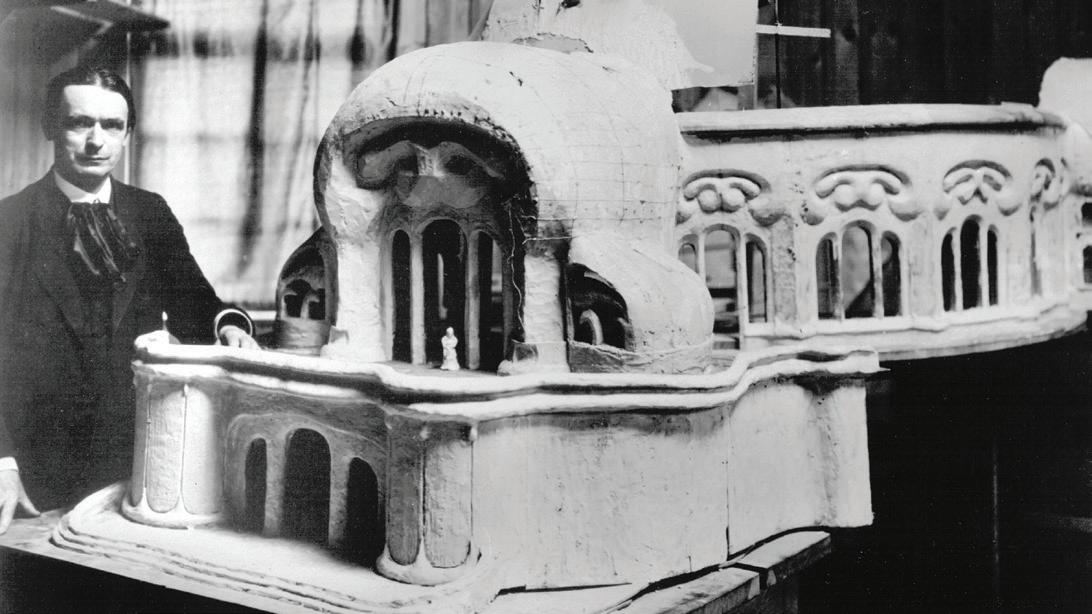


34 • being human arts & ideas
First Goetheanum


Left page top left: Rudolf Steiner with a model of the new building. Also shown: floor plan, cross section, workers, early construction, aerial view, West entrance, and four views of building details. — Above, panoramic view. Right and below, watercolors by Hermann Linde: autumn, spring, and an imagination of a dramatic production on the stage. Linde also worked on the paintings of the cupolas; he died shortly after the Goetheanum burned, “of a broken heart.”

summer issue 2013 • 35
THE GOETHEANUM 1913-2013


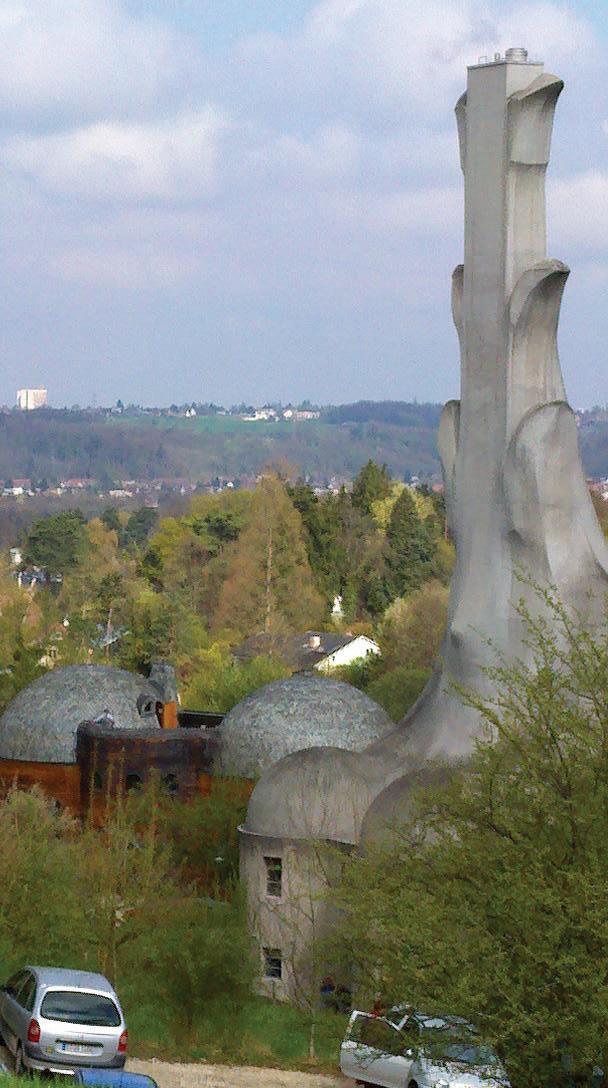


36 • being human arts & ideas
Second Goetheanum


Left page top row: other Steiner works near the Goetheanum: Haus Duldeck, Glashaus, Atelier. Left center, the heating house. Right center, ruins after the fire that destroyed the first, largely wooden structure; plans for the dramatic new building of concrete. Bottom row, and this page above and right: the new Goetheanum in warm evening and cool daytime light (photos by Carla Beebe Comey). Below, a design by Frank Chester shown in 2012 at the Goetheanum for a “Goetheanum in the West” (see next page).

summer issue 2013 • 37
THE GOETHEANUM 1913-2013
Frank Chester: Imagining a Gotheanum-West
 By John Beck
Frank Chester continues on a remarkable path of creative discovery. In 2012 he lectured at the world-class Rhode Island School of Design, and brought his work to the “eloquent concrete” of Rudolf Steiner’s second Goetheanum in Switzerland. In 2013 he began testing a water cleaning and enlivening system in a new research lab in Silicon Valley. Which seem far away visiting his apartment in San Francisco’s Presidio with the Pacific a few hundred feet away and its air streaming in.
Rudolf Steiner valued real expertise in specialized fields. He told medical students to get their standard MD first, then come work with him. Frank Chester had been hands-on with design and engineering for decades when he met Steiner’s thought and methods at Rudolf Steiner College. The models in his window (left), whether artistic and highly finished like the heart sculpture, or a simple looking mock-up (below) are full of thought and testing.


Some thirty years ago the idea surfaced of “a Goetheanum in the West”—understood to be probably a construction in the spirit, not in wood or concrete. But for Frank it was an obvious and practical question. Steiner’s second building is both closely related and very different from the first; Ita Wegman said it was designed for its enemies as well as its friends. Frank has embraced the same questions and placed them in a North American context. Over here, according to Steiner, humans are focused on sense experiences, so Frank externalizes the structural supports to expose new forms. He makes the surfaces evanescent with mesh and changing, tourmaline colors. Two spheres intersect, as in the original, but one above the other not side-by-side. Their intersection is left open to provide shifting light inside. Columns are not needed, so a series of sculptured bells express the seven steps of development. Everything is full of new geometry.
The Goetheanum-West model and much, much more can be explored, along with video talks and a new book, on a beautiful multimedia website created for Frank by Seth Miller at www.frankchester.com.
38 • being human arts & ideas
The Goetheanum Cupola Motifs
Peter Stebbing, ed. & trans., The Goetheanum Cupola Motifs of Rudolf Steiner: Paintings by Gerard Wagner. Great Barrington, Mass.: SteinerBooks, 2011. 246 pages, 208 illustrations.

Review by David Adams
This large-format, hardbound book is a most significant publication for anthroposophical art in the English-speaking world, and once again we have Peter Stebbing to thank for putting together a finely crafted tome presenting a stellar collection of paintings and complementary texts. The book is beautifully laid out with intelligently selected photographs and artwork relating to passages in its texts.
We are given not only high-quality colored reproductions of all of Rudolf Steiner’s original motifsketches for the paintings on the two cupolas of the first Goetheanum and the colored photographs that were taken of his painting on the small cupola, but also all of Assya Turgenieff’s colored engravings of each of the Goetheanum windows, and other vintage photographs and artwork as well. Most of this visual material has appeared in English-language publications before (especially in Hilde Raske’s The Language of Color in the First Goetheanum [1983] and the Wilhelm Rath/William Mann publication, The Imagery of the Goetheanum Windows [1976]), but what particularly distinguishes this latest work are the juxtaposition with several lectures and excepts of lectures by Rudolf Steiner and, especially, the colorful and impres-
sively executed collection of glowing watercolor paintings on many of these same motifs by Gerard Wagner. Wagner’s multi-decades creative occupation (apparently beginning around 1977) with Steiner’s Goetheanum motifs reveals something of the abundance of expressive possibilities still contained within the organic “living entity,” as Wagner puts it, in each of these motifs.

Aside from Wagner’s own short explanatory essay about his painting work (“practice and study”) with the large cupola motifs, Stebbing wisely does not include further analysis or discussion of the specific paintings but lets the gallery of Wagner’s work on each motif speak for itself. In his essay Wagner suggests that the Goetheanum motifs “can be experienced as if one motif were to wander through the various colors of the rainbow—extending over the large cupola space in great waves of color—undergoing in this way a transformation corresponding to the influence of the particular background color.” His painting research with the motifs then explored both the sequential development of the different colors within each motif that would “lead into the formative forces giving rise to this motif” and the varying effects of specific background colors on the metamorphic development of that colorsequence within the organic whole of the motif. It is a method aimed at patiently gaining free access to the original spiritual “archetypal sources of the motifs, out of the color.” Perhaps most astonishingly, as a result of this painting research Wagner further relates his felt intuition that the various motifs “are all in fact metamorphoses of each other. It is as though one motif, were to manifest itself again and again in different ways, as determined by the various background colors....”
As Stebbing comments in his preface, these paintings by Wagner “cannot be separated
summer issue 2013 • 39
Gerard Wagner: I A O Motif, 1976, watercolor using plant colors
from the Goetheanum itself and the art impulse for which it stands. They can be fully understood only in the context of anthroposophical spiritual science, of which the Goetheanum is, in Rudolf Steiner’s words, a ‘true emblem.’” Thus, there is a variety of material presenting the original Goetheanum work as well, including a short foreword by Sergei Prokofieff and an appendix of biographical sketches and photographs of the original cupola painters (with an earlier section listing who was assigned which motifs), as well as a somewhat longer biographical presentation on Wagner himself. There is even a short section describing and picturing some interesting 1982 experiments by Wagner for metamorphosing the large cupola motifs and color scheme within the context of a new second Goetheanum ceiling structure and color base (“slightly subdued background colors, i.e., ‘broken’ with black”). Most significant, I would say, is the inclusion of two related lectures, an essay, and a number of brief excerpts from lectures by Rudolf Steiner on specific motifs, most of which have not previously appeared in English (although a manuscript translation of the last lecture has been available from the Rudolf Steiner Library). I only found missing one very suggestive Steiner quotation on the large cupola paintings, which he gave in his lecture of Dec. 29, 1918 (in English, on p. 112 of How Can Mankind Find the Christ Again?).
I found the most interesting and important lecture to be the first one, “The Renewal of the Artistic Principle” from October 25, 1914. In it Steiner begins by noting that the art in the Goetheanum building embodies something new in human evolution that is now essential for humanity’s further development. He characterizes this as calling something that had been at rest into life, into motion. One example is the metamorphosing forms of capitals and architraves in the Goetheanum.
Another follows changing motifs from below upwards. Another in the realm of painting is a movement from imitative, local-color painting that tries to record what is static and on the surface of things to a new living within the flowing, creative element in colors that of itself can give birth to form in painting. In this way painting, too, can be freed and set into motion.
The lecture also covers differences between drawing and painting; thinking, feeling, and willing aspects in the design of the Goetheanum; humanity’s need to discover the “spiritual America”; the future end of both material and spiritual evolution; learning to think not only with the physical brain; the creative language of the distant future common to all humanity; and how the Goetheanum cupola is “an expression of the Mystery of Golgotha in architecture.” Here are a few telling quotations from the lecture: “Only they are true artists who live to an extent together with things out there in the cosmos and for whom artistic activity is but the occasion for reproducing their life within the cosmos.” “If one releases color from objects and lives with color, then it begins to reveal profound secrets, and the entire world becomes a flooding, surging sea of color.” “The form will be born out of the color… Indirectly, by means of color, one will thus enter into the creative element in the world. Only in this way can it happen that painting not only covers the surface, but directs us out into the entire cosmos, uniting us with the life of the whole cosmos.” “What is to be created in our building, however, will not be there in order to be looked at, not in the least! ... But what is done here is not only there to be looked at, but to be properly experienced.” “The material substance of what is painted should be forgotten. Rather should it be as though transparent. In looking out beyond what is painted on the surfaces, one then looks out into spiritual distances.”

40 • being human arts & ideas
Gerard Wagner: Eye & Ear Motif, 1975, watercolor using plant colors
The second Steiner piece is a shorter essay titled “Goethe and the Goetheanum,” which points out that Goethe “introduced into knowledge the spiritual activity by which he was effective as an artist. He sought the path from artist to knower and found it.” Out of Goethe’s worldview Steiner was able to lead his idea of metamorphosis over into artistic work, thereby approaching inwardly the creativity of nature. In the process, one can also realize that each soul power (thinking, feeling, and willing) is a metamorphosis of the others. By living into and together with sense appearances, thinking can become objective, as Goethe discovered. If one further adopts and applies the metamorphosis idea in the realms of soul and spirit, one’s thinking becomes “spirit-enlivened” or “spirit-bearing.” As Steiner puts it, “It undergoes a metamorphosis to become ‘seeing’ and has then become free of the body.”
The final Steiner lecture, “The Paintings of the Small Cupola: The Goetheanum as a True Emblem of Anthroposophy” of January 25, 1920, is Steiner’s only sustained coverage of the cupola motifs within a lecture. In the process he also says some important things about the nature of color and its relation to our human experience (as well as to elemental beings). One sample: “Anyone able to immerse themselves in the world of color will be able to rise to the feeling that out of this mysterious world of color, a world of ‘being’ sprouts forth. By means of our inner forces, color wants of itself to evolve into a world of being.” Stebbing helpfully illustrates this lecture with the original black-andwhite details of the small cupola paintings (although it must have been tempting to use colored examples). At the conclusion is attached another only slightly jocular quotation from Steiner linking the two centaur-like creatures in the “Germanic Initiate” motif to Ameri-

can President Woodrow Wilson and his influential wife (especially telling today when one sees what has become economically and socially of the direction Wilson launched then with his 14 Points). Stebbing even managed to find a suitable photograph of the Wilsons to juxtapose amusingly with the detail of the centaurs!
Two further quite interesting written pieces follow. One is a study by Stebbing (especially following the work on this by Daniel van Bemmelen) of Steiner’s instructions to complete the painting of the north side of the small cupola in the “counter-colors” (vs. complementary colors) to those he had used in painting the south side and also the relationship of this to the Steiner’s “twelve-color color circle” (vs. Goethe’s color circle). The second essay is “Indications of Rudolf Steiner for Engraving the Window Motifs” by Assya Turgenieff, describing her various interactions with Steiner in developing her etchings of the Goetheanum window motifs and the technique of black-andwhite shaded drawing.
Finally, in the appendix is Stebbing’s translation of another essay by Wagner on the development of his approach to painting out of Steiner’s motifs and training sketches, titled “A Path of Practice in Painting.” Let me close this too-long review by reminding again how pleasurable it is just to look through this book visually. I count 152 color illustrations, most of them full- or half-page in size and tastefully presented, as is the book layout in general.
summer issue 2013 • 41
David Adams (ctrarcht@nccn.net) teaches art history at Sierra College in California, is the Secretary of the Council of the Art Section in North America, and co-edits the Art Section Newsletter.
Gerhard Wagner: Goetheanum Red Window Middle Motif, 1974, watercolor using plant colors
The Blue Star of Individuality
by C.T. Roszell
In the second scene of Rudolf Steiner’s mystery drama The Portal of Initiation , the human individuality is evoked through the imagination of a sparkling star. Maria says to Johannes, “You will have to undergo all the trepidations which one bereft of their senses could have to face—so speaks your star.” And in the following scene Benedictus encourages him with the following word, “My son, you have persevered this far—you will make it all the way through. I see your star shining full.”
What is the meaning of the star spoken of here? Rudolf Steiner conveys the viewpoint of Benedictus in the lecture cycle At the Gates of Spiritual Science (GA 95), while delineating how the soul-spiritual configuration of a human being appears to the clairvoyant. In two lectures he treats two different aspects of the phenomenon. On August 22, 1906 in Stuttgart the astral sheath is portrayed as a form in constant movement except: … in one single small space, which is like an egg-shaped blue sphere slightly extended at either end, just a little behind the brow at the root of the nose. This is only true of the astral form in humans. In more cultured individuals it is less noticeable; it is more prominent in people living in the wild. Actually, there isn’t anything there; it is an empty space. Just as the interior of a flame, there where it is empty, appears blue due to the surrounding aura of light, so it is with the human astral aura. Light is cast into the dark empty space. That is the outward expression of the I.
In the lecture of August 24, 1906 Rudolf Steiner describes the phenomenon from a more inward point of view. He depicts the changes that moral, artistic and wisdom powers bring about in the sheaths:

The more … that one works on oneself through the essential powers of the I, the more rays go out from the blue sphere, from the I center. These rays represent forces by which a person gains mastery over the astral body. Viewed this way, one can speak of two astral members—one member that remains bound to the instinctive realm, and another that one has made one’s own.
Rudolf Steiner describes how, Imaginatively speaking, over time the blue-hued empty space is superseded by a shining star. The space is gradually transformed into a shining star, shooting through and ennobling the astral body. Until this transformation is completed, a person is, in a way, twins—and the two are not at all of one view in all things. There are two souls in one’s heart, capable of going separate ways—both originating from out of the identical soul-spiritual blue. What does it mean? We want to harness all our resources to find out, and trace the consequences to the their conclusion.
We can start with an artist’s impressions, one capable of creating authentic high art—cohesive, true impressions that give form and expression to activity from beyond the bodily senses, brought into true relation to the sense world.
Lord Bulwer-Lytton and the Silver Spark
Lord Bulwer-Lytton was a nineteenth century English novelist, occultist and parlamentarian.1 His friendship was an inspiration, among others, to Charles Dickens, and it is no coincidence that Dicken’s A Christmas Carol is rich with so many nuances of authentic spiritual vision.
Bulwer-Lytton evokes far-ranging, subtle dynamics of the soul-star in his novel A Strange Story. In an Imagination, the protagonist meets the figure of Margrave, a nefarious interlocutor in the story who also figures as the protagonist’s double. From Chapter XXXII:
Margrave at once became stiff and rigid as if turned to stone. …. I looked, and gradually—as shade after shade falls on the mountainside, while the clouds gather and the sun vanishes at last—so the form and face on which I looked changed from exuberant youth into infirm old age. … The countenance had passed into gloomy discontent, and in every furrow a passion or a vice had sown the seeds of grief.
And the brain now opened on my sight, with all its labyrinth of cells. I seemed to have the clue to every winding of the maze.
I saw therein a moral world, charred and ruined, as in some fable I have read, the world of the moon is de-
42 • being human arts & ideas
1 Sir Edward George Bulwer-Lytton (1803-1873) was best known for his novels. Rudolf Steiner refers to his Zanoni while depicting the nature of the Guardian of the Threshold in his basic work, Knowledge of Higher Worlds
Rudolf Steiner, 1861-1925
scribed to be; yet withal it was a brain of magnificent formation. … I observed three separate emanations of light; the one of a pale red hue, the second of a pale azure, the third a silvery spark.
The red light, which grew paler and paler as I looked, undulated from the brain along the arteries, the veins, the nerves. And I murmured to myself, “Is this the principle of animal life?”
The azure light equally permeated the frame, crossing and uniting with the red, but in a separate and distinct ray, exactly as, in the outer world, a ray of light crosses or unites with a ray of heat, though in itself a separate individual agency. And again I murmured to myself, “Is this the principle of intellectual being, directing or influencing that of animal life; with it, yet not of it?”
But the silvery spark! What was that? Its centre seemed the brain. But I could fix it to no single organ. Nay, wherever I looked through the system, it reflected itself as a star reflects upon the water. And I observed that while the red light was growing feebler and feebler, and the azure light was confused, irregular—now obstructed, now hurrying, now almost lost—the silvery spark was unaltered, undisturbed. …. I became strangely aware that if the heart stopped in its action, and the red light died out, if the brain were paralyzed, that energetic mind smitten into idiocy, and the azure light wandering objectless as a meteor wanders over the morass,—still that silvery spark would shine the same, indestructible by aught that shattered its tabernacle. And I murmured to myself, “Can that starry spark speak the presence of the soul?”
… I turned my sight towards … the elephant and the serpent: to the tiger, the vulture, the beetle and the moth; to the fish and the polypus, and to yon mockery of man in the giant ape. … In none was visible the starry silver spark.
The light of animal vitality is consonant with the brown and red-brown tones of the first aura as described in chapter six of Rudolf Steiner’s basic work Theosophy with Imaginative impressions of the instinctual life of the body the human shares in common with the animal kingdom. And the azure light appears to function like

reflections of mentation in the human sentient body.
The silver spark though—how consonant are the speech of its imagery and activity with the shining star of Rudolf Steiner’s mystery play! And the silvery spark is consonant with the unfolding drama of interpersonal destinies, destinies that are protected, recollected and carried into the future as if under the guidance of the stars in the firmament of the heavens, watching over the earth.
Swami Muktananda and the Star of Reincarnation
In his autobiography, The Play of Consciousness, (San Francisco, 1978) Swami Muktananda, a convincingly authentic Indian yogi adept, gives a remarkably detailed account of the results of yoga initiation in the twentieth century, and in a language and storyline as richly cohesive as that of Portal of Initiation and A Strange Story

The yogi delineates a progressive unfolding of four groups of inner light realms, corresponding to four decisive levels of development on the yoga path. What unfolds here goes far beyond any romantic vacation portrayal of the charm of exotic lands, to touch on the deepest riddles of human existence.
The first supersensory field of perceptions is bathed in red light, closely associated with the body. A white light follows, in which the subtle body casts awareness over the provinces of sleep and dream. A yet deeper and higher function is carried out by a third dynamic, the work of what the yogi designates as the causal body, a sheath of awareness that functions beyond light, described as black light.
The highest dimension of awareness and its corresponding imaginative light qualities he characterizes as the supra-causal body of blue light, the size of a sesame seed in relation to the physical body. At this stage of development a dynamic soul activity begins to take on a special note in blue light. The blue light goes over into a higher dynamic that plays out between the eyebrows at the root of the nose, that the yogi aptly terms the “blue pearl.” The round, small form and its site description invoke the atavistic light of the self that we have already noted Rudolf Steiner describing in the lecture cycle At the Gates of Spiritual Science
After a series of experiences in the realm of the blue pearl, a yet higher dynamic unfolds under the aegis of a
summer issue 2013 • 43
Swami Muktananda, 1908-82
Sir Edward George Bulwer-Lytton (1803-1873). Rudolf Steiner refers to his novel Zanoni while depicting the nature of the Guardian of the Threshold in Knowledge of Higher Worlds
blue star. “It was not the Blue Light or the Blue Pearl, but a blue star.” (p.149) And so also here in the fine delineations of Muktananda, a distinction arises between an enclosed blue light form and one that radiates outward, a particularly noticeable correlation with the dynamic described in At the Gate of Spiritual Science touched on above.
With the appearance of the blue star, Muktananda enters onto the field of the core meaning of the many patterns of light phenomena:
It is … by means of the blue star that the individual soul passes from one body to another in the cycle of birth and rebirth. However many times a man is burned or buried, the blue star will always stay the same. …. When the individual is born again, the blue star is born with it. When the star exploded, my cycle of coming and going was ended. The vehicle had broken down, so how could I come and go anymore? (p. 154)
The story of the blue star has arrived at a breathtaking confluence of how differing cultural and individual artistic sensibilities respond differently—how remarkably divergent our receptions are to the dramatic finish of the story! For many, the ending will serve as a complete triumph of human experience, a long delayed achievement of complete and final release from error, bondage and the suffering of earth existence.
Then there will be those who cannot respond with feelings of triumph to the drama’s finish, it isn’t in their hearts to be moved this way. Those of us who cannot relate to the note of triumph, though, would certainly err to chauvinistically devalue the genuine moral-aesthetic response of those who can.
But for those of us for whom the ending remains existentially open ended, we are left to ask—what then is the mission of the earth and of humanity? Are error, bondage and suffering in the world ultimately thoroughly inherent in individuality itself, or are they not? For those of us who are left with such questions, the path continues.
The Alter Ego and Rebirth
What could bring the modern Westerner to want to blow the candle of individuality out? Many of us are drawn directly back to the fascinating riddle we found Lord Bulwer-Lytton addressing with such depth and subtlety in A Strange Story —to the shadow figure Margrave, and the problem of his redemption.
Margrave is truly an archetypal configuration in the Western psyche, and runs broadly and deeply throughout the canon of our experience. He is the hard to reach
“enfant terrible” of the soul life, as exemplified in such well-known folk tales as the Sorcerer’s Apprentice or Rumpelstiltskin. The shadow must be brought into the light and recognized by name; his creative wealth needs to be harnessed and put into the service of the individuality— or he will indeed only continue on and on the in the vein of the “enfant terrible.”
Modern Western psychology has developed something of a portrait of the alter ego and its function, for example, in the depth psychology of C.G. Jung. Maupassant’s double is recorded to have taken a seat in his visitor’s chair to help the writer over a difficult passage. In his autobiography, Goethe describes a meeting with himself while traveling. His likeness was dressed in clothes that the writer would years later actually acquire! Over and again, in many countries the double is reported to appear several days before death, frequently in association with a sudden marked sense of peace that comes over the dying in their final days.
And at least since Plato, the motif of the double has appeared in relation to the riddle of reincarnation. In Phaedrus, Plato represents the shadow twin as a force of spiritual gravity that brings the soul back to earth for rebirth. Plato conveys the story in the Imagination of the charioteer driving the chariot with two horses. The charioteer is the individuality leading a life in the body, and he depends on the two horses to respond to his cues in concert to make headway. The horse on the right is lustrously bright and fleet, agile, skilled and responsive. Not a touch of the whip is called for.
But the horse on the left is dark, proud, mysterious, and rebellious. This horse checks the flight into the skies, and causes the soul to lose its wings, and the charioteer to fall to earth. The soul is compelled to sojourn on the earth under the constraints of the body.
This is easily recognizable as a variation of Rudolf Steiner’s Imagination we entertained earlier—the twins of astral blue, one of which remains enclosed, bound to the instinctive realm, while the other, the one the individuality has worked into, shines freely in rays of individualized beauty, truth and goodness.
Rudolf Steiner depicts how, viewed one way, the alter ego functions as the lesser Guardian of the Threshold. Here the form is a mix of the soul’s perishable and imperishable features, each feature representing past actions and patterns that either follow and represent the divine, or have failed to.
Let us take stock of the clear messages the sages and
44 • being human arts & ideas
great artists of world cultures have conveyed to us. We may find that these are consonant with our own experience! Where this is so, the process of human experience and culture then comes down to this: either we dissolve, or continue to transform, the alter ego.
Swami Muktananda’s autobiography is again deeply instructive with respect to the dynamic of the alter ego on our journey—he is indeed a superbly masterful storyteller of so many of its most salient fine points. In the second chapter of part two of his narrative, he tells the parable of a poor and miserable man who seems to carry his penchant for bad luck and disaster everywhere he goes. If he stays with a generous host in this or that village, that man’s enterprise falls into ruin soon after, as well. In a vignette that has all the hallmarks of a portrayal of a meeting with death and the beyond, the storyteller goes on to describe how the poor man sets off for Mount Kailasa, the abode of the gods.
He spies a fellow traveler on the lonely way up, and catches up with him to greet him, to ask him to keep him company the rest of the way. The fellow traveler turns to him, and is revealed as the epitome of sorrow and misery. And he replies that the two cannot walk the way side by side together, for it is his task is to go ahead always, to prepare and stage all the misfortunes, miseries and accidents that the poor wretch has stubbornly insisted be there to meet him—for all this must be already in place to greet the poor fellow when he arrives.
A Therapeutic Meeting with the Lesser Guardian in the Contemporary West
Remarkably, the Indian sage has articulated the very scenario Rudolf Steiner envisions as a therapeutic and viable technique to imagine and engage the karmic double. Recreating the scenario over and again in detail awakens the sense for karma, and a sense of the responsibility a strong individuality will feel to grow beyond the limits of a merely personal interest in only this life:
What would the result be, if we were on some occasion to construct an artificial person in our thoughts, a vehicle of thought for a hypothetical exploration. … Picture for yourself for example underway somewhere, and a piece of masonry from a roof at the side of your path comes loose, rolls out—falling on and injuring your shoulder. Our first inclination doing this might be to accept the event as a coincidence. But then you could test out our hypothetical thought-construct man, sending him up the roof, and imagining him loosening and
letting roll out that piece of rock shingle at the only angle possible for it to hit your shoulder! If we graphically apply this technique to all the events in our lives that we otherwise dispatch as accidental, the following will happen: we will arrive at an expanded power of memory, a memory of the heart, a feeling power of memory. And doing this, we are in fact feeling our past incarnation. (Lecture, February 20, 1912, Stuttgart, GA 135.)
The feeling that our lives are so rich in meaning that we are willing to accept the hardships of descending into embodiment, so that we can live and work together to unfold what we can become together, goes to the essence what it means to be human.
Being human opens the vision of the heart across the vistas of the ages, to the point that the words of the Evangelist match the speech of one’s own heart: “I will not lose my first love, so that I can stay the course through these trials that make me seem at the verge of death to myself.” John’s last book, his book of Imaginations, tells this story of the soul in our time, in the pictures of the letters to the seven communities. The Highest of the High shows John the Guardian’s judgments over the story of the soul in each of the ages. The first letter, addressed to the community of Ephesus, is the judgment on the first great cultural age that went out from the greatness of India: “I have a thing against thee, for you have left your first love.” That is nothing other than the willingness to continue to undergo the travails of incarnation until the human soul completes all the challenges of earth evolution. The fifth letter, the letter to the community of Sardis, is the Guardian’s warning to our own time. “You flatter yourselves, celebrating how spiritual, how alive you believe you are, but you are in fact nearly half dead! Wake up quickly now, so as not to allow the rest of what you are to completely die.”
Waking the memory of the heart is nothing less than the will of our essential individuality responding to answer the call, the will of the blue star to stream out, the will of a progressive Platonic western Eros to transmute

summer issue 2013 • 45
John the Evangelist by Simone Cantarini (1612-1648)
all that the highest in the human being can of the ephemeral into values to live in eternity. Rudolf Steiner speaks out of the depths of a twentieth century Phaedrus when in the final chapter of Knowledge of Higher Worlds he observes that the Guardian of the Threshold has carried the burden over the eons to hold together all that has passed in the world, but that it gradually comes instead to be “the task of every truly human being to carry all that can be garnered from the sense world into the world of the future.”
C.T. Roszell teaches German at Washtenaw Community College in Ann Arbor, Michigan, and is currently developing a multi-media German language course based on poetry, story-telling and guitar. This article first appeared in Germany’s Anthroposophical Quarterly Mitteilungen aus der Anthroposophischen Arbeit in Deutschland, 43/3, Michaeli 1989. It is an exposition from an ongoing series of seminars being offered together with Frederick Amrine on Rudolf Steiner’s lectures on karma and reincarnation for members of the Anthroposophical Society and their guests.
Understanding Ourselves as Embryo



Embr o In Motion y
with Jaap van der Wal, PhD, MD
This seminar explores how human prenatal development expresses the essence of human spiritual unfoldment. Understanding the stages of embryological development provides a basis for therapeutic recognition of embryological forces in all later stages of life. This seminar is a rare opportunity to hear a world authority on modern embryology through a unique synthesis of scientific and spiritual principles.
ANTHROPOSOPHY NYC
the New York Branch of the Anthroposophical Society in America

138 West 15th Street, NY, NY 10011 (212) 242-8945
“The word ‘anthroposophy’ should be interpreted as ‘the consciousness of our humanity.’” – Rudolf Steiner
TALKS
spirituality, health, education, social action, esoteric research, human & cosmic evolution
WORKSHOPS
self-development, biography, therapies, rhythms & cycles, threefolding, economics
VISUAL ARTS
exhibits, workshops, talks, museum walks
EURYTHMY
Rudolf Steiner’s therapeutic art of sacred movement
EVENTS
music, theater, festivals, community celebrations
STUDY GROUPS
free, weekly and monthly, exploring transformative insights of Rudolf Steiner, Georg Kühlewind, Owen Barfield and others
SOME UPCOMING PROGRAMS
at 7pm except as noted; details at www.asnyc.org
9/11, Wed: Kühlewind Memorial Lecture: László Böszörményi: “Empty Consciousness: the Unwritten Book of Georg Kühlewind”
9/18, Wed: David Anderson: Spiritual Beings and Their Work (first of ten monthly lectures)
9/20-21, Fri-Sat: László Böszörményi: Workshop:
“Healing Memory: Learning, Remembering, Forgetting”
9/28, Sat 2pm: Jonathan Stedall Documentary Film Showing: “The Challenge of Rudolf Steiner”

10/25, Fri: Glen Williamson: “Beat the Devil” (the story of Faust)
10/26-27, Sat-Sun: Gail Langstroth: “Poetry and Movement”

12/7, Sat: Eugene Schwartz: “In the Midst of Life: Understanding Death” (first of four lectures)
RUDOLF STEINER BOOKSTORE
Browse dozens of works by Steiner and many others on education, science, health, art, spirit, biodynamics. Open Tues-Sat, 1-5pm, from 9/6.
46 • being human arts & ideas
www. asnyc .org centerpoint gallery
spiritual, therapeutic, world, & ‘outsider’ art
PortlandBranch.org
4 DVD Set Available exclusively at
news for members & friends of the Anthroposophical Society in America
The Society’s Rudolf Steiner Library: An Evolving Story
Over the past several years, members of the General Council, along with the Society’s staff, have been working quietly and intensively observing the phenomena of how anthroposophy is living in the United States in order to better understand our times, especially the appropriate role of the Society and what practical steps it can take to continue to help anthroposophy thrive in America.
The applied applications of anthroposophy continue to grow— in many instances flourish—yet individuals throughout the movement have expressed concern regarding the strength of the connection many of these institutions have with anthroposophy itself—the root of all of these endeavors and the inspiration for their continued health and development.
Membership in the world-wide society is relatively stationary, with growth occurring in areas where anthroposophy is being newly discovered. Here in the U.S., the Society experienced modest growth in 2012, and yet we lack the vibrancy as an organization that one would expect based on the wide interest in Rudolf Steiner, anthroposophy, and the anthroposophic movement.
Much has been written about the financial health of the U.S. Society. In response to an increasingly difficult economic climate, General Council members over the past decade have overseen a process of reducing the Society’s expenses, eliminating non-essential spending.
Five years ago the council recognized we could no longer “cut” our way to a balanced budget. Growth needed to occur. It was necessary to re-evaluate all that we do and how we do it. How are we connecting with the world, and how do we connect with each other?
Many changes have been taking place. Some are quite visible, such as our publication being human, the activities and materials developed to celebrate Rudolf Steiner’s 150th anniversary, and the process which led to the colloquium and conference in Ann Arbor last year. Others have been more behind-the-scenes, such as transitioning to a new accounting system, implementing our new relational membership database, and reviewing our current staffing structure. All of this work has been undertaken with a singular focus—how can we cultivate an atmosphere of engagement that is able to support a diverse community of researchers and practitioners in an environment that is open, respectful, and rooted in the impulses of spiritual science as indicated by Rudolf Steiner?
One program that has been a focal point in this discussion is the Rudolf Steiner Library in Harlemville, New York. In 2007, upon the request of library director Judith Soleil, a preservation assessment was done for the library. Judith was concerned with how the environment of the physical building was affecting the books and archives. The report disclosed that there were some immediate and intermediate steps that could be taken to protect the collection, but long-term solutions would be costly. Through the report it became clear that the library building was not an optimum or even a suitable physical setting for a collection of such
value to the Society. Moreover, the increasing maintenance costs for the building and the fundraising that would be necessary to offset the needs of proper maintenance and suitable program development presented an increasingly difficult dilemma of where to focus the diminishing resources of the Society. The immediate needs were attended to. Much of the work to secure the safety of the collection and the individuals who work in the building has now been completed, but the long-term questions remain.
Since then, the general council has requested help from several groups as they tried to imagine what was being called for. A task force, comprised of Judith Soleil, general council members, and Society members from across the country, formed in 2009 to look at the building and to make a recommendation whether to renovate the Carriage House or move the collection to a new space. In 2010, a group of individuals in the Berkshire/Taconic region, along with Judith Soleil, council member Virginia McWilliam, General Secretary Torin Finser, and Society administrator Marian León, came together and hosted a world café in order to discuss the question more closely with local members and gather their thoughts and concerns. The world café provided an opportunity for conversation that was significantly helpful to the overall process, including the valuable insight that the library must be thought of as more than a collection of books. Finally, in 2011, the council gave a two-year mandate to a library committee to articulate a vision for the next evolutionary phase of the library.
As the conversation about the library has grown over the years, several things have become clear:
The current building housing the collection is no longer adequate. It is a serious concern to house the books, journals and papers—some of which are irreplaceable—in a wooden residential building.
The location of the building is not ideal. There is a desire to “bring it out from under the basket,” as one local Harlemville member stated. It would be good for the Society to seek a more accessible location for the collection, one that can also enjoy a reliable technical infrastructure.
The concept and understanding of what a library IS is undergoing tremendous change all over the world. The standing collection and the service to the members has been of great value to the membership and the intellectual life of the Society over the last forty years. Deep thinking should be applied to the question of how to grow the concept of the library and extend its services so that it can remain a vital force within the Society for the next forty years.
The current library is both a regional resource as well as a national resource. What services can the library provide to actively engage with all those wanting to work with this body of knowledge? How can we further conceptualize the “conversations” which Fred Paddock built up in the collection, which are so central to the cultural life of anthroposophy and humanity, and how can we expand them to members and friends? Who are our partners in this work? How can we make this valuable resource
summer issue 2013 • 47
a felt presence in communities across the country?
The work continues in several directions. We are actively engaged in conversation with the Harlemville community to see if we are able to work in partnership to find a new home for the collection. Work is being done with the collection to identify what is rare and needs to be preserved, what could be digitized, and what processes can be streamlined. The collection policy will be reviewed to make sure it continues to guide acquisitions in an appropriate way. And to reference Henry David Thoreau when he received questions about the size of his cabin by the pond—how can we make the library bigger than it seems? We must ask ourselves how the library can extend beyond the limitations of its physical space and provide a parlor big enough to welcome and serve every part of the membership, the daughter movements, the associated organizations, and all those who seek a place of knowledge, contemplation, and conversation. The several years of discussion that have led to this point in time have prepared us, as a Society, to start to build a new vision, a new imagination for the future of the library. The library committee has begun the process of gathering input from the membership at large through a survey, which can be found at www.anthroposophy.org/index.php?id=291
We invite you to take just a moment, even if you have never used the library, to imagine with us and provide your thoughts about what could be. This survey will be followed up by a variety of focused activities designed to extend and deepen the imaginative process. Before us stands an opportunity that is hopeful and energizing, a chance to accomplish a thing of significance for the current membership, and for the generations to come.
What’s Happening in the Anthroposophical Society in America
Torin Finser Visits the Sacramento Faust Branch
The Sacramento Faust Branch of the Anthroposophical Society meets each Wednesday evening, September through May, on the campus of Rudolf Steiner College in Fair Oaks, California. The meetings alternate between talks by local and visiting lecturers, artistic activities (recently sculpture and eurythmy), and member-led studies of lectures of Rudolf Steiner that relate to the General Society’s theme of the year. Usually between twenty-five and thirty members and guests attend.
On June 4, 2013, Torin Finser, General Secretary of the Society, drove from San Francisco to meet with the Branch members. Although our official “year” had ended, more than forty people gathered. The evening included an interesting, informative presentation by Torin and then a period of questions and discussion.
Torin reported on trends of membership in the international Society—slight decreases in Central Europe and growth almost everywhere else—and in the US Society—continued steady growth. He also spoke about the situation at the Goetheanum and the movement there toward a more broadly inclusive mode of governance. Torin gave news of Sergei Prokofieff’s condition and that of Judith von Halle.
Regarding the “sister movements,” Torin spoke of the importance of biodynamics, Waldorf education, Camphill, and the others being rooted in anthroposophy and keeping a strong connection to the Society. He mentioned the challenge many anthro-
The Annual Members’ Meeting of the Anthroposophical Society in America will be held on Sunday, October 13, 2013 at the Monadnock Waldorf School, 98 Lincoln St., Keene, New Hampshire. The meeting will begin at 10:30am and conclude at 1:00pm.
Members are invited to submit proposals to be considered for the meeting. Items for consideration may be addressed to the General Council and must be submitted in writing and sent via first-class mail postmarked August 23, 2013 at the latest. Send your request to the Society office at 1923 Geddes Avenue, Ann Arbor, MI 48104. Thank you.
posophical institutions face in finding staff who have any knowledge of, or relation to, Anthroposophy. Torin reminded us that our great task in this time is to continue our evolution as beings of freedom and love and to cultivate a living experience of “Christ in us.”
The evening was full of inspiring spiritual thoughts and pictures, goodwill, camaraderie, and humor. Torin’s warmth of heart, clarity of thought, and commitment to Anthroposophia were in full evidence. I and my fellow members of the Faust Branch felt proud and reassured to have Torin as General Secetary of the national Society and as our representative in the world.
Two New Members Added to the Eastern Regional Council
At the General Council meeting held the last weekend in October, two new members were approved to join the Eastern Regional Council, Sarah Hyde of Maine and Linda Evans of Washington, DC.
Edward Scherer, who has been on the Council for many years, will be retiring form active service and will serve as a consultant to the group. Kathleen Wright will be taking on his former role as Treasurer of the ERC. Ann Finucane, the only other member, is its representative on the General Council.
Sarah Hyde discovered Anthroposophy at the age of 35. Her daughters attended a Waldorf School. Sarah attended the Rudolf Steiner Institute, where she met Henry and Christy Barnes and they became fast friends. Because of Christy's inspiration, Sarah went for Speech training and then for Waldorf teacher training at Antioch. Sarah also worked with Craig Giddens in Speech work. She met Susan Lowndes who introduced her to the Christian Community. Sarah taught at the Merriconeag School as a high school English teacher. She has also worked as a remedial consul-
48 • being human
Ronald E. Koetzsch, on behalf of the Faust Branch
tant and tutored children for 10 years with Extra Lesson work. Sarah is a member of the First Class.
Linda Evans found out about Waldorf education while working as a Social worker at a public school. The friend told her to look into Waldorf and she did. In 2003 she went to the Teacher training program in Detroit. There she learned about the Society, the First Class and the Christian Community and she joined all three. She also became a friend and student of Ernst Katz's. She also became interested in biodynamics. Now living in Maryland, Linda works as a coordinator for Alternative Education. She is also attending the Extra Lesson Program during summers.
Having these two new members will help greatly in reaching out to members in our large Eastern area. A search continues to find another member or two for the very populated New York area.
Kathleen Wright, from the Sophia Sun newsletter
With her term as Eastern Region representative on the General Council ending later this year, Ann Finucane has made another life change in moving from the Washington DC area to “Camphill Ghent, Elders in Community” in upstate New York. A stalwart communicator and a constant “helping hand,” Ann has been a great help to being human as chair of the Council’s communications committee.
John Beck, Editor
Western Council Visits Seattle
The Western Regional Council (Daniel Bittleson, Linda Connell, Joan Treadaway) visited Seattle March 8–9, 2013. The full agenda was met with great enthusiasm. It focused upon connecting, expansion, and healing, especially through the Madonna series. A cozy Friday evening dinner at a trustee’s home included many issues close to all our hearts and minds. We could clearly count on the WRC to help us understand complicated steps standing before the future for the Society, not only in America but as a world-wide movement.
Saturday, the WRC met in a circle with class members where we were able to review some past activities and WRC mem-
bers shared what is working in their communities. This discussion has led to a new practice. After the showing of the cards, in the prepared space for the lesson, any member can stand and share concisely a thought, experience, or understanding from the previous lesson. We then move into the lesson for the month.
We next heard a talk by Joan on “The Five Etheric Streams and The Mission of Raphael” viewing the human being as a five pointed star in light of the five Etheric streams. This gave a wonderful introduction to the incarnations of Raphael who painted most of the pictures in the Madonna Treatment. After a community pot-luck, Joan led us through this revitalizing treatment. At its close we left in the quietness of this sacred mood flowing with healing love: offered in radiating candle light with lyre music by Stephanie Croft.
Our community thanks the WRC members and the trustees of the Seattle Branch with special thanks for the planning done between Pam Engler and the WRC.
Submitted by Christina Sophia
What’s Happening at the Rudolf Steiner Library
Judith Kiely, our extraordinary colleague—mastermind of the library’s digitization project; engineer of our online catalog (an enormous feat of organization and deployment of expertise); finance whiz; intrepid researcher; creative problem-solver; patron favorite; and, not least, a treasured, loving, and supportive friend—is no longer working at the library. Her last day was June 8. We are grateful for her many years of service, and will miss her.
Judith Soleil, Librarian
Anne Mendenhall
March 20, 1930–May 8, 2013

In celebration of the life of Anne Mendenhall, of Lansing, NY, we acknowledge a life carefully lived and helpful to the Earth. Anne was born March 20, 1930 and crossed the threshold of earth life on Wednesday
evening, May 8, 2013. After graduation from Duke University, Anne worked as researcher and writer for tv shows in NYC. In 1953 she decided to become a farmer.
She took ag courses from Cornell School of Agriculture and Iowa State and did apprentice farm work for a few years before buying her own 167 acre farm on Britt Road, near Poplar Ridge, NY, where she farmed for forty years. She became a biodynamic/ organic farmer raising hogs/poultry/beef cattle/lambs. She grew her own livestock feed and hay. During her farming years, she also served as a news reporter of local school and community events. She helped found the Poplar Ridge Volunteer Ambulance service. She had a Waldorf homeschool in her farm home for several years.
After semi-retiring from farming, Anne became National Director of the American Demeter Association which certifies biodynamic and organic farms in the US.
When she left the Demeter work, Anne took up her love of creating beautiful pottery and photography. Her most ardent retirement work was as guardian/political spokesperson for organic foods, for responsible care and protection of our Earth, and for the protection of human freedoms. She notified many friends of bills in Congress that needed our attention, of petitions that needed to be signed, and of issues that needed our action.
Her final work was to face the diagnosis of colorectal cancer with holistic, drug-free health practices. This allowed her to live her days in relative health and peace, as she chose.
Anne leaves behind her her friend/companion of 40 years, Karen Menges; brother and sister-in-law, Warner and Judy Mendenhall; adoptive daughters Nica Weeks and Johanna Messer; plus many nephews and nieces and former farm apprentices/friends whose lives were touched by having worked with Anne on her farm.
From Karen Menges
summer issue 2013 • 49
David Spear Mitchell
December 6, 1945–June 8, 2012
By Ronald E. Koetzsch
David Mitchell was born in Salem, Massachusetts in 1946 on December 6, the feast day of Saint Nicholas, a saint known for his love of children, generosity, and warmth of heart. From his early years, David excelled both at academics and athletics. He played football in high school and was admitted to the University of Massachusetts at Amherst on a football scholarship.
After two years, David was drafted into the army and was trained as a demolitions expert in the Special Forces. David was assigned to go to Vietnam, but literally at the airport just before he was to depart, a change-order arrived, sending him to Germany. David was a much commended, model soldier during the two years he spent in Germany but realized that the military was not part of his future life path.
After his discharge, David completed his BA at UMass Boston. He majored in literature and began writing poetry, nurturing, one might say, his distinctly non-military side. There, through a fellow student, Paul O’Leary, David discovered Rudolf Steiner, anthroposophy, and Waldorf education. In the year after graduation, David was a lineman on the taxi squad of the New York Giants professional football team.
It was the late 1960’s, the era of the hippie subculture and drugs, sex, and rock and roll. David’s earnestness and his compelling quest for what was wholesome and positive in life, however, led him in quite a different direction. He applied to the Harvard Graduate School of Education, was accepted, and enrolled. After a few months in Cambridge, though, David decided on the path-less-traveled. He left Harvard and went to Emerson College in England, a center for Waldorf teacher education.
There David met and courted a beautiful Norwegian girl. After completing their training at Emerson, Anniken and
David married in Norway in 1971 and stayed for a year. The first of their four children, a daughter, was born there. David taught manual arts and chemistry at a Waldorf school outside Oslo. He became fairly fluent in Norwegian, but sometimes relied on one of the students to help him express fine points of a lesson. That student, named Jens Stoltenberg, is currently prime minister of Norway.
In 1972, the little family returned to the United States and spent one year at Camphill Village Copake in upstate New York. This is an anthroposophical community in which adults with special needs and co-workers live and work together. While living at Copake, David was the first-grade teacher in the seed school that was to become Hawthorne Valley School.


In 1973, David was recruited as a class teacher at the newly founded Pine Hill Waldorf School in Wilton, New Hampshire. Soon after arriving there, David, working with a friend, built a house for his wife and family. David remained in Wilton for nineteen years as a class teacher at Pine Hill and also as a high school teacher at High Mowing School. He was instrumental in founding the Waldorf teacher training program at Antioch University New England and was
an adjunct professor there from 1978-1992. With his boundless energy, strong will, his love of nature, his dedication to children, and his commitment to Waldorf education and anthroposophy, David was a pillar of the community.


From Wilton, David and his family moved to Boulder, Colorado where he was instrumental in founding the Waldorf high school. He specialized in the teaching of science and of literature, especially Shakespeare. David also taught blacksmithing. Having retained the strength and size of a football player, David, when he stood before the forge in his shop apron, looked indeed the archetypal blacksmith.
During his time in Wilton, David had begun to take an active role in the larger Waldorf world. He was for some years the eastern regional chair of the Association of Waldorf Schools of North American. In Boulder, around 1997, David stepped back from teaching and became the fulltime director of AWSNA Publications. In the next fifteen years, he published a treasure chest of books, usually eight to ten each year, all intended to help Waldorf teachers fulfill their vocation. David wrote several books himself and many articles. Along the way he founded and published the Waldorf Science Newsletter with his colleague, John Petering. David was also was the co-founder of Waldorf Research Institute with Douglas Gerwin.
From the founding of Renewal, David was an unfailing friend and supporter of the magazine. David’s energy, experience, knowledge, insight, and generosity benefited our work greatly. In recent years we have listed David on our masthead as “Giver of Moral and Practical Support.” An article by David on teaching ninth-grade science appeared in our Spring/Summer 2012 issue, published just as he was crossing the threshold of death.
A few weeks before he died, I called David up and said, “David, we have an article on painting in the Waldorf high school and we need some graphics…”
50 • being human
David was at that time already very sick and weak and when I asked him how he was, he said, “Yeah, well this thing will do me in sooner or later.” Nevertheless, two days later a priority mail packet arrived with a flash drive containing fifty or sixty photos that David had culled from his files.
Renewal is still created at 3911 Bannister Road in Fair Oaks, California, which for years was the home of the Association that David served so well and so long. My wife and I are now owners of the property. We have planted a pomegranate tree, symbol of resurrection and eternal life, here in David’s memory. Soon a small plaque will read:
In memory of David Spear Mitchell (1946–2012), a tireless worker for the children of the present and of the future and for the life of the Spirit

Ronald E. Koetzsch is editor of Renewal magazine from AWSNA and Dean of Students at Rudolf Steiner College.
Lotte K. Emde
February 29, 1916 – February 23, 2013
Lotte Emde quietly closed the door of her earthly life and entered joyfully the spiritual world to join her husband, Robert, on February 23, 2013. Lotte is known and remembered for her paintings, her work with anthroposophy, and her independent spirit.


Lotte (nee Klein) Emde was born in Stuttgart, Germany, during World War I on February 29, 1916, to Frida (Eisele) and Wilhelm Klein. She was joined four years later by sister Hilde in a loving and caring home where they enjoyed hiking, attending concerts and opera, and singing together.


After high school, Lotte worked in England for two years as an unpaid “house daughter,” preparing for life by doing all the
work in the home. Returning to Germany, she received a diploma from business school and then interpreter school in Leipzig where she learned commercial English and English shorthand. After working as a foreign correspondent for 3 years, she was drafted into a war industrial plant in the last phase of World War II. Lotte’s skills led to jobs as interpreter and court reporter in the US Military Government Court from 1945–1951 and the Court Marshall Court until 1953.
In 1944, Lotte was introduced to the lectures and philosophy of Rudolf Steiner. She worked as secretary for the anthroposophical doctors in Stuttgart 1953 to 1955. Then a judge with whom Lotte had worked, Marshall Herro from Milwaukee, offered to sponsor her in moving to the US; with little hesitation, Lotte took the trip. She immediately sought members of the Anthroposophical Society and met her future mother-in-law Ada K. White who introduced her to her son, Robert Emde. Two souls recognized each other at once and they joined their hands in marriage on February 2, 1957. Lotte and her new husband invited and sponsored her sister Hilde to join them, and in December 1960, Lotte became a US citizen.
In 1956, Lotte was hired at Northwestern Mutual Life Insurance Company, eventually becoming executive secretary for the Senior Vice President of Investments. In 1981 she retired at age 65.

Lotte became very involved in the Anthroposophical Society. With her husband and mother-in-law, she started the Michael Study Group in 1961, which has been meeting regularly for more than fifty years. The Emde home became a center of activity for anthroposophy as well as music history and appreciation courses. Lotte served on the board of
the Waldorf School of Milwaukee and led a study group for its faculty. Robert died in 1986 after a long illness.
Lotte enjoyed painting, creating mosaics, and playing the organ and piano. She studied with her Uncle Otto, a painter, and from 1948 to 1955 with Margarete von Beeren, a well known artist in Germany. Margarete introduced Lotte to Goethe’s color theory. For many years Lotte, conducted art classes in her home as well as exhibiting in one-man shows and many art shows in southeastern Wisconsin.
Lotte painted in layers and used genuine plant extracts in pigment form which came from Switzerland. They were mixed with an emulsion of 7 different resins, oils and wax which gave them their color fastness and special brilliance. As she said in her resume for her art shows, “in contrast to the manufactured water colors gained from a coal tar-based product, the plants from which my colors are gained are exposed to the influences of day and night, cold and warm, heaven and earth, and the four seasons.” Through numerous subtle shades and layers of color, “the colors themselves remain transparent, luminous, and alive.”
Lotte’s other loves included the Milwaukee Symphony and Art Museum, and she enjoyed traveling in Europe and Asia. She is survived by her sister Hilde Smith. Lotte leaves behind family in Germany and in the United States as well as many friends.
From Sharleen Leonard’s obituary (written with help from Hilde Smith, Barbara Fadrowski), and Lotte’s own biography written in 2003.
summer issue 2013 • 51
Alicia Stewart Busser
December 3, 1916 – April 28, 2013
Alicia was born in Buenos Aires to American parents, Alice Wall Stewart and Charles Perkins Stewart. She grew up in Washington D.C., where she attended the Maret School, and received her BA degree in French at Bryn Mawr College. She married William Franklin Busser on January 1, 1937 and spent the next 17 years as a diplomat’s wife, becoming a mother of five daughters: Sylvie, Katie (deceased), Carol, Julie, and Anna. The family spent those years in Buenos Aires, Mexico City, Vienna and London before coming back to Alicia’s beloved Austria where she resumed music study and received a diploma in vocal pedagogy.
Alicia’s family returned to the USA in 1961 where they settled in the New York City area. Her love of music, writing and anthroposophy were incorporated into her new career of school teaching, which she pursued on and off, interspersed with years spent in Central and South America and the Philippines while Bill was a director with the International Executive Service Corps (IESC). Upon his retirement she taught in San Francisco and Albuquerque Waldorf Schools.
Alicia settled with Bill in Chestertown, New York in 1980. She co-founded the Waldorf School of Saratoga Springs, New York and also taught at the Waldorf School in Wolcott, Vermont. She nursed Bill for four years after a severe stroke until his death in 1996. She never stopped reading, studying or playing the piano until a very advanced age. Her family and wide circle of friends will remember her with much love and admiration as a dedicated mother, romantic idealist, and loyal friend. She is survived by four of her five daughters, her grandchildren Nicolas, Sophia, and Beatrice, and her three great grandsons William, Noah, and Benjamin.
Julia Busser du Prey, from Chanticleer, the newsletter of the Berkshire-Taconic Branch
Members Who have Died
Margaret Barnetson, North Hills, CA; died 6/10/2013
Alicia S. Busser, Chestertown, NY; died 4/28/2013
Lotte K. Emde, Milwaukee, WI; died 2/23/2013

Anne Mendenhall, Lansing, NY; died 5/08/2013
Sally M. Smith, West Nyack, NY; died 7/19/2013
Deborah Andersen; Foxborough, MA
Jody Anderson; Nashville, TN
Sarah Arnold; Harvard, MA
William Aubrecht ; Craftsbury Common, VT
Hannah Avellone; Chicago, IL
Jessica Bady; Philadelphia, PA
Shannon Baer; Spring Valley, NY
Suzanne Bedell; Edwardsville, IL
Benjamin Bell; Eugene, OR
Elanor Brummer; Rochester, NY
Ulla Burnham; Cummington, MA
Phaedra Cheydleur; Playa Del Rey, CA
Grigoras Cilmau; Coral Springs, FL
Sandrine Courtade; Alameda, CA
Chris Michael DeRusse; Fort Worth, TX
Renee Dorn; Flanders, NJ
Virginia T Dow; Hudson, NY
Michaela Esselman; Milaca, MN
Dean Fairbanks; Chico, CA
Milo Fiore; Los Angeles, CA
Angela Foster; Decatur, GA
Marianne Freeman; Corvallis, OR
Rene Garrity; Ann Arbor, MI
Darlene Goodman; Carefree, AZ
Elizabeth Hale; Kents Store, VA
Chuck Hansen; Rockford, IL
Joe Harris; Glenmoore, PA
Robin Haynes; Durham, NC
Andrea Hodgson; Washington, DC
Sona Houck; Palmetto Bay, FL

David Howerton; Maplewood, MO
Beth Ingham; Winchendon, MA
Fred Jand; Shenorock, NY
Suzanne Jand; Shenorock, NY
Robert D Lanier; Louisville, KY
Jason Lavelle; Cottonwood, AZ
Cheryl Lawler; Saint Louis, MO
Bonnee Majzun; Saint Louis, MO
Sandra Mayo; Clinton, MD
Louise Merritt ; Nashville, TN
Don Mohler; Mt Pleasant, SC
Gwendolyn Moss; Louisville, KY
Lisa Mullaney; South Milwaukee, WI
D. Todd Newlin; Kimberton, PA
Anne Nicholson; Nashville, TN
Jennifer Parker; Denver, CO
Terry Pelton; Seattle, WA
Tracy Pierce; Hampshire, IL
David Piotrowski; Kelseyville, CA
Timothy Price; Selma, AL
Doris Rainville; Grass Valley, CA
Lisa Renner; Modesto, CA
Daniel Ripperton; Chapel Hill, NC
Francesco Salvatore; Portland, OR
Amy Schick; Encinitas, CA
Shabana Shahbaz; El Cerrito, CA
MaryAnn Skillman; Fountain Run, KY
Elisa Sobo; San Diego, CA
Calisa Tucker; Dexter, MI
Monica Vegelj; Bedford, NH
Silvia Weitzenfeld; Boulder, CO
Jill Ann Welch; Elk River, MN
Kate Winslow; Washington, VT
Tara Buckley Wyman; Atlanta, GA
Mohammad Shekari Yazdi; Piscataway, NJ
Gloria Zahka; Norwich, VT
52 • being human
new Members of the Anthroposophical Society in America, recorded by the Society 2/19/2013 to 7/22/2013
An Important Reformation and its Consequences for a Renaissance
commentary by Nathaniel Williams
Introduction
I would like to state that my intention with this article is to present in brief, simple and clear terms some issues that I find deserve heightened attention within the Anthroposophical Society. I have been involved in the Class of the School for Spiritual Science, various circles of responsibility within the society and school, and I have found it necessary to resign from one position and decline the acceptance of another. My conscience demanded of me that I share my reasons and this essay is the result. I have written for those who are unfamiliar with the society’s history and structure and for those who are very familiar with it. The second group will need to bear this in mind as they encounter much they already know. I present a simple history of the society and the school of spiritual science and then wonder about what ultimate consequences will be born from certain practices in the first class and accepted attitudes among many representatives of anthroposophy. I have to adamantly state that I do not doubt for one instant the deep meaning and substance the class work currently assumes in thousands of lives nor will I be able to express in this essay my respect and admiration for much going on in the anthroposophical movement. I have had the experience that many cannot follow my observations because they know their work and the class provides them with existential nourishment. Again, I am not doubting this. My purpose is to indicate that if certain attitudes, and even methods, in the class continue to develop as they have, I foresee extremely unfortunate consequences. Indeed, I already see consequences, which are described below. Some may find the presentation one-sided. It is a side I found needed a polishing, and its particularity does not take away from its objective validity that I hope will be useful.
The Reformation of the Anthroposophical Society in 1923
The reformation of the anthroposophical society was an ambitious project couched within a very ambitious life, the prodigious life of Rudolf Steiner (1861-1925). The society had existed, to an extent, as an association of individuals since 1902. It was at this time that Steiner had become the general secretary of the German branch of the Theosophical Society. In 1913 he was excluded from the society along with 2500 members, at which point the Anthroposophical Society was formed that he approached 10 years later, in 1923, as a reformer. He was a very busy man and so he had to have a strong justification for taking up such a big initiative. He had worked for years clarifying a model-free, phenom-
enological approach to science inspired by Johann Wolfgang Goethe’s investigations.1 He had developed a series of cognitive exercises and practices that facilitated a more complex and profound experience of life, ultimately reaching into purely subtle spiritual dimensions. This led to discoveries and revelations in science, human development, history, art, agriculture, and sociology. Steiner stated that the exercises he worked out reveal, to those who diligently and methodologically pursue them, that besides the biological and psychological aspects of the human, there is also a spiritual element. This spiritual element does not only become perceptible in individual humans but it also appears in the greater world. He called the practice of these cognitive exercises, and the eventual experiences of life they lead to, anthroposophically oriented spiritual science. Heinz Zimmerman captures the significance of this as an ”epoch making watershed in intellectual history,”2 which does not seem an overstatement. Yet Steiner is not simply awaiting judgment on this. He went on to spearhead epic art projects and to collaborate with professionals in various fields trying to apply the insights gained through spiritual research until his death. The year he took on the reformation of the anthroposophical society he was working tirelessly already on new research and various collaborative projects.
Steiner came to the decision to try his best to reform the society. It had assumed a pivotal position, and its configuration would determine how his other work would be able to develop. The society had two possibilities: it could become an association of individuals who worked together in a manner that facilitated spiritual science being able to prove itself by continuing to develop and grow; or, on the other hand, the society could hinder, and ultimately block the ability for spiritual science to become an acknowledged and practical force for renewal in the 20th and 21st centuries. He explicitly stated this the year before he took on the reformation of the society, 1922, as well as in the years thereafter.3 It was a project of great consequence in his eyes.
Steiner gave concrete form to the new society at a conference held during Christmas time in 1923-24,4 taking on the presidency himself. Afterwards he continued to provide leadership and express ideals for this new association in letters and articles to the members that appeared regularly until his death in 1925.5 He strove to create the ideal society for the maturation and development of anthroposophy, which is, after all, what the society was named for. It was to be an association of attitudes, not a society of statutes. Simple, clear attitudes of a general, humanitarian character were required. This society, as a legal entity, may have re-
1 For recent innovations along these lines see Craig Holdrege, Georg Maier, and Johannes Kuhl.
2 The School of Spiritual Science—An Orientation and Introduction, Temple Lodge; First edition 2010, p9.
3 Rudolf Steiner, Awakening to Community, Anthroposophic Press, 1974, p38 and The Constitution of the School of Spiritual Science, The Anthroposophical Society in Great Britain, 1964, p14-17.
4 Rudolf Steiner, The Christmas Conference for the Foundation of the General Anthroposophical Society, Rudolf Steiner Press, 1987.
5 Rudolf Steiner, The Life, Nature and Cultivation of Anthroposophy, Anthroposophical Society in Great Britain, 1963.
summer issue 2013 • 53
quired various permits but its success depended on much, much more. Steiner repeatedly spoke out about his ideal association, one that required very little from the general member. It should be public and accessible in the highest degree like any other public society. An interest in any aspect of the work could lead to membership. There was also another type of member, namely those in the association who actively engaged in spiritual science and anthroposophy, and gave their creativity to its development. Steiner called these members active members, and he described that in a healthy anthroposophical society activity implied responsibility. Whoever wanted to promote and cultivate anthroposophy in the public had to feel the weight of responsibility this implied. The public would view them as representatives of anthroposophy and so the reputation of these revolutionary (which implies controversial) developments depended in part on the conduct and actions of these active members. He expressed four points in an open letter he published in the society newsletter:
…For the members who are active in it, the Anthroposophical Society by its very nature involves definite responsibilities, and these—for the same reason—must be taken most seriously. A member, for example, may wish to communicate to others the knowledge and perceptions of anthroposophy. The moment his instruction extends beyond the smallest and most quiet circle, he enters into these responsibilities. He must then have a clear conception of the spiritual and intellectual position (geistige Lage) of mankind today. He must be clear in his own mind about the real task of anthroposophy. To the very best of his ability he must keep in close contact with other active members of the Society; and it must be far from him to say, ‘I am not interested when anthroposophy and those who represent it are placed in a false light, or even slandered by opponents’.6
[Emphasis NW]
He pictured an association of world-conscious individuals who recognized the importance of anthroposophy and who were determined to work together and to stand up for the dignity of each other’s efforts.
He integrated a school for spiritual science into the society, a school for facilitating initiation and the partially guided awakening to the spiritual aspects of reality. In the context of the school he also stressed the need for individual meditative practice and for the will to know and change oneself. The school was even divided into sections that were dedicated to various aspects of life, not unlike departments in a university. These sections were spaces for specific practical research and had appointed leaders, who collectively were responsible for the school. Active members were encouraged to join this school and it was permeated by the same admonitions for earnestness.
Steiner poured his energy into this re-founded society with the school at its center until his death. He was driven as he felt our time demanded nothing less.
It would be extremely difficult for the Anthroposophical Society to tend to what must be done for the cultivation of anthroposophy if the Society did not demonstrate an understanding for the greatest possible open-mindedness as well as the greatest possible enthusiasm. Anthroposophy itself cannot abide narrow-
6 Ibid., p23.
mindedness and apathy. Now everywhere today you can see how those human relationships that have spiritual substance in them are working energetically to care for the relationships they have achieved by means of spiritual substance. Today we see how everywhere these human groups—large groups of human beings around the world—are beginning to work in the most active way because this is the time of great decisions in human hearts. The Anthroposophical Society can actually become something that has a voice in the present time if the intentions I just indicated are taken up by its members.7
The society counted many capable, stellar individuals among its members and its leadership. After Steiner’s death strife erupted among those trying to collaborate.8 It is undeniable that the ideals expressed in the four points mentioned above were broken, along with many hearts. A very real discord arose between thousands of members and the various leaders. Instead of the good-willed, world-conscious association of collaborators, self-involved groupings developed, busy engaging one another in various heated disagreements. For many, the “reformed” society (the Christmas conference society) kept its name, but drifted away from its aims.
Today, in 2013, this society still exists and Steiner’s research in education, agriculture, medicine, economics, curative education, and other fields have inspired thousands of projects sprouting up all over the globe during the last decades. Anyone who feels a connection to this work can find themselves wondering about the current condition of the society and the school at its center. If you follow the fruit of all the practical initiatives back to the stem, and the stem down to the root, you will discover spiritual scientific inquiry. Spiritual scientific research and discovery are roots that need practice, care, and tending. Spiritual science, as an advance in empiricism leading into experiences that our bodily senses cannot access, must be cultivated and practiced and Steiner created a space for individuals to methodologically approach spiritual aspects of reality. This was to be the school of spiritual science. Clearly, if these activities are not cared for they will wither and all the fruits and leaves with them.
So how do things stand today?
The School of Spiritual Science in the 21st Century
Much reconciliation has taken place since the battles of the 1930’s and 1940’s. In 2008 the council of the anthroposophical society and the leaders of the various sections of the school of spiritual science collaborated in publishing a book called The School of Spiritual Science: An Orientation and Introduction
One can find the sentiments that animated Rudolf Steiner alive in the book; for instance Steiner’s demand that active members must “…have a clear conception of the spiritual and intellectual position (geistige Lage) of mankind today.” Bodo von Plato writes, “…the principles of transparency and public presence have played an important role in social life since the beginning of the twentieth century. The modern human being is called upon to lend
7 Rudolf Steiner, The Constitution of the School of Spiritual Science, p26-27.
8 Zeylmans von Emmichoven, Who Was Ita Wegman? Mercury Press, 1995, and Johannes Kiersch, The History of the School of Spiritual Science, Temple Lodge, 2006.
54 • being human
a public dimension to the cultivation of his inner development.”
A few pages later: “The School of Spiritual Science is public and based on the collaborative work of its members. By its very nature, anthroposophical development engenders not only personal responsibility but also a shared responsibility for an interest in our contemporaries and the state of the world in general. The meditative approach and practice anthroposophy offers is an intimate affair but not a private one.” And then, “…the Anthroposophical Society…should have at its core a cultivation of our sense of a shared humanity. A spiritually-oriented commitment in the present time is characteristic of the School of Spiritual Science.”9 Indeed, it is obvious from all of the contributions to this book that, on the whole, the spirit and inspiration of the Christmas reformation is alive in the leaders of the international society and school. Even if one might expect to see more, one should think an “epoch making watershed in intellectual history…” will demand time as well as collaboration from many, many individuals.
Current Tendencies in the Society Relating to Contemporary Consciousness
The society is happy to count many honest, good-willed, and very capable people among its members. When one looks into the local, national, and international meetings of both a general and specific nature10 for evidence of the Christmas conference society, many questions naturally arise. For anyone who has spent time working within the society the tremendous difficulties Steiner faced are not strange difficulties of the past, they are with us in the present. Often, in these meetings, members do not overlook the revolutionary character of Rudolf Steiner’s discoveries. As is appropriate, they receive considerable attention. However, they are often described and contrasted with “contemporary culture.” It does not take much sensitivity while listening to eventually become aware that there are few specifics in this conception of contemporary culture; it has an anemic body, no true name or face. I have repeatedly experienced in my field of interest, for instance, that “active members” may find it difficult to name five well-known contemporaries from their field. There is also no hesitancy to claim Steiner is the lone voice advocating for particular things while not actually knowing if there are other groups pursuing the same goals. I have personally heard, on many occasions, statements that only teach me about the lack of worldly culture of “active members” due to their obvious closeted areas of interest. Steiner’s first point in the above quoted letter refers to this, of course. These meetings are not simply filled with critiques of contemporary culture, instead a positive enthusiasm creates a solid point of common interest. Still, from the perspective of the greater task of the anthroposophical society that Bodo von Plato expresses, one can point out that although interest is most definitely good, extreme self-interest is vanity and self- centeredness. This in turn leads to closed-mindedness and thus negates half of
9 The School of Spiritual Science—An Orientation and Introduction, p12-17.
10 Besides general meetings for members there are meetings of the sections mentioned above under the auspices of the School of Spiritual Science.
the hopes Steiner envisioned for the society: “…the greatest possible open-mindedness as well as the greatest possible enthusiasm.”
I do indeed know many anthroposophists clearly possessing… “a clear conception of the [current] spiritual and intellectual position of mankind…” which, in the above-mentioned letter, was the first point Steiner demanded of those wanting to be active representatives in his reformed society. I have witnessed, unfortunately, that this is not the rule. And it is not subtle hypocrisy in all cases; I have had discussions with “representatives” of anthroposophical initiatives who express, besides ignorance, plain lack of interest or even fanatic distaste when faced with the question of how they understand the contemporary developments in their field. Anyone who has researched Steiner’s inspiration for the new society’s “active members” can see that this did not belong in it. Steiner’s vision was, without a doubt, of a society with leaders capable of sincere listening and empathy, taking in deeply the questions of the day. This would most definitely lead the society into an element of life.11
We All Live in One World
The distance that seems to well up between anthroposophical meetings and contemporary life is severely aggravated by another tendency. This tendency has to do with the way the practices Steiner engaged in, and his resulting honed abilities, are thought of. In one lecture by an “active” member, Steiner’s spiritual experiences come off as so unrelated to normal cognition that we can have no conception of them. He possessed “Imaginative cognition,” but this is not essentially related to human imagination. Goethe had a “human imagination” of the primal plant, but it was not akin to “clairvoyance.” In another presentation Steiner is described as an artist giving an objective interpretation of a spiritual inspiration while all other attempts are merely clumsy intimations of spiritual realities.12 These attitudes among leaders in the school and society turn spiritual science into “the spiritual scientist” and thus they implode for it is an inherent contradiction that a science could be accessible to only one person. Followers of great individuals can have the oppressive effect of making their heroes inhuman and making all others detestable or unfortunate. I have to admit that I have left anthroposophical meetings feeling depressed and reminded of Emerson’s words “…that which shows God out of me, makes me a wart and a wen. There is no longer a necessary reason for my being. Already the long shadows
11 Rudolf Steiner, The Life Nature and Cultivation of Anthroposophy, IX letter: “It is often emphasized, and rightly, that anthroposophy must come to life in mankind and not remain a mere teaching. But a thing can only come to life when it takes a perpetual stimulus from life.”
12 Rudolf Steiner was not guilty of this vanity as his many statements concerning his art reveal. For instance Rudolf Steiner, Color, Rudolf Steiner Press, 2005, p63‐80: “… the way in which these things must be looked at is not yet fully understood even among ourselves. The unshakable standpoint must be that something new, a new beginning, is at least intended in our movement. What lies beyond this ‘intention’ has of course yet to come. We with our building can still do no more than ‘intend.’ Those who can do more than intend [will come in the future]...”
summer issue 2013 • 55
of untimely oblivion creep over me, and I shall decease forever.”13 The meeting itself can be permeated with this mood: “…man is ashamed of himself; he skulks and sneaks through the world, to be tolerated, to be pitied, and scarcely in a thousand years does any man dare to be wise and good, and so draw after him the tears and blessings of his kind.”14
One cause of this distance between daily life and “spiritual experiences” is briefly diagnosed in one of Steiner’s most basic introductions to the field:
The higher organs are often involuntarily pictured as too similar to the physical organs. It should be understood that these organs are spiritual or soul formations. It ought not to be expected, therefore, that what is perceived in the higher worlds should be only something like a cloudy, attenuated form of matter. As long as something is expected of this kind, no clear idea can be formed of what is really meant here by higher worlds. For many persons it would not be nearly as difficult as it actually is to know something about these higher worlds—of course, at first only about the elementary regions—if they did not form the idea that what they are to see is again merely rarefied physical matter. Since they take for granted something of this kind, they are not at all willing, as a rule, to recognize what they are really dealing with. They look upon it as unreal, and refuse to acknowledge it as something satisfactory. [Emphasis NW] True, the higher stages of spiritual development are accessible only with difficulty. Those stages, however, that suffice for the perception of the nature of the spiritual world — and that is already a great deal — should not be at all difficult to reach if people would first free themselves from the misconception that consists in picturing to themselves the soul and spiritual merely as a finer physical.15
In the same chapter he uses an expression from Goethe to express the immanence of reality:
[Goethe says]“. . . Nature thus speaks downwards to the other senses—to known, unknown, and unrecognized senses. It thus speaks to itself and to us through a thousand phenomena. To the attentive, nature is nowhere either dead or silent.”
It would not be correct were one to interpret this saying of Goethe as though the possibility of knowing the essential nature of things were denied by it. Goethe does not mean that we perceive only the effects of a thing, and that the being thereof hides itself behind them. He means rather that one should not speak at all of a “hidden being.” The being is not behind its manifestation. On the contrary, it comes into view through the manifestation. This being, however, is in many respects so rich that it can manifest itself to other senses in still other forms. What reveals itself does belong to the being, but because of the limitations of the senses, it is not the whole being. This thought of Goethe corresponds entirely with the views of spiritual science set forth here.16
Peter Selg describes one anecdote illustrating this from Steiner’s collaboration with teachers:
Rudolf Steiner was speaking as an initiated spiritual scientist and thus as someone who had absolutely exceptional powers of
13 Ralph Waldo Emerson, The Essential Writings of Ralph Waldo Emerson, Modern Library, 2000, p69.
14 Ibid., p74.
15 Rudolf Steiner, Theosophy, Anthroposophic Press, 1985, p75-76.
16 Ibid, p72-73.
perception, which he made available for healing education. The distance between a group of gifted, hard-working teachers (or indeed the young curative teachers) and Rudolf Steiner clearly was as great as could be; at the same time Rudolf Steiner made it clear that, without doubt, making use of their supersensible organs of perception as they continued to relate to the children in the way described, and indeed the further inner development gained by intensively entering into the child’s nature, was in no way “metaphysical” or otherworldly but reflected world-immanence enhanced in the Goethean sense, and thus the power of love. In his curative education course he said:
“You should never say: ‘I would need to be clairvoyant to perceive such things.’ That is inner laziness and anyone who takes up the teaching profession should never have this! No, the point is that long before you achieve the level of clairvoyance which is needed for research in general, the loving devotion to anything which shows itself in the human being, developing especially in abnormal conditions, this loving devotion creates the ability in you simply to look at the things which matter. What you say to yourself at that moment will be the right thing.”
In July 1924, he considered this in more detail in Arnhem: “Everything we can perceive in a human being with Imagination, Inspiration and Intuition […] can also be assessed by considering the physical organization of the child, for it everywhere comes to expression in the child.”17
Rudolf Steiner was working toward a scientific approach to the spiritual. And in this spirit we also find his own self-doubt and calls for peer review:
In this area [research into the immediate spiritual aura of the human being] a good result will only come from comparing, weighing, and complementing statements of various observers one with the other. With mere repetitive chanting of the Theosophical Dogmas we will not get anywhere. Each individual needs to be aware of the responsibility he carries through expressing his findings. On the other hand it must be kept in mind that in these high regions of observation mistakes are absolutely possible in this or that matter; indeed they are much more likely than in scientific observations in the sense world.18
It is deeply troubling, to say the least, that in many anthroposophical circles it is felt to be blasphemous to even consider Steiner ever making a mistake. The deeply demoralizing effect of this fanatical reverence is hard to express. I am never so lonely as I am in the presence of machines and idols.
There is no doubt that the contentedness that many active members exude is certainly rooted in their conviction of the inherent value of anthroposophy. The enthusiasm I mentioned above is certainly genuine. This genuine contentedness cultivated in an insular circle, removed from contemporary life, can develop a strange undertone. An attitude can develop where the very mention of anthroposophy or Steiner in a conversation, a lecture, or a book solicits respect while other things, when brought up, are quickly passed by. C.S. Lewis, trying to come to terms with what moderns experience as boring in the literature produced in the medieval times, sketched a shift in consciousness which oc-
17 Peter Selg, The Therapeutic Eye, Steiner Books 2008, p37.
56 • being human
18 Rudolf Steiner, Luzifer-Gnosis, Gesammelte Aufsaetze 1903-1908, Verlag der RS Nachlass, 1960, p136-137 (NW translation).
curred around the 15th century that I am convinced is related to this. The medieval writer found real personal edification in repeating and describing the ideas and themes of his world view; its propagation was sufficient to give deep and moving qualities to his work in a medieval context. The literature was born out of a love and devotion for the worldview. The world conception contained wisdom and genius (living spirit); his work had merit as a picture. And truly, who would mistake a picture for reality?! On the other hand the modern individual faces a world that has no given spiritual meaning and the modern artist finds meaning in her individual creation and experience of significance. These experiences nourish the conception of personal genius and the ideals of modern science that demand individual experience and knowledge line up. Immanence is demanded, not Images; Knowledge, not Faith. Spiritual science, distinct from faith, is practiced as a cognitive journey revealing wise relationships at work in reality but it claims no system need be imposed on experience, not a religion or “a philosophy.” In meetings where anthroposophy is presented and admired as a system and not with a sense for immanent cognition it begins to share the characteristics Lewis points out in medieval literature:
The writer feels everything so interesting in itself that there is not need for him to make it so. The story, however badly told, will still be worth telling; the truths, however badly stated, still worth stating. He expects the subject to do for him nearly everything he ought to do himself. Outside literature we can still see this state of mind at work. On the lowest intellectual level, people who find any subject entirely engrossing are apt to think that any reference to it, of whatever quality, must have some value. Pious people on that level appear to think that the quotation of any scriptural text, or any line from a hymn, or even any noise made by a harmonium, is an edifying sermon or a cogent apologetic.19
The practice of spiritual science leads to an unfolding recognition of the immanence of meaning in life so it is not surprising when many will see in it a similarity to older times when religion and faith served the purpose of giving life meaning. So long as it appears surrounded by such a garb it will not touch the hearts of modern people. Yet what is so significant about Steiner’s work is not the ordering of a grand theory or philosophy that can be believed but a path that individuals can take to gain first-hand insight into spiritual realities in their own lives and experience, first through unbiased thought and reflection. In other words, it is not spiritual philosophy or religion but spiritual science and it must be able to stand up to all the discoveries and developments of modern life and science, indeed live in them and through them, and resist any retreat into any established coherence, if it will stay true to its path. When Steiner wrote the article “Lucifer ” in a magazine in 1902, which can be seen as a credo he followed for the rest of his life, he described this marriage of immediacy and wisdom, the individual and the spiritual, as the fundamental goal of his endeavors. He calls for those dedicated to current culture and science to bring the difficult questions monism demands to consciousness; for instance, the question of the relationship between physics and consciousness. He describes how knowledge (Lucifer) was traditionally depicted as an enemy of religion or spirituality, 19 CS Lewis, The Discarded Image, Cambridge UP, 2006, p204-205.
as typified in the old medieval German story of Faust. For him this depiction had to be transformed:
Those on the paths of modern science wanting to also research the laws of the soul should be inspired by a new version of the saying of Angelus Silesius, the 17th century mystic. He said, “Christ could be born a thousand times in Galilee—but all in vain until He is born in me.” In the same spirit we can say today: “The wonder of the natural world order can arise in you a thousand times, yet until you discover how the laws of the heavenly stars live in your soul, it is all in vain.” What is being expressed here is closer to us than any object of nature: the human spirit. What addresses each person in these lines is nothing other than his very self. He, who apparently stands so close at hand and yet who is known by very few, yes, who many seem to not even want to know. For those who are in search of the light of the spirit, Lucifer should be a messenger. He will not speak of a faith foreign to knowledge. He will not flatter the heart to sneak past the scientific guardian of the gate. He will bring the upmost respect to his guardian. He will not preach piousness or grace, rather he will show paths knowledge has to traverse when it seeks, out of itself, to travel through the world spirit with a religious sentiment, in devout contemplation. Lucifer knows that the brilliant sun can only rise within the heart of each individual, yet he also knows that only the paths of knowledge lead up the mountain where the sun reveals its divine raiment. Lucifer should not be a devil, who leads the striving Dr. Faust into hell, but an awakener for those who believe in the wisdom of the world and believe that it can be transformed into divine wisdom. Lucifer wants to freely look Copernicus, Galileo, Darwin and Haeckel in the eye; yet also not sink his gaze when the wise speak of the origins of the soul.20
A new saying for the active members of the anthroposophical society could be “Anthroposophy could come alive in your heart a thousand times, yet until you discover how this relates to life in the 21st century, you are lost.”
Practices in the School of Spiritual Science and their Possible Ramifications
During Steiner’s original reformation he asked a number of individuals to teach in the School for Spiritual Science situated at the center of the Society. He needed others to join him in the school and facilitate the meditative work with various mantras, particularly in other countries. These collaborators gave lessons to introduce these mantras to circles of students in the school. In the decades that followed Steiner’s passing a different protocol constituted the lessons, eventually becoming common practice. This practice is known as reading. A “Class Reader” reads, word for word, the lessons Steiner used to facilitate meditative work with the mantras for those individuals present in his classes in 1924-25. At a certain point after Steiner’s death Ita Wegman, who was instrumental in the founding of the school as well as the development of anthroposophically inspired medicine, encouraged this.21 Steiner, in general, vehemently discouraged reading in the
20 Rudolf Steiner, Luzifer-Gnosis, p32-33 (NW translation).
21 Peter Selg, in Rudolf Steiner and the School for Spiritual Science, Steiner Books, 2012, p109, quotes an introduction of a class lesson by Ita Wegman which contains these statements: ”We knew that the continuation
summer issue 2013 • 57
class, insisting on the individual creativity of each regional leader. He did allow it on one occasion in the context of the School, but it was an exception to the rule. On occasion he even tried to conceal the fact that the lessons existed in written form. He discouraged reading in the School for Spiritual Science, in public lecturing, and in higher education generally as truly ineffective and detrimental.22 So today, though some time ago some teachers started teaching freely again in the School for Spiritual Science under the initial lead of Jorgen Smit, a form is currently promoted that implies the ability of anthroposophical teachers to introduce the mantras to their community, in their cultural context and geographic setting, as inferior to reading particular words Rudolf Steiner used in his particular time and place. In this context it struck me as surreally normal to hear class readers, as honest people, admitting that they cannot give guidance in developing the most basic spiritual perceptions. In my opinion the continued practice of reading Steiner’s lessons is effectively increasing the gap between anthroposophy and the life of individuals in the 21st century. This is a matter of life not content. Taking this into account one is not surprised to discover that in the School current discussions constantly oscillate between Steiner’s time, context, and his statements on the one hand while on the other one’s own general inability to maintain a practice is discussed.23
Herbert Witzenman, who was on the council of the General Society, defended the practice of reading in 1984 in the following words:
of esotericism did not imply the presentation of new esoteric results. Continuation had to mean that the given wisdom was guarded in the right way.” Regardless of the rightness of this statement in its original context and time, today, coupled with a mood of the transcendental nature of anthroposophy, it becomes worrying. My opinion is that it is undermining consciousness of anthroposophical immanence and inflating dogmatism in anthroposophical work. For those able to actually acknowledge the historical development the school has passed through it is interesting to ask what state the school and the society would be in if reading had never been ritualized and, instead, individual responsibility and initiative had been cultivated with the same reverence and zeal the ritual readings received. How formative those practices are that we engage our whole selves in on a repeated basis! Or, it is even possible to consider the form she gave the class as exactly what was required of the last century and yet still see it has become insufficient for the 21st century. This is a matter of speculation, but regardless it is clear that Ita Wegman’s insights into her time cannot be used as a ready-made measure for today.
22 Rudolf Steiner, The Life Nature and Cultivation of Anthroposophy, p24-26. Steiner tries to describe how to protect individuality without compromising true and inner association in the society. He goes so far as to state that “Spiritual activity can of course only thrive by free unfoldment on the part of the active individuals—and we must never sin against this truth.” For other examples see Rudolf Steiner, Veroffentlichungen Aus Dem Literariaschen Fruhwerk, Sektion fur Redende und Musische Kunste am Goetheanum, 1939, p195-197; Rudolf Steiner, The Art of Lecturing, Mercury Press, 1984.
23 I am well aware that my own presentation in this very article is guilty of this to some degree. My reason is that I hope it will be heard by as wide a circle of “active members” in the society as possible, and these circles are largely united in their respect for Rudolf Steiner and his intentions.
The class lessons were originally held in the Goetheanum, and within this context the class members first received the transmissions of the mantras. Already at that time the practice was introduced of assigning “class readers” to repeat the lessons at various locations. Even today this is mostly done by truly repeating the words of Rudolf Steiner that have been passed down. To give a “free” rendering appears misleading when you consider that they are the manifested legacy of Steiner’s high initiation.24 He is incorrect, as I have already stated, about the assignments of class readers. This practice was spread through Ita Wegman after Rudolf Steiner’s death.25 Here I have to ask the reader to pay particular attention to the fact that I am not making any point regarding the profundity of Steiner’s lessons, I am asking how anthroposophy is being worked with and what the effects are of this. Steiner’s words are, in my eyes, exemplary of anthroposophic practice. He was the prolific originator of the science. I am not discussing whether his lessons contain profound content and direction. This is not the point. Nor is it the point to compare him to other class teachers. For me it is very disappointing to see that the ritual reading of his texts should be further defended and promoted within the school, as Peter Selg has recently done in a book.26 The ritualized reading of Steiner’s lessons, paired with the feeling of dualism that permeates class work seems extremely dangerous to me as a path claiming to lead to scientific grasp of the spirit. The dangerous trajectory it describes is not toward science but sectarianism. Steiner wanted to intensify the seriousness as the class matured. “The School of Spiritual Science will impose on its members increasingly stern obligations, otherwise it would have no substance—it would be meaningless.”27 Yet, looking at what has developed since its inception I could not verify that this has been the trend.28
In essence, in the School of Spiritual Science a subtle cynicism is alive concerning the immanent humanity of anthroposophy. One could also call it a cynicism concerning the inherent divinity in the human being. Many will say I am focusing on Steiner’s limited historical person instead of his unlimited spirit which is present when his lessons are read. I am doing the opposite; my point is that many in the society have become more sentimentally centered on his person than would be hoped for.
These are clearly some of the very issues Steiner struggled with
24 Herbert Witzenman, Die Prinzipien der Allgemeinen Anthroposophischen Gesellschaft als Lebens Grundlage und Schulungsweg, Gideon Spicker Verlag, 1984, p45-46. (Translation NW).
25 Johannes Kiersch, The History of the School of Spiritual Science
26 Peter Selg, in Rudolf Steiner and the School for Spiritual Science, Steiner Books, 2012.
27 Rudolf Steiner, The Constitution of the School of Spiritual Science, p39.
28 Recently in Anthroposophy Worldwide a report on discussions at the Goetheanum regarding the bar for membership in the society and school appraised the former as set too high and the latter too low. I have heard members of the society talk to prospective members as needing to consider “taking up karma” and “deciding if they are with us or not,” or considering if they are “committed to Rudolf Steiner.” I agree that this is a bar set very high for a “public” society! On the other hand the level of work and commitment in the class is not extremely high and much is tolerated which paralyzes the work.
58 • being human
in 1923. The year before Steiner took up the renewal of the society he had an extraordinary meeting called where many of the issues I have raised were aired. He expressed his views on them as well. He stood in the midst of hundreds of individuals interested in, even fanatical about, the cultural renewal they thought to see in anthroposophy and rebuked their referral to him as an authority. People come forward, quite rightly proclaiming anthroposophy with great enthusiasm. But they emphasize that what they are proclaiming is a doctrine based not on their own experience but on that of a spiritual investigator. This makes for instant conflict with the way of thinking prevailing in present day civilization, which condemns anyone who advances views based on authority. Such condemnation would disappear if people only realized that the findings of spiritual research recognized by anthroposophy can be arrived at with the use of various methods suited to various ways of investigation, but that once they are obtained, these results can readily be grasped by any truly unprejudiced mentality. But findings acceptable to all truly unprejudiced mentalities can be made and still not lead to fruitful results unless those presenting anthroposophical material do so with attitudes required for anthroposophical presentations that are not always prevailing.29
During this meeting Steiner lamented that active members, presenting anthroposophy and trying to work together, neglected the practices that led to the discoveries they were describing. For instance, Steiner shares how the concentrated reading of his book The Philosophy of Freedom could lead to cognitive events that amounted to a firsthand experience of the foundations of spiritual scientific research.30 Then one would naturally speak totally differently about Steiner’s research, the tone of the presentation would not imply his person as an authority but as a colleague. He also lamented that many “active members” did not do the most basic exercises, exercises he gave leading to clear thinking, control of the will, open mindedness, equanimity, and positivity. He was adamant that anthroposophy was being misrepresented, appearing as something unapproachable and secret. He was convinced that if the spirit of anthroposophy could build its own style through inspired, hardworking individuals, even the automobile king Henry Ford, a representative citizen of the age, could recognize something he was searching for.31
What is Ahead?
Today there are individuals inside and outside the society working in the spirit Steiner envisioned. I see that negative tendencies of the old society are still very much among us, untransformed, some further entrenched. Steiner’s last years appear in the majesty of their true proportions for anyone who can see the complexity of the situation he was facing. Today, anyone looking for a positive turn in the society through some modification of its current form, or the election or appointment of some individual, is destined for disappointment in my view. A common and spiritually inspired effort of many people would be necessary. A particular and distinct spirit has to become palpable and active for
29 Rudolf Steiner, Awakening to Community, p38-39.
30 Ibid., p44‐45.
31 Rudolf Steiner, The Constitution of the School of Spiritual Science, p14-17.
this to happen. It is a striking paradox that those who feel most intimately connected to Steiner often inadvertently work against his spirit. The curious image of anthroposophically oriented spiritual science is of a bridge with one foot in the immediate life of humanity (Anthropos) and the other in spiritual reality (Sophia). Many versed in Steiner’s indications are often unable to fulfill his demand of a thorough understanding of the state of contemporary culture which results in the work taking on a tint resembling aloof religious sentiments of medieval times. One of the most important challenges is to promote the spirit of monism that science demands, recognizing the immediate, living spirit in our peers and experience.
Sergei Prokofieff and Peter Selg have recently made contributions concerning the lack of honor Rudolf Steiner is granted at the Goetheanum, and the absence of any clear defense against slander, as clear symptoms of a crisis. Whoever recognizes the importance of anthroposophy for the future will see fit to stand up for its founder, Rudolf Steiner. The fourth point in the letter to active members quoted above calls for exactly this in the Society. I am convinced there is a lack of attention given to Rudolf Steiner as well. I would like to add that it is possible to neglect showing the respect Steiner is due in another way. Without a renewed culture of individual responsibility and integrity among the active members of the society, and in all the collaboration and dealings of the school of spiritual science, emphasis on Rudolf Steiner’s greatness can lead inadvertently away from spiritual light and cognition into the darkness of sectarianism.
These challenges will not simply go away; radical and thoughtful reform and energy, supported, as Steiner courageously modeled, by spiritual inspiration, are the only fires that can grant integrity to the work.
Nathaniel Williams studied painting and anthroposophy at the neueKUNSTschule in Basel, Switzerland where he graduated in 2002. The next year he spent painting and learning to play marionettes. He has been active as an artist and teacher in art since returning to the USA, co-founded the Free Columbia project, and is active in the Berkshire-Taconic Branch and art conferences. His “Art, Postmodernity and Anthroposophy” is based on a conference lecture.
summer issue 2013 • 59
Rudolf Steiner Library
New Book
Annotations
By Judith Soleil
Anthroposophy—Rudolf Steiner
The Wonders of Sleep: An Anthroposophical Study from the Works of Rudolf Steiner, compiled and edited by Richard Seddon and Jean Brown, Wynstones Press, 2012, 144 pgs. — An account of the many aspects of sleep excerpted from the collected works of Rudolf Steiner. Chapters 6 (“Overcoming Sleeplessness”) and 20 (“Bodily Restorative Processes”) are largely the authors’ own conclusions arising from Steiner’s work.
Anthroposophy—Agriculture
Greenhorns: 50 Dispatches from the New Farmers’ Movement, Zoe Ida Bradbury, Severine von Tscharner Fleming, Paula Manalo, eds., Storey Publishing, 2012, 256 pgs. — The Greenhorns is a nontraditional grassroots nonprofit organization whose mission is to recruit, promote, and support a new generation of young farmers. This book, companion to a film of the same name, is a practical, personal, and very engaging glimpse at new farmers around the country and their diverse experiences.
Wisconsin Hills Farm Stories: Adventures of a Biodynamic Farmer, Marie-Laure Valandro, Portal Books, 2012, 208 pgs. — The author, a painter—and an avid traveler and chronicler of her travels— here presents adventures and insights from her life and work on a 60-acre biodynamic farm and garden in a small rural town in eastern Wisconsin. “Readers get a rare and intimate glimpse into the realities of modern farm life, replete with its beauty and magic, challenges and demands.”
Anthroposophy—Biography
Taco Bay: His Life and Work, Deborah Ravetz, Floris, 2012, 96 pgs. — Priest Taco Bay headed the Christian Community from 1986-2005. He was the first such leader to step down from his office, consciously passing it on during his own
lifetime. This moving biography presents a thoughtful world citizen, his family, and his inspired and inspiring work.
Representative Men in the Light of Anthroposophy: Moses, Grünewald, Goethe, Nietzsche, Wilde, Kafka, Eckstein, Steiner, T.H. Meyer, Carla Vlad, trans., Lindisfarne, 2012, 162 pgs. — “Each individual portrayed in this book may, beyond his unique nature, be considered representative of one or several aspects of human nature and human striving, and for the obstacles such striving must encounter.”
Anthroposophy—Science—Astrosophy
Journal for Star Wisdom 2013, Robert Powell, ed., Lindisfarne Books, 2012, 250 pgs. — The Journal for Star Wisdom is published yearly. Its central feature is a calendar comprising monthly ephemeris pages along with commentaries “drawing attention to the Christ events remembered by the ongoing cosmic events.” This edition features articles by, among others, Robert Powell, Lacquanna Paul, David Tresemer, and Brian Gray.
Anthroposophy—Geometry & Mathematics
Mathematical Physics in Space and Counterspace, Oliver Conradt, Verlag am Goetheanum, 2008, 200 pgs. — The author, head of the Section for Mathematics and Astronomy at the Goetheanum, in this published doctoral dissertation, looks at “the role played by the projective principle of duality in physics. The investigations are performed in terms of the numbers of Geometric Clifford Algebra.” The book is highly technical.
Ancient Stone Rings Experienced
Etherically as Path Curves, Pat Toms, Measures of the Mind, 2011, 80 pgs. — “Many ancient stone rings are circular, elliptical and egg shaped, they vary in size. This booklet describes how their geometry marries polar etheric influences and how path curves in projective geometry can be used to represent many of them. What is meant by etheric in sensual terms and how path curves arise in geometrical terms is explained.”
Anthroposophy—Literature
Glossolalia: A Poem about Sound, Andrei Bely, English translation by Thomas R. Beyer, Jr., Pforte Verlag, 2003,
263 pgs. Text in German, English, and Russian; introduction and notes in German and English. — The author, known to many readers for his Reminiscences of Rudolf Steiner, considered this work to be the most successful of his longer poems. A complex work, it is at once a “treatise on the origins of language, [and] an essay on the relationship between sound and meaning....” Its “essence...is a mixture of free associations, inspired by sound, and grafted onto Steiner’s cosmogony....” Fascinating, and challenging!
Claire Ange: A Novel, M.A. Kirkwood, Spirit Star Press, 2012, 282 pgs. — Claire Molyneaux is a talented student and pianist (with a nose ring) whose mother kicks her out of the house. Out on the streets Claire has little money and nowhere to go. Read Penelope Baring’s interview with the author in the Articles section at www.anthroposophy.org
Simon Lazarus: A Novel, M.A. Kirkwood, Airleaf Publishing, 2003, 324 pgs. — “Eighteen-year old Simon is on a quest of sorts that somehow leads to his own initiation. There is a spiritual subtext that’s subtle, yet significant, in this modern day Bildungsroman, something that’s not usually found in most fiction today.” [from Penelope Baring’s interview with the author.]
Cosmic Child: Inspired Writing from the Threshold of Birth, selected and arranged by Eve Olive, Wrightwood Press, 2013, 183 pgs. — Eurythmist Eve Olive has collected poems and “little stories” that all have to do with a sense of awareness before birth. “The writings stretch across the centuries, from Rumi and Wordsworth to contemporary poets [I was particularly struck by the poems of Louis MacNiece and Jon Stallworthy] both well known and less known, each with a unique view of this mysterious event that brings us into being.”
Anthroposophy—Science—Technology
From Gondhishapur to Silicon Valley: volume 1: Spiritual Forces in the Development of Data Processing and the Future of Computer Technology, Paul Emberson, Etheric Dimensions Press, 2009, 462 pgs. — An updated and expanded edition of a work first published in French in 1991, the author states that this “new edition is so extensively rewritten that it is practically a new work.” While
60 • being human
concerned about the physical and mental effects of computer use, Emberson says “[t]he real problem concerns the future of humanity....As early as 1916, when binary computers were still in their early stages, [Rudolf] Steiner pointed out that if we continued to develop them, [hu]mankind would degenerate within three centuries into a race of subhuman creatures wholly dependent on machine intelligence.” In volume 2, not yet published, he promises to describe moral techniques with which to meet this challenge.
Anthroposophy—Waldorf Ed.–Early Childhood
The Journey of the “I” into Life: A Final Destination or a Path toward Freedom? Lectures from the 2012 International Waldorf Early Childhood Conference at the Goetheanum, Nancy Blanning, ed., WECAN, 2012, 77 pgs. — The lectures in this book include: “Our Children: Our Guides Toward Becoming Truly Human,” by Louise deForest; “From Unbornness to I-consciousness: The Three Great Steps of Incarnation,” by Dr. Michaela Glöckler; “The I, the Self, and the Body: Steps Going Up and Steps Going Down,” by Dr. Edmond Schoorel; “Working with Accelerated and Delayed Development in Early Childhood Education,” by Dr. Renate Long-Breipohl; and “Twelve Doorways to the World: The I and the Body in Sensory Existence, by Claus-Peter Röh.
Juegos de Gestos de Man. Para el jardin de infancia y la primera edad escolar, Wilma Ellersiek, Editorial El Liceo, Spain 2011, 134 pgs. — A Spanish translation of selections from several volumes of gesture games by Wilma Ellersiek.
Slow Parenting: Caring for Children with Intention—An Inspiring Approach from the Nøkken Kindergarten, Helle Heckmann, LILIPOH Publishing, 2012, 123 pgs. — Waldorf educator Nancy Blanning characterizes this book as a “handbook for slow growing.” Helle Heckmann’s early-childhood center in Denmark is a model for the care of preschool-age children in a Waldorf setting. This book, generously illustrated with photos, offers us a peek at the wonder that is Nøkken.
Under the Stars. The Foun-
dations of Steiner Waldorf Early Childhood Education, Renate Long-Breipohl, Hawthorn Press, 2012, 240 pgs. — The author, a longtime educator of both children and adults, here offers a collection of her scholarly and practical articles on topics such as recognizing and nurturing young children’s life forces; thinking and the consciousness of the young child; the development and education of the will; incarnation as a guide to self-development; and more. An important book.
Anthroposophy—Waldorf Ed.—Arts and Crafts
Painting and Drawing in Waldorf Schools: Classes 1 to 8, Thomas Wildgruber, Floris, 2012, 376 pgs. — This is a comprehensive guide for teaching painting that includes 280 practical exercises, and more than 800 examples of children’s drawings and paintings. Lavishly illustrated in color, this would also be a useful book for self-study. This will surely take its place as a fundamental resource beside Margrit Jünemann’s classic Drawing and Painting in Rudolf Steiner Schools (1994), also available from the library.
Anthroposophy—Waldorf Education—Plays

Clothing the Play: The Art and Craft of Stage Design, Roswitha Spence, AWSNA, 2012, 111 pgs. — Describing the art and craft of stage and costume design, Roswitha Spence from Emerson College in England shares her inspired expertise and enthusiasm from decades of producing and costuming plays. She discusses design; color, texture, style and form; scenery; lighting; and more. The book is, fittingly, beautiful to look at.
Anthroposophy—Waldorf Education—Science
Embryology Experienced through Modeling in Clay, Christian Breme, AAP
Verlag, 2011, 67 pgs. — The author presents a path of 7 exercises for students to undertake in 11th grade—exercises developed in the course of a biologist’s collaboration with a sculptor in teaching embryology. The book explains the underlying pedagogy, and also discusses practicalities. It contains many photos, and also includes a 35-minute DVD featuring a demonstration of the exercises.
Celtica
A Rosslyn Treasury: Stories and Legends from Rosslyn Chapel, P. L. Snow, Floris, 2011 [2009], 185 pgs. — Rosslyn Chapel, near Edinburgh, Scotland, dates from the 15th century and is “filled with eloquent carvings that illustrate biblical, historical, and legendary tales—stories from the beginnings of the world, ancient Egypt, the Holy Land, Celtic myth, and Scottish history.” This book brings many of these tales to life.
The Shifty Lad and the Tales He Told, retold by P. L. Snow, Floris, 2010, 163 pgs. — “The Shifty Lad, as his name suggests, had a way with him about escaping from tricky situations. In these delightful and amusing tales of roguery and cunning, we learn about his childhood, how he longed to become a thief, and his career among the villains of the highways and byways.”
Festivals
The Advent Craft and Activity Book. Stories, Crafts, Recipes, and Poems for the Christmas Season, Christel Dhom, Floris, 2012, 144 pgs. — This practical, fully-illustrated book includes creative suggestions for the whole Christmas season, from the first of December to Epiphany. Inspired by German Christmas traditions, the book offers delicious recipes, beautiful craft projects, and games, songs, poems, and seasonal lore. The author also created Making Magical Fairy-Tale Puppets, available from the library.
Gnosticism
Walking with Your Time: A Manichaean Journey, Christine Gruwez, Lulu.com, 2012 128 pgs. — “Are we condemned to remain spectators, watching the news with growing indignation, powerless as we are? Or

summer issue 2013 • 61
is there a way to develop the presence of mind that is needed in facing our turbulent times? Manichaeism has offered a way for almost two thousand years to encounter evil in an existential way and thereby the light and darkness in ourselves. Christine Gruwez makes this Christian initiation path of the future accessible for everyone who wants to position him- or herself in life as a contemporary.”
Mathematics
Making Geometry: Exploring ThreeDimensional Forms, Jon Allen, 2012 136 pgs. — This book shows how to make models of all the Platonic and Archimedean solids, as well as several other polyhedra and stellated forms. It provides systematic instructions for constructing the three-dimensional forms, and is generously illustrated with both color photographs and diagrams. By the author of Drawing Geometry, also available from the library.
Science—General—Ecology
Spiritual Ecology: A Quiet Revolution, Leslie E. Sponsel, Praeger, 2012, 284 pgs.
Spiritual ecology is a “developing field that joins ecology and environmentalism with the awareness of the sacred within creation. It calls for responses to environmental issues that include spiritual awareness and/or practice.” This book, by a scientist and scholar, introduces some of the field’s pioneers, including a brief chapter on Rudolf Steiner. The presentation of Steiner is unfortunately rather superficial. The book as a whole has garnered wide praise.
Stories
The Knottles, Nancy Mellon, illustrated by Ruth Lieberherr, SteinerBooks, 2012, 32 pgs. — “When a family builds a new home at the edge of a pine forest, the children go to sleep in their new bedroom for the first time. As the full moon shines on the beautiful new pinewood floors, walls, and ceiling, they have the most surprising dream...out of a large pinewood knot climb seven little Knottles, who are the guardians of the pine trees.” A picture book for young children.
rudolf steiner library newsletter: reviews
Review: Biomental Child Development, continued from page 15

niscent of Martin Buber, his writing brings into experience the centrality of relationship in all living systems. The author mentions systems thinking in general, but makes no specific reference to Ludwig von Bertalanffy, Karl Ernst Schaefer, general systems theory, or complexity theory, which might provide some anthroposophers with a meaningful context for making a connection with the depth and breadth of his work.
Anthroposophers who are either acquainted with contemporary medical concepts or are open to learning new terminology will find here a wealth of information that is likely to enrich their understanding of child and adolescent development. The author’s philosophy of parenting and his conversational tone lend insight and hope to a number of challenging issues confronting many parents, including the pervasive exposure to screen media. The contemporary scientific understanding that characterizes Biomental Child Development can then be integrated into the general anthroposophical worldview, particularly the biography of the threefold human being. Comprehensive and highly detailed, this book may be challenging at times for some readers. Even professionals, who may be more conversant with only one or two theoretical frames of reference, may find some sections of this work less familiar, but extraordinarily rewarding. As a psychologist and anthroposopher with over 40 years of experience, I have found no better way of thinking about organizing human experience than Ludwig von Bertalanffy’s General Systems Theory 11 integrated with Steiner’s anthroposophy as outlined in Karl Ernst Schaefer’s Toward a Man-Centered Medical Science 12 and Martin Buber’s I and Thou 13 relationship. These perspectives offer a worthwhile foundation for appreciating Dr. Ninivaggi’s truly integrative approach, and for maintaining a commitment to delving into specific details that may later be organized into a meaningful sense of the whole person.
Chapters include, among others, “A Philosophy of Parenting,” “The Psychology of the Child,” “Infant and Child Development,” “The Psychology of Parents as Adults,” “Parenting Styles,” and “More Worth Noting on Parenting,” and there is a separate list of references in each.
Everyone with an open heart and inquiring mind, whether student, scholar, practitioner, or layperson, will find Biomental Child Development well worth their time and effort. It will reward readers with better understanding of our human experience, helping to foster better human relationships and to develop more cooperative social organizations, neighborhoods, and communities.
62 • being human
11 Braziller, New York, 1968.
12 Charles Scribner’s Sons, New York, 1970.
13 Futura, Mount Kisko, NY, 1977.
The Individual Encounter and The Path to Community
Friday, October 11 – Sunday, October 13, 2013
Monadnock Waldorf School, 98 S Lincoln Street, Keene, NH 03431 • 603. 357. 4442
Friday • October 11
3:30 p.m. – 5:00 p.m. Esoteric conversation for members of the School for Spiritual Science at Monadnock Waldorf School
5:30 – 6:45 p.m. Reception
7:00 p.m. Welcome – Torin Finser
Panel discussion – Robert Karp, facilitator, with Douglas Gerwin, education; Guy Alma, Camphill; Steffen Schneider, biodynamics; Kathleen Schwerin, business; Patrick Kennedy, Christian Community; and Leslie Loy, Youth Section.
Saturday • October 12
8:30 a.m. Eurythmy performance, Mollie Amies
9:00 a.m.
Presentation by Constanza Kaliks, leader of the Youth Section at the Goetheanum
11:00 a.m. Short scene from the 4th Mystery Drama by Rudolf Steiner, then break into conversation groups.
2:00 p.m. Workshops
A. Meditative Work and the Life of the Community – members of the Logos Working Group
B. Taking Up the Task of “Renewing Civilization” – Seth Jordan and others from Think OutWord
C. The Threads That Connect – Kathleen Bowen, a biography session with artistic exercises and conversation.
D. Eurythmy – Mollie Amies

E. Reverse Ritual in Shaping Community Life – members of the Section for Social Sciences
F. The Act of Understanding in the Human Encounter – John Cunningham
G. Discovering the Clown Within – Angie Foster
H. “The laboratory table will become an altar ” – Rev. Patrick Kennedy
4:00 p.m. Scenes from the Mystery Dramas – Barbara Renold; with Laurie Portocarrero and Glen Williamson
7:30 p.m.
Sunday • October 13
9:00 a.m.
9:15 a.m.
10:30 a.m.
1:00 pm
Contra dance with local caller and musicians. No partner or experience necessary!
Eurythmy performance – Mollie Amies
Presentation: The Individual Encounter and the Path to Community by Torin Finser, General Secretary
Annual General Meeting, including reports on the work of the General Council, the finances of the U.S. Society. A plenum, entitled How Do We Move to Life Beyond the Truth?, will be facilitated by Nathaniel Williams.
Foundation Stone Meditation; Conference concludes
Youth Section Members are warmly invited! Plus there will be an intensive and meeting of the Youth Section, with Constanza Kaliks, following the conference, Sunday evening, October 13 through mid-afternoon on Tuesday, October 15. Free, local accommodations will be available for all events. To find out more, email na@youthsection.org or call Leslie Loy at 503.819.3399.
summer issue 2013 • 63
Register today at anthroposophy.org or call 734.662.9355

11 – 13, 2013 Monadnock Waldorf School Keene, New Hampshire Join us for the Anthroposophical Society in America’s 2013 fall conference and annual meeting See inside the back cover for details. Register online at anthroposophy.org The Individual Encounter and the Path to Community
October
