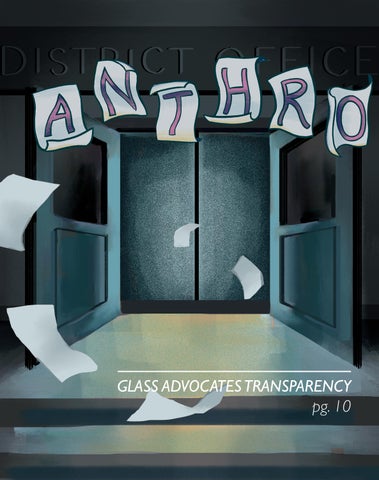
GLASS ADVOCATES TRANSPARENCY pg. 10
ANTHRO
October 2026 Volume 9 Issue 1
Mission Statement Anthro Magazine, Palo Alto High School’s social activism publication, aims to create a platform for student voices and opinions on current issues relevant to the Paly community. Activism highlights overlooked issues at the intersection of social, political, and economic interests to raise awareness and drive change. On this platform, we will promote diversity and respect by seeking a wide range of ideas from different backgrounds in our reporting. As a publication, we aim to be inclusive and will not tolerate hate speech or the targeting of individuals or groups. We hope to highlight the impact of local and global activism on the Paly community.
From the Editors Dear Readers, We are excited to present the first edition of Anthro magazine this school year! In this edition, we continue to report on political activism and highlight local activists in our community. First, in “Who’s afraid of Uncle Sam?” (page 7), Priya Tamura examines The Stanford Daily’s victory in its First Amendment showdown with the federal government. In our editorial, “What the flock?” (page 12), the Anthro Staff focuses on Palo Alto’s use of Automated License Plate Reader cameras. We argue that Palo Alto should continue using ALPR cameras while cutting ties with Flock. In “Glass advocates transparency” (page 20), Naomi Espinoza and Jeshurun Wang share an activism-focused interview with new Palo Alto Unified School District Superintendent Jason Glass. It has come to our attention the recent debate around if University of California colleges should bring back standardized tests for admissions. In light of recent UC developments, Abigail Nuemann and Jeshurun Wang gather multiple perspectives in “Breaking the precedent” (page 17), starting from a UC professor and local students on whether these tests will impact future admissions. Finally, Benji Sandel and Odin Strohecker introduce the eight Palo Alto City Council candidates in “Eight vie for three seats” (page 25). The story gives readers a look at the candidates and their perspectives on certain issues affecting Palo Alto, including housing, transportation and community development. We are thankful to our staff for their work and dedication to the production of this issue, and to our readers for your continued support. We hope you enjoy our second edition as editors-in-chief: Anthro Volume 9.1!
Staff Editors-in-Chief Naomi Espinoza Jeshurun Wang Chapin Walker Managing Editors Joyce (Leyi) Ma Benji Sandel Business Manager Richard Klinkner Staff Writers Mayu Altekar-Okazaki Naomi Espinoza Caitlin Ko Alexander Lawson Joyce (Leyi) Ma Mack Reller Odin Strohecker Priya Tamura Juni Thurston Abigail Neumann Julianne Yoon Jeshurun Wang Photographers Naomi Espinoza Araina Gupta Priya Tamura Roshan Gautham Artists Caitlin Ko Joyce (Leyi) Ma Adviser Paul Kandell
– Naomi Espinoza, Jeshurun Wang and Chapin Walker, editors-in-chief
anthromagazine.org
3
IN THIS ISSUE 5
News section
7
Who’s afraid of Uncle Sam?
11
School Chromebooks: Equitable or encumbering?
12
A path to English fluency
14
Teens for bikes
17
Breaking the precedent
20
Glass advocates transparency
22
School board candidates lay out priorities
Photo by ROSHAN GUATHAM
Photo by ROSHAN GAUTHAM Letters to the Editors The staff welcomes letters to the editors. We reserve the right to edit all submissions for length, grammar, potential libel, invasion of privacy and obscenity. Send all letters to anthro-managing@ googlegroups.com or to 50 Embarcadero Road, Palo Alto, CA 94301. Printing & Distribution Anthro is printed by Folger Graphics in Hayward, California.The Palo Alto Parent Teacher Association mails Anthro to every student’s home. Past issues are available at anthromagazine.org. Publication Policy Anthro, a social activism magazine published by students in Palo Alto High School Incubator class, is a designated limited open forum for student expression and discussion of issue of concern to its readership. Anthro is distributed to its readers and the student body at no cost. For more on our policies, please visit anthromagazine.org.
4
October 2026
24
Eight vie for three seats
27
What the flock?
On the cover:
Photo by ROSHAN GAUTHAM
The cover of Anthro 9.1 features a creative drawing of the district office by Joyce (Leyi) Ma and Caitlin Ko
News Section Palo Alto residents to vote on Measure J
P
alo Alto residents will vote on Measure J, which looks to expand the city’s share of Cubberley Community Center by increasing local sales tax by 0.5%, in the upcoming November election. Following the expansion, a multi-phase development would go into place. The initial two phases consist of a new gym and theater space, while also focusing on visual arts and technology. The final phase would then be various amenities serving as community gathering areas. For those who are in support of Measure J, the increasing sales tax seems like a direct solution to help repair necessary aspects of the community center. The counterargument to the measure is its vagueness. The tax is estimated to raise around $15 million but the specificities of where this money will be spent is unclear. Junior Matias Sanchez supports this idea as fixing Cubberley opens more community opportunities. “I like this idea as Cubberley has a very useful campus that could seriously benefit the community,” Sanchez said.
Text by ROSHAN GAUTHAM Photo by JESHURUN WANG
Police officer T fired for misuse of Flock data
he San Jose Police Department fired an officer for using the department’s license-plate tracking system to search for a woman who had accused his cousin of abuse in April. The officer was fired after a year-long investigation, surrounding allegations that he used his personal phone to access vehicle information and later shared it with his cousin, who had been charged with domestic violence. Neither he nor his cousin was criminal-
ly charged. This instance of Flock camera misuse is part of a growing list of breaches across the country, increasing apprehension about the cameras. Palo Alto High School junior Vila Song raises concerns about this technology. “These cameras were meant to improve safety,” Song said. “When the information is used inappropriately like this, it defeats the purpose of them.”
Text by CAITLIN KO
San Jose bans private detention facilities
O
n Sept. 15, San Jose passed a moratorium, a temporary halt on activity, on applications for private detention facilities, making it the first city in the Bay Area to enact such restrictions. The ban resulted from fears that Immigration and Customs Enforcement might use these facilities to detain immigrants.
Palo Alto High School senior Maura Hambly noted how the move will protect the immigrant community. “Banning these detention facilities keeps the immigrant community safe and prevents them from experiencing as many fears as other communities with detention centers would,” Hambly said.
The ban is set to last 45 days while the city council is looking for ways to prolong the temporary law. The environmental impact, as well as the strain these facilities will put on public services like first responder response time, were also cited as issues for enacting the moratorium. Text by MACK RELLER
anthromagazine.org
5
NEWS
Country music legend and literacy activist Dolly Parton dies
O
n August 25, beloved singer-songwriter Dolly Parton died from cancer at the age of 80 in Nashville, Tennessee. The performer not only won 11 Grammy awards and released 25 No. 1 Billboard country hits, but also was a prominent activist. In 1990, the Dollywood Foundation, Parton’s non-profit organization, founded the Buddy Project. Its goal was to help combat high school dropout rates by pairing students with “buddies” in middle school and donating $500 to participating students at their graduation. Dropout rates for participating classes dropped from 36% to just 6%, according to the website. In 1995, Parton was inspired by her illiterate father and found-
ed the Imagination Library which has donated over 330 million free books to children under five years old. “When I was growing up in the hills of East Tennessee, I knew my dreams would come true,” Parton said on her website. “I know there are children in your community with their own dreams ...The seeds of these dreams are often found in books and the seeds you help plant in your community can grow across the world.” Parton dedicated her life and career to using her fame to support women in need, donating over $1 million to birthing services and founding the Dolly Parton Center for Women’s Services in 2007. Parton continued to help suffering communities, donating $12 million to help families affected by Sevier County wildfires in 2016 and over $2 million to families impacted by Hurricane Helene in 2024. While Parton, herself, is no longer here, her legacy continues to change lives for the better. “The Dollywood Foundation continues to build on Dolly Parton’s enduring belief that small acts of kindness can create lasting change,” her website reads. “Whether inspiring a child’s love of reading, supporting students as they pursue their dreams or helping families rebuild after disaster, The Dollywood Foundation remains committed to creating brighter futures—one child, one family and one community at a time.”
PALY PTSA SUPPORTS PALY JOURNALISM USE THE QR CODE TO JOIN US 6
October 2026
Text by JULIA CURTIS
NEWS
Who’s afraid of Uncle Sam? Inside the Stanford Daily’s First Amendment showdown against Federal intimidation
anthromagazine.org
7
F
rom Walt Disney’s Big Bad Wolf, toms Enforcement detained pro-palestinian for those of us who are citizens, and for the to Edward Albee’s Virginia Woolf, college activists Mahmoud Khalil and Ru- university administration to become more America has long asked who we meysa Öztürk in March 2025, Reich said aware and to try and do more to stand up ought to fear. As the United States admin- The Daily’s coverage of Stanford’s inter- for our peers who are facing really serious istration began weaponizing immigration national students caught the attention of fears of government action,” Porteous said. status against international college jour- FIRE, a higher education legal non-profit. Although the lawsuit’s ruling directly nalists, Stanford University students found “We wrote impacts college journalthemselves facing a chilling pressure from this article outists, SPLC attorney Jonthe federal government instead. Refusing lining the fear “This problem has athan Gaston-Falk said to let the government’s threats continue to we were notic- become so widespread the legal victory can also filter their speech, The Stanford Daily has ing,” Reich said. provide important profought to reclaim their students’ freedom of “She [Öztürk] that it affects our basic tections for high schoolers expression from federal officers’ grip. had just written human right of free against similar governU.S. District Judge Noël Wise ruled in an article in the ment pressures. favor of The Daily on Aug. 28, finding the Tufts student speech, where if anyone “The ruling gives federal government’s threats to noncitizen paper stating lawfully-present noncitsays anything negative student journalists unconstitutional — a political beliefs izen journalists a strong defining precedent for students’ right to ex- of hers, and that about the government ... basis to challenge immipression regardless of citizenship. was apparently gration consequences tied The Daily, represented pro bono by cause enough we become a target of to protected reporting, the Foundation for Individual Rights and for the adminis- systemic oppression.” commentary or associaExpression and supported with an amic- tration to target tion,” Gaston-Falk wrote us brief by the Student Press Law Center, her for deporta— SAM KHAN, Palo Alto High School to Anthro Magazine. brought the lawsuit against the U.S. Secre- tion, which was Wise granted The graduate tary of State Marco Rubio and Secretary very scary and Daily’s request to declare of Homeland Security Markwayne Mullin [an] incredibly the federal policies in vioAugust last year. valid reason for students to fear for their lation of the First and Fifth Amendments, The suit cites the government’s pattern safety. That sparked FIRE … to reach out but fell short of granting an injunction — a of detaining and deporting international and ask us [The Daily] to be a part of a law- formal order to halt future federal enforcestudents who have expressed empathy for suit.” ment against international students’ speech, Palestinian people, or criticized Israel’s acUpon hearing news of the lawsuit’s according to Gaston-Falk. tions regarding the conflict in Gaza. victory, George Porteous, Editor-in-Chief “The judgment declares the challenged Since the current federal administra- of The Daily, said he and his publication provisions unconstitutional when enforced tion took office in January 2025, previous felt grateful, but knew that fear had already against protected speech, but it does not diStanford Daily Edbeen seeded into many rectly command officials to stop through an itor-in-Chief Greta “Do what feels right at international students. injunction,” Gaston-Falk said. “The deciReich said that many “The courts can sion also does not protect unlawful conduct, noncitizen students the time and what you only do so much, be- prevent immigration action on independent requested their quotes cause there is still some lawful grounds or address visa admission can stand by in that be redacted, while lasting cultural dam- decisions involving people outside the U.S.” writers for The Daily period of time. I really age that has been done Putting this case into perspective, Gasresigned and pulled to free speech on cam- ton-Falk said the suit addresses a broader past articles criticizing stand by that lawsuit. pus,” Porteous said. pattern the SPLC is tracking, in which ofthe government. “My reaction [to The ficials use powers outside traditional censorAnd even if we hadn’t “When I took Daily’s win] was one ship rules to pressure student media. over [as EIC], we start- won, I would have of relief, but ultimate“Nationally, that [government presed noticing a lot of ly, I think there’s still a sure] includes immigration enforcement wanted to have done it lot more to be done.” that chills reporting, commentary and international students really fearing contrib- anyway.” In light of the sourcing,” Gaston-Falk said. “At the state uting to or being a part federal administra- and campus levels, threats increasingly inof student journalism tion’s deportation clude funding cuts, publication closures, ad— GRETA REICH, former edion campus,” Reich threats, Porteous said viser retaliation and administrative controls tor-in-chief of The Stanford Daily said. “The goal of a he wants this case to over access or distribution.” student paper … is to encourage citizen stuSenior Jane, who we have given anorepresent all the voices on campus and the dents to defend their noncitizen peers’ rights nymity to considering her immigration stastories that are happening on campus. If a and safety. tus, said she has experienced a type of chillsolid chunk of that campus doesn’t want to “Because this case was very much ing effect at the local level when reporting talk to you or feel comfortable reporting for about the conditions and challenges that on a recent lawsuit brought against the Palo you, we are not able to do our job.” international students face, my hope is that Alto Unified School District. After the U.S. Immigration and Cus- it has brought more attention to that reality “I’ve had multiple sources decline to
8
October 2026
VICTORY IS CARDINAL RED — Inside The Stanford Daily’s house, old publication front covers line the walls. “We were not back together as a newsroom yet, but I got a message from The Daily’s lawyer just saying, ‘VICTORY’ in all caps over email, “ George Porteus, The Stanford Daily Editor-in-Chief said.
interview because they’re afraid that they will get sued by the same people that are suing the [PAUSD] administration for the SJP [Social Justice Pathway] mosque trip,” Jane said. “They’re afraid that they’ll get into trouble and get entangled in legal drama, so that is why they declined to interview. It says a lot about the state of our country right now, where you feel unsafe telling your opinion to a journalist.” Jane said the looming threat of legal conflict pushes community members to self-censor or pick sides, which fragments open dialogue and polarizes the neighborhood. “One thing that they [the federal administration and PAUSD] both have in common is that they have a lot of lawsuits against them,” Jane said. “Whatever the [district] administration does, it causes a deep split within the community that cannot be repaired, and now people are afraid to speak out about the administration or support the administration just because they don’t want to anger other people.” Jane, who is in the U.S. on a green card, said the current administration’s immigration enforcement contradicts the democratic ideals it promotes globally. “If you [the U.S] are trying to push democracy as this founding principle of your country, then you should be able to support
it for everybody, whether they’re a citizen or not,” Jane said. “You’re [the U.S.] trying to influence other countries that are not even within your jurisdiction to practice democracy, and yet you’re deporting them [immigrants] when they are doing so within your own borders.” Paly alumnus San Khan, political science major at Saint Mary’s College of California, said he agrees with the court’s ruling that the government weaponized immigration enforcement to silence dissenting voices. “The way that this administration and ICE have handled people … is nothing less than illegal, but also inhumane, unjust and overall catastrophic,” Khan said. “This problem has become so widespread that it affects our basic human right of free speech, where if anyone says anything negative about the government and ICE, we become a target of systemic oppression.” Senior Tessa Berney, Verde Magazine Editor-in-Chief, said that she was impressed by The Daily’s ambition and commitment to protecting student expression. “I still remember finding out about the lawsuit, and I thought to myself, ‘Wow, they’re taking on a very big initiative, suing the United States government,’ but it [the lawsuit’s result] just shows that the student press is very strong.”
These strengths, Reich said, stem from the unique and influential role student publications play in connecting and reflecting their campus communities. “The power that student journalists have on their campuses is the most out of students on that campus in general and the insight they have into their campuses is a huge tension point in American politics right now,” Reich said. “The impact they can have should not be taken for granted. So, if you are a student journalist and you are frustrated by what you think is a lack of people listening to you — know that people are listening. People care what you have to say.” Reich said that regardless of what the suit’s ruling could have been, standing up for her own and her publication’s belief in free expression was well worth the risk, and that she hopes other students can do the same. “Don’t be afraid to do something that is maybe not going to be looked back at as the most obviously correct decision, but do what feels right at the time and what you can stand by in that period of time,” Reich said. “I really stand by that lawsuit. And even if we hadn’t won, I would have wanted to have done it anyway.”
Text and photos by PRIYA TAMURA
anthromagazine.org
9
26’-27’ Meeting Schedule Wed, Nov 4, 2026 Wed, Jan 20, 2027 Wed, Mar 3, 2027 Thurs, May 6, 2027
10
October 2026
FEATURE
School Chromebooks: Equitable or encumbering? How new personal device policies are influencing classrooms
I
n classrooms across Palo Alto High School, shiny silver Mac“It would definitely help with curbing cheating,” Wang said. Books have dominated desks for years. Recently howev- “If you have a Mac, you’re able to have AI built into your browser, personal device policies implemented by the Palo Alto er, and that can lead to a lot of cheating. On Chromebooks, you Unified School District, such as the requirement to stow away can cheat, but it’s much harder.” phones in pouches and cubbies before class, have changed the According to senior Audrey Mi, however, the slower proway that many Palo Alto High School classrooms operate digi- cessing speed of Chromebooks can sometimes hinder productally. tivity. Although not directly required by the district, some teach“I’ve been a MacBook user since sophomore year, and I ers have recently begun requiring students to use their school-is- think it allows me to access more documents at once without my sued Chromebooks when tech is needed in the classroom. This device crashing,” Mi said. means that MacBooks and other personal laptops — although According to Mi, Chromebooks can also make it harder to permitted by the district — are not alaccess some websites due to district-imlowed in some classrooms. restrictions. “I think having a fair play- plemented Palo Alto High School AP English “Chromebooks also have lots of regteacher Alanna Williamson is one of the ing ground for everyone is ulations on them, which has pros and teachers who began requiring the use of cons, but mostly cons since a lot of resuper important.” Chromebooks following the phone ban. sources end up being blocked, and you According to Williamson, she was have an extra thing to maneuver to try to — PAUL WANG, senior reach the resource you’re trying to look prompted to implement this requirement in her classroom not only because of the for,” Mi said. phone ban, but also because of the rise of other technologies, Wang likes that Chromebooks help create equal opportunisuch as artificial intelligence. ties for students, especially in rigorous classes. “When the school implemented the policy [phone ban], we “I like the fact that for some of the classes, which are more also started getting more AI technology and things, so I was wor- competitive,” Wang said. “I think having a fair playing ground ried that students would just be texting on their computers and for everyone is super important.” doing that anyway,” Williamson said. “[I thought] why are we taking your phone if we’re not taking your MacBook?” Text by ALEXANDER LAWSON According to Williamson, a lack of necessity for chromebooks could decrease motivation for Paly to improve the Art by KAELA CHEN Chromebooks, potentially making class time that requires tech harder for those without their own devices. “It also because we’re not all doing it; it makes the school potentially less motivated to keep the Chromebooks super up to date and working super fast, so that’s a con for sure,” Wiliamson said. Williamson says that equity could play a role in making a Chromebook requirement worthwhile, but widespread implementation is required for such a benefit to take form. “That [equity] would be an awesome side effect of asking all students to only use their school Chromebooks, but because everybody doesn’t have that same policy, it’s pretty tough [to achieve],” Williamson said. Senior Paul Wang agrees that a Chromebook requirement can be beneficial, citing the prevention of academic dishonesty as a leading benefit of Chromebook requirements.
anthromagazine.org
11
FEATURE
A path to English fluency
that do the fast food work [and] that to promote it [services] to our families and English Together and Valley, take care of houses,” Constantakis said. to try to get some volunteers for English Togoal is to connect those workers [with gether on the language learner side. They’re Pathwise look for “The the broader English-speaking community].” going to let us expand into Palo Alto and Together and Pathwise, a non- give this service to our [Pathwise] families, student mentors to profitEnglish enrichment program, are currently which is really valuable.” to promote equity through lanThis partnership will also introduce serve the Spanish- partnering guage. A lack of fluency can often create new opportunities for students. unnecessary stress when dealing with everyEnglish Together has historically respeaking community day tasks, and breaking down that commu- cruited adult volunteers, but they have
I
n a community where so many struggle with English fluency, there is a need for accessible language-learning resources. English Together, a nonprofit organization built on helping low-wage workers, aims to solve this issue. Based in Palo Alto, English Together is a nonprofit organization founded in 2021 that focuses on serving the community of Spanish-speaking residents through one-toone online meetings where they can work on practical English skills. According to Diego Constantakis, expansion and capacity manager at English Together, scripted online practice gives learners the tools to handle verbal communication instead of full fluency, which is not as feasible in a short amount of time. “[Our program] helps those workers learn the English that they need to be able to get ahead in the workplace,” Constantakis said. “But also to help them navigate their daily lives, like being able to talk to their kids’ teachers or communicate properly with a doctor.” Constantakis said the program hopes to aid the invisible workforce of Silicon Valley. “There are people all around us that take care of the kids of people in Silicon
12
October 2026
”
nication barrier can greatly decrease lan- occasionally enlisted the help of student guage-related struggle. volunteers from San Pathwise executive director Nicole Mateo Union High Chiu said that coSchool District. ordination between Chiu-Wang said nonprofits is an effecthey are now look“They can help these tive method of serving to work with vulnerable learners ing the community high school stu“When you do dents from Palo understand that the work that is focused Alto in order to community cares on leveling the playserve more English ing field, in particlearners. “They about them and wants ular, [many] non[English Togethprofits serve similar, er] are open to the them to succeed.” overlapping commufact that our high nities,” Chiu-Wang school students — DIEGO CONSTANTAKIS, said. “At the same are quite mature English Together capacity and time it’s a small netand could be realexpansion manager work because we’re ly great partners,” oftentimes focused on Chiu-Wang said. overlapping communities.” According to Constantakis, the vulnerChiu-Wang said she is specifically work- ability the English learners show means that ing on increasing awareness on resources of student volunteers are responsible for creatall kinds within the broader community. ing a safe learning environment. “How do we collaborate and work to“[Students] come to understand a very gether with these other nonprofits to make different walk of life from what they’re used sure that everyone that is overlapping knows to,” Constantakis said. “But at the same all the services that are available?” Chiu- time, understand that, despite coming from Wang said. “We [non-profits] partner to- different walks of life, people are more simgether where it’s relatively low effort for us ilar than they’re different, and many folks
Text and art by CAITLIN KO and JOYCE (LEYI) MA
will have the same struggles, the same joy. Getting to share in that, I think, is an invaluable experience that will help shape you.” Rishabh Purwar is a senior in Burlingame High School who has volunteered with English together for three eight week cycles. Purwar said he encourages high school students with any Spanish ability to participate. “English Together is really impactful for the people who choose to be the tutors and the practice partners as well as the stu-
dents [English learner],” Purwar said. “I got better at just talking to people in Spanish. It helped me develop my skills, and I’m just a lot more confident teaching. ” While volunteers will be working under English Together, Pathwise will be the one reaching out to the community and gauging interest. “I got permission to expand the English language practice partner side to include high school students, and we’ll be
reaching out to all the local high schools that we currently get volunteers from,” Chiu-Wang said. According to Constantakis, there will be an application and training process for students interested in working with English Together, which is slightly different than the process for adult volunteers. Unlike adults, students must submit a recommendation letter. Once a student volunteer is accepted, they will go through 90 minutes of training. They will then be paired with an English learner based on their own level of Spanish proficiency in weekly, hour-long virtual practice sessions for 8 weeks. “Volunteers who speak Spanish can work with absolute beginners, and volunteers who do not speak Spanish have to work with somebody who’s beyond beginner level,” Constantakis said. “But there are plenty of advanced learners who just want to be able to speak to somebody in English because they don’t necessarily have very many opportunities to do so in their daily life.” Purwar said his time volunteering at English Together has been smooth and simple. “It’s not that much of a commitment from our end, but the work we’re doing is really impactful and can really change someone’s life,” Purwar said. “It’s definitely worth it.” Although typical tutoring programs can also create change, Constantakis believes that English Together offers a particularly unique opportunity through the personal connections volunteers can form. “They can expect an opportunity to make a real difference in someone’s life,”
anthromagazine.org
13
FEATURE
Teens for bikes W
Art by JULIANNE YOON
carbon-neutral electricity, so greenStudent-run environ- 100% house gas emissions from gas vehicles make largest portion currently.” mental organization up theAccording to Miao, the focus on teenagers, combined with infrastructure changfocuses on advocat- es, may allow the coalition to have a more immediate impact. ing for “It’s easier to encourage students to bike and take public transport than to consustainable teen vince a family to switch to an electric car,” Miao said. “We’re researching areas in Palo Alto lacking bikeable streets and/or bike transportation
parking and looking into PA’s discontinued alking down the streets of shuttle system as something to encourage Downtown Palo Alto, you will the city to bring back.” According to Mu, volunteering with likely notice the wide streets packed with cars, more cars, and sporadi- PASCC has provided her with valuable opcally placed bike racks. This issue is top of portunities to build skills and she encourages mind for members of the Palo Alto Student curious students to participate. “It’s a really great way … [to] learn Climate Coalition (PASCC), a student-run about local policy and local civic engageclimate advocacy group. aing for more sustainable teen trans- ment,” Mu said. “[If] you just want to have an impact, PASCC is a portation in the really great way to do c o m m u n i t y “[Being director] was that on a hyper-local through the imlevel.” plementation a really great opportuMiao said seeing of supportive nity for me to not only the outcome of PASinfrastructure. CC’s advocacy in Palo P A S C C deepen my involvedrives his contriDirector Jenna ment in local sustain- Alto butions. Mu, a senior at The “Because sustainKehillah School, ability, but also to ability manifests in said the group many physical, tangible is zooming in develop soft skills.” ways, it’s encouraging on teen tran— JENNA MU, PASCC director when we succeed,” sit to center its Miao said. “[One of] advocacy efforts PASCC’s biggest recent around creating more opportunities for bike parking and impacts has been preventing the PA airport expansion into the Baylands. … I was encouraging active transportation. “We thought having this rallying biking past the airport last weekend and it theme would be more conducive towards was rewarding to see the joy from families both unifying the coalition and [mak- at the Baylands, and to know we had a role ing a] better impact,” Mu said. “We’re in that.” [focusing] on increasing the amount of biking in the area, specifically SPEAKING UP — Palo Alto Student Climate Cothrough trying to install protected alition director Jenna Mu, a senior at The Kehillah School, presents on local climate warming at the 2025 bike lanes around … downtown Extreme Heat Summit. Mu said her work with PASCC shopping areas.” has taught her how to engage in political discourse Palo Alto High School senior more thoughtfully. “Because of PASCC, … I’ve learned Aiden Miao, a PASCC advocacy how to advocate for myself and the issues that I care committee member, explained the val- about,” Mu said. “It [being PASCC director] was a reue of this specific theme in a statement ally great opportunity for me to not only deepen my involvement in local sustainability, but also to develop emailed to Anthro Magazine. soft skills.” (Photo by Phoebe Mota-Judges) “Palo Alto’s biggest barrier to becoming a net-zero city is transportaText by JULIANNE YOON and tion,” Miao said. “We already run on NAOMI ESPINOZA
14
October 2026
16
October 2026
FEATURE Text by ABIGAIL NEUMANN and JESHURUN WANG
g n i k a the e Br Precedent
University of California continues heated debate over standardized test requirements for applicants
F
ive years ago, the COVID-19 pandemic transformed the lives of high school students. Academics had to immediately adapt, including classes, tests, and college applications. However, that change made during the pandemic continues to impact high school students today as the UCs currently grapple with the decision on whether or not to reinstate the test requirements. While other elite colleges like Ivy League schools have mostly shifted back this year to requiring scores upon application, the UCs are still in a bind. According to CalMatters, the UC Academic Senate, the system's official faculty government, is expected to formally review bringing back test requirements until June 2027. Gabriel Rossman, professor of Sociology at the University of California, said there were no good reasons for getting rid of the test requirement other than the pandemic. “There was never a good intellectual reason for getting rid of it,” Rossman said. “It was only the practical reason for making it optional during COVID.” Rossman said the main reason for
bringing back SAT/ACT requirements is also said the rise of students using Artificial vital to the prestige that often comes with Intelligence has also contributed to the push UCs. to bring back standardized test scores. “If you get a good SAT [score] and “AI makes it so that any kind of term good grades, you're going to apply to Stan- paper or take-home or whatever or homeford,” Rossman said. “You're not going to work for that matter is less of a credible bother applying to signal than it used Cal.” to be.” Rossman said “The equity issue… it’s This worry advocacy for the a disadvantage for those isn’t completely unreturn of standardfounded; a report by ized tests is rising that don’t have the finanthe College Board among UC staff that “the cial means to manage that stated because high school percentage of high grades and course- [SAT prep].” school students who work are proving report using GenAI to be less reliable — DESHA STALEY-RAATIOR, Cabrillo tools for schoolwork to gauge academic College director of career development is growing, increasperformance than ing from 79% to before. 84% between Janu“I will say that those of us who want ary and May 2025.” to bring that safety back, we worry about Recent reports show that AI usage grade inflation,” Rossman said. “High among students has already provided signifschool GPAs are less valid signals than they icant challenges for university professors; it used to be because there's so much grade in- upended a 133-year proctored free-testing flation at the high school level.” tradition at Princeton University in May of On top of grade inflation, Rossman this year.
anthromagazine.org
17
According to an article published by state’s average in education are less likely The Daily Princetonian, “All in-person ex- to get into UC schools compared to those aminations at Princeton will be proctored who score higher on standardized tests, arstarting July 1, representing the most signifi- guing that this is the reason why UCs need cant change to the honor system since it was to bring back test requirements to secure the established in 1893.” best students possible for admissions. An independent study by Hart HorWhile some may disagree, Rossman nor-Jones, a gradsaid that there is no uate student in Sodisadvan“We need this information inherent ciology from the tage to requiring University of Cali- when we’re letting people SATs for students fornia, San Diego, different dein because it’s better for ev- from found that after a mographic backtest blind application erybody.” grounds. policy was instituted “[Standardat the University of ized] tests give you — JAMES BACKLUND, private the same predicCalifornia, Berkecollege admissions counselor tions [in college] ley from 2023-2025, high school students regardless of your who met CAASPP ethnicity or your requirements were less likely to get accepted income or whether your parents went to compared to high school students who did college or even when you got A’s or B’s from not meet the same requirements. high school,” Rossman said. Rossman said the same was true with Paly senior Weston Bailey said that Palo Alto High School. students with lower testing scores are more “[In] schools like Palo Alto [High likely to apply for UCs not purely based on School], where almost everybody is rated as their performance but also because of savat grade level or higher by the Smarter Bal- ing costs in college. anced [CAASPP] test, it’s actually harder “For residents in California, I think if to get in [to test-blind colleges] from those you [California residents] were to have a schools than it used to be” lower SAT score, you p ro b The data from the research supported ably are more likethis opinion, as throughout the two years ly to actually go test-blind has been applied, the admission t o rate for Paly students to UC Berkeley was 0.153 (admittees ÷ applicants), while 76.8% of test takers from Paly between 2023-2025 met the CAASPP average. This study supports Rossman’s claims that California students who meet the
a UC because they are cheaper than the Ivy League, and they’re still relatively good schools, and a lot of them are not the most difficult to get into.” Junior Carys Olsen believes that bringing back the standardized test requirements will result in many students being deterred from applying to the UCs. “Some students might not feel as confident about applying to [UC schools] if they know that their score is going to make college admissions officers hesitate to admit them,” Olsen said. According to junior Nico Resmini, SAT and ACT requirements should not be brought back because access to tests is not available for everyone. “It’s expensive to take the SAT, so that counts out a lot of people who can’t afford it, which makes it unequal for different minorities who aren’t able to access it,” Resmini said. Olsen said that she believes that while the tests provide valuable information for the UCs, they can actually harm disadvantaged students. “On the one hand, it [standardized testing requirements] provides a really good baseline for a lot of colleges to understand … at least something about the students,” Olsen said. “However, I feel like it’s also unfair in a way because there are students who have
Art by JOYCE (LEYI) MA
18
October 2026
SAT tutors and can pay for a lot of different resources, versus students who can’t afford that, and they all have to take the same test.” Desha Staley-Raatior, director of career development at Cabrillo College, said that those disparities are significant, which is one of the main reasons she does not support bringing back standardized testing requirements. “The equity issue… it’s a disadvantage for those that don’t have the financial means to manage that [SAT prep],” Staley-Raatior said. Additionally, Staley-Raatior said that she does not believe that standardized tests actually measure a student’s aptitude and therefore should not be a major consideration in admissions. “There are so many other factors involved in being successful in college, and that [standardized test scores] does not need to be the leading one,” Staley-Raatior said. “College is a holistic experience, so you’re looking at the whole person, not just their academic ability… there’s so much value in people’s perspective and life experience.” According to private college admissions counselor James Backlund, who echoes Rossman’s belief that standardized test requirements should be brought back, applications do involve many different aspects. Backlund said that while SATs and ACTs are an important part of the applications, the UCs consider many factors in admissions. “[The UC schools] should really emphasize that these tests are just a component of your application; they are not at all the most important thing,” Backlund said. “What’s more important is everything else you’ve been doing over the long term.” Like Staley-Raatior, many people believe that the standardized test requirements will put students from lower-income families at a disadvantage, because they do not have easy access to additional support, such as tutoring or expensive prep courses. However, Backlund argues that the UC schools recognize students’ individual circumstances and take those factors into account when assessing them for admission. “The schools know there are huge differences in people’s circumstances [and] contexts in which they encounter the test, and they really do try to tell this apart with students,” Backlund said. While there may be disparities between students from different backgrounds, Backlund points out that those disparities exist in
other aspects of their academic experiences as well. He argues that the SAT can provide students with an opportunity to show their skills on a more equal playing field than some other parts of the application process. “I don’t think there’s anything unique about disadvantaged students being disadvantaged on the test, and there’s been a lot of arguments that it provides a lot of equity of access because people can just pop in and maybe really show their stuff on that test or at least show some promise,” Backlund said. Additionally, Backlund says that the College Board has been continuously working to make the SAT more neutral for students taking it. “I know there’s been a lot of accusations and studies that have shown the SAT in previous years to be biased, and they’ve been making their tests less and less biased over time and trying to make it more clearly neutral,” Backlund said. According to Backlund, SAT and ACT score submissions have been continuously increasing following the pandemic. “Last year officially marked the first time where more students sub-
mitted SAT or ACT scores with their college applications than did not,” Backlund said. Backlund believes that the UC schools ultimately need to bring back the standardized test requirements, along with more clarity for students about how different aspects of their applications are evaluated. “Bring them [standardized tests]
back, bring clarity, and give us a better sense of the holistic application; the relative standing of the elements of the holistic application, like the transcript, is really the most important one,” Backlund said. Backlund emphasized that bringing back requirements of standardized tests not only benefits the UC schools, but also the students hoping to attend them. “We need this information when we’re letting people in because it’s better for everybody,” Backlund said. “Not to keep people out, but when we accept people, and they’re coming in, we want to work with them to help them succeed in their major and beyond.”
Art by CAITLIN KO
anthromagazine.org
19
FEATURE
Glass advocates transparency
Exclusive interview: New superintendent Jason Glass says community voices must shape PAUSD’s future
LISTENING IN — Superintendent Jason Glass listens during a Palo Alto Unified School District Board of Education meeting on Aug. 18. In an interview with Anthro Magazine, Glass said he intends to focus on learning from the Palo Alto community as he develops a plan. “I have learned through hard knocks and experience that the right thing to do is really try to sense what the priorities and the values [are] in the place that you’re coming into, and then work with the community to design a strategic plan and budget efforts around that,” Glass said. “That [approach] makes it [the plan] durable.” (Photo by Naomi Espinoza)
20
October 2026
F
rom Kentucky, Jason Glass left his position as Kentucky Education Commissioner in response to anti-LGBTQ laws passed in the state in 2023. Anthro Magazine sat down with the new superintendent for an advocacy-focused conversation on Tuesday. Anthro: Anthro highlights activists in the community and raises a platform for the different forces of advocacy that are happening around us. What do you advocate for in your work? Glass: As a public education leader, you have to be an advocate for public education from a number of standpoints. One is around funding and support from the legislature. … You need to work to develop relationships and influence legislators as part of that process to ensure that public education continues to receive support. … Part of this entry work is developing those connections and relationships. It’s also standing up for public education more broadly outside the legislative process, working to educate the community on the complexity of public education. … We try to balance that [complexity] and find a stable path for the community [and] the district to navigate. [Also,] standing up for public education when it’s under attack from political forces that may be here in the community or in the state or nationally. You mentioned the complexity of public education and the issues that may arise. I’m curious what you anticipate as being focus points in that regard. People have different views on what the purpose of public education is. Some people believe that its purpose is to educate people for jobs so that they can be employed when they leave school. Others believe that its primary purpose is academics or knowledge. … Others may say that it’s to get kids into elite colleges. Still others may [have] this Jeffersonian approach [that] the purpose of public education is so that you have educated citizens who can participate in a democratic republic, or that its purpose is to have people from very different backgrounds and upbringings come together and learn how to work together in a multicultural society. I have a hard time arguing with any of those. … They’re all really important, but sometimes they’re in opposition to one another and so in each community you have to work to figure out what’s the right balance of those things.
Coming into Palo Alto, what do you see as our community’s tension that you’re looking to explore further? There are some hard things this community’s been through over the past couple of years. Some of those are related to the suicide clusters that the schools have experienced, grieving that [and] thinking about what we can do not just as a school system, but with students, [and] with the larger community, to be protective around our students. … Another [priority] is this tension of balancing … the pressure that comes from being a high-expectation, high-performing school district, with creating rich, meaningful, fun learning experiences for students. … It’s also … a school district that has gone through a lot of change over the past year. We’ve had a lot of central administrative staff who have left. I’m brand new. … Things need to feel normal for a while. We’ve been working on that: Trying to take some of the drama out of the organization, steady us up and have the school district be a firmer foundation … from which we can take a leap of faith, or try something new. You resigned as Kentucky’s education commissioner in 2023 in response to restrictions on transgender students and some policies that were happening there. I would be interested to hear about your choice. It was really a broader piece of legislation around LGBTQ young people and people. Transgender restrictions were part of it, but it was, I think, one of the most shameful pieces of legislation in the nation’s history around LGBTQ people and youth. It conflicted with my values as an education professional and as a human being. As the commissioner of education in the state, your charge is to carry out and execute the laws that the legislature passes, so that was not something that I felt I could do in good conscience. So that’s why I resigned from that position. It was a painful choice. Kentucky is my home state. I love that work, love that job. My family is from there. I grew up in the state, so it was a tremendous honor to get to do that job. But that was not something that I could do. As you mentioned, there has been a suicide cluster in the last few years, which has had an impact on the community. In its wake, there seems to be a greater focus on mental health in community discussion and I’m curious what that translates to on the administrative side. When it comes to student mental health and well-being, the district has invested heavily. … There’s a lot of support and energy put into this [student mental health and well-being support] and that’s only been amplified since this last cluster. … Just tonight, we have a joint meeting with the city happening here [at the district office] in a couple of hours, where the Jed Foundation will … speak publicly about their report on the state of Palo Alto. … An outside foundation coming in and doing an analysis means they’re here for a few days, they talk to people, they look at documents, they write a report and they leave. The work then becomes ours. So that’s really the more important and more interesting thing: What do we do as a community, as a city, as a school district with students? I have also heard from students that they don’t always feel like their perspectives are taken into account when decisions are made and
that what they need isn’t heard. To me, that’s something that we’ve got to work on over the next several years. … [This means] intentional efforts to raise up student voice and student decision-making and then real changes happening in response to what the students told us. I don’t expect anybody to believe me when I say that we’re going to do that. We just have to do it. What is your philosophy when handling concerns raised by the community? Parents standing up for their kids, demanding quality services for their kids … is not new here in Palo Alto. It is the norm. Most parents really know how to advocate. They’ve got the means, the background and the tenacity to stand up and demand quality for their children. That’s one of the reasons that this school district is as good as it is. … Parents demanded quality and the system responded to that pressure with quality. … Anytime we get these sorts of complaints, concerns, they are opportunities for us to check ourselves and get better. … Sometimes we haven’t done what we needed to do for a kid or a family and we’ve got to step back and get better — not just for that single instance, but … [also regarding] the series of events and the practices and the policy decisions that led to that failure. … There’s a lot going right here that we should also celebrate, along with acknowledging we’ve got some areas to get better. Is there anything you would like to emphasize to our readership? I’m really working on hearing from people. I have learned over the years not to come into this role with a prefabricated plan and sort of drop it on the place. I’ve done that in the past; it does not work well and I have learned through hard knocks and experience that the right thing to do is to really try to sense what are the priorities and the values in the in the place that you’re coming into and then work with the community to design a strategic plan and budget efforts around that. That makes it [the plan] durable. … The aspirations people in Palo Alto have, or the aspirations that the students have … should be defining our future direction. Thank you for all of your thoughtful answers. That’s everything I have for you.
Want to hear this conversation as it happened? Scan and listen to Glass’s responses and view the full transcript on our website, anthromagazine.org. Reporting by NAOMI ESPINOZA and JESHURUN WANG
anthromagazine.org
21
School board candidates lay out priorities Candidates outline their academic, technological priorities and student mental health vision for the district
W
ith two open Palo Alto Unified School District school board seats and election day approaching on Nov. 3, candidates John Craig, Linda Henigin and Avery Wang outlined priorities during a panel discussion on Sept. 8 at Palo Alto High School. Student journalists from The Campanile and Verde led and monitored the discussion. Responses to the questions have been separated to provide unified profiles of each candidate, which are ordered alphabetically below.
tion: how do you keep things up to date?” Craig said. “The knowledge that you guys [students] need is changing continuously. There’s AI, there’s new technologies, there’s new cultural practices [and] there’s new norms. All those things should be incorporated as effectively as possible into what we teach and how we teach.” According to Craig’s campaign website, student mental health is a growing and urgent priority. “Academic pressure, social stress and a dynamic always-on environment are directly impacting our students’ and the comJohn Craig is a PAUSD parent, and munity’s well-being,” the website states. “I was most recently vice president of com- will ensure our schools share information munications for Frank S. Greene Jr. Middle and work collaboratively with the city and School’s Parent Teacher Association, before the broader community … [so] we can ofresigning to run for the board. He has a fer our students, their families, teachers and background in electrical engineering and is staff the best possible services.” Craig said he campaigning with would call for an fellow board candiaudit and fiscal redate Avery Wang. view to examine “I’ve been … “It’s something that is PAUSD’s expenson the boards [of] core to the mission of es. His goal is to either executive or reduce spending on the board of any good educational while keeping the several different institution: how do you same level of edunonprofits, for-profexcellence it enterprises with keep things up to date?” cational for students. a multinational “I’ve gone reach,” Craig said. — JOHN CRAIG through several “[I am] used to kinds of fairly exdealing and mantreme restructuraging across many different cultures, and also dealing with fis- ings that have been because of that [budget deficits], sometimes it’s not as bad as you cally very challenging situations.” Craig, who spoke in favor of Multivari- think when you actually dig into the numable Calculus during the March 17 school bers,” Craig said. “You also want to do that board meeting, said a top priority is ensur- in a way that highlights the importance of all the things you’re spending money on, ing PAUSD remains competitive. “It’s something that is core to the and builds trust within the community. … mission of any good educational institu- I think Palo Alto is willing to invest in edu-
22
October 2026
cation. We just have to give them a reason to do so.”
Linda Henigin is a PAUSD parent and math support teacher at Duveneck Elementary School. According to Palo Alto Online, Henigin was also a Track Watch Volunteer who monitored rail crossings last year for student safety, and is involved with the community through working with Jane Lathrop Middle School programs. “The more I got involved [in the school community], the more I wanted to do for our young people,” Henigin said. “I’m running for the school board, so I can keep working to make students’ and staff’s lives better. I want to deliver an excellent education to all students, strengthen their sense of belonging, and rebuild trust in our community.” According to Henigin, any decision that the board makes to improve student learning needs to be informed by teachers who are delivering the instruction. “We [school board members] need to be constantly talking with our teachers about whether we are meeting their needs for professional development, for supplies [and] for whatever it is that they need to deliver for the students,” Henigin said. Henigin said students need to know how to use AI because of its prevalence. “They [students] need to be able to know what it [AI] does well and what it’s bad at doing, … and we want you [students] to not be using it as a crutch to substitute for your own thinking,” Henigin said. “Sometimes the work you have to do is hard, and you need to engage in that hard struggle in order to generate new ideas and really learn deeply. ” According to Henigin’s campaign website, she will strengthen mental health re-
FEATURE
SCRIBBLING AWAY — Palo Alto Unified School District school board candidates John Craig, Linda Henigin and Avery Wang attend a panel discussion on Sept. 8 at Palo Alto High School. PAUSD is currently facing a $33 million budget reduction by the 2027-28 school year. (Photo by Joshua Joo)
sources for students and staff through part- and ensuring support, safety and respect for drawbacks. nerships with community organizations. educators and staff. “Some of the big downsides [of AI] “All students and staff deserve to feel “Evidence-based policy … means mea- I’ve seen include cheating — that’s a huge safe, supported, and valued in our district,” suring things honestly, analyzing data, and topic — and thinking can be impaired by the website states. “I will advocate for a following best practices for pedagogy and the overuse of AI,” Wang said. “AI can be culture of connectmental health,” a force multiplier, or it could be something edness and care for Wang said. “I stand that suppresses your mental activity.” “We need to be conboth students and for empathy [and] Wang said that due to the addictive nastaff, which includes respect, and will ture of screens, the district needs to develop stantly talking with our physical and emonot tolerate bullying a blanket policy guided by the greater good tional safety on camfrom any stakehold- to mitigate risk. teachers about whether pus, zero tolerance er, including from “Screens: there’s a lot of research that we are meeting their for bullying … I’ll students, teachers, has shown that screens can result in stimensure students are staff, parents and ulating neural pleasure pathways similar needs.” included as advisors other community to crack cocaine, so many students don’t and stakeholders in members.” have the ability to regulate themselves,” — LINDA HENIGIN these efforts.” Wang advo- Wang said “A blanket question about all this Henigin, who cates adjusting class technology is ‘What kind of a blanket polrestructured parent planning through icy should we have?’ and this is a complex fundraising for the JLS Connections pro- community feedback, such as polls or guid- question.” gram to better support teachers, said that ance counselor interviews with students to Wang said to reduce the budget deficit, although the budget deficit is still a projec- ensure that student opinions are reflected in he would start with an independent audit tion, the district needs to consider options to course offerings. to examine wasteraise revenue while also reducing spending. “It seems like ful spending, care“I would trust staff to “The way we have had our parcel tax there may be a difully consider how structured is not the only way to actually vergence between to budget to benunderstand ... what is run a parcel tax,” Henigin said. “We can what the students efit students and best for the students, be more creative in looking at instituting a may want and what teachers, and push permanent parcel tax that doesn’t have a is offered,” Wang for a parcel tax in and also be interested in sunset, with taxes that ratchet up with infla- said. “I would trust the next mid-cycle tion, so we can have a more steady stream staff to understand, election. student voices.” of funding that doesn’t have a sunset every along with the “One of four, five, or six years.” guidance counselmy examples [of — AVERY WANG ors, what is best for wasteful spending] is the half million Avery Wang is a parent of three the students, and dollars that was PAUSD alumni and a Stanford graduate also be interested in spent on the middle school math skip test, with a PhD in electrical engineering, and has student voices.” Wang has also spoken in support of which was completely unnecessary,” Wang pushed for incorporating more advanced courses at PAUSD. He is the co-founder of advanced math classes like MVC in school said. “The challenge is we have a $47 milboard meetings. lion deficit next year.” Shazam, a popular song identification app. According to Wang, generative AI and According to Wang, his campaign has Text by MAYU ALTEKAR-OKAZAKI four main pillars: academic excellence, ev- other new technologies present amazing opand JOYCE (LEYI) MA idence-based policy, financial responsibility portunities, but there are a myriad of severe
anthromagazine.org
23
Text by BENJI SANDEL and ODIN STROHECKER
FEATURE
Eight vie for three seats Residents of Palo Alto to vote for new City Council members
O
n Nov. 4, three of the eight seats of the Palo Alto City Council will be up for reelection. There are eight candidates running,
Yudy Deng is a Chinese immigrant and Palo Alto small business owner. In the past, she has been a member of the Greene Middle School PTA, a board member of the Palo Alto Police Foundation, and a commissioner on the Parks and Recreation Commission. According to Deng, she can uniquely represent parents of the community because she is the only candidate with kids currently in the school district and an immigrant. Deng said this is important because she can better represent the Palo Alto population on the council. “A city’s council [should] reflect its population,” Deng said. “Palo Alto is almost
24
October 2026
two of which are incumbents. You can vote as long as you are eighteen, a citizen of the United States, and a redisent of Palo Alto you are eligible to vote.
Anthro Magazine interviewed the candidates hoping to give our readers a clear sense of what each candidate stands for.
Bryna Chang is the chairperson of Palo Alto’s Planning and Transportation Commission, where she reviews zoning laws and development proposals. Before this, she managed Stanford’s MBA program and lectured at Stanford’s Graduate School of Business. Chang grew up in Palo Alto and later raised her children in the city. Chang wants the city and Palo Alto Unified School District to coordinate more closely as new housing is approved. She said four current school-board members were unaware of some important changes that could bring more students into the district. “If the school district isn’t prepped for
hiring in order to accommodate population growth or changes in district lines… that would have a pretty big impact on families and students,” Chang said. Chang also suggested parent support groups focused on teen mental health. She said cultural and educational differences can make student stress difficult for some families to deal with. “Having parent support groups would be very helpful,” Chang said. “It would help parents educate each other that what your child is going through is not something to be hidden. It’s not something unique, but, like, everybody is going through the same thing.”
40% immigrants, yet we don’t see that representation on our council.” According to Deng’s website, she is campaigning on “Smart growth.” “We grow where density already exists. That means we grow near transit centers … We have so many vacant storefronts [downtown] … [and] we can turn those into affordable housing.” Deng said that moving slowly is costing Palo Alto money and she will change that. “I have a master’s degree in economics, and I’m a small business owner, so I understand time is money,” Deng said. “If I’m elected … I want to make things happen and get things done.”
Henry Etzkowitz is an academic, sociologist and entrepreneur whose research focuses on relations between universities, industries and governments. He first came to Palo Alto to study a solar-energy startup and later conducted research at Stanford. Utilizing the experience gained from his involvement in the development of New York City’s SoHo neighborhood, Etzkowitz wants Palo Alto to convert unused industrial buildings along San Antonio Road into spaces where artists can live and work. “The models are there from New York,” Etzkowitz said. “It’s [conversion of
industrial buildings] now moved all the way up the Hudson.” Etzkowitz also said that he proposes that Palo Alto annexes Stanford’s unincorporated land. He said that annexation would give the city more influence over Stanford property while allowing more students and faculty to vote in local elections. “Palo Alto is the town; Stanford is unincorporated land,” Etzkowitz said. “The town annexes the unincorporated land … And the students and faculty will have a vote… because you guys [students] are affected by these elections, too.”
Gary Gechlick, an emergency physician in San Jose, has lived in Palo Alto since 2000. He came to the city to study law at Stanford University after completing medical school. “After you live in a place for a while, you want to bring your experiences of what you enjoy to your local community,” Gechlick said. When Gechlick first came to Palo Alto, he recalled a certain charm. “I remember the charming feeling of Palo Alto at the time. I think the charm has been lost,” Gechlick said. Gechlick said that if he were a council member, he would ensure the creation of
Raymond Goins is a community organizer, community health worker, and wildland firefighter. A member of Silicon Valley Democratic Socialists of America, he recently lived at Palo Alto’s Opportunity Center. He said that this experience showed him that some residents were not heard by city officials. Goins questions whether housing described as affordable is actually accessible to low-income residents and local workers. “Affordable to whom?” Goins said. “Is it low-income affordable, or would you have to make a certain amount of money to even qualify to be affordable in Palo Alto? There’s levels to that affordability.”
youth centers to restore that charm. “I think having a specific youth center would be cool, something for Junior High School students [and] High School students to hang out separate from the schools and libraries.” Gechlick also said we would encourage local businesses as opposed to larger chains. “I think there is a lot to be said for open-minded creativity. Think about all the stores in Palo Alto; most are now corporatized chain stores … Now, it is CVS, Trader Joe’s, Safeway, Chevron, Chipotle, just like everywhere else. I think my preference would be to encourage individuality and to reward individuality.”
Goins suggested subsidizing rents based on workers’ earnings. For example, employees at Town & Country Village could receive priority for nearby housing at rates they can afford. His second goal is making the city more connected with its residents. He said government workers should speak directly with citizens instead of assuming what they need. “It doesn’t matter what I think,” Goins said. “What I think is not what you know. What I think is not what you’re going through… I have to ask you guys, how can I, as a Palo Alto City Council member, help your life better.”
anthromagazine.org
25
Brian Hamachek, the CEO of Ventley, is a software engineer who has worked at Microsoft, HP, and several startups. Born and raised in Palo Alto, he eventually attended Palo Alto High School. Hamachek supports moving the Caltrain underground, despite the cost and disruption construction would cause, to improve safety and create new public space above. “I think putting the train underground is definitely the way to go,” Hamachek said. “Everything would be much safer because there would be no crossings, there would be no tracks. We would just have, like, a strip
of parkland going across the city instead of deadly train tracks.” Hamachek also wants the City Council to negotiate more aggressively with developers. He criticized the proposed 14-story development at Mollie Stone’s on California Avenue, arguing that it would affect nearby residents’ sunlight and privacy. “I think that we just need to push back harder against developers,” Hamachek said. “I know the Mollie Stone’s plan was originally 17 stories, and the council was able to negotiate it down to 14. I would have liked to have seen it getting negotiated down to eight or 10 at most.”
Ed Lauing is one of two incumbent candidates for this year’s City Council race. According to his campaign website, in his first term he served as Mayor, Vice Mayor, and as the Chair of the Finance and Housing Committees. According to his website, in his previous term, Lauing led policy changes for zoning and created programs for new housing, transportation, and public safety. “I have led on policy changes for zoning and programs for new housing and transportation needs, public safety investments, fiscal discipline, retail vibrancy, and homelessness,” Lauing’s website stated. “We continue to deal with challenging issues,
Vicki Veenker, Palo Alto’s current mayor and incumbent City Council Candidate, said she values hard work, integrity, and responsibility. In her time as mayor, her term is approaching a year, the City Council came to a deal with the school district over Cubberly, after 20 years of effort. One accomplishment Veenker said she is particularly proud of that happened during her tenure was Palo Alto’s first Pride parade. “I’m super proud that the city’s first pride event was on my watch this year,” Veenker said. “The event was amazing, and we had … 40 community groups’ tables … I think something like almost 2000 people
26
October 2026
came… It was [a] grand success.” Veenker also serves as one of fifteen commissioners on the US’s international trade commission and as a commissioner on the Northern California Power Agency. Veenker said she would continue to oversee the modernization of Palo Alto’s grid to ensure it can handle increased electricity as Palo Alto goes green. “One of the things that we’re in the midst of working on that’s fabulous is a grid modernization project, because our electric facility here in town is aging,” Veenker said. “We still need to further lower our greenhouse gas emissions. We’ve done some amazing work, but there’s more to do.”
and I remain highly motivated to serve the residents of our city and make Palo Alto an even better place to live.” On his website, Lauing writes that in his second term he will continue to manage growth responsibly as well as increase housing. “I will continue working to expand affordable housing, strengthen public safety, protect our parks and neighborhoods, responsibly manage growth, and maintain the fiscal discipline needed to prioritize and sustain excellent city services,” the website wrote. Lauing did not respond to a request for comment.
WHAT T
EDITORIAL
HE
FLOCK?
Palo Alto should keep its ALPR cameras but cut ties with Flock
A
s Palo Alto prepares to commission an audit of the Automated License Plate Reader cameras, the staff of Anthro Magazine wants to thank the city council for heeding the community’s concerns and taking action. We believe that even though there have been problems with Flock cameras in the past, the city is moving toward a sensible compromise that maximizes the benefits of ALPR cameras while reducing the downsides. The cameras aid the police in solving crime, lead to a tangible increase in safety, and delete the data after 30 days. On the other hand, there have been violations of the data in other cities, and in the past, Flock shared our data nationwide. At least two Flock cameras have been verified by Anthro to be in the vicinity of Palo Alto High School. This information has also been independently verified by Palo Alto Police Department Lieutenant of Administrative Service Nicolas Martinez in an email to Anthro. “While there are cameras in the area of Palo Alto High School, it is because the school is located on two major thoroughfares for the city and it is in proximity to a major retail center,” Martinez stated in an email to Anthro. Paly junior Emily Lee brings up concerns about leakage of personal information to the public and stresses restrictions on Flock cameras. “Flock cameras are an invasion of privacy,” Lee said. “I understand that they may have some safety uses, but there need to be restrictions on who has access to this information so situations like these can be avoided.” We understand that in late 2023 and the majority of 2024, Palo Alto’s data was included in Flock’s National Lookup Network without informing Palo Alto’s officials, releasing our data to national organizations.
We acknowledge that the fact that Palo Nicholas Martinez, listed the ways ALPR Alto’s data was shared nationwide is suspi- cameras have benefited the police force in cious and raises doubts about the privacy of an email he wrote to Anthro. our data in the hands of Flock. “It has helped us solve cases, recover In the same statement to the Daily stolen vehicles and property, apprehend Post, Reifschneider said that “PAPD found wanted individuals, and safely locate missthat no searches [during the National Look- ing and suicidal persons,” Martinez stated. up leakage] had been performed by ImmiA study recently published on the crimgration and Customs Enforcement as well inology site CrimRxiv, a database overseen as Customs and Border Protection. by the University of Manchester, found that According to Flock cameras rethe Immigration duced car theft by Policy Tracking “It has helped us solve 11% and increased Project, the only cases, recover stolen arrest clearance for reason that ICE motor vehicle theft has obtained Flock vehicles and properby 15.9%. The footage is that local site noted the data ty, apprehend wanted city governments changed meaningaround the coun- individuals, and safely fully three months try choose to share after the cameras their own ALPR locate missing and suiwere implemented. footage with ICE. One example cidal persons.” According to of ALPR cameras the City of Palo — NICHOLAS MARTINEZ, lieutenant of aiding the police Alto, “Data capforce in real life was PAPD administrative services tured by ALPR shared with us in an technology is autointerview with Palo matically purged after 30 days, unless a spe- Alto mayor Vicki Veenker. cific record has been identified as relevant to “There was a break-in up the street a specific criminal investigation.” from me where there was a child at home While we acknowledge the data pro- when it [the burglary] happened,” Veenker tections that PAPD already provides, there said. “[The] offender was actually caught is also room for improvement in terms of through using ALPR data.” police misconduct concerning the cameras. We live in Palo Alto, California. We live One such call for concern about the in a state that, since 2025, has made it illegal technology includes when a San Jose po- to share ALPR data outside of the state. We lice officer leaked Flock footage to a family live in a city that has so far managed our member who was suspected in a domestic data responsibly, solving crimes using the assault case, according to ABC7. cameras. In this situation, a future preventative Ultimately, whether or not Flock is the step is that the police department should right contractor for Palo Alto, ALPR camerneed warrants to look at the Flock data. as are important for our safety. That way, police officers could only access Text by THE ANTHRO STAFF the footage with permission. Lieutenant of Administrative Services, Art by CAITLIN KO
anthromagazine.org
27