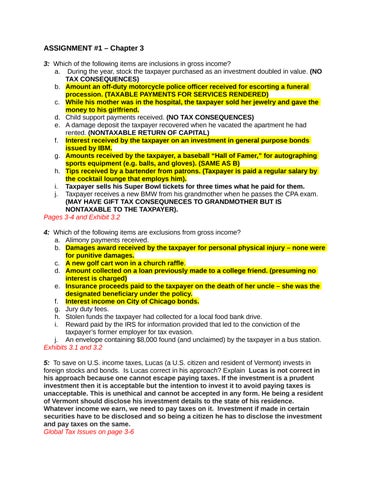
ASSIGNMENT #1 – Chapter 3 3: Which of the following items are inclusions in gross income? a. During the year, stock the taxpayer purchased as an investment doubled in value. (NO TAX CONSEQUENCES) b. Amount an off-duty motorcycle police officer received for escorting a funeral procession. (TAXABLE PAYMENTS FOR SERVICES RENDERED) c. While his mother was in the hospital, the taxpayer sold her jewelry and gave the money to his girlfriend. d. Child support payments received. (NO TAX CONSEQUENCES) e. A damage deposit the taxpayer recovered when he vacated the apartment he had rented. (NONTAXABLE RETURN OF CAPITAL) f. Interest received by the taxpayer on an investment in general purpose bonds issued by IBM. g. Amounts received by the taxpayer, a baseball “Hall of Famer,” for autographing sports equipment (e.g. balls, and gloves). (SAME AS B) h. Tips received by a bartender from patrons. (Taxpayer is paid a regular salary by the cocktail lounge that employs him). i. Taxpayer sells his Super Bowl tickets for three times what he paid for them. j. Taxpayer receives a new BMW from his grandmother when he passes the CPA exam. (MAY HAVE GIFT TAX CONSEQUNECES TO GRANDMOTHER BUT IS NONTAXABLE TO THE TAXPAYER). Pages 3-4 and Exhibit 3.2 4: Which of the following items are exclusions from gross income? a. Alimony payments received. b. Damages award received by the taxpayer for personal physical injury – none were for punitive damages. c. A new golf cart won in a church raffle. d. Amount collected on a loan previously made to a college friend. (presuming no interest is charged) e. Insurance proceeds paid to the taxpayer on the death of her uncle – she was the designated beneficiary under the policy. f. Interest income on City of Chicago bonds. g. Jury duty fees. h. Stolen funds the taxpayer had collected for a local food bank drive. i. Reward paid by the IRS for information provided that led to the conviction of the taxpayer’s former employer for tax evasion. j. An envelope containing $8,000 found (and unclaimed) by the taxpayer in a bus station. Exhibits 3.1 and 3.2 5: To save on U.S. income taxes, Lucas (a U.S. citizen and resident of Vermont) invests in foreign stocks and bonds. Is Lucas correct in his approach? Explain Lucas is not correct in his approach because one cannot escape paying taxes. If the investment is a prudent investment then it is acceptable but the intention to invest it to avoid paying taxes is unacceptable. This is unethical and cannot be accepted in any form. He being a resident of Vermont should disclose his investment details to the state of his residence. Whatever income we earn, we need to pay taxes on it. Investment if made in certain securities have to be disclosed and so being a citizen he has to disclose the investment and pay taxes on the same. Global Tax Issues on page 3-6
6: One class of deductions is variously described as deductions for AGI, above the line deductions and page 1 deductions. Explain the meaning of the various designations. A “deduction for” is one that can be claimed in arriving at AGI. Since AGI is the bottom line of page 1 of Form 1040, a “deduction for” is an “above the line” deduction or a “page 1” deduction. Page 3-5 7: In late 2013, the Polk’s come to you for tax advice. They are considering selling some stock investments for a loss and making a contribution to a traditional IRA. In reviewing their situation, you note that they have large medical expenses and a casualty loss, neither of which is covered by insurance. What advice would you give the Polk’s? The sale of the stock investment will result in a capital loss. The capital loss will offset any capital gain, and any excess (of up to $3,000) can be applied against ordinary income to arrive at AGI. The contribution to the traditional IRA is a deduction for AGI. Thus, both the capital loss and the IRA contribution reduce AGI. By reducing AGI, the Polk’s will increase their allowable medical and casualty deductions. [The medical deduction is the excess over 10% (7.5% if age 65 or over) of AGI in 2013, while the casualty loss is the excess over 10% of AGI.] Page 3-6 and Examples 3 and 4 8: In choosing between the standard deductions and itemizing deductions from AGI, what effect, if any, does each of the following have? a. The age of the taxpayer(s). The age of the taxpayer would favor the standard deduction choice if it brought into play the additional standard deduction (age 65 or older)/ b. The health (i.e., physical condition) of the taxpayer. If the taxpayer is blind, an additional standard deduction is available. c. Whether taxpayers rent or own their residence. If the taxpayer is still making house payments, the interest deduction may make itemizing more attractive. d. Taxpayer’s filing status (e.g., single, married, filing jointly). Because the amount of the standard deduction varies depending on filing status, this factor is highly relevant to the decision. e. Whether married taxpayers decide to file separate returns. If married persons file separate returns, the returns must be consistent in the choice made. Thus if one spouse itemizes the other spouse must also itemize. f. The taxpayer’s uninsured personal residence was recently destroyed by fire. Because a large casualty loss seems probable, this increases the advantage to be gained by itemizing. g. The number of personal dependency exemptions the taxpayer can claim. Personal and dependency exemptions have no effect on whether a taxpayer itemizes or chooses the standard deduction option. Page 3-9 to 3-11 and 3-37 10: David is age, 78, is a widower, and is being claimed as a dependent by his son. How does this situation affect the following? a. David’s own individual filing requirements. The filing requirements for persons being claimed as dependents by others are more complex than those applicable to regular taxpayers. They depend on whether the dependent has only earned income, only unearned income, or both earned and unearned income, and the amount of gross income. These rules are summarized on page 3-21 and 3-22 of text
b. David’s personal exemption. Dependents are not allowed to claim a personal exemption. Example 12 c. The standard deduction allowed to David. In 2013, the basic standard deduction is the greater of $1,000 or earned income plus $350. The total basic standard deduction allowed, however, cannot exceed $6,100 (the 2013 standard deduction for single taxpayers). Page 3-11 d. The availability of any additional standard deduction. The additional standard deduction of $1,500 is allowed in full. Example 10 11: Sam and Abby are dependents of their parents, and each has income of $2,100 for the year. Sam’s standard deduction for the year is $1,000 while Abby’s is $2, 450. As their income is the same, what causes the difference in the amount of the standard deduction? Sam’s $2,100 is unearned income. Thus, he is allowed the minimum standard deduction of $1,000. Abby’s $2,100 is earned income; so she is allowed a $2,450 [$2,100 (earned income for the year) + 350] standard deduction. Page 3-11 14: Heather, age 12, lives in the same household with her mother, grandmother and uncle. a. Who can qualify for the dependency exemption? Heather is a qualifying child to all three parties. b. Who takes preference? As the parent, the mother takes precedence. If the mother waives, the exemption goes to whoever has the highest AGI as between the grandmother and the uncle. Table 3.3 16: Isabella, Emma, and Jacob share equally in the support of their parents. Jacob tells his sisters to split the dependency exemptions between the two of them. Explain what Jacob means? Under a multiple support agreement, either Isabella, Emma or Jacob can claim either (or both) of their parents as dependents. Jacob is suggesting that his sisters share the exemptions. Page 3-16 and 3-17 18: Mario, who is single, is a U.S. Citizen and resident. He provides almost all of the support of his parents and two aunts, who are citizens and residents of Guatemala. Mario’s parents and aunts are seriously considering moving to and becoming residents of Mexico. Would such a move have any impact on Mario? Why or Why not? Mario should encourage his parents and two aunts to make the move to Mexico. As residents of Mexico, they can be claimed by Mario as dependents. Currently, they do not meet any of the exceptions to the citizenship or residency test for dependents. Page 3-18 22: Comment on the availability of head-of-household filing status for 2013 in each of the following independent situations. a. Taxpayer lives alone but maintains the household of his parents. In July 2013, the parents use their savings to purchase a Lexus automobile for $62,000. If the taxpayer meets the support test, the taxpayer can claim head of household filing status as at least one of the parents must be his dependent. This seems unlikely, however,
since their purchase of an auto is part of their support. Thus, the taxpayer must have contributed at least more than $62,000 toward total support. b. Taxpayer maintains a home in which she and her dependent father lives. The father enters a nursing facility for treatment for a mental disorder. Is the stay in nursing home temporary or permanent? If the father can be expected to return to taxpayer’s home, she qualifies for head of household filing status. c. Taxpayer, a single parent, maintains a home in which she and her unmarried son live. The son, age 18, earns $5,000 from a part-time job. Head of household filing status is available since the son is a dependent under the qualifying child category. d. Assume the same facts as in ©, except that the son is age 19, and 18. Head of household filing status is not available. Due to the age test, the son is not a qualifying child. (It is assumed that the son is not disabled or a full-time student.) Due to the gross income test, the son does not satisfy the requirements of a qualifying relative. e. Taxpayer is married and maintains a household in which he and his dependent stepson lives. Normally, a married taxpayer cannot use head of household filing status. If, however, the taxpayer qualifies as an abandoned spouse, this filing status is appropriate. f. Taxpayer lives alone but maintains the household where her dependent daughter lives. Head of household filing status is not available. The daughter is not a member of taxpayer’s household. g. Taxpayer maintains a household that includes an unrelated friend who qualifies as his dependent. Head of household status is not available because the friend, although a dependent, does not meet the relationship test. Page 3-27 and 3-28 25: In connection with the application of the kiddie tax, comment on the following: a. The child has only earned income. The kiddie tax does not apply to earned income. b. The child has a modest amount of unearned income. The kiddie tax does not apply unless unearned income exceeds $2,000. c. The child is age 20, not a student, and not disabled. The kiddie tax will not apply. The age coverage is under 19 or a full-time student under age 24. d. The child is married. The kiddie tax does not apply if the child is married and files a joint return. e. Effect of the parental election. If the parental election is made, the child need not file a return. f. The result when parental election is made and the married parents file separate returns. For married parents filing separate returns, the parent with the greater taxable income is the applicable parent. Page 3-32 – 3-34 26: During the year, Hernando has the following transactions: a. Gain on the sale of stock held as an investment for 10 months. b. Gain on the sale of land held as an investment for 4 years. c. Gain on the sale of a houseboat owned for 2 years and used for family vacations. d. Loss on the sale of a reconditioned motorcycle owned for 3 years and used for recreational purposes. How should Hernando treat these transactions for income tax purpose? Gain on the sale of the stock is a short-term capital gain and is taxed as ordinary income rates. The gain on the sale of the land and houseboat should be combined. As long-term capital gain, the
total is subject to tax at preferential rates – 15% or 0%. The loss is personal and, therefore, nondeductible. Page 3-34 to 3-36 29: Compute the taxable income for 2013 in each of the following independent situations: a. Drew and Meg, ages 40 and 41, respectively, are married and file a joint return. In addition to four dependent children, they have AGI of $65,000 and itemized deductions of $15,000. AGI $65,000 Less: Itemized deductions (15,000) Personal and dependency exemptions (6 x $3,900) (23,400) Taxable income $26,600 b. Sybil, age 40, is single and supports her dependent parents who live with her, as well as her grandfather who is in a nursing home. She has AGI of $80,000 and itemized deductions of $8,000. AGI $80,000 Less: Standard deduction (head of household) (8,950) Personal and dependency exemptions (4 × $3,900) (15,600) Taxable income $55,450 c. Scott, age 49, is a surviving spouse. His household includes two unmarried stepsons who qualify as his dependents. He has AGI of $75,000 and itemized of $10,100. AGI $75,000 Less: Standard deduction (surviving spouse) (12,200) Personal and dependency exemptions (3 × $3,900 (11,700) Taxable income $51,100 d. Amelia, age 33, is an abandoned spouse who maintains a household for her three dependent children. She has AGI of $58,000 and itemized deductions of $9,100. AGI $58,000 Less: Itemized deductions (9,100) Personal and dependency exemptions (4 × $3,900) (15,600) Taxable income $33,300 e. Dale, age 42, is divorced but maintains the home in which he and his daughter, Jill, live. Jill is single and qualifies as Dale’s dependent. Dale has AGI of $64,000 and itemized deductions of $9,900. AGI $64,000 Less: Itemized deductions (9,900) Personal and dependency exemptions (2 × $3,900) (7,800) Taxable income $46,300 Page 3-10 and Table 3.1 30: Compute the taxable income for 2013 for Emily on the basis of the following information. Her filing status is single. Salary $85,000 Interest income from bonds issued by Xerox 1,100 Alimony payments received 6,000 Contributions to traditional IRA 5,500 Gift from parents 25,000 Short-term capital gain from stock investment 2,000 Amount lost in football office pool (sports gambling is against the law 500 where Emily lives)