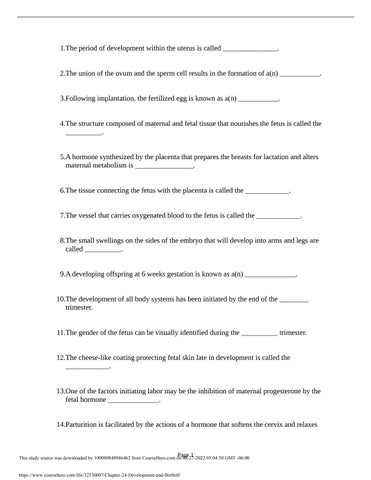
1.The period of development within the uterus is called _______________. 2.The union of the ovum and the sperm cell results in the formation of a(n) ___________. 3.Following implantation, the fertilized egg is known as a(n) ___________. 4.The structure composed of maternal and fetal tissue that nourishes the fetus is called the __________. 5.A hormone synthesized by the placenta that prepares the breasts for lactation and alters maternal metabolism is ________________. 6.The tissue connecting the fetus with the placenta is called the ____________. 7.The vessel that carries oxygenated blood to the fetus is called the ____________. 8.The small swellings on the sides of the embryo that will develop into arms and legs are called __________. 9.A developing offspring at 6 weeks gestation is known as a(n) ______________. 10.The development of all body systems has been initiated by the end of the ________ trimester. 11.The gender of the fetus can be visually identified during the __________ trimester. 12.The cheese-like coating protecting fetal skin late in development is called the ____________. 13.One of the factors initiating labor may be the inhibition of maternal progesterone by the fetal hormone ______________. 14.Parturition is facilitated by the actions of a hormone that softens the cervix and relaxes
Page 1
This study source was downloaded by 100000840946462 from CourseHero.com on 02-27-2022 05:04:50 GMT -06:00
https://www.coursehero.com/file/32530007/Chapter-24-Development-and-Birthrtf/
the pubic symphysis. This hormone is called ____________. 15.An episiotomy would be performed during the __________ stage of labor. 16.The baby is delivered during the ______________ stage of labor. 17.The fertilization of two ova by two spermatozoa results in _______________ twins. 18.Milk passes from the mammary gland lobes to the nipple via the __________ ducts. 19.The hormone that stimulates milk let-down is _____________. 20.The mammary glands produce small amounts of a fluid called _____________ for several days following parturition. 21.The implantation of a zygote in the oviduct results in a(n) ___________________. 22.Premature detachment of the placenta from the uterine wall results in __________________. 23.Untreated pregnancy-induced hypertension can lead to a more serious disorder called _______________. 24.Infections associated with childbirth are called ___________________. 25.The word part zyg/o means ________________. 26.The ___________ is a small hole in the right atria of the fetus that allows blood to bypass the right ventricle and the pulmonary circuit.
A) B)
27.The average length of gestation is 3 months 38 weeks
Page 2
This study source was downloaded by 100000840946462 from CourseHero.com on 02-27-2022 05:04:50 GMT -06:00
https://www.coursehero.com/file/32530007/Chapter-24-Development-and-Birthrtf/
C) D)
42 weeks 1 year
28.The fertilized egg normally attaches to the A) myometrium B) oviduct C) fimbriae D) endometrium 29.The normal chromosome number of the zygote is A) 23 B) 46 C) 69 D) None of the answers are correct. 30.After implantation, the fertilized egg is known as a(n) A) zygote B) fetus C) embryo D) egg
A) B) C) D)
31.The hormone produced by embryonic cells that maintains the corpus luteum is luteinizing hormone human placental lactogen progesterone human chorionic gonadotropin
A) B) C) D)
32.The umbilical cord contains one artery and one vein two arteries and two veins two arteries and one vein one artery and two veins
A) B) C) D)
33.The placenta secretes estrogen progesterone relaxin All of the answers are correct.
Page 3
This study source was downloaded by 100000840946462 from CourseHero.com on 02-27-2022 05:04:50 GMT -06:00
https://www.coursehero.com/file/32530007/Chapter-24-Development-and-Birthrtf/