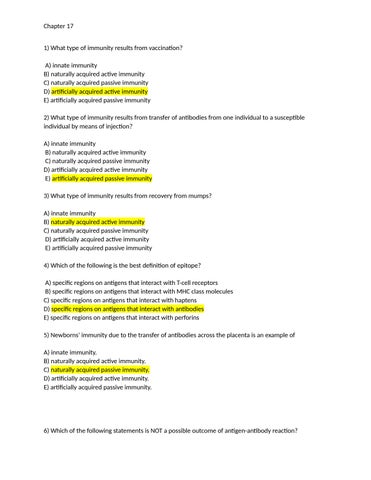
Chapter 17 1) What type of immunity results from vaccination? A) innate immunity B) naturally acquired active immunity C) naturally acquired passive immunity D) artificially acquired active immunity E) artificially acquired passive immunity 2) What type of immunity results from transfer of antibodies from one individual to a susceptible individual by means of injection? A) innate immunity B) naturally acquired active immunity C) naturally acquired passive immunity D) artificially acquired active immunity E) artificially acquired passive immunity 3) What type of immunity results from recovery from mumps? A) innate immunity B) naturally acquired active immunity C) naturally acquired passive immunity D) artificially acquired active immunity E) artificially acquired passive immunity 4) Which of the following is the best definition of epitope? A) specific regions on antigens that interact with T-cell receptors B) specific regions on antigens that interact with MHC class molecules C) specific regions on antigens that interact with haptens D) specific regions on antigens that interact with antibodies E) specific regions on antigens that interact with perforins 5) Newborns' immunity due to the transfer of antibodies across the placenta is an example of A) innate immunity. B) naturally acquired active immunity. C) naturally acquired passive immunity. D) artificially acquired active immunity. E) artificially acquired passive immunity.
6) Which of the following statements is NOT a possible outcome of antigen-antibody reaction?
Chapter 17
A) clonal deletion B) activation of complement C) opsonization D) ADCC E) agglutination 7) Which of the following cells is NOT an APC? A) dentritic cells B) macrophages C) immature B cells D) natural killer cells E) None of the answers is correct; all of these are APCs. 8) When an antibody binds to a toxin, the resulting action is referred to as A) agglutination. B) opsonization. C) ADCC. D) apoptosis. E) neutralization. 9) CD4+ T cells are activated by A) interaction between CD4+ and MHC II. B) interaction between TCRs and MHC II. C) cytokines released by dendritic cells. D) cytokines released by B cells. E) complement. 10) Which of the following recognizes antigens displayed on host cells with MHC II? A) TC cell B) B cell C) TH cell D) natural killer cell E) basophil
11) The specificity of an antibody is due to
Chapter 17 A) its valence. B) the H chains. C) the L chains. D) the constant portions of the H and L chains. E) the variable portions of the H and L chains. 12) Which of the following is NOT a characteristic of B cells? A) They originate in bone marrow. B) They have antibodies on their surfaces. C) They are responsible for the memory response. D) They are responsible for antibody formation. E) They recognize antigens associated with MHC I. 13) Which of the following is NOT a characteristic of cellular immunity? A) The cells originate in bone marrow. B) Cells are processed in the thymus gland. C) It can inhibit the immune response. D) B cells make antibodies. E) T cells react with antigens. 14) Plasma cells are activated by a(n) A) antigen. B) T cell. C) B cell. D) memory cell. E) APC. 15) The antibodies found in mucus, saliva, and tears are A) IgG. B) IgM. C) IgA. D) IgD. E) IgE. 16) The antibodies found on the surface of B cells, and which always exist as monomers, are A) IgG. B) IgM. C) IgA. D) IgD. E) IgE.