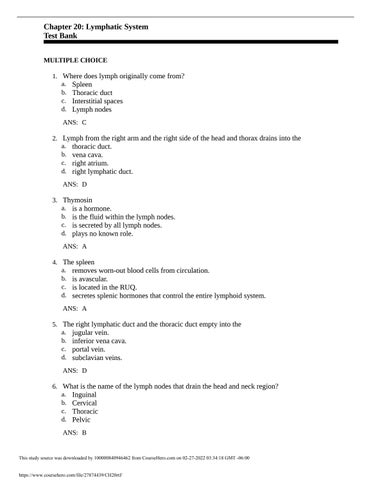
Chapter 20: Lymphatic System Test Bank MULTIPLE CHOICE 1. Where does lymph originally come from? a. Spleen b. Thoracic duct c. Interstitial spaces d. Lymph nodes ANS: C 2. Lymph from the right arm and the right side of the head and thorax drains into the a. thoracic duct. b. vena cava. c. right atrium. d. right lymphatic duct. ANS: D 3. Thymosin a. is a hormone. b. is the fluid within the lymph nodes. c. is secreted by all lymph nodes. d. plays no known role. ANS: A 4. The spleen a. removes worn-out blood cells from circulation. b. is avascular. c. is located in the RUQ. d. secretes splenic hormones that control the entire lymphoid system. ANS: A 5. The right lymphatic duct and the thoracic duct empty into the a. jugular vein. b. inferior vena cava. c. portal vein. d. subclavian veins. ANS: D 6. What is the name of the lymph nodes that drain the head and neck region? a. Inguinal b. Cervical c. Thoracic d. Pelvic ANS: B
This study source was downloaded by 100000840946462 from CourseHero.com on 02-27-2022 03:34:18 GMT -06:00
https://www.coursehero.com/file/27874439/CH20rtf/
7. What structures are located near the opening of the nasal cavity in the upper throat and are
also called the adenoids? Palatine tonsils Thymus glands Lingual tonsils Pharyngeal tonsils
a. b. c. d.
ANS: D 8. The inguinal lymph nodes a. line the entrance of the spleen. b. are the Kupffer cells within the liver. c. are located in the groin. d. are part of the hepatic portal circulation. ANS: C 9. What happens if the lymphatic vessels and nodes are removed from the right axillary region? a. All lymph will drain directly into the superior vena cava. b. The right arm will become gangrenous from lack of oxygen. c. The right arm will become edematous. d. The patient will experience anginal pain. ANS: C 10. If proteins are allowed to accumulate in the interstitial space, they will a. dehydrate the tissue space. b. block or clog the capillary pores. c. “hold water” and cause edema. d. act as antigens and cause an allergic reaction. ANS: C 11. Which of the following is caused by a viral infection involving the lymph nodes and is called
the “kissing disease”? Hodgkin’s disease Elephantiasis Infectious mononucleosis Anaphylaxis
a. b. c. d.
ANS: C 12. What is the term that refers to the removal of the palatine tonsils? a. Appendectomy b. Lymph node resection c. Adenoidectomy d. Tonsillectomy ANS: D 13. Which of the following conditions is most likely to cause a platelet deficiency? a. Lymphedema
This study source was downloaded by 100000840946462 from CourseHero.com on 02-27-2022 03:34:18 GMT -06:00
https://www.coursehero.com/file/27874439/CH20rtf/
b. A hyperactive spleen c. Lymphadenopathy d. Infectious mononucleosis ANS: B 14. What structure is concerned with the processing and maturation of T lymphocytes? a. Medulla oblongata b. Thymus gland c. Coronary sinus d. Pericardium ANS: B 15. Which lymphoid organ is located in the ventral cavity, thoracic cavity, and mediastinum? a. Spleen b. Liver c. Thymus gland d. Adenoids ANS: C 16. The subclavian veins a. receive lymph from the large lymphatic ducts. b. pump blood into the large lymphatic ducts. c. form the thoracic duct. d. are called lacteals. ANS: A 17. The spleen, thymus gland, tonsils, and lymph nodes are a. confined to the thoracic cavity. b. lymphoid organs. c. primarily concerned with hematopoiesis. d. concerned only with phagocytosis. ANS: B 18. What is (are) the lymphoid structure(s) that is (are) generally removed during a mastectomy? a. Spleen b. Liver c. Axillary lymph nodes d. Adenoids ANS: C 19. Which of the following is (are) described as partially encapsulated lymph nodes located in the
throat area? a. Spleen b. Tonsils c. Thymus gland d. Lacteal
This study source was downloaded by 100000840946462 from CourseHero.com on 02-27-2022 03:34:18 GMT -06:00
https://www.coursehero.com/file/27874439/CH20rtf/
ANS: B 20. A lacteal is located within the a. adenoid. b. tonsil. c. thymus gland. d. intestinal villus. ANS: D 21. Which of the following is least characteristic of the pharyngeal tonsils? a. Lymphoid organs b. Called adenoids c. Protect body from infection d. Most commonly removed by tonsillectomy ANS: D 22. Lymph is a. pumped by the left heart into the systemic circulation. b. formed when fluid is filtered across the subclavian veins into the tissue spaces. c. formed from tissue fluid. d. red, like blood. ANS: C 23. Why does lymph contain protein? a. Protein is synthesized by the lymph nodes. b. Protein leaks out of the capillaries into the tissue spaces and is absorbed into the
lymphatic capillaries. c. The cells that line the lymphatic vessels synthesize protein. d. Adenoids transport plasma protein into the lymphatic vessels. ANS: B 24. An overly active spleen may prematurely remove platelets from the circulation, thereby
predisposing a person to arteriolar vasospasm and hypertension. granulocytopenia and infection. thrombocytopenia and bleeding. hyperbilirubinemia and jaundice.
a. b. c. d.
ANS: C 25. Elephantiasis is a. CO = HR SV pulse pressure. b. caused by the destruction of valves within the lymphatic vessels. c. edema formation in response to impaired lymphatic drainage. d. caused by the removal of the spleen. ANS: C 26. A person has a severe streptococcal pharyngitis (sore throat). He is most likely to develop
This study source was downloaded by 100000840946462 from CourseHero.com on 02-27-2022 03:34:18 GMT -06:00
https://www.coursehero.com/file/27874439/CH20rtf/
a. b. c. d.
hypertrophied thymus gland. cervical lymphoma. enlarged inguinal lymph nodes. painful cervical lymph nodes.
ANS: D 27. A young woman is diagnosed with breast cancer. She is most apt to have a. a sentinel node biopsy before the mastectomy is performed. b. a sentinel node biopsy after breast reconstruction surgery. c. the sentinel node radiated during the mastectomy surgical procedure. d. a mastectomy and excision of all axillary lymph nodes; only then is the sentinel
node biopsied. ANS: A 28. Which of the following best describes the lymphatic capillaries? a. They closely follow the path of the aorta. b. They have large pores and follow venous pathways. c. They are found only in lymph nodes. d. They are found only in the spleen. ANS: B 29. Which of the following is true about lymph? It is a. absorbed by lymphatic capillaries from the interstitium. b. filtered by the lymphatic capillaries into the interstitium. c. secreted by the subclavian veins into the large lymphatic ducts. d. synthesized and stored within the lymph nodes. ANS: A 30. The thoracic duct a. filters lymph into the subclavian veins. b. receives lymph from large lymphatic vessels that drain the left side of the body. c. functions like a heart that pumps lymph throughout the body. d. is a collection of lymph nodes. ANS: B 31. What is the similarity between the thoracic duct and the right lymphatic duct? Both a. drain lymph exclusively from the lower extremities. b. empty their lymph into the left subclavian vein. c. are large lymphatic ducts that collect lymph from smaller lymphatic vessels. d. are lymphatic capillaries associated exclusively with the cerebral circulation. ANS: C 32. With which of the following are lymph nodes populated? a. Megakaryocytes and platelets b. Reticulocytes and erythrocytes c. Lymphocytes and macrophages d. Granulocytes and Kupffer cells
This study source was downloaded by 100000840946462 from CourseHero.com on 02-27-2022 03:34:18 GMT -06:00
https://www.coursehero.com/file/27874439/CH20rtf/