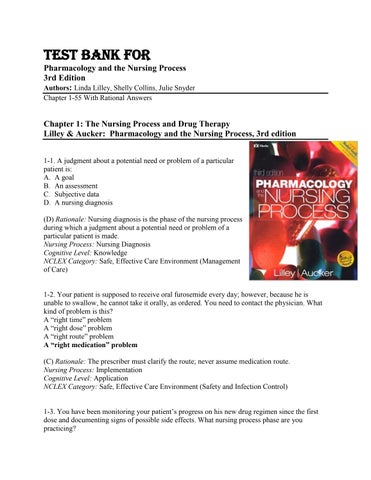
Test Bank for Pharmacology and the Nursing Process 3rd Edition Authors: Linda Lilley, Shelly Collins, Julie Snyder Chapter 1-55 With Rational Answers
Chapter 1: The Nursing Process and Drug Therapy Lilley & Aucker: Pharmacology and the Nursing Process, 3rd edition 1-1. A judgment about a potential need or problem of a particular patient is: A. A goal B. An assessment C. Subjective data D. A nursing diagnosis (D) Rationale: Nursing diagnosis is the phase of the nursing process during which a judgment about a potential need or problem of a particular patient is made. Nursing Process: Nursing Diagnosis Cognitive Level: Knowledge NCLEX Category: Safe, Effective Care Environment (Management of Care)
1-2. Your patient is supposed to receive oral furosemide every day; however, because he is unable to swallow, he cannot take it orally, as ordered. You need to contact the physician. What kind of problem is this? A ―right time‖ problem A ―right dose‖ problem A ―right route‖ problem A “right medication” problem (C) Rationale: The prescriber must clarify the route; never assume medication route. Nursing Process: Implementation Cognitive Level: Application NCLEX Category: Safe, Effective Care Environment (Safety and Infection Control) 1-3. You have been monitoring your patient’s progress on his new drug regimen since the first dose and documenting signs of possible side effects. What nursing process phase are you practicing?
2 A. Planning B. Evaluation C. Implementation D. Nursing diagnosis (B) Rationale: Monitoring the patient’s progress is part of the evaluation phase. Nursing Process: Evaluation Cognitive Level: Application NCLEX Category: Safe, Effective Care Environment (Management of Care)
1-4. You have a patient who is newly diagnosed with Type 1 (insulin-dependent) diabetes mellitus. Which of the following best illustrates an outcome criteria for this patient? A. The patient will follow instructions. B. The patient will not experience complications. C. The patient adheres to the new insulin treatment regimen. D. The patient demonstrates a safe insulin self-administration technique. (D) Rationale: This is a specific and measurable outcome criteria. Nursing Process: Planning (outcome criteria) Cognitive Level: Application NCLEX Category: Safe, Effective Care Environment (Management of Care)
1-5. Which activity best reflects the implementation phase of the nursing process for the patient who is newly diagnosed with Type 1 (insulin-dependent) diabetes mellitus? A. Providing education regarding self-injection technique B. Recording a drug history regarding over-the-counter medications used at home C. Formulating nursing diagnoses regarding knowledge deficit related to new treatment regimen D. Formulating nursing diagnoses regarding deficient knowledge related to new treatment regimen (A) Rationale: Education is an intervention that occurs during the implementation phase. Nursing Process: Implementation Cognitive Level: Analysis NCLEX Category: Safe, Effective Care Environment (Management of Care)
1-6. You are working during a very busy evening shift, and the physician has just hurriedly given you a list of orders over the telephone. What would be the best way to avoid medication errors? A. Recopy the orders neatly on the order sheet. B. Consult with the pharmacist for clarification. C. Abbreviate dosages and products to save time. D. Repeat the verbal orders and spell the drug names aloud. (D) Rationale: This will allow for immediate clarification of orders with the prescriber.
3 Nursing Process: Implementation Cognitive Level: Application and analysis NCLEX Category: Safe, Effective Care Environment (Management of Care)
1-7. The five rights of medication administration include: A. The right drug, the right route, the right dose, the right time, and the right patient B. The right drug, the right effect, the right route, the right time, and the right patient C. The right patient, the right strength, the right diagnosis, the right drug, and the right route D. The right patient, the right diagnosis, the right drug, the right route, and the right time (A) Rationale: The five rights of medication administration must always include the right drug, the right route, the right dose, the right time, the right patient. Nursing Process: Implementation Cognitive Level: Comprehension NCLEX Category: Safe, Effective Care Environment (Safety and Infection Control)
1-8. The phases of the nursing process are described as: A. First, assessing, then diagnosing, implementing, and evaluating B. Diagnosing, planning, assessing, implementing, and, finally, evaluating C. A linear direction that begins with assessing, continues through diagnosing and planning, and ends with implementing D. An ongoing, often circular process that beings with assessing, continues with diagnosing, planning, implementation, and evaluating (D) Rationale: Even though the nursing process is often presented as a linear process, it is ongoing and essentially a circular process that begins with assessing, then continues through diagnosing, planning, implementing, and, finally, evaluating, which may then lead back to any of the other phases. Nursing Process: General Cognitive Level: Application NCLEX Category: Safe, Effective Care Environment (Management of Care)
Chapter 2: Pharmacologic Principles Lilley & Aucker: Pharmacology and the Nursing Process, 3rd edition 2-1. Mr. Fargo is receiving two different drugs; however, at their current dose forms and dosages, both drugs are absorbed into the circulation at identical amounts. Thus, since they have the same absorption rates, they are: A. Equivalent B. Synergistic C. Compatible D. Bioequivalent (D) Rationale: Two drugs absorbed into the circulation at the same amount (in specific dosage forms) have the same bioavailability; thus, they are bioequivalent. Nursing Process: General Cognitive Level: Comprehension NCLEX Category: Physiologic Integrity (Pharmacologic and Parenteral Therapies)
2-2. Mrs. Camarrata is receiving her medication via intravenous injection. You tell her this means that: A. She is taking advantage of the fastest enteral route available. B. The medication will be absorbed slowly into the tissues over time. C. She is receiving her drug via the fastest route by which it can be absorbed. D. Most of the drug is inactivated by the liver before it reaches the target area. (C) Rationale: Intravenous injections are the fastest route of absorption. Nursing Process: Implementation Cognitive Level: Comprehension NCLEX Category: Physiologic Integrity (Pharmacologic and Parenteral Therapies)
2-3. Drugs given via the parenteral route: A. Bypass the first-pass effect B. Decrease blood flow to the stomach C. Are altered by the presence of food in the stomach D. Exert their effects while circulating in the bloodstream (A) Rationale: Drugs given via the parenteral route bypass the first-pass effect, but they still must be absorbed into cells and tissues before they can exert their effects. Nursing Process: General Cognitive Level: Analysis NCLEX Category: Physiologic Integrity (Pharmacologic and Parenteral Therapies) 2-4. Which of the following would be classified as an ―adverse drug event?‖
Copyright © 2002, Mosby, Inc., An Affiliate of Elsevier Science (USA). All rights reserved.
Chapter 1: The Nursing Process and Drug Therapy
Lilley & Aucker: Pharmacology and the Nursing Process, 3rd edition
A. A side effect B. An allergic reaction C. An idiosyncratic reaction D. A medication error that results in patient harm (D) Rationale: Adverse drug events are medication errors that result in patient harm. Nursing Process: General Cognitive Level: Comprehension NCLEX Category: Physiologic Integrity (Pharmacologic and Parenteral Therapies) 2-5. A drug’s half-life is the time it takes for: A. The drug to elicit half of its therapeutic response B. One half of the original amount of a drug to reach the target cells C. One half of the original amount of a drug to be removed from the body D. One half of the original amount of a drug to be absorbed into the circulation (C) Rationale: A drug’s half-life is the time it takes for one half of the original amount of a drug to be removed from the body. It is a measure of the rate at which drugs are removed from the body. Nursing Process: General Cognitive Level: Comprehension NCLEX Category: Physiologic Integrity (Pharmacologic and Parenteral Therapies)
2-6. Duration of action is: A. The time it takes for the drug to elicit a therapeutic response B. The time it takes a drug to reach its maximum therapeutic response C. A corresponding response to increasing drug concentrations at the site of action D. The time during which drug concentration is sufficient to elicit a therapeutic response (D) Rationale: Duration of action is the time during which drug concentration is sufficient to elicit a therapeutic response. Nursing Process: General Cognitive Level: Comprehension NCLEX Category: Physiologic Integrity (Pharmacologic and Parenteral Therapies)
2-7. A drug interacts with enzymes by: A. Altering cell membrane permeability B. ―Fooling‖ a receptor on the cell wall C. Enhancing their effectiveness within the cells D. ―Fooling‖ enzymes into binding with it instead of its normal target cell
Copyright © 2002, Mosby, Inc., An Affiliate of Elsevier Science (USA). All rights reserved.
5