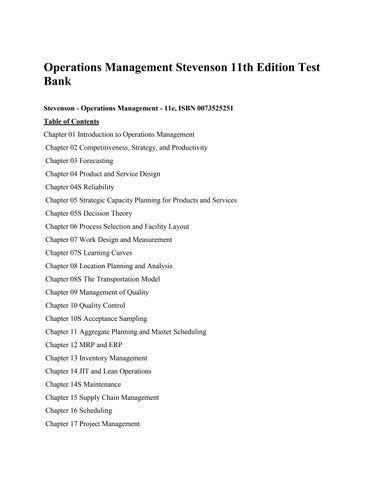
Operations Management Stevenson 11th Edition Test Bank Stevenson - Operations Management - 11e, ISBN 0073525251 Table of Contents Chapter 01 Introduction to Operations Management Chapter 02 Competitiveness, Strategy, and Productivity Chapter 03 Forecasting Chapter 04 Product and Service Design Chapter 04S Reliability Chapter 05 Strategic Capacity Planning for Products and Services Chapter 05S Decision Theory Chapter 06 Process Selection and Facility Layout Chapter 07 Work Design and Measurement Chapter 07S Learning Curves Chapter 08 Location Planning and Analysis Chapter 08S The Transportation Model Chapter 09 Management of Quality Chapter 10 Quality Control Chapter 10S Acceptance Sampling Chapter 11 Aggregate Planning and Master Scheduling Chapter 12 MRP and ERP Chapter 13 Inventory Management Chapter 14 JIT and Lean Operations Chapter 14S Maintenance Chapter 15 Supply Chain Management Chapter 16 Scheduling Chapter 17 Project Management
Chapter 18 Management of Waiting Lines Chapter 19 Linear Programming
Chapter 01 Introduction to Operations Management Student: ___________________________________________________________________________ 1. Operations managers are responsible for assessing consumer wants and needs and selling and promoting the organization's goods or services. True False
2. Often, the collective success or failure of companies' operations functions will impact the ability of a nation to compete with other nations. True False
3. Companies are either producing goods or delivering services. This means that only one of the two types of operations management strategies are used. True False
4. Operations, marketing, and finance function independently of each other in most organizations. True False
5. The greater the degree of customer involvement, the more challenging the design and management of operations. True False
6. Goods producing organizations are not involved in service activities. True False
7. Service operations require additional inventory because of the unpredictability of consumer demand. True False
8. The value of outputs is measured by the prices customers are willing to pay for goods or services. True False
9. The use of models will guarantee the best possible decisions. True False
10. People who work in the field of operations should have skills that include both knowledge and people skills. True False
11. Assembly lines achieved productivity but at the expense of standard of living. True False
12. The operations manager has primary responsibility for making operations system design decisions, such as system capacity and location of facilities. True False
13. The word "technology" is used only to refer to "information technology". True False
14. ‘Value added' by definition is always a positive number since 'added' implies increases. True False
15. Service often requires greater labor content, whereas manufacturing is more capital intensive. True False
16. Measurement of productivity in service is more straightforward than in manufacturing since it is not necessary to take into account the cost of materials. True False
17. Special-purpose technology is a common way of offering increased customization in manufacturing or services without taking on additional labor costs. True False
18. One concern in the design of production systems is the degree of standardization. True False
19. Most people encounter operations only in profit-making organizations. True False
20. Service involves a much higher degree of customer contact than manufacturing. True False
21. A systems approach emphasizes interrelationships among subsystems, but its main theme is that the whole is greater than the sum of its individual parts. True False
22. The Pareto phenomenon is one of the most important and pervasive concepts that can be applied at all levels of management. True False
23. Operations managers, who usually use quantitative approaches, are not really concerned with ethical decision-making. True False
24. The optimal solutions produced by quantitative techniques should always be evaluated in terms of the larger framework. True False
25. Managers should most often rely on quantitative techniques for important decisions since quantitative approaches result in more accurate decisions. True False
26. Many operations management decisions can be described as tradeoffs. True False
27. A systems approach means that we concentrate on efficiency within a subsystem and thereby assure overall efficiency. True False
28. Prior to the Industrial Revolution, goods were produced primarily by craftsmen or their apprentices using custom made parts. True False
29. Elton Mayo's "Hawthorne Experiment" was the focal point of the Human Relations Movement, which emphasized the importance of the human element in job design. True False