Test Bank for Chapter 3
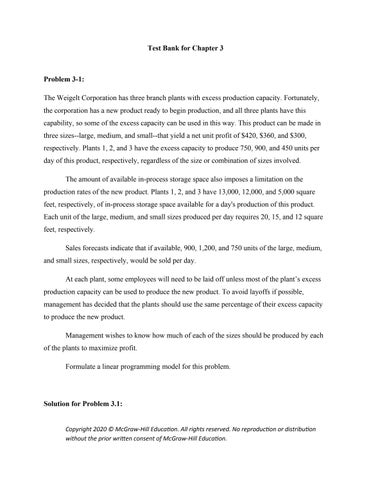
Problem 3-1: The Weigelt Corporation has three branch plants with excess production capacity. Fortunately, the corporation has a new product ready to begin production, and all three plants have this capability, so some of the excess capacity can be used in this way. This product can be made in three sizes--large, medium, and small--that yield a net unit profit of $420, $360, and $300, respectively. Plants 1, 2, and 3 have the excess capacity to produce 750, 900, and 450 units per day of this product, respectively, regardless of the size or combination of sizes involved. The amount of available in-process storage space also imposes a limitation on the production rates of the new product. Plants 1, 2, and 3 have 13,000, 12,000, and 5,000 square feet, respectively, of in-process storage space available for a day's production of this product. Each unit of the large, medium, and small sizes produced per day requires 20, 15, and 12 square feet, respectively. Sales forecasts indicate that if available, 900, 1,200, and 750 units of the large, medium, and small sizes, respectively, would be sold per day. At each plant, some employees will need to be laid off unless most of the plant’s excess production capacity can be used to produce the new product. To avoid layoffs if possible, management has decided that the plants should use the same percentage of their excess capacity to produce the new product. Management wishes to know how much of each of the sizes should be produced by each of the plants to maximize profit. Formulate a linear programming model for this problem.
Solution for Problem 3.1: Copyright 2020 © McGraw-Hill Education. All rights reserved. No reproduction or distribution without the prior written consent of McGraw-Hill Education.
The decision variables can be denoted and defined as follows:
xP1L = number of large units produced per day at Plant 1, xP1M = number of medium units produced per day at Plant 1, xP1S = number of small units produced per day at Plant 1, xP2L = number of large units produced per day at Plant 2, xP2M = number of medium units produced per day at Plant 2, xP2S = number of small units produced per day at Plant 2, xP3L = number of large units produced per day at Plant 3, xP3M = number of medium units produced per day at Plant 3, xP3S = number of small units produced per day at Plant 3.
Also letting P (or Z) denote the total net profit per day, the linear programming model for this problem is
Maximize P =
420 xP1L + 360 xP1M + 300 xP1S + 420 xP2L + 360 xP2M + 300 xP2S + 420 xP3L + 360 xP3M + 300 xP3S,
subject to xP1L + xP1M + xP1S
750
Copyright 2020 © McGraw-Hill Education. All rights reserved. No reproduction or distribution without the prior written consent of McGraw-Hill Education.
xP2L + xP2M + xP2S
900
xP3L + xP3M + xP3S
450
20 xP1L + 15 xP1M + 12 xP1S
13000
20 xP2L + 15 xP2M + 12 xP2S
12000
20 xP3L + 15 xP3M + 12 xP3S
5000
xP1L + xP2L + xP3L
900
xP1M + xP2M + xP3M
1200
xP1S + xP2S + xP3S
750
1 1 750 ( xP1L + xP1M + xP1S ) - 900 ( xP2L + xP2M + xP2S ) = 0
1 1 750 ( xP1L + xP1M + xP1S ) - 450 ( xP3L + xP3M + xP3S ) = 0 and
xP1L 0, xP1M 0, xP1S 0, xP2L 0, xP2M 0, xP2S 0, xP3L 0, xP3M 0, xP3S 0.
The above set of equality constraints also can include the following constraint:
= 0. Copyright 2020 © McGraw-Hill Education. All rights reserved. No reproduction or distribution without the prior written consent of McGraw-Hill Education.
However, any one of the three equality constraints is redundant, so any one (say, this one) can be deleted.
Problem 3-2: Comfortable Hands is a company which features a product line of winter gloves for the entire family — men, women, and children. They are trying to decide what mix of these three types of gloves to produce. Comfortable Hands’ manufacturing labor force is unionized. Each full-time employee works a 40-hour week. In addition, by union contract, the number of full-time employees can never drop below 20. Nonunion, part-time workers can also be hired with the following unionimposed restrictions: (1) each part-time worker works 20 hours per week, and (2) there must be at least 2 full-time employees for each part-time employee. All three types of gloves are made out of the same 100% genuine cowhide leather. Comfortable Hands has a long term contract with a supplier of the leather, and receives a 5,000 square feet shipment of the material each week. The material requirements and labor requirements, along with the gross profit per glove sold (not considering labor costs) is given in the following table.
Material Required
Labor Required
Gross Profit
Glove
(square feet)
(minutes)
(per pair)
Men’s
2
30
$8
Women’s
1.5
45
$10
Children’s
1
40
$6
Copyright 2020 © McGraw-Hill Education. All rights reserved. No reproduction or distribution without the prior written consent of McGraw-Hill Education.
Each full-time employee earns $13 per hour, while each part-time employee earns $10 per hour. Management wishes to know what mix of each of the three types of gloves to produce per week, as well as how many full-time and how many part-time workers to employ. They would like to maximize their net profit — their gross profit from sales minus their labor costs. Formulate a linear programming model for this problem.
Solution for Problem 3-2:
The decision variables can be denoted and defined as follows: M = number of men’s gloves to produce per week, W = number of women’s gloves to produce per week, C = number of children’s gloves to produce per week, F = number of full-time workers to employ, PT = number of part-time workers to employ.
(Alternative notation for the decision variables is xM, xW, xC, xF, and xPT, respectively.) Also letting P (or Z) denote the total net profit per week, the linear programming model for this problem is
Maximize P =
8 M + 10 W + 6 C – 13(40)F – 10(20) PT,
subject to 2 M + 1.5 W + C 5000 Copyright 2020 © McGraw-Hill Education. All rights reserved. No reproduction or distribution without the prior written consent of McGraw-Hill Education.