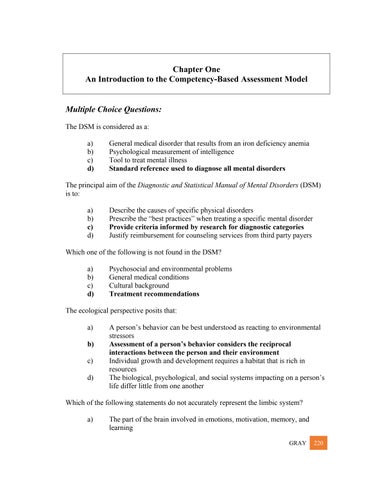
Chapter One An Introduction to the Competency-Based Assessment Model Multiple Choice Questions: The DSM is considered as a: a) b) c) d)
General medical disorder that results from an iron deficiency anemia Psychological measurement of intelligence Tool to treat mental illness Standard reference used to diagnose all mental disorders
The principal aim of the Diagnostic and Statistical Manual of Mental Disorders (DSM) is to: a) b) c) d)
Describe the causes of specific physical disorders Prescribe the “best practices” when treating a specific mental disorder Provide criteria informed by research for diagnostic categories Justify reimbursement for counseling services from third party payers
Which one of the following is not found in the DSM? a) b) c) d)
Psychosocial and environmental problems General medical conditions Cultural background Treatment recommendations
The ecological perspective posits that: a) b) c) d)
A person’s behavior can be best understood as reacting to environmental stressors Assessment of a person’s behavior considers the reciprocal interactions between the person and their environment Individual growth and development requires a habitat that is rich in resources The biological, psychological, and social systems impacting on a person’s life differ little from one another
Which of the following statements do not accurately represent the limbic system? a)
The part of the brain involved in emotions, motivation, memory, and learning GRAY
220
b) c) d)
Acts as a relay station for incoming information from the sensory organs Found in the inner margin of the upper brain Includes the thalamus, hypothalamus, hippocampus, amygdala, and anterior cingulate cortex
The social worker who asks about a client’s work history is exploring: a) b) c) d)
Intrapersonal issues Social issues Interpersonal issues Cultural issues
Which of the following statements does not apply to the competency-based assessment in mental health practice: a) Emphasizes the importance of identifying client competencies b) Focuses on assets instead of deficits c) Represents the practitioner’s judgment of the individual’s overall level of functioning d) Strives to build and enhance client skills as they attempt to deal with life conditions The competency-based assessment refers to: a) b) c) d)
Factors as thoughts, feelings, perceptions, motivation, and reactions to “illness” An examination of cultural, environmental, and familial influences Reciprocal interactions that are assumed between a person’s behavior and his or her environment Considers select factors that contribute to the development of psychopathology
The DSM-5 replaced the DSM-IV-TR “Not Otherwise Specified” or NOS label with 2 additional categories: “Other specified (disorder)” and “”Unspecified (disorder). Which of the following statements accurately represents the Unspecified diagnostic categories? a) The Unspecified diagnosis is considered when the practitioner considers the client’s condition is time-limited; 6 months or less b) The Unspecified diagnosis is considered when the client has fewer than 3 symptoms of any of the disorders in a specific diagnostic classification c) The Unspecified diagnosis is used when the practitioner chooses not to specify the reason that criteria are not met for a specific disorder d) The unspecified diagnosis is used when the client shows symptoms in 2 (or more) disorders in separate diagnostic classifications
GRAY
221
Which of the following statements do not apply to the revised DSM-5? a) Specific disorders are framed in the context of age, gender, and cultural explanations in addition to being organized along a developmental lifespan within each chapter b) Key disorders were combined (or reorganized) because the relationships among the different categories placed them along a single continuum c) A new section of the manual introduces emerging measures, models, and cultural guidance to help clinicians in their evaluation of patients d) The multi axial system found in the DSM-IV-TR has been retained but specific medical conditions that are important to understanding an individual’s disorder must be listed separately
True/False: The Diagnostic and Statistical Manual, first published in 1952, is a highly theoretical and descriptive approach to diagnosis. False The competency-based assessment includes the ability to differentially apply knowledge of human behavior (specifically bio-psycho-social-spiritual theories) to better understand the client’s current functioning. True The Global Assessment of Functioning Scale found in the DSM-IV-TR remains as a separate category and coded in the DSM-5 assessment. False Autistic disorder, Asperger’s disorder, and pervasive developmental disorder have been consolidated into one disorder called autism spectrum disorder in the DSM-5. True Avoidant personality disorder is a diagnosis that has been deleted from the personality disorders in the DSM-5. False Although the personality disorders originate during the childhood years, they are generally considered adult disorders. True Social phobia is a specifier listed for the social anxiety disorder in the DSM-5. False Generalized anxiety disorder is one of the anxiety disorders in the DSM-5. True To improve clinical utility, the DSM-5 is organized around developmental and lifespan considerations. True The boundaries between normality and pathology vary across cultures for specific types of behaviors in the DSM-5. True
Fill in the Missing Answer: GRAY
222
From each of the following terms, indicate which applies to the following statements. Terms: Comorbidity Culture-related diagnostic issues Diagnostic features Diagnostic markers Differential diagnosis Gender-related diagnostic issues Prevalence Recording procedures Specifiers Statement: __________ Provides the option to define subgroupings that share features within a particular disorder (Specifiers) __________ Addresses specific coding requirements for the diagnosis (Recording procedures) __________ Elaborates the specific diagnostic criteria (Diagnostic features) __________ Describes the occurrence of the disorder (Prevalence) __________Elaborates cultural influences to better inform the practitioner how a client’s symptoms can be influenced by culture, race, ethnicity, religion, or geographic origin (Culture-related diagnostic issues) __________ Reviews potential gender differences in the expression of the symptoms of a disorder (Gender-related diagnostic issues) __________ Explains key indicators to look for when making the assessment (Diagnostic markers) __________ Differentiates the diagnosis from other syndromes (Differential diagnosis)
GRAY
223
__________ Describes other potential co-occurring disorders (Comorbidity)
Short Essay: Describe how specifiers are used in the DSM-5’s diagnostic system. Suggested response:
Specifiers are provided for increased diagnostic specificity Provide opportunities to define a more homogeneous subgrouping of individuals with a disorder who share certain features (i.e.: major depressive “with mixed features”) More than one specifier may be assigned to a diagnosis Specifiers may describe course, severity and/or descriptive features (i.e.: with poor insight)
Describe how other specified and unspecified disorders are used in the DSM-5. Suggested response:
To enhance diagnostic specificity, the DSM-5 replaces the previous NOS designation with 2 options: other specified disorder and unspecified disorder.
Section III of the DSM-5, Cultural Formulation, provides a detailed discussion of culture and the diagnosis. What are the 3 concepts that offer greater clinical utility than the former culture-bound syndrome? Suggested response:
Cultural syndrome – or a cluster of co-occurring symptoms found is a specific cultural group, community or context Cultural idioms of distress – a phrase or way of talking about suffering among individuals of a cultural group referring to shared concepts of pathology and ways of expressing, communicating or naming essential features of distress Cultural explanation or perceived cause – an explanatory model that offers a culturally conceived cause for symptoms, illness or distress
Chapter Two Neurodevelopmental Disorders GRAY
224