Test Bank For World Politics A Critical Introduction to International Relations First Edition by Catherine Goetze
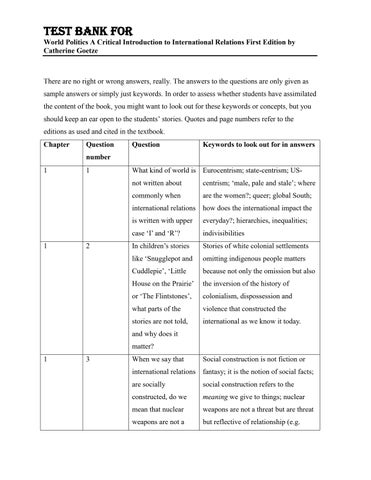
There are no right or wrong answers, really. The answers to the questions are only given as sample answers or simply just keywords. In order to assess whether students have assimilated the content of the book, you might want to look out for these keywords or concepts, but you should keep an ear open to the students’ stories. Quotes and page numbers refer to the editions as used and cited in the textbook. Chapter
Question
Question
Keywords to look out for in answers
number 1
1
What kind of world is Eurocentrism; state-centrism; USnot written about
centrism; ‘male, pale and stale’; where
commonly when
are the women?; queer; global South;
international relations how does the international impact the
1
2
is written with upper
everyday?; hierarchies, inequalities;
case ‘I’ and ‘R’?
indivisibilities
In children’s stories
Stories of white colonial settlements
like ‘Snugglepot and
omitting indigenous people matters
Cuddlepie’, ‘Little
because not only the omission but also
House on the Prairie’
the inversion of the history of
or ‘The Flintstones’,
colonialism, dispossession and
what parts of the
violence that constructed the
stories are not told,
international as we know it today.
and why does it matter? 1
3
When we say that
Social construction is not fiction or
international relations fantasy; it is the notion of social facts; are socially
social construction refers to the
constructed, do we
meaning we give to things; nuclear
mean that nuclear
weapons are not a threat but are threat
weapons are not a
but reflective of relationship (e.g.
1
4
real threat?
USA-GB vs USA-Soviet Union).
If critical social
From a critical perspective the notion
sciences reject most
of truth does not make sense;
of the vocabulary of
alternative notions would be terms like
natural science,
‘correct’, ‘appropriate’, ‘just’; holistic
especially the idea of
and critical approach asks us to look at
objective knowledge,
many sides; reflexivity is a means to
how do we know that
self-correct.
what critical analysis says is true? 1
5
Describe a way of
Questioning terms of analysis;
applying reflexivity
thinking about conditions of
in the study of
possibility and contingency;
international
transparency about observer’s role;
relations.
positioning of the observer in society and observation.
1
Spotlight 1
With reference to one
The intro uses the plot of being a
of the book’s case
migrant, queer person who just
studies, explain how
watched a play; reflection on
the title of Rahul
modernity and time; Uganda case
Rao’s book Out of
study: in terms of queer, Uganda was
Time reflects a
‘progressive’ before colonisation when
critical epistemology.
it was considered ‘backward’ by Europeans, while current homophobia is also seen as ‘progressive’ by government while it is seen as ‘backward’ by queer rights movements.
1
Spotlight 2
With reference to
Knowledge not something to have but
Black Pacific’s main
to share, stories, music, narratives and
focus, explain what
people; case: encounters across oceans
Robbie Shilliam
to reconstruct black identities.
means by ‘cultivating knowledge’. 1
Spotlight 3
Explain Sarah
Breaking with colonial and patriarchal
Motta’s argument in
politics through a radical rethinking of
Liminal Subjects that
knowledge; the body itself is theorised
a woman’s body is a
as a site of knowledge and epistemic
central place of
resistance; knowledge that emerges
knowledge about the
from the lived, bodily experience of
world.
racialised women; reclaiming female subjecthood by resisting denial, shame and erasure.
2
2
1
2
How is the
Myth of 1648; ahistorical
Eurocentrism of IR
understanding of state as if it had
expressed in the
always existed even though only a
claim that the state is
recent political development;
the most important
reproducing colonial denial of
actor of the
sovereignty towards non-European
international?
polities and rulers.
Name a key author of
See Table 2.1.
one of the three mainstream IR theories and explain how their epistemology is different to that of critical analysis. 2
3
What does Robert
Neutrality is not possible; there is
Cox mean when he
difference between policy advising
says that ‘theory is
analysis from within existing
always for something
epistemological paradigms and critical
and for someone’?
theory that steps back and looks at conditions of possibility and social
forces that shape these. 2
4
Explain why critical
State is a configuration of power that
approaches reject the
is historically institutionalised, thus
idea of the state as a
also effect of social struggle and
universal set of
violence; incorporates social
institutions and law
hierarchies like gender, sex, race and
and how they
class.
understand the state instead. 2
5
With reference to
Kant’s view of human evolution,
Box 2.1 on Immanuel
history and an ethical community
Kant’s philosophy,
based on hierarchies of ‘races’ is
explain why the
implicit in his political writings but
liberal claim of
not explicitly discussed thus feigning
‘value neutrality’ is
neutrality.
problematic. 2
Spotlight 1
How does Robert
Race relations – the starting point of
Vitalis (2015)
early U.S. international relations
challenge the
thought.
mainstream origin
Howard School – African-American
story of International
intellectuals theorising IR from the
Relations, and what
perspective of the oppressed.
role does he attribute
White supremacy – the dominant but
to African-American
often silenced foundation of
scholars in shaping
mainstream IR.
alternative
Erasure – the post-WWII silencing of
foundations of the
race and empire in IR scholarship.
discipline? 2
Spotlight 2
With reference to
Migrants, i.e. trans-border crossers,
Cynthia Weber’s
disturb ethnic nationalist
arguments about
understandings of territorial, nation-
queerness, explain
state borders in ways similar to queer
why migrants and
people disturbing binary sex systems;
migration are one of
students should be able to draw
the outstanding fields
parallels between non-binary
where queer theory
subjectivities, undermining of
can make sense of
heteronormativity; complexities of
international
and/both vs neither/nor logics;
relations.
transgression, perversity, boundary/border crossing; embodiment of territory.
2
Spotlight 3
What are the
Eurocentrism of social sciences is
arguments with
based in assumption that world history
which Gurminder
is endogenous to Europe and has been
Bhambra calls for a
universalised; counter-proposal:
pluriversal social
pluriversal social science as an
science?
approach that embraces multiple epistemologies without subordinating them to a single universal framework; need to foreground connectivity and multiplicity in order to decentre and provincialise the European experience.
3
1
What does it mean to
Ideology: epistemic ideas of practice
say that ideological
oriented towards the future that gain
ideas can only be
their force from the claim to ‘truth’;
verified?
falsification would annihilate this claim to truth.
3
2
How do ideologies
Provide consistent and reasoned
produce legitimacy
framework of cause and effect chains
for political action?
in political action; instil ideas of necessity and inevitability; claim of making the world better through political action.
3
3
In many countries the
Conservatism is about maintaining a