Name______________________________ Section__________ Date______________
Chapter 1
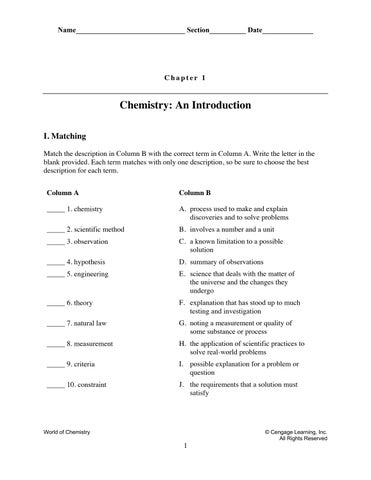
Chemistry: An Introduction I. Matching Match the description in Column B with the correct term in Column A. Write the letter in the blank provided. Each term matches with only one description, so be sure to choose the best description for each term. Column A
Column B
_____ 1. chemistry
A. process used to make and explain discoveries and to solve problems
_____ 2. scientific method
B. involves a number and a unit
_____ 3. observation
C. a known limitation to a possible solution
_____ 4. hypothesis
D. summary of observations
_____ 5. engineering
E. science that deals with the matter of the universe and the changes they undergo
_____ 6. theory
F. explanation that has stood up to much testing and investigation
_____ 7. natural law
G. noting a measurement or quality of some substance or process
_____ 8. measurement
H. the application of scientific practices to solve real-world problems
_____ 9. criteria
I. possible explanation for a problem or question
_____ 10. constraint
J. the requirements that a solution must satisfy
World of Chemistry
© Cengage Learning, Inc. All Rights Reserved
1
Name______________________________ Section__________ Date______________
II. Multiple Choice Choose the one best answer and write its letter in the blank. _____ 11.
Which of the following careers involve chemistry? a) engineer b) beautician
_____ 12.
c) farmer d) all of the above
Which of the following is a microscopic property? a) color of a solid b) density of a liquid
_____ 13.
c) number of atoms in a molecule d) texture of a solid
Which of the following is a quantitative observation? a) The object had a mass of 2.3 g. b) The liquid looked yellow. c) Carbon dioxide was produced. d) A yellow solid formed.
_____ 14.
Which of these is a chemical change? a) Wood burns. b) An egg cooks.
_____ 15.
c) Food is digested. d) all of the above
When using the scientific method, the first step is to a) design an experiment. b) complete several experiments. c) make a hypothesis. d) make observations.
_____ 16.
When using your five senses to gather information, you are a) drawing a conclusion. b) developing a theory. c) making observations. d) establishing scientific law.
World of Chemistry
© Cengage Learning, Inc. All Rights Reserved
2
Name______________________________ Section__________ Date______________
_____ 17.
How do the practices of science and engineering differ? a) Scientists make observations; engineers take measurements. b) Scientists communicate information; engineers develop models. c) Scientists construct explanations; engineers design solutions. d) Scientists use mathematical thinking; engineers use computational thinking.
III. Free Response Answer the questions in the space provided. Use complete sentences and provide support for your answer. 18.
Describe the difference between a natural law and a theory.
19.
Briefly define the term trade-off and explain why engineers often must make trade-offs when developing solutions.
World of Chemistry
© Cengage Learning, Inc. All Rights Reserved
3
Name______________________________ Section__________ Date______________
Chapter 2
Matter I. Matching Match the description in Column B with the correct term in Column A. Write the letter in the blank provided. Each term matches with only one description, so be sure to choose the best description for each term. Column A
Column B
_____ 1. element
A. not the same throughout
_____ 2. physical properties
B. has mass and occupies space
_____ 3. compound
C. cannot be separated into simpler substances
_____ 4. solid
D. the same throughout
_____ 5. physical change
E. atoms of different elements chemically combined
_____ 6. solution
F. has a fixed shape and volume
_____ 7. homogeneous
G. a homogeneous mixture
_____ 8. gas
H. has a fixed volume but assumes the shape of its container
_____ 9. chemical change
I. inherent characteristics of a substance
_____ 10. matter
J. composition of a substance is not affected
_____ 11. liquid
K. no fixed volume or shape
_____ 12. heterogenous
L. a new substance is formed
World of Chemistry
© Cengage Learning, Inc. All Rights Reserved
1
Name______________________________ Section__________ Date______________
II. Multiple Choice Choose the one best answer and write its letter in the blank. _____ 13.
Anything that has mass and occupies space is called a) a solid.
_____ 14.
b) oxygen
c) ice
d) air
c) melts at 83 °C d) floats in water
Which of the following is a physical change? a) rusting
_____ 17.
d) a compound.
Which of the following is a chemical property? a) burns b) conducts electricity
_____ 16.
c) matter.
Which of the following would be classified as a mixture? a) carbon
_____ 15.
b) a liquid.
b) freezing
c) rotting
d) cooking
Which of the following is characteristic of a compound? a) pure substance b) homogeneous c) contains different kinds of atoms d) all of the above
_____ 18.
A liquid is a state of matter that a) flows. b) takes the shape of its container. c) is easily compressed. d) has a definite shape.
_____ 19.
A chemical change must produce which of the following? a) a new substance b) a pure substance
c) a compound d) a mixture
World of Chemistry
© Cengage Learning, Inc. All Rights Reserved
2