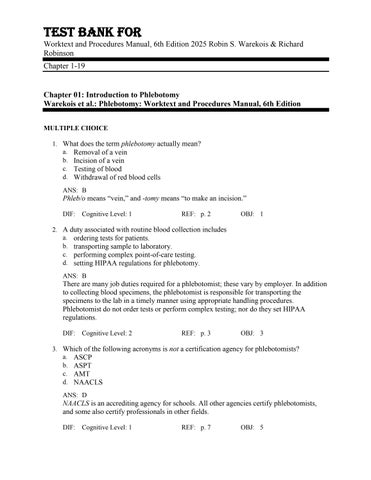
Test Bank For Worktext and Procedures Manual, 6th Edition 2025 Robin S. Warekois & Richard Robinson Chapter 1-19
Chapter 01: Introduction to Phlebotomy Warekois et al.: Phlebotomy: Worktext and Procedures Manual, 6th Edition MULTIPLE CHOICE 1. What does the term phlebotomy actually mean? a. Removal of a vein b. Incision of a vein c. Testing of blood d. Withdrawal of red blood cells ANS: B
Phleb/o means ―vein,‖ and -tomy means ―to make an incision.‖ DIF: Cognitive Level: 1
REF: p. 2
OBJ: 1
2. A duty associated with routine blood collection includes a. ordering tests for patients. b. transporting sample to laboratory. c. performing complex point-of-care testing. d. setting HIPAA regulations for phlebotomy. ANS: B
There are many job duties required for a phlebotomist; these vary by employer. In addition to collecting blood specimens, the phlebotomist is responsible for transporting the specimens to the lab in a timely manner using appropriate handling procedures. Phlebotomist do not order tests or perform complex testing; nor do they set HIPAA regulations. DIF: Cognitive Level: 2
REF: p. 3
OBJ: 3
3. Which of the following acronyms is not a certification agency for phlebotomists? a. ASCP b. ASPT c. AMT d. NAACLS ANS: D
NAACLS is an accrediting agency for schools. All other agencies certify phlebotomists, and some also certify professionals in other fields. DIF: Cognitive Level: 1
REF: p. 7
OBJ: 5
4. Which of the following terms is evidence that an individual has demonstrated proficiency
in a particular area of practice? a. Accreditation b. Approval c. Certification d. Standardization ANS: C
Certification is evidence that an individual has demonstrated proficiency in a particular area of practice. Certification is awarded to an individual who has passed a voluntary proficiency examination given by a professional agency. Accreditation or approval is given to programs that train laboratory professionals according to specified standards. DIF: Cognitive Level: 1
REF: p. 6
OBJ: 5
5. A phlebotomist must ensure that the patient understands and agrees that his or her blood is
going to be drawn. What is the name of this process? a. Confidentiality b. Informed consent c. Legality d. Privacy ANS: B
This process is the definition of informed consent. Confidentiality is the protection of private information. DIF: Cognitive Level: 1
REF: p. 8
OBJ: 7
6. The Health Insurance Portability and Accountability Act of 1996 regulates which of the
following areas? a. Privacy of health information b. Health insurance transfers on changing jobs c. Informing patients of intended procedures d. Phlebotomy training ANS: A
HIPAA requires that healthcare agencies and personnel protect a patient’s private health information. DIF: Cognitive Level: 1
REF: p. 9
OBJ: 7
7. You have entered a patient’s room and explained that you need to draw blood, and the
patient repeatedly refuses. What should you do? a. Attempt to draw it anyhow because the physician ordered the test. b. Call for another phlebotomist to help you to convince the patient. c. Take the request form back to the laboratory after you have finished drawing your other patients. d. Notify the patient’s physician according to the institution’s written policies. ANS: D
A patient must give informed consent. Refusal indicates that the patient does not give consent. Inform the patient’s physician who ordered the test and document your actions. DIF: Cognitive Level: 3
REF: p. 8
OBJ: 7
8. The term informed consent means a. a patient must be informed of all intended treatments and risks before the treatment
is performed. b. a patient must inform the physicians concerning what procedures they need. c. a nurse informed by the phlebotomist can overrule a patient’s refusal. d. as long as the patient is informed, he or she cannot refuse a treatment. ANS: A
Informed consent means having all pertinent information concerning the procedure and giving consent. Only the patient can give consent, except in the case of a minor or an incapacitated patient. DIF: Cognitive Level: 1
REF: p. 8
OBJ: 7
9. Which of the following is true of phlebotomy? a. Phlebotomy is an ancient profession dating back at least 3500 years. b. Phlebotomy is a new profession arising during World War II. c. Phlebotomists today draw blood from patients for the same reasons as ancient
phlebotomists. d. Phlebotomy equipment has not changed since the original phlebotomists. ANS: A
Phlebotomy originated at least 3500 years ago dating back to the ancient Egyptians. ―Bleeding‖ patients was once thought to cure many illnesses. Today’s equipment is very different. DIF: Cognitive Level: 1
REF: p. 2
OBJ: 1
10. Which of the following professionals performs a variety of tasks related to specimen
preparation in the clinical laboratory? a. Accessioner b. Laboratory assistant c. Medical assistant d. Medical technologist ANS: A
An Accessioner performs a variety of tasks related to specimen preparation in the clinical laboratory. A laboratory assistant assists in performing routine laboratory testing. A medical assistant works in a clinic or hospital to assist other staff in patient care facility preparation. DIF: Cognitive Level: 2
REF: p. 3
OBJ: 3
11. After becoming certified, what is a requirement to maintain that certification? a. Take an annual phlebotomy course. b. Complete a minimum of 500 sticks each year. c. Participate in continuing education programs.
d. Take a bi-annual national certification examination. ANS: C
Maintaining a certification requires participation in continuing medical education to remain certified. The other three choices are not required for maintaining a certification. DIF: Cognitive Level: 1
REF: p. 8
OBJ: 7
12. What is the term given to any information about the patient’s health status, treatment, or
payment for health care? a. Demographics b. Protected Health Information c. Diagnosis d. Private Health Plan ANS: B
Any information about the patient’s health status, treatment, or payment for health care is the definition of Protected Health Information (PHI). DIF: Cognitive Level: 1
REF: p. 9
OBJ: 7
13. A successful quality healthcare professional is one who a. exhibits emotional stability. b. maintains professional aloofness. c. doesn’t get bogged down in the details. d. waits for problems to arise versus before they arise. ANS: A
Emotional stability is important to the success of healthcare professionals due to the stress that arises from traumatic situations, suffering, and death of patients. Other attributes include being detail-oriented, exhibiting empathy not aloofness, and identifying problems quickly as they arise or before arising. DIF: Cognitive Level: 2
REF: p. 3
OBJ: 2
Chapter 02: Healthcare Structure Warekois et al.: Phlebotomy: Worktext and Procedures Manual, 6th Edition MULTIPLE CHOICE 1. The hospital laboratory falls under which of the following categories of administrative
services? a. Fiscal b. Nursing c. Professional d. Support ANS: C
The laboratory is a part of a hospital’s professional services. Fiscal services attend to financial matters; nursing services are in charge of the direct patient care; and support services include departments such as dietary and housekeeping. DIF: Cognitive Level: 1
REF: p. 14
OBJ: 1
2. Which abbreviation represents a certified laboratory professional? a. CCU b. CLIA c. MLS d. RN ANS: C
MLS stands for medical laboratory scientist (also known as a medical technologist [MT] or medical laboratory technologist [MLT]); these are laboratory professionals. CCU stands for cardiac care unit, CLIA refers to the Clinical Laboratory Improvement Act, and RN stands for registered nurse. DIF: Cognitive Level: 2
REF: p. 15
OBJ: 4
3. Which abbreviation stands for a type of blood collection vacuum tube? a. CCU b. GTT c. RBC d. SST ANS: D
SST stands for serum separator tube. GTT stands for glucose tolerance test, RBC stands for red blood cell, and CCU stands for cardiac care unit. DIF: Cognitive Level: 2
REF: p. 18
OBJ: 7
4. Which of the following is the organization that accredits and inspects clinical laboratories? a. POL b. HMO c. TJC d. NAACLS