Test Bank For Understanding Terrorism Challenges, Perspectives, and Issues Eighth Edition Gus Martin Chapters 1-15
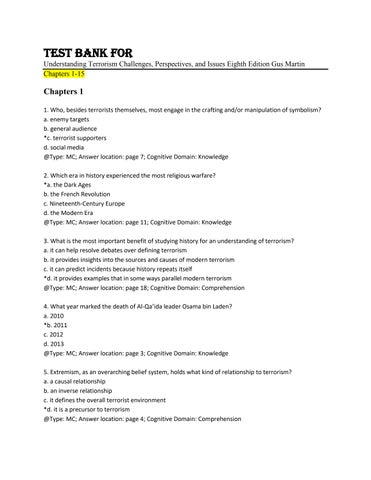
Chapters 1 1. Who, besides terrorists themselves, most engage in the crafting and/or manipulation of symbolism? a. enemy targets b. general audience *c. terrorist supporters d. social media @Type: MC; Answer location: page 7; Cognitive Domain: Knowledge 2. Which era in history experienced the most religious warfare? *a. the Dark Ages b. the French Revolution c. Nineteenth-Century Europe d. the Modern Era @Type: MC; Answer location: page 11; Cognitive Domain: Knowledge 3. What is the most important benefit of studying history for an understanding of terrorism? a. it can help resolve debates over defining terrorism b. it provides insights into the sources and causes of modern terrorism c. it can predict incidents because history repeats itself *d. it provides examples that in some ways parallel modern terrorism @Type: MC; Answer location: page 18; Cognitive Domain: Comprehension 4. What year marked the death of Al-Qa’ida leader Osama bin Laden? a. 2010 *b. 2011 c. 2012 d. 2013 @Type: MC; Answer location: page 3; Cognitive Domain: Knowledge 5. Extremism, as an overarching belief system, holds what kind of relationship to terrorism? a. a causal relationship b. an inverse relationship c. it defines the overall terrorist environment *d. it is a precursor to terrorism @Type: MC; Answer location: page 4; Cognitive Domain: Comprehension
6. Examples of “soft targets” given in the book include civilian targets and what else? a. schools b. churches c. leisure time facilities *d. administrative government targets @Type: MC; Answer location: page 5; Cognitive Domain: Knowledge 7. Who, besides terrorists themselves, most engage in the crafting and/or manipulation of symbolism? a. enemy targets b. general audience *c. terrorist supporters d. social media @Type: MC; Answer location: page 7; Cognitive Domain: Knowledge 8. If terrorism is considered to have no acceptable qualities, what term best applies to it? *a. mala in se b. mala prohibita c. unjust war d. intractable conflict @Type: MC; Answer location: page 7; Cognitive Domain: Knowledge 9. Which term refers to the correct conditions for waging war in the first place? a. jus in bello *b. jus ad bellum c. jus adminimum d. jus proportion @Type: MC; Answer location: page 8; Cognitive Domain: Knowledge 10. Which era in history experienced the most religious warfare? *a. the Dark Ages b. the French Revolution c. Nineteenth-Century Europe d. the Modern Era @Type: MC; Answer location: page 11; Cognitive Domain: Knowledge 11. What ancient people had their land ploughed with salt so the soil would remain forever desolate? a. Athenians *b. Carthaginians c. Whigs d. Zealots @Type: MC; Answer location: page 10; Cognitive Domain: Knowledge
12. Which two countries have revolutionary tribunals like those which existed during the French Revolution? a. Saudi Arabia and Somalia b. Belgium and Sweden *c. China and Iran d. Bosnia and Greece @Type: MC; Answer location: page 12; Cognitive Domain: Knowledge 13. Which famous anarchist anticipated the late-20th-century fear that terrorists might acquire weapons of mass destruction? a. Edmund Burke b. Guy Fawkes c. Joseph Guillot *d. Karl Heinzen @Type: MC; Answer location: page 12; Cognitive Domain: Knowledge 14. Who was one of the first terrorist groups to combine anarchism and Marxism? a. the Whigs b. the Luddites *c. the People’s Will d. the Jacobins @Type: MC; Answer location: page 13; Cognitive Domain: Knowledge 15. What kind of disguise did Anders Breivik use to commit his terrorist attacks in Norway? *a. a policeman b. a tour guide c. a musician d. an immigrant @Type: MC; Answer location: page 15; Cognitive Domain: Knowledge 16. The Unabomber, Ted Kaczynski, was arrested in a remote cabin in what state? a. Idaho *b. Montana c. Utah d. Washington @Type: MC; Answer location: page 16; Cognitive Domain: Knowledge 17. Ramzi Yousef, the mastermind behind the first World Trade Center bombing, had a college degree in what field of study? a. Early European literature b. Criminal justice *c. Computer-aided electrical engineering
d. Koranic studies @Type: MC; Answer location: page 17; Cognitive Domain: Knowledge 18. What is the most important benefit of studying history for an understanding of terrorism? a. it can help resolve debates over defining terrorism b. it provides insights into the sources and causes of modern terrorism c. it can predict incidents because history repeats itself *d. it provides examples that in some ways parallel modern terrorism @Type: MC; Answer location: page 18; Cognitive Domain: Comprehension 19. Behavior that we now define as terrorism is historically ancient. However, examples from the French Revolution and 19th-century Europe were arguably immediate precedents for modern terrorism. If you agree with this assessment, how so? If you disagree, how not? Explain your answer. @Type: E; Cognitive Domain: Analysis 20. Discuss the significance of symbolism as it pertains to the September 11, 2001 attacks on the American homeland. @Type: E; Cognitive Domain: Analysis 21. Is the “war on terrorism” truly a war? In your opinion, how has the New Terrorism affected and redefined how nations pursue warlike options? @Type: E; Cognitive Domain: Analysis 22. Compare and contrast the cases of Ramzi Yousef and the terrorist attacks on September 11, 2001. Discuss how their cases exemplify the threat of international terrorism in the United States. In your opinion, does the scale of violence committed in these incidents make either of them “more” or “less” acts of war than the other? Explain your answer. @Type: E; Cognitive Domain: Analysis 23. In your opinion, was the French Reign of Terror and other similar acts of violence arguably necessary to build a better future society? Explain your answer. @Type: E; Cognitive Domain: Analysis 24. Are all extremist beliefs inherently wrong and unnecessary, or are they sometimes correct and necessary? At what point should they be understood rather than rejected? @Type: E; Cognitive Domain: Analysis 25. Discuss the role of symbolism. Are the “objectification” or “dehumanization” of targets merely labels used to excuse political violence? @Type: E; Cognitive Domain: Analysis
26. Was the Second World War practice of “total war” by deliberately attacking civilian targets justifiable? Explain your answer. @Type: E; Cognitive Domain: Analysis 27. Describe a movement which in your opinion is a “freedom fighting” movement. Compare and contrast it with one which in your opinion is a “terrorist” movement. @Type: E; Cognitive Domain: Analysis 28. Briefly explain the significance of the attacks on September 11, 2001. @Type: E; Cognitive Domain: Analysis 29. Briefly describe how the modern era of terrorism differs from past eras. @Type: E; Cognitive Domain: Analysis 30. Why is it important to understand historical perspectives on terrorism? @Type: E; Cognitive Domain: Analysis 31. In your opinion, is the “just war doctrine” a legitimate reason to engage in violence? @Type: E; Cognitive Domain: Analysis 32. In your opinion, under what circumstances is political violence malum prohibitum violence? @Type: E; Cognitive Domain: Analysis 33. Is tyrannicide justifiable? @Type: E; Cognitive Domain: Analysis 34. In your opinion, are so-called “revolutionary courts” legitimate? @Type: E; Cognitive Domain: Analysis 35. In your opinion, is the modern war on terrorism justifiable? @Type: E; Cognitive Domain: Analysis 36. Was Guy Fawkes a terrorist? @Type: E; Cognitive Domain: Analysis 37. Is politically-motivated violence justifiable? @Type: E; Cognitive Domain: Analysis 38. The Just War doctrine condemns the use of violence for any reason. a. True *b. False @Type: TF; Cognitive Domain: Comprehension