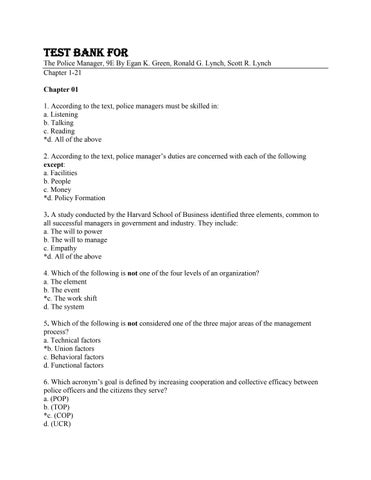
Test Bank For The Police Manager, 9E By Egan K. Green, Ronald G. Lynch, Scott R. Lynch Chapter 1-21 Chapter 01 1. According to the text, police managers must be skilled in: a. Listening b. Talking c. Reading *d. All of the above 2. According to the text, police manager’s duties are concerned with each of the following except: a. Facilities b. People c. Money *d. Policy Formation 3. A study conducted by the Harvard School of Business identified three elements, common to all successful managers in government and industry. They include: a. The will to power b. The will to manage c. Empathy *d. All of the above 4. Which of the following is not one of the four levels of an organization? a. The element b. The event *c. The work shift d. The system 5. Which of the following is not considered one of the three major areas of the management process? a. Technical factors *b. Union factors c. Behavioral factors d. Functional factors 6. Which acronym’s goal is defined by increasing cooperation and collective efficacy between police officers and the citizens they serve? a. (POP) b. (TOP) *c. (COP) d. (UCR)
7. What technological advances play a major role in socially isolating police officers from the communities they protect? a. Radar b. The radio c. The automobile *d. Both B and C 8. What was the response of some police agencies to poor community relations? *a. Reinstituting foot patrol b. Trying to reduce officer contact with citizens c. Giving officers permission to work off-duty jobs d. None of the above 9. According to the text, in which order did the history of management occur? a. Human relations management, systems management, scientific management b. Systems management, scientific management, human relations management *c. Scientific management, human relations management, systems management d. None of the above 10. For which philosophical approach to management is Frederick Taylor given credit? a. Systems management *b. Scientific management c. Human relations management d. Management by objectives 11. Taylor places emphasis on the formal administrative structure, which of the following is not a name of those administrative structures? a. Chain of command b. Authority *c. Improvement of labor d. Span of control 12. In 1935, Luther Gulick developed the acronym POSDCORB. What does this stand for? a. Planning, organizing, supervising, delegating, coordinating, reasoning, belonging b. Processing, solving, developing, coordinating, restructuring, belonging *c. Planning, organizing, staffing, directing, coordinating, reporting, and budgeting d. Political, organizations, designed, to solve, and correct, report, building 13. Who said there was a best method for each job? *a. Frederick Taylor b. Luther Gulick c. Douglas McGregor d. Abraham Maslow 14. There are four components that contribute to efficiency through scientific management. Which of the following is not one of those components?
a. Division of labor *b. Incentive pay c. Orderly arrangement of administrative units d. The use of a small span of control 15. The informal organizational structure consists of: a. The rumor process b. Cliques c. Informal status systems *d. All of the above 16. Sears Roebuck’s flat organizational structure emphasized: a. Scanning, analysis, response, and assessment b. A command chain that limits interaction between officers and the chief to assess only pressing issues *c. Careful selection, training, and placement of new employees d. Years of experience, education, and advancement of new employees 17. What is Abraham Maslow famous for developing? a. The organizational hierarchy b. Chain of command c. Both a and B *d. Hierarchy of needs 18. Douglas McGregor pointed out that the “soft” approach to management occasionally led to employees: a. Appreciating police managers more and as a result increased their respect b. Delegate their duties onto other officers *c. Expecting more and giving less in return d. Understanding operations better and giving more in return 19. Which of the following did the systems management approach not recognize? a. Authority and responsibility were essential b. Overall organization was required *c. Leadership positions can be mitigated and reduced if respect is present d. It is necessary to have some hierarchical arrangement to bring about cooperation and coordination 20. Theory X and Theory Y were developed by: a. Abraham Maslow b. Frederick Taylor c. Luther Gulick *d. Douglas McGregor
21. In 1964, R.R. Blake and J.S. Mouton emphasized two concerns that every
a. Concern for management b. Concern for production c. Concern for people *d. Both B and C 22. Frederick Taylor believed there was no one best way to do a job. a. True *b. False 23. The automobile and the radio weakened police relations with citizens. *a. True b. False 24. With Community-Oriented Policing, some departments re-instituted foot patrol. *a. True b. False 25. Luther Gulick is known as the “father of scientific management.” a. True *b. False 26. Elton Mayo emphasized time and motion studies. a. True *b. False Chapter 02 1. What are the two general types of motivators? a. personal and moral b. money and benefits c. economic and work conditions *d. personal and professional 2. What factors affect the salaries for the heads of law enforcement agencies? a. size of the community b. the affluence of the community c. the salary of the previous chief *d. all of the above 3. Which of the following is not defended by the union to some extent? a. Sergeant b. Lieutenant c. Entry-level officer *d. Chief 4. What are the three Ps that police chiefs have to deal with?
a. pensions, problems, and pay *b. politicians, the public, and the press c. policy, promises and promotions d. none of the above 5. Lawrence W. Sherman reported that some popular crime prevention programs had been evaluated and found to be ineffective. What was the result of this finding? a. The funding was immediately halted *b. Nothing, the funding continued regardless of this finding c. Chiefs utilizing such programs were ordered to evaluate every week with CompStat meetings d. Research institutions reevaluated what was functional and provided an updated program 6. A philosophy is defined as: a. a course of action *b. values, beliefs, and principles c. interests and concerns d. standards and guidelines 7. According to the text, what should follow policies, decisions, practices, and procedures? a. decisions *b. principles c. policy manuals d. commitment 8. According to the text, principles are best stated in: *a. a policy manual b. memoranda c. standard operating procedures d. postings on the bulletin board 9. According to the text, a few general principles are better than a long list, because: a. it is easier to understand and adhere to a few b. development of a long list could create conflict between principles c. none of the above *d. both a and b 10. To be successfully translated into results, principles must be reflected in: a. daily decision making b. actions and behaviors c. actions and behaviors of the chief *d. all of the above 11. Examples of how values, beliefs, and principles can be reflected in actions and behavior include: *a. Daily decision making, routine activities, standards, and policies and procedures b. Policies and standards only