Test Bank For All Chapters
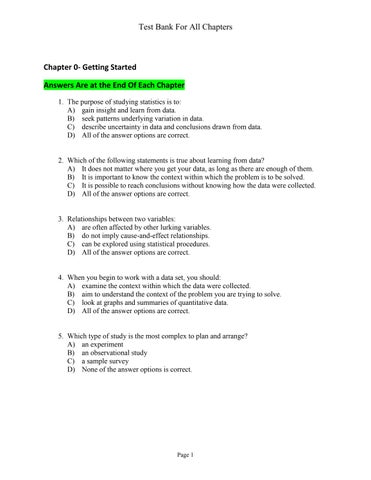
Chapter 0- Getting Started Answers Are at the End Of Each Chapter 1. The purpose of studying statistics is to: A) gain insight and learn from data. B) seek patterns underlying variation in data. C) describe uncertainty in data and conclusions drawn from data. D) All of the answer options are correct.
2. Which of the following statements is true about learning from data? A) It does not matter where you get your data, as long as there are enough of them. B) It is important to know the context within which the problem is to be solved. C) It is possible to reach conclusions without knowing how the data were collected. D) All of the answer options are correct.
3. Relationships between two variables: A) are often affected by other lurking variables. B) do not imply cause-and-effect relationships. C) can be explored using statistical procedures. D) All of the answer options are correct.
4. When you begin to work with a data set, you should: A) examine the context within which the data were collected. B) aim to understand the context of the problem you are trying to solve. C) look at graphs and summaries of quantitative data. D) All of the answer options are correct.
5. Which type of study is the most complex to plan and arrange? A) an experiment B) an observational study C) a sample survey D) None of the answer options is correct.
Page 1
6. Which type of study is a subset of one of the other types? A) an experiment B) an observational study C) a sample survey D) None of the answer options is correct.
7. Drawing conclusions about the greater world based on examining patterns in variation within a sample of data is called: A) data analysis. B) data production. C) statistical inference. D) None of the answer options is correct.
8. Describing data using graphs and quantitative summaries is part of: A) data analysis. B) data production. C) statistical inference. D) None of the answer options is correct. 9. Which four-step process answers the question ―What do the data tell me?‖ A) Plan your work; solve with graphs and calculations; check accuracy; and state conclusions. B) Plan your work; state a problem in context; state conclusions; and show graphs and calculations. C) State a problem in context; plan your work; solve with graphs and calculations; and state conclusions. D) State a problem in context; solve with graphs and conclusions; check accuracy; and state conclusions.
10. Which of the following statements is true about variation? A) Variation indicates that there is a problem with the data. B) Variation is common in data sets. C) There is usually only one source of variation. D) All of the answer options are correct.
Page 2
11. Which of the following is true? A) Because variation is everywhere, conclusions can be made with certainty. B) Statistics gives us a language that is used and understood by some statistically literate people. C) Statistics allows us to say how confident we are about a finding based on a clinical trial. D) A clinical trial allows us to be certain that a vaccine reduces risk.
12. It is unethical to use randomized studies to expose humans to harmful substances. Observational studies, where we compare those exposed to those not exposed, are sometimes used in such situations. Which statement describes a possibly misleading finding from such a study? A) We can safely compare those exposed to those not exposed, as long as we have enough study subjects. B) We have to be concerned about lurking variables, which might lead us to erroneously conclude that the compound is causing the disease. C) If we do not carry out a randomized study, we can be sure that lurking variables will mislead us. D) On average, an observational study will provide us with the correct conclusion.
13. If we want to study the effect of social media on the GPAs of college freshmen, the best study is: A) a survey to be conducted online at the end of freshman year, in which we ask students how much time they spent on sites such as Facebook and we record their GPAs. B) an observational study that compares the GPAs of a group of freshmen who were observed to have spent at least three hours per day on social media to those who spent less than 30 minutes per day. C) a study that recruits volunteers who agreed to spend at least two hours per day on social media and another group of volunteers who agreed to spend no more than 30 minutes per day on social media. D) None of the answer options is correct.
14. If we want to study the reasons that students binge drink, we should: A) randomly assign students to a group that is allowed to binge drink. B) observe which students binge drink and which students do not, and see if we can identify any differences. C) do a survey of students, asking about binge drinking and their reasons for doing so. D) None of the answer options is correct.
Page 3
15. A PhD student in Education wants to study the relationship between the time spent studying and the grade received. He obtains research funding and recruits 30 students each in three majors. He then randomly assigns each student to study 0.5 hours, 1 hour, 1.5 hours, or 2 hours per day for the subject. At the end of the semester, he should do the following with the data: A) plot numerical grade received against time studied. B) calculate averages for each time group and, if different, declare that time studied determines grade received. C) look at variability in grades received. If students in different time groups have the same grade, he should conclude that there is no relationship between time studied and grade received. D) None of the answer options is correct.
Page 4
Answer Key 1. D 2. B 3. D 4. D 5. A 6. C 7. C 8. A 9. C 10. B 11. C 12. B 13. D 14. C 15. A
1. Employees at a large company are surveyed about their health insurance status. Employees are coded as ―1‖ if health insurance is obtained through the company's benefit program, ―2‖ if health insurance is obtained from another source (such as through a spouse's employment benefit program), or ―0‖ if the employee does not have health insurance. This variable is: A) numerical. B) categorical. C) quantitatively categorical. D) All of the answer options are correct.
2. A company has three divisions and three conference rooms for meetings. To keep track of the use of their facilities, for each meeting the company records the name of the division holding the meeting, the conference room used, and the length of time of the meeting. Which of the variables is quantitative? A) the name of the division holding the meeting B) the conference room used C) the length of time of the meeting D) All of the answer options are correct.
Page 5