Test Bank For Sorrentino's Canadian Textbook for the Support Worker 5th Edition by Mary J. Wilk Chapter 1-47
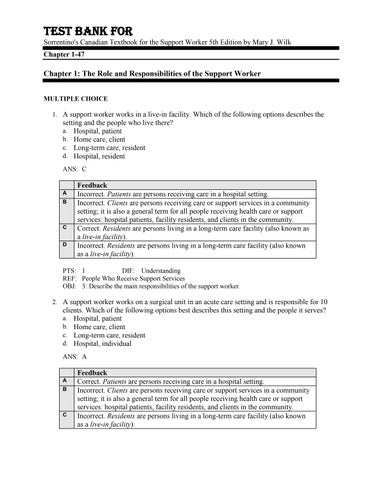
Chapter 1: The Role and Responsibilities of the Support Worker MULTIPLE CHOICE 1. A support worker works in a live-in facility. Which of the following options describes the
setting and the people who live there? a. Hospital, patient b. Home care, client c. Long-term care, resident d. Hospital, resident ANS: C
A B
C D
Feedback Incorrect. Patients are persons receiving care in a hospital setting. Incorrect. Clients are persons receiving care or support services in a community setting; it is also a general term for all people receiving health care or support services: hospital patients, facility residents, and clients in the community. Correct. Residents are persons living in a long-term care facility (also known as a live-in facility). Incorrect. Residents are persons living in a long-term care facility (also known as a live-in facility).
PTS: 1 DIF: Understanding REF: People Who Receive Support Services OBJ: 3: Describe the main responsibilities of the support worker. 2. A support worker works on a surgical unit in an acute care setting and is responsible for 10
clients. Which of the following options best describes this setting and the people it serves? a. Hospital, patient b. Home care, client c. Long-term care, resident d. Hospital, individual ANS: A
A B
C
Feedback Correct. Patients are persons receiving care in a hospital setting. Incorrect. Clients are persons receiving care or support services in a community setting; it is also a general term for all people receiving health care or support services: hospital patients, facility residents, and clients in the community. Incorrect. Residents are persons living in a long-term care facility (also known as a live-in facility).
D
Incorrect. Individuals are single human beings, distinct from a family or group.
PTS: 1 DIF: Understanding REF: People Who Receive Support Services OBJ: 3: Describe the main responsibilities of the support worker. 3. A support worker travels to Mrs. Eaton‘s home and must perform the following tasks with the
client: bathing, feeding, laundry, and cleaning the kitchen. Which of the following tasks represent activities of daily living (ADLs) and which ones instrumental activity of daily living (IADLs)? a. ADLs: Laundry, feeding, bathing for client every day IADLs: Light housekeeping for client every day b. ADLs: Feeding and bathing for client every day IADLs: Laundry and light housekeeping for client every day c. ADLs: Laundry, feeding, bathing for client some days IADLs: Light housekeeping for client some days d. ADLs: Feeding and bathing for client some days IADLs: Laundry and light housekeeping for client some days ANS: B
A
B
C
D
Feedback Incorrect. Laundry is not a self-care activity; it is an instrumental activity of daily living (IADL). Feeding and bathing are self-care activities; they are activities of daily living (ADL). Light housekeeping is not self-care; it is an IADL. Correct. Feeding and bathing are self-care activities; they are ADLs that people perform to remain independent and to function effectively in society. Laundry and light housekeeping are not self-care activities; they are instrumental activities of daily living (IADL). Incorrect. Laundry and is not a self-care activity; it is an instrumental activity of daily living (IADL). Feeding and bathing are self-care activities; they are activities of daily living (ADL). Light housekeeping is not self-care; it is an IADL. ADLs are performed daily, not some days. Incorrect. Feeding and bathing are self-care activities; they are ADLs that people perform to remain independent and to function effectively in society. Laundry and light housekeeping are not self-care activities; they are instrumental activities of daily living (IADL). ADLs are performed daily, not some days.
PTS: 1 DIF: Analyzing REF: Personal Care OBJ: 4: Differentiate between activities of daily living (ADLs) and instrumental activities of daily living (IADLs). 4. A 72-year-old woman is a new admission to a live-in facility. She and her family need an
introduction to the facility and assistance with unpacking her belongings. The support worker should: a. Refer the woman and family to the physician for assistance. b. Assist the woman and family with these activities. c. Refer the woman and her family to the registered nurse for assistance.
d. Assist the nurse with these activities. ANS: B
A B
C
D
Feedback Incorrect. The physician diagnoses and treats clients with illnesses and injuries. Correct. In many facilities, support workers assist with admissions and discharges by introducing the client and family to the facility and helping the client unpack and settle in. Support workers may help clients participate in social activities. Incorrect. The nurse assesses; makes nursing diagnoses; plans, implements, and evaluates nursing care; tends to clients with unstable health conditions; provides direct client care; administers medications; and supervises support workers. Incorrect. The nurse is not responsible for these activities. Support workers assist nurses or other health care team members by following the established care plan for each client.
PTS: 1 DIF: Analyzing REF: Personal Care OBJ: 6: Describe the importance of understanding the roles and responsibilities of support work. 5. Which statement best describes the aging process? a. Social and emotional changes always happen with older persons. b. All older persons eventually move into live-in facilities. c. Many older persons enjoy good health. d. Aging is considered an illness. ANS: C
A B C D
Feedback Incorrect. Social and emotional changes may occur with aging, but not always. Incorrect. Not all older persons move into live-in facilities; some stay in their own homes. Correct. Aging is a normal process and is not an illness or disease. Incorrect. Aging is a normal process and is not considered an illness or disease.
PTS: 1 DIF: Understanding REF: People Who Receive Support Services OBJ: 8: List the principles of client-centred care. 6. Which statement accurately describes people living with disabilities due to illness, injury, or
conditions present at birth? a. Many adults with disabilities live in their own homes. b. All adult disabilities are the result of an illness. c. All adult disabilities are the result of an accident. d. Disabilities do not affect mental functions. ANS: A
A B
Feedback Correct. Many adults with disabilities live in their own homes. Incorrect. Disabilities may result from an illness, but not always.
C D
Incorrect. Disabilities may result from an accident, but not always. Incorrect. Disabilities may affect physical functions, mental functions, or both.
PTS: 1 DIF: Understanding REF: People Who Receive Support Services OBJ: 3: Describe the main responsibilities of the support worker. 7. Which of the following statements is true about regulated professions? a. Support workers belong to a regulated profession. b. A regulated profession is governed by the Canadian government. c. A regulated profession has a professional organization called a college. d. There are no official requirements for education in regulated professions. ANS: C
A B C D
Feedback Incorrect. Support workers are unregulated health care providers. Incorrect. A regulated profession is self-regulated by its members. Correct. The professional organization that regulates a profession is called a college. Incorrect. There are requirements for education and licensing.
PTS: 1 DIF: Applying REF: Regulated and Unregulated Workers OBJ: 5: Distinguish between regulated and unregulated health care providers. 8. Joanne is a support worker graduate and is not sure of her scope of practice. Which of the
following sources would provide Joanne with information regarding her scope of practice? a. College of Nurses of Ontario b. Written policies from her current employer c. Her co-worker who has been on the job for 25 years d. Her school classmate who always has the answers ANS: B
A B C D
Feedback Incorrect. This is the regulatory body for nurses only. Correct. Three sources include educational programs, employer policies, and supervisors. Incorrect. Although her co-worker is potentially a good source of information, they are not an official source. Incorrect. Her school classmate is not a reliable source.
PTS: 1 DIF: Understanding REF: Scope of Practice OBJ: 6: Describe the importance of understanding the roles and responsibilities of support work. 9. Jenny is a support worker who has been hired directly by Mrs. Shaver to help take care of Mr.
Shaver, her husband. Who does Jenny report to? a. Dr. Tam, Mr. Shaver‘s physician b. Irene, the registered nurse who works with Dr. Tam c. Mrs. Shaver, her employer
d. Steve, Mr. Shaver‘s respiratory therapist ANS: C
A B
C D
Feedback Incorrect. Mrs. Shaver hired Jenny and is her employer, so Jenny must report to her. Incorrect. Although nurses supervise and lead support workers in most cases, the nurse is not who Jenny reports to in this case, because Jenny was hired and is being supervised directly by the client. Correct. Some support workers are hired and supervised by clients. Incorrect. The respiratory therapist focuses on rehabilitation; assists in treatment of lung and heart disorders; and gives respiratory treatments and therapies. However, Jenny does not report to him because he is not her employer.
PTS: 1 DIF: Understanding REF: The Supervision of Support Workers OBJ: 2: Identify the role support workers play within the health care team. 10. Which of the following actions demonstrates that Pradeep, a support worker, is able to
maintain his professionalism when faced with a heavier-than-usual workload? a. He does the work and keeps his feelings to himself until break time, when he talks about his anger with a close friend. b. He refuses to do the extra work assigned to him and walks off the unit. c. He speaks with his supervisor to share his concern about being able to safely carry out his assignment. d. He writes a letter of complaint to his employer, describing the unfair working conditions. ANS: C
A B C D
Feedback Incorrect. This action does not show a positive attitude, may not maintain discretion or confidentiality, and is not professional. Incorrect. This action could be considered abandoning or neglecting clients and is not considered professional. Correct. If done in a polite way, this approach is professional. Incorrect. Complaining has a negative effect, and writing a letter would indicate that the reaction is too late, leaving the employer unable to respond in a timely manner.
PTS: 1 DIF: Understanding REF: Being a Professional OBJ: 7: Describe the significance of having a professional approach to support work. 11. Which one of the following teams is most likely to include support workers? a. The health care team b. The board of trustees c. The case management team d. The nursing team ANS: A