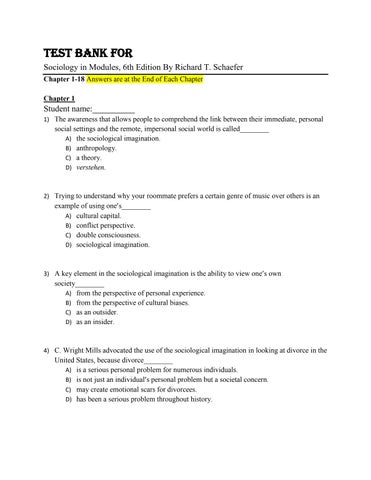
Test Bank for Sociology in Modules, 6th Edition By Richard T. Schaefer Chapter 1-18 Answers are at the End of Each Chapter Chapter 1
Student name:__________ 1) The awareness that allows people to comprehend the link between their immediate, personal
social settings and the remote, impersonal social world is called________ A) the sociological imagination. B) anthropology. C) a theory. D) verstehen.
2) Trying to understand why your roommate prefers a certain genre of music over others is an
example of using one’s________ A) cultural capital. B) conflict perspective. C) double consciousness. D) sociological imagination.
3) A key element in the sociological imagination is the ability to view one’s own
society________ A) from the perspective of personal experience. B) from the perspective of cultural biases. C) as an outsider. D) as an insider.
4) C. Wright Mills advocated the use of the sociological imagination in looking at divorce in the
United States, because divorce________ A) is a serious personal problem for numerous individuals. B) is not just an individual’s personal problem but a societal concern. C) may create emotional scars for divorcees. D) has been a serious problem throughout history.
5) The scientific study of social behavior and human groups is known as________ A) psychology. B) political science. C) anthropology. D) sociology.
6) The body of knowledge obtained by using methods based on systematic observation is called
a(n)________ A) theory. B) verstehen. C) science. D) ideal type.
7) Sociology is considered a science because sociologists________ A) teach at respected universities. B) engage in organized and systematic study of phenomena to enhance understanding. C) receive government funding for research projects. D) construct middle-range theories to explain social behavior.
8) Sociology, anthropology, economics, and history are fields within the________ A) natural sciences. B) social sciences. C) medical sciences. D) humanities.
9) Which academic discipline studies the influence of society on people’s attitudes and behavior
and the ways in which people shape society? A) anthropology B) economics C) sociology D) physics
10) Which social science would be interested in studying individual cases of emotional stress
among workers, investors, and business owners? A) history B) economics C) sociology D) psychology
11) While psychologists would look at the issue of climate change by studying its impact on the
well-being of individuals who live and work in areas most vulnerable to it, sociologists would more likely study how climate change impacts________ A) various parts of the population more than others due to economic, social, or political dynamics. B) which politicians get elected based on their positions on climate change. C) long-term economic growth and well-being. D) the stock market and investments in retirement accounts.
12) Of the following, a social scientist would be most likely to study the________ A) composition of a meteorite discovered in a remote area of Siberia. B) reasons for the decreasing divorce rate in the United States. C) newest procedure in heart transplant surgery. D) possibility of life on Mars.
13) Sociologists argue that, unlike scientific knowledge, commonsense conclusions are
not________ A) published. B) reliable. C) politically correct. D) easily disseminated.
14) An attempt to explain problems, actions, or behavior in a comprehensive manner is called
a(n)________ A) science. B) typology. C) theory. D) ideal type.
15) In Émile Durkheim’s study of suicide, he related suicide rates to________ A) divorce rates. B) the genetic predisposition for depression. C) the extent to which people were integrated into the group life of a society. D) climatic conditions such as oppressive heat, heavy rain, and cold winters.
16) Émile Durkheim’s explanation of suicide was scientific because he________ A) developed conclusions based on a systematic examination of data. B) carefully studied the personalities of hundreds of suicide victims. C) worked in a university setting. D) divided suicide into four distinctive categories.
17) Émile Durkheim developed a classic sociological study of________ A) suicide. B) abortion. C) soccer. D) crowd control.
18) The discipline of sociology was given its name by the French thinker________ A) Émile Durkheim. B) Auguste Comte. C) Harriet Martineau. D) Marcel Marceau.
19) Which sociologist translated the works of Auguste Comte into English and emphasized the
impact economies, laws, trade, and population could have on contemporary social problems? A) Émile Durkheim B) Jane Addams C) Harriet Martineau D) Talcott Parsons
20) Which early sociologist applied the concept of evolution to societies in order to explain how
they change over time? A) Émile Durkheim B) Charles Darwin C) Harriet Martineau D) Herbert Spencer
21) Anomie refers to a________ A) construct or model for evaluating specific cases. B) loss of direction that is felt in a society when social control of individual behavior has
become ineffective. C) classification scheme containing two or more categories. D) type of suicide caused by depression.
22) The concept of anomie was introduced into sociology by________ A) Auguste Comte. B) Émile Durkheim. C) Max Weber. D) C. Wright Mills.
23) The concept that Max Weber used to stress the need for sociologists to take into account
people’s emotions, thoughts, beliefs, understandings, and attitudes was________ A) verstehen. B) cultural capital. C) anomie. D) social capital.