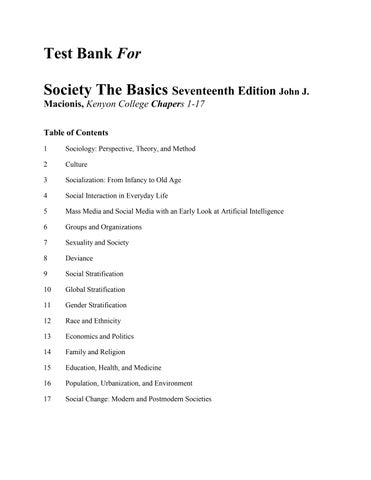
Test Bank For Society The Basics Seventeenth Edition John J. Macionis, Kenyon College Chapers 1-17 Table of Contents 1
Sociology: Perspective, Theory, and Method
2
Culture
3
Socialization: From Infancy to Old Age
4
Social Interaction in Everyday Life
5
Mass Media and Social Media with an Early Look at Artificial Intelligence
6
Groups and Organizations
7
Sexuality and Society
8
Deviance
9
Social Stratification
10
Global Stratification
11
Gender Stratification
12
Race and Ethnicity
13
Economics and Politics
14
Family and Religion
15
Education, Health, and Medicine
16
Population, Urbanization, and Environment
17
Social Change: Modern and Postmodern Societies
Chaper 1: Sociology: Perspective, Theory, and Method In this revision of the test bank, I have updated all of the questions to reflect changes in Society: The Basics, Seventeenth Edition and increased the number of questions by 50 percent so that this test bank covers all the new material that has been added and better meets your needs. The questions are tagged according to four levels of learning that move from lower-level to higher-level cognitive reasoning. The four levels: Recollection: a question involving recall of key terms or factual material Understanding: a question testing comprehension of more complex ideas Application: a question applying sociological knowledge to some new situation Analysis: a question requiring identifying elements of an argument and their interrelationship The 279 questions in this chaper‘s test bank are divided into four types. True/False questions are the least demanding. As the table below shows, two-thirds of these are ―Recollection‖ questions, and all of them fall within the lowest three levels of cognitive reasoning (―Recollection,‖ ―Understanding,‖ and ―Application‖). Multiple-choice questions span a broader range of skills (almost half are ―Recollection‖ questions and the remainder are divided among the three higher levels). Short-answer questions also span a broad range of skills (from ―Understanding‖ to ―Analysis‖). Finally, essay questions are the most demanding because they require analysis and other higher levels of cognitive reasoning. Types of Questions True/False
Multiple Choice
Short Answer
Essay
Total Qs
60 (70%)
71 (49%)
6 (19%)
0
137
Understanding 19 (22%)
22 (15%)
9 (28%)
0
50
Application
7 (8%)
30 (20%)
5 (16%)
3 (20%)
45
Analysis
0
23 (16%)
12 (38%)
12 (80%)
47
86
146
32
15
279
Recollection
Chaper 1: Sociology: Perspective, Theory, and Method TRUE/FALSE QUESTIONS Most people in the United States marry partners whose racial and ethnic identity differs from their own. Answer: False Learning Objective: LO 1.1: Apply the sociological perspective to show how society shapes our individual lives. Topic: The Sociological Perspective Difficulty Level: Easy Skill Level: Recollection According to sociologists, human behavior mostly reflects our personal ―free will.‖ Answer: False Learning Objective: LO 1.1: Apply the sociological perspective to show how society shapes our individual lives. Topic: The Sociological Perspective Difficulty Level: Easy Skill Level: Recollection Sociology is defined as the systematic study of human society. Answer: True Learning Objective: LO 1.1: Apply the sociological perspective to show how society shapes our individual lives. Topic: The Sociological Perspective Difficulty Level: Easy Skill Level: Recollection Sociologists focus only on unusual or unexpected patterns of behavior. Answer: False
Learning Objective: LO 1.1: Apply the sociological perspective to show how society shapes our individual lives. Topic: The Sociological Perspective Difficulty Level: Easy Skill Level: Recollection Using the sociological perspective, we would look at society based on the assumption that people‘s lives are mostly a result of what they, as individuals, decide to do. Answer: False Learning Objective: LO 1.1: Apply the sociological perspective to show how society shapes our individual lives. Topic: The Sociological Perspective Difficulty Level: Moderate Skill Level: Application On average, college students in the United States come from families with aboveaverage incomes. Answer: True Learning Objective: LO 1.1: Apply the sociological perspective to show how society shapes our individual lives. Topic: The Sociological Perspective Difficulty Level: Easy Skill Level: Recollection Emile Durkheim provided evidence that categories of people with weaker social ties have lower suicide rates than people with stronger social ties. Answer: False Learning Objective: LO 1.1: Apply the sociological perspective to show how society shapes our individual lives. Topic: The Sociological Perspective Difficulty Level: Moderate
Skill Level: Recollection In the United States, Black people have a higher suicide rate than White people. Answer: False Learning Objective: LO 1.1: Apply the sociological perspective to show how society shapes our individual lives. Topic: The Sociological Perspective Difficulty Level: Easy Skill Level: Recollection In the United States, men have a higher suicide rate than women. Answer: True Learning Objective: LO 1.1: Apply the sociological perspective to show how society shapes our individual lives. Topic: The Sociological Perspective Difficulty Level: Easy Skill Level: Recollection In the United States, White people have a lower suicide rate than people who identify as Hispanic. Answer: False Learning Objective: LO 1.1: Apply the sociological perspective to show how society shapes our individual lives. Topic: The Sociological Perspective Difficulty Level: Easy Skill Level: Recollection People with lower social standing are usually more likely to see the world from a sociological perspective than people who are well off. Answer: True Learning Objective: LO 1.1: Apply the sociological perspective to show how society shapes our individual lives.