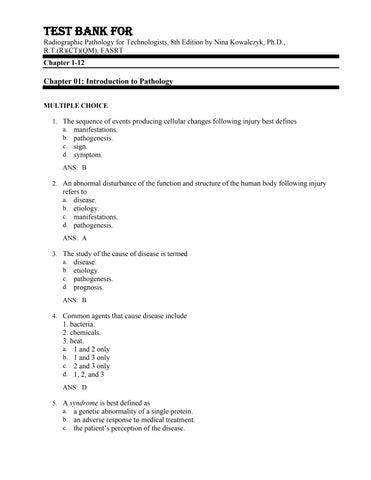
Test Bank For Radiographic Pathology for Technologists, 8th Edition by Nina Kowalczyk, Ph.D., R.T.(R)(CT)(QM), FASRT Chapter 1-12
Chapter 01: Introduction to Pathology MULTIPLE CHOICE 1. The sequence of events producing cellular changes following injury best defines a. manifestations. b. pathogenesis. c. sign. d. symptom. ANS: B 2. An abnormal disturbance of the function and structure of the human body following injury
refers to a. disease. b. etiology. c. manifestations. d. pathogenesis. ANS: A 3. The study of the cause of disease is termed a. disease. b. etiology. c. pathogenesis. d. prognosis. ANS: B 4. Common agents that cause disease include
1. bacteria. 2. chemicals. 3. heat. a. 1 and 2 only b. 1 and 3 only c. 2 and 3 only d. 1, 2, and 3 ANS: D 5. A syndrome is best defined as a. a genetic abnormality of a single protein. b. an adverse response to medical treatment. c. the patient’s perception of the disease.
d. signs and symptoms that characterize a specific abnormal disturbance. ANS: D 6. An adverse response to medical treatment itself is termed a. autoimmune. b. iatrogenic. c. idiopathic. d. nosocomial. ANS: B 7. Prognosis refers to a. diseases usually having a quick onset. b. the name of the particular disease. c. the predicted course and outcome of the disease. d. the structure of cells or tissue. ANS: C 8. Diseases that generally require a decrease in the exposure technique are considered a. destructive. b. lytic. c. subtractive. d. All of the above. ANS: D 9. The investigation of disease occurring in large groups best defines a. epidemiology. b. incidence. c. prevalence. d. All of the above. ANS: A 10. Data regarding the number of deaths caused by a particular disease averaged over a population
are collected and reported by the a. American College of Radiology. b. Centers for Disease Control. c. Food and Drug Administration. d. National Center for Health Statistics. ANS: D 11. Which of the following are leading causes of death in the United States for adults aged 45
years and greater? 1. Heart disease 2. Malignant neoplasm 3. Polycystic kidney disease a. 1 and 2 only b. 1 and 3 only c. 2 and 3 only
d. 1, 2, and 3 ANS: A 12. In 2018 health spending accounted for approximately _____% of the US gross domestic
product. a. 12.5 b. 17.7 c. 21.8 d. 33.9 ANS: B 13. Each cell in the human body, except the reproductive cells, contains _____ pairs of autosomal
chromosomes, _____ sex chromosomes. a. 11, 1 b. 11, 2 c. 22, 1 d. 22, 2 ANS: D 14. The types of gene maps that grew out of the identification of DNA sequences include
1. genetic maps. 2. SNP maps. 3. physical maps. a. 1 and 2 only b. 1 and 3 only c. 2 and 3 only d. 1, 2, and 3 ANS: B 15. The identification of common DNA pattern sequences and common patterns of genetic
variations of single DNA bases resulted in a. the Genome Project. b. genetic linkage maps. c. haplotype mapping. d. physical mapping. ANS: C 16. Diseases that are present at birth from genetic or environmental factors are classified as a. congenital. b. degenerative. c. genetic. d. metabolic. ANS: A 17. A genetic disorder caused by an abnormality on one of the 22 non-sex chromosomes is
considered a. autosomal.
b. dominant. c. recessive. d. sex linked. ANS: A 18. A protein coat surrounding a genome of either RNA or DNA without an organized cellular
structure best describes which type of microorganism? a. Bacteria b. Fungi c. Virus d. All of the above ANS: C 19. The ease with which a pathogenic organism can overcome the body’s defenses best describes a. etiology. b. infection. c. pathogenesis. d. virulence. ANS: D 20. Diseases caused by the disturbance of normal physiologic function are classified as a. degenerative. b. metabolic. c. neoplastic. d. traumatic. ANS: B 21. The lymph node into which the primary neoplasm drains during metastasis is termed the
_____ node. a. primary b. sentinel c. metastatic d. neoplastic ANS: B 22. The spread of cancerous cells into surrounding tissue by virtue of the close proximity best
describes a. lymphatic spread. b. hematogenous spread. c. invasion. d. oncogenesis. ANS: C 23. Cancer originating in epithelial tissue is termed a. carcinoma. b. leukemia. c. lymphoma.
d. sarcoma. ANS: A 24. In classification of a tumor using the TNM system, the T refers to the a. size of the primary tumor. b. lymph node involvement. c. distant metastasis. d. histologic grading of the primary tumor. ANS: A 25. Which of the following imaging modalities are used in the staging of neoplastic tumors?
1. CT 2. PET 3. MRI a. 1 and 2 only b. 1 and 3 only c. 2 and 3 only d. 1, 2, and 3 ANS: D 26. In the treatment of neoplastic disease, interferons and interleukins are associated with a. chemotherapy. b. radiation therapy. c. hormone therapy. d. immunotherapy. ANS: D MATCHING
Match the type of altered cell biology with the correct description. a. A generalized decrease in cell size b. A generalized increase in cell size c. An increase in the number of cells in tissue as a result of excessive proliferation d. Conversion of one cell type into another cell type e. Abnormal changes of mature cells 1. 2. 3. 4. 5.
Hypertrophy Atrophy Metaplasia Hyperplasia Dysplasia
1. 2. 3. 4. 5.
ANS: B ANS: A ANS: D ANS: C ANS: E
TRUE/FALSE 1. A tumor consisting of differentiated cells has a higher probability for malignancy. ANS: F 2. A histologic evaluation of a primary cancer that is graded as an “I” is considered well
differentiated. ANS: T
Chapter 02: Skeletal System Kowalczyk: Radiographic Pathology for Technologists, 8th Edition MULTIPLE CHOICE 1. Which primary bone tumor should be investigated with the utilization of CT? a. Osteosarcoma b. Osteoid osteoma c. Chondrosarcoma d. Ewing sarcoma ANS: B 2. Which of the following characteristics does NOT assist in the differentiation between a
primary metastatic bone lesion as compared to a secondary metastatic bone lesion? a. Soft tissue mass b. Periosteal reaction c. Length of lesion d. Calcification of blood vessels
ANS: D 3. What skeletal pathology presents radiographically with a “soap bubble” appearance? a. Giant cell tumor b. Ewing sarcoma c. Osteoid osteoma d. Osteoblastoma ANS: A 4. Osteopetrosis requires what type of technical factor change? a. Increase b. Decrease c. No change ANS: A 5. Which neoplasm involves a nidus? a. Osteoid osteoma b. Osteoblastoma c. Osteosarcoma d. Paget disease ANS: A 6. Which disease is congenital? a. Pott disease b. Osteoporosis c. Paget disease d. Osteogenesis imperfecta ANS: D 7. Diploë is specific to cancellous bone located in what anatomic structure? a. Femur b. Humerus c. Sternum d. Skull ANS: D 8. A 15-year-old male patient presents for a right knee series after sustaining a varus injury while
playing football. AP, lateral, and both oblique radiographs of the knee demonstrate an avulsion fracture of the lateral tibial plateau (Segond fracture). What additional imaging modality would be best utilized in the diagnosis for this patient? a. CT b. Knee arthrography c. MRI d. Nuclear medicine ANS: C 9. Heberden nodes and Bouchard nodes are associated with what skeletal pathology?