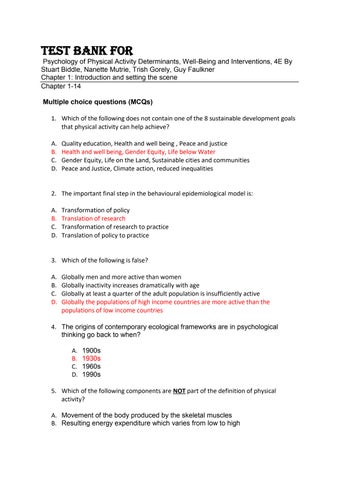
Test Bank For Psychology of Physical Activity Determinants, Well-Being and Interventions, 4E By Stuart Biddle, Nanette Mutrie, Trish Gorely, Guy Faulkner Chapter 1: Introduction and setting the scene Chapter 1-14 Multiple choice questions (MCQs) 1. Which of the following does not contain one of the 8 sustainable development goals that physical activity can help achieve? A. Quality education, Health and well being , Peace and justice B. Health and well being, Gender Equity, Life below Water C. Gender Equity, Life on the Land, Sustainable cities and communities D. Peace and Justice, Climate action, reduced inequalities
2. The important final step in the behavioural epidemiological model is: A. Transformation of policy B. Translation of research C. Transformation of research to practice D. Translation of policy to practice
3. Which of the following is false? A. Globally men and more active than women B. Globally inactivity increases dramatically with age C. Globally at least a quarter of the adult population is insufficiently active D. Globally the populations of high income countries are more active than the populations of low income countries 4. The origins of contemporary ecological frameworks are in psychological thinking go back to when? A. 1900s B. 1930s C. 1960s D. 1990s 5. Which of the following components are NOT part of the definition of physical activity? A. Movement of the body produced by the skeletal muscles B. Resulting energy expenditure which varies from low to high
C. A positive correlation with physical fitness. D. Associated with competition Other learning tasks 1. Choose two of the milestones depicted in Figure 1.1. Make these milestones at least one decade apart. For each milestone provide: a. In 100 words or less describe the output [ for example give the authors and journal citation and summarise the findings or the message from this output] b. In 100 words or less say why you think this has been selected as in important milestone in the history of physical activity for health 2.
Search for your own Physical Activity country card here :
http://new.globalphysicalactivityobservatory.com/countrycards/
a. For your own country there should be a current and previous version of the card. Note any improvements that you can see from the previous card to the current card. What improvements you would like to see over the next 5 years on any of the data presented on the current card? b. Select another country of your choice and write a short report [500 words] on the differences you can note [eg overall prevalence rate, gender gap ] between the two countries. Note some possible reasons for the differences you observe.
Chapter 2: PHYSICAL ACTIVITY AND PSYCHOLOGICAL WELL-BEING Multiple choice questions (MCQs) Question 1. This chapter reviews the evidence on the links between physical activity and psychological well-being, looking at which combination of these four items: 1) Depression, 2) Mood, 3) Self-esteem, and 4) „core‟ affect? a) 1 and 2 b) 3 and 4. c) 2 and 4 d) 1 and 4. Question 2. Rejeski et al. (1996) suggest that it is typical for health-related quality of life (HRQoL) to be defined in terms of participants‟ perceptions of function. They outline six types of HRQoL measures, but which one of the below is NOT one of those measures? a) Global indices of HRQL b) Physical symptoms c) Social function d) Spiritual function Question 3. Which measure of HRQoL uses a visual analogue scale ranging from „worst imaginable health state‟ (score = 0) to „best imaginable health state‟ (score = 100)? a) EQ-5D. b) SF-12. c) SF-36. d) QALY - 24. Question 4. What is defined as “global set of affective (feeling) states we experience on a day-today basis and may last hours, days, weeks, or even months”? a) Affect b) Emotion c) Mood d) Arousal Question 5. Evidence suggests that maintenance of physical activity is best predicted by which affective states? a) Those before exercise b) Those during exercise c) Those after exercise d) None of the above
Question 6. Which of the below is not one of the approaches to enjoyment identified that are relevant to health-related physical activity? a) Intrinsic motivational processes b) Csikzentmihalyi's 'flow' model c) Exercise deprivation model. d) Exercise-related affective states. Question 7. Physical activity can be continued during menstruation and may reduce premenstrual symptoms. True or false? a) False b) True Other Learning tasks 1. We have provided here three psychological assessment scales that might be used to assess how people feel after exercise:
The Positive and Negative Affect Schedule (PANAS) The Feeling Scale (FS) The Felt Arousal Scale (FAS).
Read all scales carefully, including the instructions.
Describe each scale How and when might you use each of the scales? List the key pros and cons of each scale, content and format
Here are the three scales:
PANAS This scale consists of a number of words that describe different feelings and emotions. Read each item and then mark the appropriate answer in the space next to that word. Indicate to what extent you have felt like this in the past few hours. Use the following scale to record your answers. Very slightly or not at all
a little
moderately
quite a bit
extremely
1
2
3
4
5
Interested Distressed Excited Upset Strong Guilty Scared Hostile Enthusiastic Proud
_____ _____ _____ _____ _____ _____ _____ _____ _____ _____
Irritable Alert Ashamed Inspired Nervous Determined Attentive Jittery Active Afraid
_____ _____ _____ _____ _____ _____ _____ _____ _____ _____
To score this scale first have a look yourself and see if you can decide which of the 20 questions are positive and which are negative. Check your own judgement with the list below. Then add your scores for the 10 positive words and separately for the 10 negative words. Now you have your positive and negative scores. The scores generated will vary along the scale of 10 – 50, with lower scores indicating low (positive or negative) affect and higher scores indicating high (positive or negative) affect. Watson, Clark and Tellegen (1988) suggest that the normal population will have a mean positive affective score of 29.7 (SD = 7.9) and a mean negative affective score of14.8 (SD = 5.4).
The 10 items for POSITIVE (PA) affect are: attentive, interested, alert, excited, enthusiastic, inspired, proud, determined, strong and active. The 10 items for NEGATIVE (NA) affect are: distressed, upset, hostile, irritable, scared, afraid, ashamed, guilty and nervous, jittery.