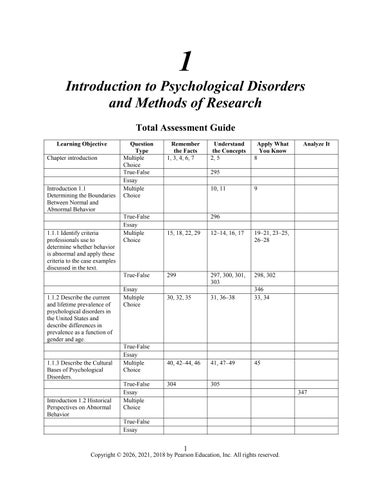
1 Introduction to Psychological Disorders and Methods of Research Total Assessment Guide Learning Objective Chapter introduction
Introduction 1.1 Determining the Boundaries Between Normal and Abnormal Behavior
1.1.1 Identify criteria professionals use to determine whether behavior is abnormal and apply these criteria to the case examples discussed in the text.
1.1.2 Describe the current and lifetime prevalence of psychological disorders in the United States and describe differences in prevalence as a function of gender and age.
1.1.3 Describe the Cultural Bases of Psychological Disorders.
Introduction 1.2 Historical Perspectives on Abnormal Behavior
Question Type Multiple Choice True-False Essay Multiple Choice
True-False Essay Multiple Choice
Remember the Facts 1, 3, 4, 6, 7
Understand the Concepts 2, 5
Apply What You Know 8
295 10, 11
9
296 15, 18, 22, 29
12–14, 16, 17
19–21, 23–25, 26–28
True-False
299
297, 300, 301, 303
298, 302
Essay Multiple Choice
30, 32, 35
31, 36–38
346 33, 34
40, 42–44, 46
41, 47–49
45
304
305
True-False Essay Multiple Choice True-False Essay Multiple Choice
Analyze It
347
True-False Essay
1 Copyright © 2026, 2021, 2018 by Pearson Education, Inc. All rights reserved.
Learning Objective 1.2.1 Describe the demonological model of abnormal behavior.
1.2.2 Describe the origins of the medical model.
1.2.3 Describe the treatment of patients in asylums during medieval times.
1.2.4 Identify the leading reformers of the treatment of the mentally ill and describe the principle underlying moral therapy and the changes that occurred in the treatment of mental patients during the 19th and early 20th centuries.
1.2.5 Describe the role of mental hospitals in the mental health system.
1.2.6 Describe the goals and outcomes of the community mental health movement.
Introduction 1.3 Contemporary Perspectives on Psychological Disorders
1.3.1 Describe the medical model of psychological disorders.
1.3.2 Identify the major psychological models of psychological disorders.
Question Type Multiple Choice
True-False Essay Multiple Choice True-False Essay Multiple Choice
Remember the Facts 51, 53, 55, 57, 58
Understand the Concepts 52, 54
59–61, 74, 78– 82
66–69, 73, 83
84, 93, 94
True-False Essay Multiple Choice
310, 311, 313
312, 314, 315
100, 102, 104, 108, 112, 114, 115, 119, 121– 123
101, 105, 107, 110, 111, 116– 118 , 120
True-False Essay Multiple Choice
316–318
319
True-False Essay Multiple Choice True-False Essay Multiple Choice True-False Essay Multiple Choice
Analyze It
306
85, 86, 88, 89, 91, 92, 95–99
True-False Essay Multiple Choice
Apply What You Know 50, 56
348 62–65, 70–72, 75–77 307–309 349 87, 90
350
350 103, 106, 109, 113
350, 351, 352 125
124
126, 128, 130
127, 129
352
320 131, 132
133, 138–140, 143, 144
134–137, 141, 142
321 147, 148, 150, 152
146, 151
145, 149, 153
2 Copyright © 2026, 2021, 2018 by Pearson Education, Inc. All rights reserved.
Learning Objective
1.3.3 Describe the sociocultural perspective on psychological disorders.
1.3.4 Describe the biopsychosocial perspective on psychological disorders.
Introduction 1.4 Methods of Studying Psychological Disorders
1.4.1 Identify four major objectives of science.
1.4.2 Identify the four major steps in the scientific method.
1.4.3 Identify the ethical principles that guide research in psychology.
1.4.4 Explain the role of the naturalistic method of research and describe its key features.
1.4.5 Explain the role of the correlational method of research and describe its key features.
1.4.6 Explain the role of the experimental method of research and describe its key features.
Question Type True-False Essay
Remember the Facts 322, 324
True-False Essay Multiple Choice True-False Essay Multiple Choice True-False Essay Multiple Choice True-False Essay Multiple Choice
Apply What You Know
Analyze It
353
Multiple Choice True-False Essay Multiple Choice
Understand the Concepts 323
154, 156, 157
155, 158
325 353, 354 159, 160
161–163
353, 354 164
165
167, 174
166, 168, 169
328
326, 327
179
176, 178, 180, 181
170–173
355 175, 177
329 182–185
True-False Essay Multiple Choice
356 186
330 357 187, 188, 190, 191
True-False Essay Multiple Choice
331
330
192, 211
193–195, 200– 205, 207–210, 212
True-False Essay Multiple Choice
332
333
True-False Essay
336, 338
189
358 196–199, 206
359, 360 228, 234, 237, 238, 240, 244, 245, 247
214, 215, 220, 221, 223, 226, 227, 232, 233, 236, 239, 242 335
213, 216–219, 222, 224, 225, 229–231, 235, 241, 243, 246 334, 337 361
3 Copyright © 2026, 2021, 2018 by Pearson Education, Inc. All rights reserved.
362, 363, 365
Learning Objective
1.4.7 Explain the role of the epidemiological method of research and describe its key features.
1.4.8 Explain the role of kinship studies and describe their key features.
1.4.9 Explain the role of case studies and describe their limitations.
Question Type
Remember the Facts
Understand the Concepts
Apply What You Know
Multiple Choice
248, 250, 255, 260, 261
249, 252, 254, 256, 257
251, 253, 258, 259
True-False Essay Multiple Choice
340
True-False Essay Multiple Choice True-False Essay
Analyze It
262
339 364, 365
263–269, 273, 275–277, 281– 283 341
270–272, 278– 280
284–286, 289, 292
288, 293, 294
345
274
342 367 287, 290, 291
343, 344 369
4 Copyright © 2026, 2021, 2018 by Pearson Education, Inc. All rights reserved.
366
368, 370
Multiple-Choice Questions 1.
The study of psychological disorders deals chiefly with __________. a. organic mental diseases b. depression and suicide c. disturbances of thinking, emotions, perceptions, or behaviors d. comparing different methods of treatment Answer: C Difficulty Level: Easy Topic: Introduction Learning Objective: None Skill Level: Remember the Facts APA Learning Objective: 1.1 Describe key concepts, principles, and theories in psychological science.
2.
The study of psychological disorders was previously known as __________ psychology, and continues to be referred to as such in some contexts. a. abnormal b. social c. evolutionary d. developmental Answer: A Difficulty Level: Easy Topic: Introduction Learning Objective: None Skill Level: Understand the Concepts APA Learning Objective: 1.4 Apply psychological content to solve practical problems.
3.
Which emotional concern has developed in Phil, the police photographer who describes his crime scene experiences in the text? a. anger b. sadness c. fear d. loneliness Answer: C Difficulty Level: Easy Topic: Introduction Learning Objective: None Skill Level: Remember the Facts APA Learning Objective: 1.1 Describe key concepts, principles, and theories in psychological science.
4.
Phil, the police photographer quoted in the text, experiences emotional reactions when __________. a. taking pictures b. riding in elevators c. driving across bridges d. arguing with others Answer: B Difficulty Level: Moderate Topic: Introduction Learning Objective: None Skill Level: Remember the Facts APA Learning Objective: 1.1 Describe key concepts, principles, and theories in psychological science.
5 Copyright © 2026, 2021, 2018 by Pearson Education, Inc. All rights reserved.