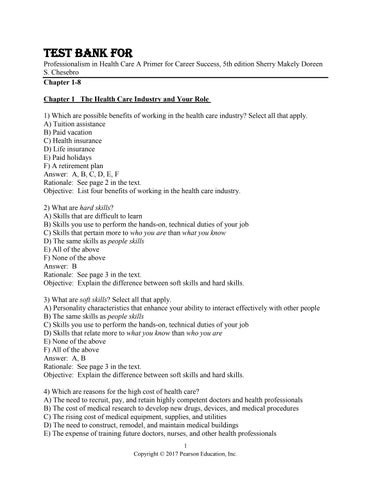
Test Bank For Professionalism in Health Care A Primer for Career Success, 5th edition Sherry Makely Doreen S. Chesebro Chapter 1-8 Chapter 1 The Health Care Industry and Your Role 1) Which are possible benefits of working in the health care industry? Select all that apply. A) Tuition assistance B) Paid vacation C) Health insurance D) Life insurance E) Paid holidays F) A retirement plan Answer: A, B, C, D, E, F Rationale: See page 2 in the text. Objective: List four benefits of working in the health care industry. 2) What are hard skills? A) Skills that are difficult to learn B) Skills you use to perform the hands-on, technical duties of your job C) Skills that pertain more to who you are than what you know D) The same skills as people skills E) All of the above F) None of the above Answer: B Rationale: See page 3 in the text. Objective: Explain the difference between soft skills and hard skills. 3) What are soft skills? Select all that apply. A) Personality characteristics that enhance your ability to interact effectively with other people B) The same skills as people skills C) Skills you use to perform the hands-on, technical duties of your job D) Skills that relate more to what you know than who you are E) None of the above F) All of the above Answer: A, B Rationale: See page 3 in the text. Objective: Explain the difference between soft skills and hard skills. 4) Which are reasons for the high cost of health care? A) The need to recruit, pay, and retain highly competent doctors and health professionals B) The cost of medical research to develop new drugs, devices, and medical procedures C) The rising cost of medical equipment, supplies, and utilities D) The need to construct, remodel, and maintain medical buildings E) The expense of training future doctors, nurses, and other health professionals 1 Copyright © 2017 Pearson Education, Inc.
F) All of the above Answer: F Rationale: See page 6 in the text. Objective: List three reasons why health care is expensive and the cost continues to rise. 5) Which are reasons why health care expenses continue to rise? Select all that apply. A) Wages are much higher than in other industries. B) Medical research is expensive. C) Patients expect the best care available. D) The expense of training future doctors, nurses, and other health professionals. E) All of the above F) None of the above Answer: B, C, D Rationale: See page 6 in the text. Objective: List three reasons why health care is expensive and the cost continues to rise. 6) Which are examples of how the Baby Boomer population will impact the health care industry? A) 6 out of 10 will have at least one chronic condition. B) 1 out of 3 will be considered obese. C) 1 out of 4 will have diabetes. D) 1 out of 2 will be living with arthritis. E) All of the above F) None of the above Answer: E Rationale: See page 9 in the text. Objective: Identify two ways that the Baby Boomer population will impact the health care industry. 7) Which are examples of how the Baby Boomer population will impact the health care industry? Select all that apply. A) Almost half of all doctor visits will be made by Baby Boomers by 2030. B) Diabetic seniors will need 55 million lab tests per year. C) Emergency departments will have 4 million fewer visits each year. D) Nearly eight times more knee replacements will be needed than in previous years. E) All of the above F) None of the above Answer: A, B, D Rationale: See page 9 in the text. Objective: Identify two ways that the Baby Boomer population will impact the health care industry. 8) Which of the following are controversial issues associated with health care reform? A) Should people who already have medical problems be eligible for health insurance? B) Should insurance companies be required to cover preventive services and, if so, which ones? C) Under what conditions, if any, should an insurance company be allowed to cancel a policy? D) What role, if any, should the government play in health care and health care reform? E) All of the above 2 Copyright © 2017 Pearson Education, Inc.
F) None of the above Answer: E Rationale: See pages 11 and 12 in the text. Objective: Describe two controversial issues associated with health care reform. 9) Which of the following is a controversial issue associated with health care reform? A) Infant mortality rate B) Individual mandate C) Sentinel event D) Six Sigma E) Adverse effects F) Gross domestic product Answer: B Rationale: See pages 10-12 in the text. Objective: Describe two controversial issues associated with health care reform. 10) Continuous quality improvement involves (select all that apply): A) Using methods and tools to identify, prevent, and reduce the impact of process failures. B) Reducing and eliminating waste. C) Duplicating blood tests when possible. D) Increasing rates of hospital-acquired infections. E) All of the above. F) None of the above. Answer: A, B Rationale: See page 13 in the text. Objective: Define continuous quality improvement. 11) What questions should you ask when doing quality improvement projects? Select all that apply. A) What are we trying to accomplish? B) What will happen if we make another mistake? C) How will we know if we are successful? D) How much money can we save? E) What options do we have and which ones might work best? F) All of the above Answer: A, C, E Rationale: See page 12 in the text. Objective: List two quality improvement goals. 12) What is a sentinel event? A) A milestone that occurs when a health care organization has been in business for 25 years B) When a discharged patient has to be readmitted to the hospital C) When a patient who was expected to survive an illness does not D) A severe injury requiring treatment in an emergency department E) All of the above F) None of the above Answer: F 3 Copyright © 2017 Pearson Education, Inc.
Rationale: See page 16 in the text. Objective: Define sentinel event. 13) Which of the following describes the connection between sentinel events and patient safety? A) Sentinel events result from effective patient safety techniques. B) Patient safety techniques help prevent sentinel events. C) Improving patient safety is the goal of sentinel events. D) Increasing the number of sentinel events improves patient safety. E) All of the above F) None of the above Answer: B Rationale: See page 16 in the text. Objective: Explain the connection between sentinel events and patient safety. 14) Which are examples of sentinel events? Select all that apply. A) A patient leaves the hospital before being discharged. B) A patient refuses medical treatment because of his or her religious beliefs. C) A patient receives the incorrect blood during a transfusion. D) Surgery is performed on the wrong patient. E) All of the above F) None of the above Answer: C, D Rationale: See page 16 in the text. Objective: Explain the connection between sentinel events and patient safety. 15) Which are National Patient Safety Goals to help reduce sentinel events that occur due to medical errors? Select all that apply. A) Improve staff communication B) Pause before surgery to check for errors C) Use guidelines to prevent infection after surgery D) Make improvements on the response to medical equipment alarms E) Identify patients using their first and last names F) All of the above Answer: A, B, C, D Rationale: See page 16 in the text. Objective: Explain the connection between sentinel events and patient safety. 16) Which is a trend in the supply and demand of registered nurses? A) About 55% of RNs plan to retire in the next 10 years. B) Approximately 20% of nurses currently work in hospitals. C) There are enough new RNs graduating from college to replace all of the retiring RNs. D) As the demand for RNs declines worldwide, more foreign-trained nurses will work in the United States. Answer: A Rationale: See page 17 in the text. Objective: Identify two trends in the supply and demand of health care workers. 4 Copyright © 2017 Pearson Education, Inc.
17) Which are advantages of electronic health records? A) Patient confidentiality cannot be breached. B) Training is not required to use EHRs. C) They are compatible with nearly all other systems. D) EHRs decrease errors related to legibility of doctor's orders. Answer: D Rationale: See pages 20 and 21 in the text. Objective: List two advantages of electronic health records. 18) Which are social media sites? A) Twitter B) LinkedIn C) Facebook D) SnapChat E) YouTube F) All of the above Answer: F Rationale: See page 25 in the text. Objective: Give two examples of social media sites. 19) Why is health care expected to continue to be one of the fastest growing occupations in the United States? A) Increases in the rate of obesity B) The rapid growth of the older population C) Expansion of health care information technology D) Increases in the number of disabled individuals E) All of the above F) None of the above Answer: E Rationale: See page 2 in the text. 20) Medicare is: A) Health care primarily for people age 65 and older. B) Health care for low-income people and families. C) Private health insurance for adults and children. D) Insurance provided through Obamacare. Answer: A Rationale: See page 5 in the text. 21) A gatekeeper is someone who: A) Monitors the cost of medical research. B) Decides which patient claims get paid by insurance. C) Manages a patient's care to ensure quality and cost-effectiveness. D) Specializes in insurance contracts. Answer: C Rationale: See page 7 in the text. 5 Copyright © 2017 Pearson Education, Inc.