Test Bank For Professional Nursing Concepts & Challenges, 9th Edition, Beth Black Chapter 1-16
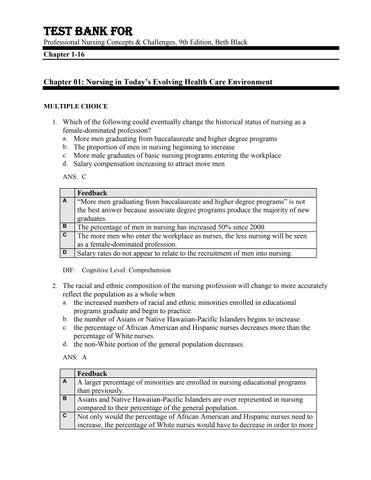
Chapter 01: Nursing in Today’s Evolving Health Care Environment MULTIPLE CHOICE 1. Which of the following could eventually change the historical status of nursing as a
female-dominated profession? a. More men graduating from baccalaureate and higher degree programs b. The proportion of men in nursing beginning to increase c. More male graduates of basic nursing programs entering the workplace d. Salary compensation increasing to attract more men ANS: C
A
B C D
Feedback ―More men graduating from baccalaureate and higher degree programs‖ is not the best answer because associate degree programs produce the majority of new graduates. The percentage of men in nursing has increased 50% since 2000. The more men who enter the workplace as nurses, the less nursing will be seen as a female-dominated profession. Salary rates do not appear to relate to the recruitment of men into nursing.
DIF: Cognitive Level: Comprehension 2. The racial and ethnic composition of the nursing profession will change to more accurately
reflect the population as a whole when a. the increased numbers of racial and ethnic minorities enrolled in educational programs graduate and begin to practice. b. the number of Asians or Native Hawaiian-Pacific Islanders begins to increase. c. the percentage of African American and Hispanic nurses decreases more than the percentage of White nurses. d. the non-White portion of the general population decreases. ANS: A
A B C
Feedback A larger percentage of minorities are enrolled in nursing educational programs than previously. Asians and Native Hawaiian-Pacific Islanders are over represented in nursing compared to their percentage of the general population. Not only would the percentage of African American and Hispanic nurses need to increase, the percentage of White nurses would have to decrease in order to more
D
accurately reflect the population as a whole. The non-White portion of the general population is not likely to decrease.
DIF: Cognitive Level: Comprehension 3. Which of the following is a correct statement about the registered nurse (RN) population? a. The racial/ethnic composition of RNs closely resembles that of the general
population. b. The number of men entering nursing has decreased steadily over the last decade. c. The rate of aging of RNs has slowed for the first time in the past 30 years. d. The majority of employed RNs working full time must work a second position. ANS: C
A B C D
Feedback The racial/ethnic composition of RNs is increasing, but does not approximate their percentage of the overall population. The number of men entering nursing is increasing. The average age of RNs in both 2004 and 2008 was 46. This is a result of the numbers of RNs under 30 in the workforce. The average age of BSN graduates is 25.
DIF: Cognitive Level: Knowledge 4. Which of the following best describes trends in nursing education? a. Numbers of RNs with bachelor‘s and higher degrees are increasing. b. Numbers of RNs with associate degrees are decreasing. c. Foreign-born nurses practicing in the United States are seen as less knowledgeable
because of their lesser educational preparation. d. Numbers of RNs with diploma educations are increasing. ANS: A
A B C D
Feedback Slightly over 50% of RNs eventually obtain their bachelors of science in nursing (BSN) or a higher nursing degree. The majority of nurses in this country get their initial nursing education in associate degree in nursing (ADN) programs. Foreign-born nurses practicing in the United States may be viewed as less knowledgeable by their peers because of language and cultural differences. The numbers of diploma-educated nurses are declining.
DIF: Cognitive Level: Knowledge 5. Despite the variety of work settings available to the RN, data indicate that the primary work
site for RNs is a. ambulatory care settings. b. community health settings. c. long-term care facilities. d. acute care hospitals.
ANS: D
A B C D
Feedback Ambulatory care settings account for about 10.5% of RNs‘ places of employment. Public health and community health settings account for 7.8% of employed RNs. Long-term care facilities account for 5.3% of RNs‘ places of employment. Statistics show that 63.2% of RNs work in acute care hospitals.
DIF: Cognitive Level: Knowledge 6. One important advantage of clinical ladder programs for hospital-based RNs is that they a. allow career advancement for nurses who choose to remain at the bedside. b. encourage nurses to move into management positions in which they can influence
patient care on a broader scale. c. encourage RNs to become politically active and guide the profession of nursing. d. provide training to staff nurses so they can move seamlessly across departments. ANS: A
A B C D
Feedback Clinical ladder programs allow nurses to advance professionally while remaining at the bedside. Clinical ladder programs are designed to keep proficient nurses at the bedside. Encouraging RNs to become politically active and guide the profession of nursing is not the goal of clinical ladder programs. Clinical ladder programs are not designed to facilitate transfer between departments.
DIF: Cognitive Level: Comprehension 7. Which of the following statements is correct about community health nursing (CHN)? a. Prevention and community education are the cornerstones of CHN. b. Nursing care is rapidly moving from the home setting to the institutional setting. c. High-tech care such as ventilators and total parenteral nutrition cannot be handled
in the home. d. Assessment skills are less important in CHN because patients are not acutely ill. ANS: A
A B C D
Feedback The community health nurse provides educational programs in health maintenance, disease prevention, nutrition, and child care. Care is moving into the home setting. Home care is increasing in complexity. Community health nurses must have excellent assessment skills as they do not have the immediate backup that an acute care facility offers.
DIF: Cognitive Level: Comprehension
8. Which of the following is most essential for the nurse entrepreneur to be successful? a. Ability to take direction well b. Excellent time-management skills c. Avoidance of risks d. A college degree in business ANS: B
A B C D
Feedback Nurse entrepreneurs must function autonomously. Nurse entrepreneurs must be well organized and efficient. Starting a business involves risk. A degree in business is not required to be a nurse entrepreneur.
DIF: Cognitive Level: Analysis 9. The major benefit of serving as a military nurse is a. broader responsibilities and scope of practice than civilian nurses. b. working with entirely baccalaureate-prepared peers on active duty. c. serving as an officer on active duty or in the reserves. d. the financial support to seek advanced degrees. ANS: D
A B C D
Feedback Although military nurses do have broader responsibilities and scopes of practice than civilian nurses do, this is not the major benefit. Although military nurses do work with entirely baccalaureate-prepared peers on active duty, this is not the major benefit. Although military nurses serve as officers on active duty or in the reserves, this is not the major benefit. Advanced education is supported by the military financially and also allows for promotion in rank at an accelerated pace.
DIF: Cognitive Level: Comprehension 10. Which of the following statements explains why the school nurse of today is truly a
community health nurse? a. The school nurse may be called on to care for a student‘s family members in underserved areas. b. The school nurse‘s primary responsibility is centered on the well child. c. The school nurse‘s primary responsibility is to maintain immunization records. d. The school nurse must be certified in CHN. ANS: A
A
Feedback In medically underserved areas a school nurse may be called on to care for members of a child‘s immediate family.
B C D
Chronically ill, disabled, and physically challenged students are in regular classrooms. School nurses detect developmental problems; counsel and educate children, parents, and teachers; and maintain immunization records. Although school nurses are considered community health nurses, certification in community health is not required.
DIF: Cognitive Level: Comprehension 11. What has been found about the outcomes of patients cared for in hospitals with a higher
percentage of BSN-prepared nurses as compared to patients in hospitals with a lower percentage of BSN-prepared nurses? a. Patient outcomes are more dependent on nurse-patient ratios. b. Outcomes were better in hospitals with more BSN-prepared nurses. c. Outcomes were similar in both types of hospitals. d. Medical patients had better outcomes, but surgical patients fared the same. ANS: B
A
B C D
Feedback Nurse-patient ratio is an important determinant of patient care outcomes but has not been shown to be more or less important that the percentage of BSN-prepared nurses providing direct patient care. Research by Aiken et al. (2003) showed that patient outcomes were better in hospitals where higher percentages of BSN-prepared nurses were employed. Research by Aiken et al. (2003) showed that patient outcomes were better in hospitals where higher percentages of BSN-prepared nurses were employed. Aiken et al. (2003) studied orthopedic, general surgical, and vascular surgery patients and found the outcomes were improved for these patients in hospitals with a higher percentage of BSN-prepared nurses.
DIF: Cognitive Level: Knowledge 12. Faith community nursing (FCN) was founded on which of the following premises? a. Nurses‘ faith beliefs do not play a part in healing. b. The spiritual aspect takes precedence over the physical body in healing. c. Spiritual health is central to a person‘s well-being. d. Faith community nurses must receive formal training as a minister or clergy. ANS: C
A B C D
Feedback The nurse‘s spiritual journey is believed to be an essential aspect of this nursing role. Patients are treated holistically under FCN. FCN is based on the belief that spiritual health is central to well-being. Faith community nurses do not need to have formal training as ministers.
DIF: Cognitive Level: Comprehension