Prelude to Programming 6th edition
Test Bank for Prelude to Programming
Elizabeth Drake
Chapter 0
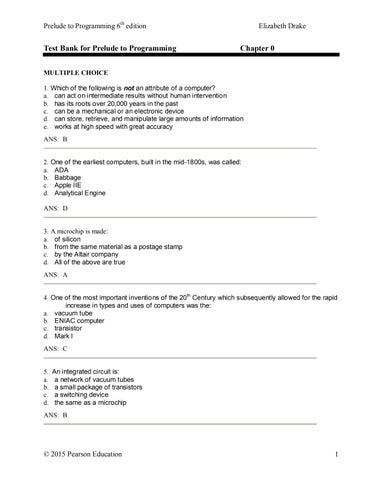
MULTIPLE CHOICE 1. Which of the following is not an attribute of a computer? a. can act on intermediate results without human intervention b. has its roots over 20,000 years in the past c. can be a mechanical or an electronic device d. can store, retrieve, and manipulate large amounts of information e. works at high speed with great accuracy ANS: B
2. One of the earliest computers, built in the mid-1800s, was called: a. ADA b. Babbage c. Apple IIE d. Analytical Engine ANS: D
3. A microchip is made: a. of silicon b. from the same material as a postage stamp c. by the Altair company d. All of the above are true ANS: A 4. One of the most important inventions of the 20th Century which subsequently allowed for the rapid increase in types and uses of computers was the: a. vacuum tube b. ENIAC computer c. transistor d. Mark I ANS: C
5. An integrated circuit is: a. a network of vacuum tubes b. a small package of transistors c. a switching device d. the same as a microchip ANS: B
© 2015 Pearson Education
1
Prelude to Programming 6th edition
Elizabeth Drake
6. The operating system developed by Google is: a. Motorola b. iOS c. Windows d. Android ANS: D
7. The brain of a computer is its: a. hard drive b. central processing unit c. system unit d. RAM ANS: B
8. The basic unit of memory in a computer is: a. hertz b. bytes c. characters d. meters ANS: B
9. DVDs and flash drives are types of: a. internal memory b. processors c. external memory d. programs ANS: C
10. Which of the following is both an input and an output device? a. keyboard b. monitor c. modem/Internet connection d. mouse ANS: C
11. The programs used by the computer to control and maintain hardware and to communicate with the user are: a. applications software b. browsers c. shareware d. system software ANS: D
© 2015 Pearson Education
2
Prelude to Programming 6th edition
Elizabeth Drake
12. Which type of programming language is understood directly by the computer? a. Assembly language b. Machine language c. VisualBasic d. Java ANS: B
13. The following instruction is an example of which type of programming language:
ADD C, D a. b. c. d.
Assembly language Machine language VisualBasic Java
ANS: A
14. Which of the following is a scripting language? a. Assembly language b. Visual Basic c. JavaScript d. COBOL ANS: C
15. Which of the following are normally used to write a program in a high-level language? a. a text editor b. a debugger c. a compiler or interpreter d. all of the above are needed ANS: D
© 2015 Pearson Education
3
Prelude to Programming 6th edition
Elizabeth Drake
TRUE/FALSE 1. True/False: The Analytical Engine was developed by Charles Babbage, assisted by Ada Augusta Byron. ANS: T 2. True/False: In early computers, vacuum tubes were used to do the internal switching necessary for computations. ANS: T 3. True/False: The transistor is a great improvement over the vacuum tube because it is much more energy efficient. ANS: T 4. True/False: The first desktop computer, the Altair 8800, was invented in 1955. ANS: F 5. True/False: A supercomputer can process over 1 billion instructions per second. ANS: T 6. True/False: Web2.0 is simply an updated version of the World Wide Web. ANS: F 7. True/False: One byte consists of eight bits. ANS: T 8. True/False: One bit is the amount of memory used to store one character of information. ANS: F 9. True/False: Hard disks are a type of mass storage device. ANS: T 10. True/False: Flash drives are less reliable than other storage devices because they consist of so many small moveable parts. ANS: F 11. True/False: Computer games are a type of application software. ANS: T 12. True/False: The computer’s master control program is the operating system. ANS: T 13. True/False: Without an operating system, a personal computer would be virtually useless. ANS: T 14. True/False: Assembly language consists of a sequence of bits that are all zeros and ones. ANS: F 15. True/False: COBOL is an object-oriented language used mainly in Web sites to provide dynamic content. ANS: F
© 2015 Pearson Education
4
Prelude to Programming 6th edition
Elizabeth Drake
SHORT ANSWER 1. A program is a(n) __________ of __________ to be carried out by a computer. ANS: list, instructions 2. The next generation of the World Wide Web is called __________. ANS: Web2.0 3. Components that are used by a computer but are located outside the system unit are known as ___________. ANS: peripherals 4. The processor in a PC consists of many transistors that reside on a microchip which plugs into the __________. ANS: motherboard 5. The two types of internal memory are __________ and __________. ANS: RAM, ROM 6. __________ is the type of internal memory that contains instructions used by the computer during its startup process. ANS: ROM 7. The type of internal memory that is used to hold data while the user is working on a computer, but is lost when the computer is turned off, is called __________. ANS: RAM 8. The computer uses __________ devices to receive data. ANS: input 9. The speed of a processor is usually measured in __________. ANS: gigahertz 10. A printer is an example of a(n) ___________ device. ANS: output 11. The most powerful and most efficient programs are written in __________ language. ANS: machine 12. To write a program in a high-level language, you type and edit the program in a(n) __________. ANS: text editor 13. When you write a program in a high-level language, a(n) __________ or a(n) __________ translates the program into machine language. ANS: compiler, interpreter 14. The two general categories of software are ___________ software and __________ software. ANS: application, system
© 2015 Pearson Education
5