Test Bank For Pilbeam’s Mechanical Ventilation-Physiological and Clinical Applications, 7th Edition by James M. Cairo PhD RRT FAARC (Author) Chapter 1-23
Chapter 01: Basic Terms and Concepts of Mechanical Ventilation MULTIPLE CHOICE 1. The body’s mechanism for conducting air in and out of the lungs is known as which of the
following? a. External respiration b. Internal respiration c. Spontaneous ventilation d. Mechanical ventilation ANS: C
The conduction of air in and out of the body is known as ventilation. Since the question asks for the body’s mechanism, this would be spontaneous ventilation. External respiration involves the exchange of oxygen (O2) and carbon dioxide (CO2) between the alveoli and the pulmonary capillaries. Internal respiration occurs at the cellular level and involves movement of oxygen from the systemic blood into the cells. 2. Which of the following are involved in external respiration? a. Red blood cells and body cells b. Scalenes and trapezius muscles c. Alveoli and pulmonary capillaries d. External oblique and transverse abdominal muscles ANS: C
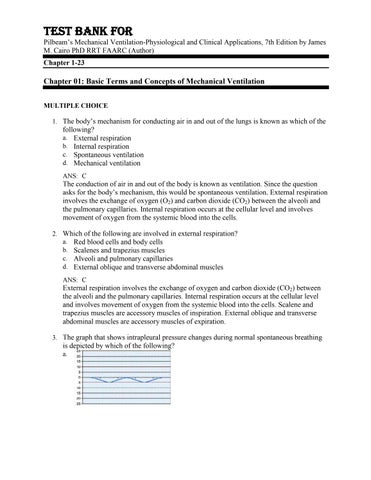
External respiration involves the exchange of oxygen and carbon dioxide (CO2) between the alveoli and the pulmonary capillaries. Internal respiration occurs at the cellular level and involves movement of oxygen from the systemic blood into the cells. Scalene and trapezius muscles are accessory muscles of inspiration. External oblique and transverse abdominal muscles are accessory muscles of expiration. 3. The graph that shows intrapleural pressure changes during normal spontaneous breathing
is depicted by which of the following? a.
b.
c.
d.
ANS: B
During spontaneous breathing, the intrapleural pressure drops from about 5 cm H2O at end-expiration to about 10 cm H2O at end-inspiration. The graph depicted for answer B shows that change from 5 cm H2O to 10 cm H2O. 4. During spontaneous inspiration alveolar pressure (PA) is about ________________. a. 1 cm H2O b. +1 cm H2O c. 0 cm H2O d. 5 cm H2O ANS: A
During normal spontaneous ventilation alveolar pressure will become 1 cm H2O which is the lowest. During the exhalation of a normal spontaneous breath the alveolar pressure will become +1 cm H2O. 5. The pressure required to maintain alveolar inflation is known as which of the following? a. Transairway pressure (PTA) b. Transthoracic pressure (PTT) c. Transrespiratory pressure (PTR) d. Transpulmonary pressure (PL) ANS: D
The definition of transpulmonary pressure (PL) is the pressure required to maintain alveolar inflation. Transairway pressure (PTA) is the pressure gradient required to produce airflow in the conducting tubes. Transrespiratory pressure (PTR) is the pressure to inflate the lungs and airways during positive-pressure ventilation. Transthoracic pressure (PTT) represents the pressure required to expand or contract the lungs and the chest wall at the same time.
6. Calculate the pressure needed to overcome airway resistance during positive-pressure
ventilation when the proximal airway pressure (Pawo) is 35 cm H2O and the alveolar pressure (PA) is 5 cm H2O. a. 7 cm H2O b. 30 cm H2O c. 40 cm H2O d. 175 cm H2O ANS: B
The transairway pressure (PTA) is used to calculate the pressure required to overcome airway resistance during mechanical ventilation. This formula is PTA = Pawo PA. 7. The term used to describe the tendency of a structure to return to its original form after
being stretched or acted on by an outside force is which of the following? a. Elastance b. Compliance c. Viscous resistance d. Distending pressure ANS: A
The elastance of a structure is the tendency of that structure to return to its original shape after being stretched. The more elastance a structure has, the more difficult it is to stretch. The compliance of a structure is the ease with which the structure distends or stretches. Compliance is the opposite of elastance. Viscous resistance is the opposition to movement offered by adjacent structures such as the lungs and their adjacent organs. Distending pressure is pressure required to maintain inflation, for example, alveolar distending pressure. 8. Calculate the pressure required to achieve a tidal volume of 400 mL for an intubated
patient with a respiratory system compliance of 15 mL/cm H2O. a. 6 cm H2O b. 26.7 cm H2O c. 37.5 cm H2O d. 41.5 cm H2O ANS: B
C = V/P then P = V/C 9. Which of the following conditions causes pulmonary compliance to increase? a. Asthma b. Kyphoscoliosis c. Emphysema d. Acute respiratory distress syndrome (ARDS) ANS: C
Emphysema causes an increase in pulmonary compliance, whereas ARDS and kyphoscoliosis cause decreases in pulmonary compliance. Asthma attacks cause increase in airway resistance.
10. Calculate the effective static compliance (Cs) given the following information about a
patient receiving mechanical ventilation: peak inspiratory pressure (PIP) is 56 cm H2O, plateau pressure (Pplat) is 40 cm H2O, exhaled tidal volume (VT) is 650 mL, and positive end-expiratory pressure (PEEP) is 10 cm H2O. a. 14.1 mL/cm H2O b. 16.3 mL/cm H2O c. 21.7 mL/cm H2O d. 40.6 mL/cm H2O ANS: C
The formula for calculating effective static compliance is Cs = VT/(Pplat
EEP).
11. Based upon the following patient information, calculate the patient’s static lung
compliance: exhaled tidal volume (VT) is 675 mL, peak inspiratory pressure (PIP) is 28 cm H2O, plateau pressure (Pplat) is 8 cm H2O, and PEEP is set at 5 cm H2O. a. 0.02 L/cm H2O b. 0.03 L/cm H2O c. 0.22 L/cm H2O d. 0.34 L/cm H2O ANS: C
The formula for calculating effective static compliance is Cs = VT/(Pplat
EEP).
12. A patient receiving mechanical ventilation has an exhaled tidal volume (VT) of 500 mL
and a positive end-expiratory pressure setting (PEEP) of 5 cm H2O. Patient-ventilator system checks reveal the following data: Time PIP (cm H2O) Pplat (cm H2O) 0600 27 15 0800 29 15 1000 36 13 The respiratory therapist should recommend which of the following for this patient? 1. Tracheobronchial suctioning 2. Increase in the set tidal volume 3. adrenergic bronchodilator therapy 4. Increase positive end-expiratory pressure a. 1 and 3 only b. 2 and 4 only c. 1, 2, and 3 only d. 2, 3, and 4 only ANS: A
Calculate the transairway pressure (PTA) by subtracting the plateau pressure from the peak inspiratory pressure. Analyzing the PTA will show any changes in the pressure needed to overcome airway resistance. Analyzing the Pplateau will demonstrate any changes in compliance. The Pplateau remained the same for the first two checks and then actually dropped at the 1000-hour check. Analyzing the PTA, however, shows a slight increase between 0600 and 0800 (from 12 to 14 cm H2O) and then a sharp increase to 23 cm H2O at 1000. Increases in PTA signify increases in airway resistance. Airway resistance may be caused by secretion buildup, bronchospasm, mucosal edema, and mucosal inflammation. Tracheobronchial suctioning will remove any secretion buildup, and a adrenergic bronchodilator will reverse bronchospasm. Increasing the tidal volume will add to the airway resistance according to Poiseuille’s law. Increasing the PEEP will not address the root of this patient’s problem; the patient’s compliance is normal. 13. The values below pertain to a patient who is being mechanically ventilated with a
measured exhaled tidal volume (VT) of 700 mL. Time Peak Inspiratory Plateau Pressure (cm Pressure (cm H2O) H2O) 0800 35 30 1000 39 34 1100 45 39 1130 50 44 Analysis of this data points to which of the following conclusions? a. Airway resistance is increasing. b. Airway resistance is decreasing. c. Lung compliance is increasing. d. Lung compliance is decreasing. ANS: D
To evaluate this information the transairway pressure (PTA) is calculated for the different times: 0800 PTA = 5 cm H2O, 1000 PTA = 5 cm H2O, 1100 PTA = 6 cm H2O, and 1130 PTA = 6 cm H2O. This data shows that there is no significant increase or decrease in this patient’s airway resistance. Analysis of the patient’s plateau pressure (Pplat) reveals an increase of 15 cm H2O over the three and a half hour time period. This is directly related to a decrease in lung compliance. Calculation of the lung compliance at each time interval reveals a steady decrease from 20 mL/cm H2O to 14 mL/cm H2O. 14. The respiratory therapist should expect which of the following findings while ventilating a
patient with acute respiratory distress syndrome (ARDS)? a. An elevated plateau pressure (Pplat) b. A decreased elastic resistance c. A low peak inspiratory pressure (PIP) d. A large transairway pressure (PTA) gradient ANS: A
ARDS is a pathological condition that is associated with a reduction in lung compliance. The formula for static compliance (CS) utilizes the measured plateau pressure (Pplat) in its denominator (CS = VT/[Pplat – EEP]). Therefore, with a consistent exhaled tidal volume (VT), an elevated Pplat will decrease CS.