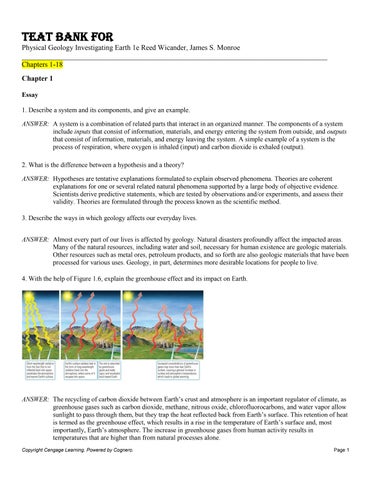
Teat Bank For Physical Geology Investigating Earth 1e Reed Wicander, James S. Monroe ____________________________________________________________________________________ Chapters 1-18 Chapter 1 Essay 1. Describe a system and its components, and give an example. ANSWER: A system is a combination of related parts that interact in an organized manner. The components of a system include inputs that consist of information, materials, and energy entering the system from outside, and outputs that consist of information, materials, and energy leaving the system. A simple example of a system is the process of respiration, where oxygen is inhaled (input) and carbon dioxide is exhaled (output). 2. What is the difference between a hypothesis and a theory? ANSWER: Hypotheses are tentative explanations formulated to explain observed phenomena. Theories are coherent explanations for one or several related natural phenomena supported by a large body of objective evidence. Scientists derive predictive statements, which are tested by observations and/or experiments, and assess their validity. Theories are formulated through the process known as the scientific method. 3. Describe the ways in which geology affects our everyday lives. ANSWER: Almost every part of our lives is affected by geology. Natural disasters profoundly affect the impacted areas. Many of the natural resources, including water and soil, necessary for human existence are geologic materials. Other resources such as metal ores, petroleum products, and so forth are also geologic materials that have been processed for various uses. Geology, in part, determines more desirable locations for people to live. 4. With the help of Figure 1.6, explain the greenhouse effect and its impact on Earth.
ANSWER: The recycling of carbon dioxide between Earth’s crust and atmosphere is an important regulator of climate, as greenhouse gases such as carbon dioxide, methane, nitrous oxide, chlorofluorocarbons, and water vapor allow sunlight to pass through them, but they trap the heat reflected back from Earth’s surface. This retention of heat is termed as the greenhouse effect, which results in a rise in the temperature of Earth’s surface and, most importantly, Earth’s atmosphere. The increase in greenhouse gases from human activity results in temperatures that are higher than from natural processes alone. Copyright Cengage Learning. Powered by Cognero.
Page 1
5. Compare the terrestrial planets with the Jovian planets. ANSWER: The composition and evolutionary history of the planets are dependent on their distance from the Sun. The terrestrial planets Mercury, Venus, Earth, and Mars were condensed at high temperatures and are small and composed of rock and metallic elements. The Jovian planets are Jupiter, Saturn, Uranus, and Neptune; consist of small, rocky cores; and are composed primarily of hydrogen, helium, ammonia, and methane, which condense at low temperatures. 6. Name and describe the three layers of Earth. ANSWER: The three concentric layers of Earth are the core, mantle, and crust. At Earth’s center is the densest layer, the 3 core, with a calculated density of 10–13 g/cm . At 16% of the total volume, the core is mostly iron, with a small amount of nickel. The core has two layers, a solid interior, and a liquid-molten outer core. The mantle 3 makes up 83% of the planet’s volume. The mantle is much less dense than the core, 3.3–5.7 g/cm . It is composed mostly of dark, dense peridotite. The outermost layer is the least dense layer, the crust. There are two major types of crust: continental and oceanic. Continental crust is granitic and thicker compared to the 3 oceanic crust and has an average density of 2.7 g/cm . Oceanic crust is composed of basalt and gabbro and is 3 thinner than continental crust with a density of 3.0 g/cm . 7. Explain the plate tectonic theory and its significance with the help of Figure 1.13.
ANSWER: The plate tectonic theory is based on the premise that the lithosphere is divided into rigid plates, which move relative to one another over the asthenosphere. The three types of plate boundaries are divergent (where plates separate and move apart); convergent (where plate boundaries move towards one another and collide); and transform (where plates slide past each other). These boundaries are where volcanic activity and/or earthquakes occur. 8. How is the rock cycle related to plate tectonics? ANSWER: Interactions between plates—convergence, divergence, lateral movements—determine to a great extent which of the three rock groups will form. Subsidence of crust results in melt, which rises to the surface to form igneous rocks. Any type of rock can be altered via heat and pressure without melting to form metamorphic rocks. Rocks exposed to weathering form sediments, which subsequently form sedimentary rocks. Due to plate tectonics, rocks are recycled through continental and oceanic crust. 9. Explain the principle of uniformitarianism and its significance in interpreting past geologic events. Copyright Cengage Learning. Powered by Cognero.
Page 2
ANSWER: The principle of uniformitarianism is based on the premise that present-day processes observed on Earth have operated throughout time, or the present is the key to the past. Uniformitarianism provides the basis for interpreting the geologic history of Earth. By using modern analogies, geologists can make reasonable interpretations about past events. Processes occurring today such as weathering, earthquakes, volcanic eruptions, severe weather, and so forth serve as good examples. 10. What is the lithosphere? ANSWER: The solid upper mantle and the overlying crust make up the lithosphere, which is broken into numerous individual pieces called plates that move over the asthenosphere, partly as a result of underlying convection cells. Interactions among these plates are responsible for the occurrence of natural phenomena such as earthquakes, volcanic eruptions, and formation of ocean basins and mountain ranges. Subjective Short Answer 11. What is the asthenosphere? ANSWER: Asthenosphere is the zone that surrounds the lower mantle. It has the same composition as the lower mantle, but behaves plastically and moves slowly. 12. According to most scientists, what is the major environmental problem facing the world and why? ANSWER: According to scientists, overpopulation is the major environmental problem facing the world today. The world’s population was 7.8 billion in 2020 and is predicted to be 9.9 billion by 2050. This increase in population would create an imbalance in resources, exceeding Earth’s carrying capacity. 13. Name any four greenhouse gases. ANSWER: Greenhouse gases include carbon dioxide, methane, nitrous oxide, ozone, chlorofluorocarbons, and water vapor. 14. What are the four forces of the universe that immediately followed the Big Bang? ANSWER: The four basic forces immediately following the Big Bang are a) gravity, b) electromagnetic, c) strong nuclear force, and d) weak nuclear force. 15. Why is Earth considered a dynamic and evolving planet? ANSWER: Earth has continually changed throughout its 4.6-billion-year existence. The size, shape, and geographic location and distribution of continents and oceans have varied throughout time; the composition of the atmosphere has evolved; and the life forms existing today are different from those from the past. Tectonic activity causing natural disasters, weathering, and so forth contribute to Earth being a dynamic and evolving planet. 16. Why is the density of the core different from that of the crust? ANSWER: The densities between the core and crust are different because they are made of different elements. The core is 3 the innermost layer, which has a density of 10 to 13 g/cm and consists mostly of iron and a small quantity of 3 nickel. It is very dense compared to the crust, which has a density of 2.7 to 3.0 g/cm and consists of silicon, aluminum, and magnesium. 17. Describe the two types of crusts. ANSWER: The two types of crust are continental and oceanic. Continental crust is much thicker and less dense (2.7 Copyright Cengage Learning. Powered by Cognero.
Page 3
3
3
g/cm ) and consists of granite and rhyolite. Oceanic crust is thinner in comparison, but denser (3.0 g/cm ) and consists of gabbro and basalt. 18. Name the type of rocks formed from magma, the two different types, and where they are formed.
ANSWER: The rocks that form from magma are igneous rocks. There are two types of igneous rocks: intrusive, which form below the surface of Earth, and extrusive, which form on the surface of Earth. 19. How are intrusive igneous rocks exposed at the surface of Earth?
ANSWER: Intrusive rocks are exposed by uplifting through tectonic activity and erosion. 20. What happens to rocks once they are exposed on Earth’s surface?
Copyright Cengage Learning. Powered by Cognero.
Page 4
ANSWER: Once rocks are exposed on Earth’s surface, they are subject to weathering, erosion, and deposition. 21. What is the process by which sediments are converted into sedimentary rocks?
ANSWER: Sediments are converted to sedimentary rocks via the process of lithification. 22. What happens to rock in the metamorphic process if the heat is great enough for the rock to melt?
Copyright Cengage Learning. Powered by Cognero.
Page 5