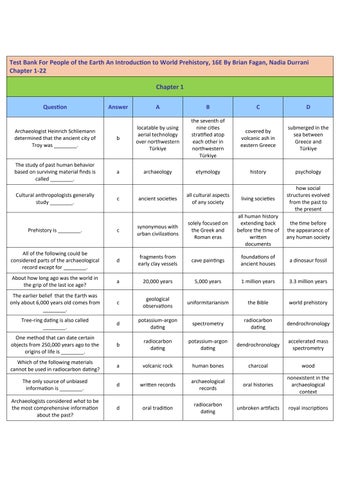
Test Bank For People of the Earth An Introduction to World Prehistory, 16E By Brian Fagan, Nadia Durrani Chapter 1-22 Chapter 1 Question
Answer
A
B
C
D
Archaeologist Heinrich Schliemann determined that the ancient city of Troy was ________.
b
locatable by using aerial technology over northwestern Türkiye
the seventh of nine cities stratified atop each other in northwestern Türkiye
covered by volcanic ash in eastern Greece
submerged in the sea between Greece and Türkiye
The study of past human behavior based on surviving material finds is called ________.
a
archaeology
etymology
history
psychology
ancient societies
all cultural aspects of any society
living societies
how social structures evolved from the past to the present
all human history extending back before the time of written documents
the time before the appearance of any human society
Cultural anthropologists generally study ________.
c
Prehistory is ________.
c
synonymous with urban civilizations
solely focused on the Greek and Roman eras
All of the following could be considered parts of the archaeological record except for ________.
d
fragments from early clay vessels
cave paintings
foundations of ancient houses
a dinosaur fossil
About how long ago was the world in the grip of the last ice age?
a
20,000 years
5,000 years
1 million years
3.3 million years
The earlier belief that the Earth was only about 6,000 years old comes from ________.
c
geological observations
uniformitarianism
the Bible
world prehistory
Tree-ring dating is also called ________.
d
potassium-argon dating
spectrometry
radiocarbon dating
dendrochronology
One method that can date certain objects from 250,000 years ago to the origins of life is ________.
b
radiocarbon dating
potassium-argon dating
dendrochronology
accelerated mass spectrometry
Which of the following materials cannot be used in radiocarbon dating?
a
volcanic rock
human bones
charcoal
wood
The only source of unbiased information is ________.
d
written records
archaeological records
oral histories
nonexistent in the archaeological context
Archaeologists considered what to be the most comprehensive information about the past?
d
oral tradition
radiocarbon dating
unbroken artifacts
royal inscriptions
A concept developed by anthropologists to describe the distinctive adaptive system used by human beings is ________.
c
invention
diffusion
culture
innovation
The spread of a new idea from one group to another, often over long distances is called ________.
a
diffusion
invention
innovation
adaptation
The way in which human societies changed in the past is called ________.
c
cultural system
adaptation
cultural process
modification
The social organization for most hunter-gatherer groups were ________.
d
chiefdoms
tribes
clans
bands
An approach to studying huntergatherer societies that is based on the assumption that people will use the most efficient foraging strategies relative to considerations of energy and time expended is called ________.
b
postprocessualism
optimal foraging strategy
processualism
contingency model
A socially stratified society with a strongly centralized government, social complexity, and extensive agriculture is a ________.
c
tribe
chiefdom
state
nomadic society
The theory that human society evolved in a straight-line fashion toward industrialization is called ________.
d
cultural ecology
multilinear cultural evolution
cultural evolution
unilinear cultural evolution
The predication that foragers will exploit the highest-ranked animal food source is called ________.
b
evolutionary model
prey model
contingency model
optimal foraging strategy
An example of climate affecting an ancient society comes from the ________ civilization on the northern coast of Peru.
d
Anasazi
Sabaean
Aksumite
Moche
Question
Answer
A
B
C
D
About how many years before present did the last Ice Age end?
c
1.6 million years
5,000 years
12,000 years
230,000 years
The last Ice Age is also known as what?
b
the Oligocene
the Pleistocene
the Holocene
the Miocene
What are the warmer periods called that occur in between ice ages?
a
interglacials
heat waves
tropical cycles
greenhouse eras
Who was the first to question the nature of the relationship between humans and their relatives, the chimpanzees and gorillas?
b
Charles Darwin
Thomas Huxley
Louis Leakey
Stephen Jay Gould
Humans belong to the following orders or suborders except for ________.
d
primates
hominoids
anthropoids
tarsiers
What is the specific term used to describe all living humans and all other species comprising the lineage that diverged from that of the chimpanzees by 7 million years ago?
b
primates
hominins
anthropoids
hominids
It has been shown that chimpanzees share ________ of their genetic makeup with humans.
c
15 percent
90 percent
99 percent
50 percent
a
carrying capacity
population density
population limit
population boom
c
artistic creation
toolmaking
bipedalism
fire making
Which of the following was not one of the ecological problems faced by early hominins?
d
living in a savannah environment
being a large mammal
being a terrestrial primate
competing against predators
What technique allows the dating of volcanic rock between 2 billion and 100,000 years old?
a
potassium-argon dating
spectrometry
radiocarbon dating
dendrochronology
The oldest known hominin (between 6 to 7 Ma) is ________.
b
Ardipithecus ramidus
Sahelanthropus tchadensis
Australopithecus afarensis
A./Kenyanthropus platyops
An important complete skeleton of Australopithecus afarensis dating to 3.18 Ma was nicknamed ________.
b
"Dikika Baby"
"Lucy"
"Toumaï"
"Big Man"
The Australopithecus line has two main lineages: gracile Australopithecus and _______ Australopithecus.
c
afarensis
garhi
robust
sediba
The ability of the environment to sustain a limited amount of the population of any species is called the ________. In adjusting to a terrestrial environment, what evolutionary step occurred for hominins after knuckle walking?
Question
Answer
A
B
C
D
Which of the Australopithecus species do some archaeologists views as a possible candidate for the ancestor of early Homo?
d
A. sebida
gracile Australopithecus
A./Kenyanthropus platyops
A. garhi
Which of these species is nicknamed ‘nutcracker man’ on account of its massive jaws and cheek teeth?
a
Paranthropus boisei
Paranthropus aethiopicus
H. georgicus
d
more nutritious plant foods
improved bipedalism
brain enlargement
After 2.5 Ma, the hominin skull changed as a direct consequence of ________. When did early Homo first appear?
H. erectus
DNA changes
b
3.0 Ma
2.5 Ma
1.0 Ma
0.5 Ma
What does Homo habilis mean?
a
handy person
large brain
speaking person
running man
Which are the following are not one of the four criteria used to classify a fossil into the genus Homo?
c
absolute brain size of at least 600 cc
an opposable thumb with precision grip
bipedalism
the ability to manufacture
The Leakey-excavated archaeological site at ________ is one of the most important for studying the earliest hominins.
d
East Turkana
Aramis
Laetoli
Olduvai Gorge
In the development of human language, researchers have noted connections between speech and all of the following except for ________.
b
grooming
arborealism
child rearing
dealing with a larger social group
Question
Answer
A
B
C
D
a
H. erectus
H. ergaster
H. heidelbergensis
H. habilis
d
Eocene
Miocene
Holocene
Pleistocene
What is the Matuyama-Brunhes boundary?
c
the genetic division of H. ergaster from H. sapiens
the Himalayan division of north Asia from south Asia
the temporal division between the Lower and Middle Pleistocene
the division of the world into two areas where hominins either appeared or did not appear
What is the average range size of modern human brains?
a
1,000-2,000 cubic cm
2,000-2,500 cubic cm
600-910 cubic cm
300-750 cubic cm
The grandmother hypothesis posits ________.
b
that grandmothers were the kin leaders of family groups
that grandmothers fed their grandchildren
that grandmothers introduced farming
that only grandmothers gathered the plant foods for their kin group
What food source may have accelerated the changes in hominins to larger bodies with greater brain capacity?
c
berries
grasses
tubers
grain
The first hominin with a similar physical build to our own was ________. In which era did H. sapiens first appear?
Question
Answer
A
B
C
D
Some anthropologists categorise African Homo erectus as________.
b
H. neanderthalensis
H. ergaster
H. habilis
H. sapiens
Many early hominins used fire in the following ways except for ________.
d
as protection against predators
as a way of hunting game by forcing it to flee in a certain direction
as a way to neutralize toxins in raw vegetables
as a way to clear land for building homes
The most famous, and the largest Middle Pleistocene hominin site in China is ________.
a
Zhoukoudian Cave
Q’en-Xia-wo
Gonwangling
Modjokerto
Of these species, which was the first to leave Africa?
a
H. erectus
H. sapiens
H. heidelbergensis
H. habilis
Of the following, what was not a regular use for hand axes by early hominins?
d
grubbing up roots
working wood
butchering game animals
cutting down trees
The oldest-known wooden implements are wooden spears from ________.
c
Zhoukoudian, China
Gran Dolina, Spain
Schoningen, Germany
Boxgrove, England
A significant cognitive advance was shown when stone ax technology moved from the crude, pointed axes of earlier times to the much more ________ axes.
a
symmetrical
heavier
individualized
light-weight
Evidence of butchery and big-game hunting was not found at which of the following sites?
d
Torralba, Spain
Boxgrove, England
Ambrona, Spain
Kebra Cave, Israel
In which of the following areas did Neanderthals live?
b
Africa and Europe
Europe and Eurasia
Asia only
Europe only
Which part of the brain is associated with speaking?
d
hippocampus
cerebellum
parietal lobes
Broca’s area
Which of these may be the first hominin species in western Europe?
c
Homo sapiens
Homo neanderthalensis
Homo antecessor
Homo floresiensis
Radiocarbon dating calculates the ________ of the carbon-14 atoms in a sample.
d
number
origins
strength
half-life
The lithic technology associated with the Neanderthals is the ________.
a
Mousterian
Acheulean
Levallois
Oldowan
b
different intelligence levels
different groups
different time periods
different skill levels
d
400,000 to 500,000
200,000 to 250,000
100,000 to 150,000
30,000 to 50,000
c
South Africans
Eastern Europeans
Papuans and Pacific Islanders
Aborigines
Bordes believed that the variation in Mousterian toolkits was due to ________. The finger bone belonging to a Denisovan child, found in Denisova Cave, dates to about ________ years ago. Traces of Denisovan DNA survive in modern-day ________.