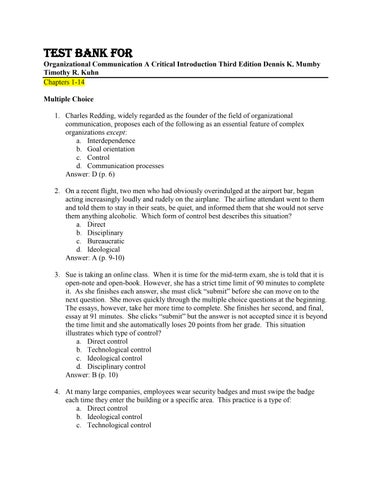
Test Bank For Organizational Communication A Critical Introduction Third Edition Dennis K. Mumby Timothy R. Kuhn Chapters 1-14 Multiple Choice 1. Charles Redding, widely regarded as the founder of the field of organizational communication, proposes each of the following as an essential feature of complex organizations except: a. Interdependence b. Goal orientation c. Control d. Communication processes Answer: D (p. 6) 2. On a recent flight, two men who had obviously overindulged at the airport bar, began acting increasingly loudly and rudely on the airplane. The airline attendant went to them and told them to stay in their seats, be quiet, and informed them that she would not serve them anything alcoholic. Which form of control best describes this situation? a. Direct b. Disciplinary c. Bureaucratic d. Ideological Answer: A (p. 9-10) 3. Sue is taking an online class. When it is time for the mid-term exam, she is told that it is open-note and open-book. However, she has a strict time limit of 90 minutes to complete it. As she finishes each answer, she must click ―submit‖ before she can move on to the next question. She moves quickly through the multiple choice questions at the beginning. The essays, however, take her more time to complete. She finishes her second, and final, essay at 91 minutes. She clicks ―submit‖ but the answer is not accepted since it is beyond the time limit and she automatically loses 20 points from her grade. This situation illustrates which type of control? a. Direct control b. Technological control c. Ideological control d. Disciplinary control Answer: B (p. 10) 4. At many large companies, employees wear security badges and must swipe the badge each time they enter the building or a specific area. This practice is a type of: a. Direct control b. Ideological control c. Technological control
d. Disciplinary control Answer: C (p. 11) 5. In Company X if a project is expected to take longer than three weeks to complete, a project plan detailing the objectives, plan of action and timeline must be written and approved. This practice represents most closely a form of: a. Bureaucratic control b. Ideological control c. Technological control d. Disciplinary control Answer: A (p. 12) 6. The coordination of a class schedule that allows the smooth running of your day on campus as you move from class to class is a form of: a. Direct control b. Bureaucratic control c. Technological control d. Ideological control Answer: B (12) 7. Which of the following is not a form of ideological control? a. Cameras that are installed in the store and directed toward the employees b. Orientation and training programs c. Vetting of potential employees to make sure that they are a good ―fit‖ d. Employee handbook which specifies appearance requirements such as the appropriate length of sideburns Answer: A (p. 13) 8. Students often worry about how competitive they will be in the job market, working to continually improve their image and brand themselves as intelligent, motivated, hardworking multitaskers. This practice is a form of: a. Bureaucratic control b. Ideological control c. Technological control d. Disciplinary control Answer: D (p. 15) 9. The ―crisis of representation‖ refers to: a. The recent emergence of challenges to the belief in an objectively existing world that can be accurately represented b. The emergence of multiple voices, challenging a single (white, male) vision of society c. Both of the above d. Neither of the above Answer: C (pp. 20-21)
10. AJ is an organizational communication scholar whose research focuses on increasing job satisfaction during corporate mergers and acquisitions. His goal is to make predictive and generalizable claims so that he can recommend best practices. AJ is working from which perspective on organizational communication? a. Functionalism b. Interpretivism c. Critical theory d. Feminism Answer: A (p. 24) 11. Mark, an organizational communication researcher, envisions communication problems as problems of transmission. His goal, then, is to improve the communication process so that a message from person A reaches person B clearly, without distortion or noise. Mark is working from which perspective on organizational communication? a. Functionalism b. Interpretivism c. Critical theory d. Postmodernism Answer: A (p. 25) 12. An organizational communication scholar, Michaela, spent several months observing and participating in the Occupy movement in New York City and interviewing many of its participants. Her goal is to reveal participants‘ experience of the movement and to understand how they collectively shape their social reality. Michaela is working from which perspective on organizational communication? a. Functionalism b. Interpretivism c. Critical theory d. Postmodernism Answer: B (p. 28) 13. The study of ―organizational culture‖ is most closely aligned with which perspective on organizational communication? a. Feminism b. Interpretivism c. Critical theory d. Postmodernism Answer: B (p. 28) 14. Fred views his department as a primarily political site, where power is fundamental in the creation of social reality. Assuming that this power is largely hidden, however, he seeks to reveal it through exposing how communication within the department inscribes or sustains current power relations. Fred is operating from which perspective on organizational communication? a. Functionalism b. Interpretivism
c. Critical theory d. Postmodernism Answer: C (pp. 30-31) 15. Luis is studying organizational narratives to explore how they constitute reality for members and subtly reinforce what is appropriate and inappropriate behavior. He is most likely working from which perspective on organizational communication? a. Functionalism b. Interpretivism c. Critical theory d. Postmodernism Answer: C (pp. 30-31) 16. Anthony believes that organizational communication research should destabilize common sense views of the world and reveal the multiple, competing, and fragmented narratives that exist simultaneously within an organization. Anthony is working from which perspective on organizational communication? a. Functionalism b. Interpretivism c. Critical theory d. Postmodernism Answer: D (pp. 31-34) 17. Those who argue against a strictly ―Western Canon‖ in university education call for the inclusion of previously marginalized voices (e.g. African American, Asian, Chicana/o, women, gay, lesbian). These proponents of an expanded representation of voices are most likely associated with which perspective? a. Interpretivism b. Critical theory c. Postmodernism d. Feminism Answer: C (p. 33) 18. Cameron‘s research focuses on how teenaged boys in the Bronx are constrained by gendered expectations which limit their career choices. Cameron is most likely working within which perspective on organizational communication? a. Interpretivism b. Critical theory c. Postmodernism d. Feminism Answer: D (p. 37) 19. Which of the following questions concerning a particular communication technology (CT) best reflects a functionalist perspective? a. In what ways does the CT shape organizational power relations?
b. How does the CT have a gendered effect on organizational communication processes? c. How can the CT increase organizational efficiency? d. How do organization members experience and manage their interactions through the CT? Answer: C (p. 42-43) 20. Which of the following educational practices is not based on the premise of an information transmission model of communication? a. Large, lecture-based class b. Discussion board used by an online class c. Podcast made available by the professor to the students d. PowerPoint presentation Answer: B (p. 44)
True/False 21. Tensions between the goals, beliefs, and desires of individual organization members and those of the larger organization are usually resolved by subordinating the goals and beliefs of individuals to those of the organization. Answer: T (p. 3) 22. Control is a linear, cause and effect phenomenon (like one billiard ball hitting another). Answer: F (p. 4) 23. Goal orientation, as an essential feature of an organization, is complex because organizations often have multiple and competing goals. Answer: T (p. 8) 24. The development of less explicit and coercive forms of control means that control is no longer an important issue in daily organizational life. Answer: F (p. 16) 25. Because the placement of armrests discourages napping, seats in many airports function as a form of technological control. Answer: T (p. 11) 26. Scientific management, bureaucracy, and human relations theory were all built on the principles of interpretivism. Answer: F (p. 24) 27. Many functionalists argue that the symbolic world is the only world we can possibly know because the world around is always mediated by language, symbols, and communicative practices. Answer: F (p. 29)
28. According to the interpretivist perspective, corporate rituals such as Christmas parties and corporate breakfasts function to subtly reassert the worldview of the management élite in the organization. Answer: F (p. 31) 29. Postmodernism is both a historical epoch and a way of thinking that rejects any single overarching social reality or grand narrative. Answer: T (p. 31-33) 30. The feminist perspective on organizational communication argues primarily for creating a level playing field to provide women voice and opportunity in organizations. Answer: F (p. 36)
Fill-in-the-Blank 31. __________________________ is the dynamic communication process through which organizational stakeholders struggle to maximize their stake in an organization. Answer: organizational control (p. 2) 32. We can define ___________ as the dynamic, ongoing process of creating and negotiating meanings through interactional symbolic practices, including conversation, metaphors, rituals, stories, dress, and space. Answer: communication (p. 18) 33. ____________________________ is the process of creating and negotiating collective, coordinated systems of meaning through symbolic practices oriented toward the achievement of organizational goals. Answer: organizational communication (p. 19) 34. A ________________ framework is a ―theory about theories‖ that enables us to compare and contrast the different assumptions on which competing theories and perspectives are based. Answer: metatheoretical (p. 19) 35. Michel Foucault uses the term _______________ to describe a system of possibilities for the creation of knowledge. Answer: discourse (p. 22) 36. The discourse of _____________________ refers to the feminist perspective on organizational communication. Answer: empowerment (p. 22) 37. Mumby refers to interpretivism as a discourse of __________________. Answer: understanding (p. 22)
38. _________________ is both a historical epoch and a way of thinking in which science, rationality, and progress are the dominant themes. Answer: modernism (p. 22) 39. The discourse of suspicion refers to the _______________ perspective on organizational communication. Answer: critical (p. 29) 40. Architect Charles Jencks places the symbolic birth of ________________ at 3:33 p.m. on July 18, 1973—the moment when the Pruitt-Igoe housing project in St. Louis was demolished. Answer: postmodernism (p. 32)
CHAPTER 2 Multiple Choice 1. Which of the following is an example of what Karl Marx identified as surplus value? a. A worker increases her rate of production but does not get a corresponding raise in pay. b. A person works a second job because he has additional time in the evenings. c. A company is owned by the workers who share equally in any profits the company makes. d. An auto mechanic uses his skills in his free time to help his neighbor fix his car. Answer: A (p. 61) 2. Which of the following envisioned popular culture as something that was administered from above as an instrument of social control? a. Cultural Studies b. The Frankfurt School c. Karl Marx d. All of the above Answer: B(p. 70) 3. Which of the following rejected the distinction between high and low culture? a. Cultural Studies b. The Frankfurt School c. Karl Marx d. None of the above Answer: A (p. 76) 4. The term used to describe a great deal of neo-Marxist theory and research based on the ideas of the Frankfurt School is: a. Critical theory b. Economic determinism c. Semiotics d. Social constructionism Answer: A (p. 69) 5. Blake has decided that to truly address the problems in his organization, he (and other organization members) must understand and address communication issues in and around the organization, because he believes communication actually creates (not simply reflects) the realities in which we live. This approach is referred to as: a. Historical materialism b. Logical positivism c. Pragmatism d. Social constructionism Answer: D (p. 84-85)
6. Which of the following modes of ownership and production did Marx not consider exploitative? a. Ancient b. Feudal c. Tribal d. All of the above Answer: C (p. 59) 7. The $1 billion Facebook paid to acquire Instagram in 2012 was based on Instagram‘s: a. Common value b. Exchange value c. Surplus value d. Use value Answer: B (pp. 60-61) 8. Nintendogs is a Nintendo game in which you take care of, train, and bond with an adorable (virtual) puppy. The availability of everything, including virtual puppy ownership, to be bought and sold is a property of capitalism called: a. Commodification b. Corporatization c. Hegemony d. Materialism Answer: A (p. 61) 9. Important Frankfurt School members included all of the following, except: a. Max Horkheimer b. Rudolf Carnap c. Theodor Adorno d. Walter Benjamin Answer: B (p. 68) 10. Frankfurt School members were interested in all of the following, except: a. Examining the course that modernist, Enlightenment thought was taking in the 20th century b. Fostering of social change c. Examining the nature of knowledge itself d. Uncovering immutable truths Answer: D (pp. 68-69) 11. According to the Frankfurt School, the culture industry affects consumerism through advertising by: a. Arguing that all needs are capable of fulfillment b. Never leaving the customer alone c. Predetermining needs d. All of the above Answer: D (p. 70)
12. Frankfurt School members were most concerned about the growing dominance of which type of reasoning? a. Emotional b. Instrumental c. Progressive d. Reflective Answer: B (p. 73) 13. McDonaldization, the term used to describe the proliferation of prepackaged, instant, easily consumable products and lifestyles, would be associated most closely with which of the following concepts? a. The cultural studies‘ systems of representation b. The Frankfurt School‘s culture industry c. Marx‘s economic determinism d. None of the above Answer: A (p. 80) 14. Culture jamming, the practice of using corporate advertising against the corporations by reworking the meaning of the advertisement, is understood best from which of the following schools of critical theory? a. Cultural studies b. Frankfurt School c. Karl Marx d. None of the above Answer: A (p. 79) 15. According to cultural studies, people with more _____________ have greater influence over the meaning construction process and are better able to get others to share in their view of the world. a. Cultural capital b. Economic resources c. Social trust d. Political clout Answer: A (p. 80) 16. According to the communicative construction of organization approach, which of the following forms of communication is (are) able to shape organizational members‘ behavior in significant ways? a. Annual report b. Organizational mission statement c. One-on-one conversation d. All of the above Answer: D (p. 85) 17. Which of the following is (are) a political site(s)?
a. The Coca-Cola Company b. Greenpeace c. Fellowship Church d. All of the above Answer: D (p. 87-88) 18. According to the critical perspective, organizations are: a. Entities constructed by powerful capitalists in order to increase wealth b. Political sites in which competing interests are equally represented c. Institutions that are key in the development of our identities d. Sites in which ethics are generally irrelevant e. Answer: C (pp. 84-91) 19. Which of the following criteria is (are) important for ethical communication? a. Communication focuses on recognizing one common organizational reality. b. Communication promotes agreement amongst different organizational stakeholders. c. Communication promotes individual and relational growth amongst organization members. d. All of the above Answer: C (p. 91) 20. The ideology of work/life balance, as promoted by corporations, can create discursive closure by: a. Highlighting the importance of work b. Equating life with family c. Making individuals responsible for the balance d. All of the above Answer: D (p. 88)
True/False 21. A Sandals resort vacation is an example of how the ―culture industry‖ operates to rationalize a product or experience. Answer: T (pp. 71-72) 22. According to cultural studies, popular culture, which includes phenomena such as movies based on comic books or the music of Brittney Spears, is a source of serious objects of study. Answer: T (p. 76) 23. According to the Frankfurt School, how we see reality depends on the ideas of those who control the means of production. In other words, the ruling material force in society is the ruling intellectual force. Answer: F (p. 68)
24. According to Marx, capitalism would naturally evolve into socialism. Answer: T (p. 65) 25. According to all three schools of thought (Marx, Frankfurt School, and cultural studies), there is always and inevitably resistance to capitalist control. Answer: F (p. 82) 26. For the most part, organizations do not exercise power coercively but engage in unobtrusive control. Answer: T (p. 86) 27. Discursive closure extends the ways in which people can think, feel, experience, speak, and act in their organizations. Answer: F (p. 88) 28. In organizational decision making, the choice of one set of ethics over another is most often based on its ethical superiority. Answer: F (p. 91) 29. The approach that explores the ways in which economics, culture, and politics interact to create social reality is called Marxism. Answer: F (p. 69) 30. Typology is the scientific study of systems of representation that focuses on the relationship, and difference, between one sign and other signs in the same system. Answer: F (p. 77) Fill in the Blank 31. The spread of corporate ideologies and discourses to every aspect of our lives, including who we are as human beings has been labeled _________________________. Answer: corporate colonization (p. 88) 32. In the system of _______________, workers are ―expropriated‖; because they do not own the means of production, they must sell their labor power in order to survive. Answer: capitalism (p. 58) 33. Members of the Frankfurt School were interested in what they termed the _______________________ : the mass production of popular culture, administered from above, that creates needs in people that they would not otherwise have. Answer: culture industry (p. 70) 34. Researchers in the ______________________ tradition take popular culture as a serious object of study, examining the complex ways in which it structures social reality. Answer: cultural studies (p. 76)
35. A group maintains _________________ when it is able to create a worldview that other people and groups actively support, even though that worldview may not be in their interests. Answer: hegemony (p. 86) 36. Marx‘s theory of _______________________ analyzes history according to different modes of production. Answer: historical materialism (p. 59) 37. The source of profit for the capitalism is the difference between the value of the labor power as purchased and the action value produced by the laborer, which Marx refers to as ___________________. Answer: surplus value (p. 61) 38. _______________ is a system of attitudes, beliefs, ideas, perceptions, and values that structure reality. Answer: ideology (p. 63) 39. The idea that the nature of society is causally determined by its economic foundation is called _____________________. Answer: economic determinism (p. 69) 40. The work of _________________ is a common thread that runs through all the variations of the critical approach. Answer: Karl Marx (p. 57)
CHAPTER THREE Multiple Choice 1. In the early 19th century approximately what percentage of U.S. citizens were selfemployed: a. 10% b. 25% c. 60% d. 80% Answer: D (p. 102) 2. Which of the following helped make industrialization possible? a. The invention of the steam engine b. Large number of immigrants to the U.S. c. Enclosure laws in the U.K. d. All of the above Answer: D (pp. 104-105)
3. In his current company, John, a network engineer, often works from home on his own schedule. When he does go in to the office, he may stay one hour, or he may stay 10. When a project is in a critical stage he puts in at least 60 hours per week. At other times, he may work approximately 20 to 30 hours a week. Which type of time best describes Mike‘s work time: a. Clock-time b. Task-time c. Mixed-time d. Idle-time Answer: B (pp. 106-107) 4. As a waitress Lucia greets all of her customers with a smile and maintains a positive demeanor throughout their meals, even if a customer is demanding or rude. She is engaged in: a. Rationalization b. Disenchantment c. Emotional labor d. Charismatic labor Answer: C (p. 144) 5. Which of the following is a basic principle of scientific management? a. The work task is designed according to ―rules of thumb‖ b. Workers choose their own work and train themselves c. Managers provide a supportive supervisory environment that provides workers with a sense of achievement d. Workers are responsible for both the planning labor of work Answer: C (p. 115) 6. The way in which Taylor‘s system is practically implemented requires a model of communication that is consistent with the discourse of: a. Representation b. Understanding c. Suspicion d. Vulnerability Answer: A (p. 117-118) 7. Alex and Sam are having their kitchen completely remodeled. Their builder recommends that they incorporate work centers in the new kitchen, specifically areas for cooking, cleaning and mixing. These areas should be designed to minimize any unnecessary motion and thus increase efficiency. Which management theory provides the foundation for this recommendation? a. Taylor‘s scientific management b. Gilbreths‘ scientific management c. Weber‘s bureaucracy d. Braverman‘s craft system
Answer: B (pp. 120-121) 8. Keegan is far from satisfied in his job. Sure, he gets a paycheck, but he feels like he is treated more like an automaton than a creative, intelligent human being. Management in this workplace most closely resemble which theorist‘s view of the worker? a. Frank and Lillian Gilbreth b. Elton Mayo c. Frederick Taylor d. Emile Durkheim Answer: C (p. 123) 9. Which of the following is an example of scientific management in today‘s workplace? a. Telephone sales in which the caller follows a script b. Grocery checkout in which the computer measures the efficiency and speed of the clerks c. Fast food preparation d. All of the above Answer: D (pp. 125-126) 10. According to Weber, the rationality of modern human society: a. Led to a broadening of human vision b. Liberated society from myth and superstition c. Strengthened a sense of community d. Was the only road to truth and social harmony Answer: B (p. 139) 11. According to Weber‘s perspective, industry leaders such as John D. Rockefeller and Steve Jobs exhibited which type of authority? a. Traditional b. Charismatic c. Rational-Legal d. None of the above Answer: B (p. 129) 12. Andrew is part of an organization in which the organizational rules and regulations are clearly defined in its governing documents and organizational members are treated impartially. From Weber‘s perspective, which form of authority best characterizes this organization? a. Traditional b. Charismatic c. Rational-legal d. Capitalist Answer: C (p. 132) 13. Weber argued that the rational-legal authority system and its bureaucratic structure promoted the development of capitalism because:
a. Bureaucracy enhances the speed of business operations b. Business people are encouraged to make decisions for emotional reasons c. Bureaucracy encourages innovation d. None of the above Answer: A (p. 133) 14. No Child Left Behind (in which each student must meet government mandated standards) is an example of the education process as: a. Departmentalized b. Humanized c. Corporatized d. Rationalized Answer: D (p. 135) 15. Jennifer works for an organization where favoritism and nepotism are the order of the day; despite her excellent work skills and qualifications, she is unable to get promoted and is thinking of leaving the organization. From Weber‘s perspective, which form of authority best characterizes this organization: e. Traditional f. Charismatic g. Rational-legal h. Capitalist Answer: A (p. 131) 16. The workers in an automobile factory know that they can perform tasks faster than they already do, but they collectively limit their output in order to limit management‘s knowledge of the labor process. This is called: a. Scientific Management b. Natural Soldiering c. Systematic Soldiering d. Systematic Withholding Answer: C (p. 113) 17. When Max Weber speaks of the ―disenchantment of the world,‖ he is referring to: a. The ways in which traditional authority is limiting the full development of bureaucratic efficiency b. The ―gain spirit‖ of Protestantism as a catalyst for the emergence of capitalism. c. The notion that within any economic system the ideas of the ruling class are the ruling ideas. d. The ways in which processes of rationalization are limiting charisma and creativity in Western bureaucratic systems. Answer: D (p. 139) 18. In Frank and Lillian Gilbreth‘s scientific management system, the ―Therblig‖ was: a. A basic unit of motion involved in a work task. b. The optimal amount of iron ore a worker should carry on a shovel.
c. The optimal distance between the stove and the sink in a scientifically designed kitchen. d. The sum total of all motions performed in a work task. Answer: A (p. 118) 19. In Taylor‘s system of scientific management, the primary place where managers located control of the labor process was in: a. The supervisor who observed how each worker performed his/her work. b. The worker‘s body. c. The impersonal system of rules and regulations that dictated how work was performed. d. The integration of conception and execution of work into each worker. Answer: B (p. 122) 20. The process of making a McDonald‘s cheeseburger has been ―perfected‖ over time to be extremely efficient; in fact, there‘s a 700-page manual that explains how this is done. What concept most aptly identifies this process? 1. Taylor‘s ―One Best Way‖ 2. Taylor‘s ―Worker Satisfaction‖ 3. The Gilbreths‘ ―Time and Motion‖ 4. Weber‘s ―Iron Cage of Bureaucracy‖ Answer: A (p. 112-113)
True/False 21. The term ―employee‖ was originally used exclusively to describe railroad workers. Answer: T (p. 102) 22. In early industrial capitalism, employees attempted to enact a strict sense of time – clock time – in order to limit their working hours. Answer: F (p. 107) 23. The shift from task-time to clock-time was an important feature in the emergence of industrial capitalism because through this shift, time became a form of currency. Answer: T (p. 107) 24. The manufacturing division of labor divides society into different occupations, and has been a feature of all societies for thousands of years. Answer: F (p. 112) 25. Opposition to scientific management came both from labor unions and factory owners. Answer: T (p. 116) 26. The progressive ideology of the early 1900s connected efficiency with social harmony. Answer: T (p. 117)
27. The Gilbreths argued for the need to increase workers‘ job satisfaction and minimize their fatigue. Answer: T (p. 119) 28. Frederick Taylor saw communication and cooperation amongst workers as problematic. Answer: T (p. 123) 29. Scientific management was ultimately rejected in favor of a human relations approach to management. Answer: F (p. 124) 30. Taylor‘s writings are generally descriptive, whereas Weber‘s are prescriptive. Answer: F (p. 138)
Fill-in-the-blank 31. Marx calls the process in which workers are separated from the means by which to engage in the production of goods _______________________________. Answer: expropriation (p. 111) 32. The process by which all aspects of the natural and social world become increasingly subject to planning, calculation, and efficiency is __________________________. Answer: rationalization (p. 134) 33. ___________________________________ is the deliberate and coordinated effort of workers to restrict output by limiting the speed at which they perform work. Answer: systematic soldiering (p. 113) 34. Scientific Management was developed by an engineer named _________________________. Answer: Frederick Taylor (p. 110) 35. The ____________ division of labor divides society into different occupations, and has been a feature of all societies for thousands of years. Answer: social (p. 112) 36. According to Weber, authority based in custom and tradition is ___________________ authority. Answer: traditional (p. 130) 37. According to Weber, authority based on an impersonal system of rules and responsibilities is ____________________ authority. Answer: rational-legal (p. 132)
38. Management by rule of thumb and use of arbitrary principles is called ____________________ management. Answer: ordinary (p. 114) 39. According to Weber, authority based on the ability of a particular individual to exercise authority over others by virtue of their special abilities is __________________ authority. Answer: charismatic (p. 129) 40. The sociologist and philosopher who is credited with developing the bureaucratic model of organizational behavior was ___________________________. Answer: Max Weber (p. 27)
CHAPTER 4 Multiple Choice
1. The principal architect of the human relations movement was: a. Rensis Likert b. Elton Mayo c. Mary Parker Follett d. Douglas McGregor Answer: B
2. The group who believed that administrative elites should take the lead in industrial development because the masses could not be trusted to make objective decisions were called: a. Industrial democrats b. Realist democrats c. Industrial republicans d. Realist republicans Answer: B
3. Many companies hold a company picnic or “fun day” for employees and their families to thank their employees and to offer a social environment for families to interact. This practice is most closely related to which of the following theories of effective management? a. Scientific management b. Bureaucratic theory
c. Human relations theory d. Family support theory Answer: C (p. 153)
4. The purpose of the interview program associated with the Hawthorne studies was: a. To allow workers to let off steam b. To collect information from workers in order for management to address their concerns c. To study the differences between the attitudes of different workers d. To determine the relationship between worker pay and worker satisfaction Answer: A (p. 161)
5. The mantra for the human relations movement was: a. “A fair day’s wage for a fair day’s work” b. “Empowered employees are eager employees” c. “A happy worker is a productive worker” d. “One best way” Answer: C (p. 163) 6. It has been argued that the ideology of the researchers associated with the Hawthorne studies is reflected in the interpretation of the data. This ideology includes the idea(s) that: a. There is a legitimate role for conflict in the workplace b. The average worker is able to understand the nature of working conditions objectively c. Gender dynamics are a negligible factor in workplace attitudes d. All of the above Answer: C (pp. 171-173)
7. Mary Parker Follett argued that in exercising power or giving orders, one’s authority arises out of the needs of the situation. She called this concept: a. Situational power b. Power of need c. Law of the situation d. Law of needs Answer: C (p. 179)
8. In today’s world, there continue to be differing views on the purpose of business in society. Of the following views, which is most like Mary Parker Follett’s belief about organizations? a. A business organization should exist to make a profit for the shareholders b. A business organization should exist to bring together resources in order to address social and environmental challenges c. A business organization should exist to enable people to reach their potential as citizens and community members
d. None of the above Answer: C (p. 179)
9. Explanations about the disappearance of Mary Parker Follett from early management theory include the fact(s) that: a. She was a woman b. Her writings were too rich and complex c. She was a strong believer in grassroots participation d. All of the above Answer: D (p. 180-181)
10. The head coach of the football team threatens and coerces his players in order to bring out their best. He assumes that the players will avoid work and responsibility unless he forces them to do otherwise. His assumptions are based on which philosophy of management control? a. Theory A b. Theory X c. Theory Y d. Theory Z Answer: B (p. 184)
11. At the College Café, managers make decisions without employee input and motivate employees to abide by these decisions and resultant rules by threatening to fire them if they don’t. Rensis Likert would classify this organization as: a. Consultative b. Exploitive-authoritative c. Participative d. Benevolent-authoritative Answer: B (p. 189)
12. In a particular college class, the instructor communicates to the students what is expected of them in order to receive good grades (which can be conceived of as either rewards or threats). Although it is a small class, and he is open to comments and questions from the students, he is ultimately responsible for setting class goals and expects his students to follow his directions. If we consider this class an organization, Rensis Likert would classify the leadership as: a. Consultative b. Exploitive-authoritative c. Participative d. Benevolent-authoritative Answer: D (p. 189)
13. All of the following were factors that played a role in the development of the human relations school, except: a. Decreasing gap between rich and poor b. The increase of public consciousness about unsafe working conditions c. The increasing power of unions d. Widespread interest in alternative political systems such as socialism and communism Answer: A (p. 154-155)
14. Elton Mayo proposed that the solution to industrial and societal ills was to be found in the application of psychological principles to the transformation of whose attitudes? a. Owners b. Managers c. Workers d. All of the above Answer: C (159)
15. One of the earliest examples of qualitative, naturalistic research in the workplace was: a. The Bank Wiring Observation Room Study b. The Illumination Studies c. The Interview Program d. The Relay Assembly Test Room Studies Answer: A (p. 162)
16. The Hawthorne Studies were a catalyst for studies in all of the following areas, except: a. Gender inequality b. Leadership c. Organizations as systems d. Small-group relations Answer: A (pp. 162-164)
17. As a pragmatist, Mary Parker Follett was most interested in which component of communication? a. Environment in which communication takes place b. Process of relating c. Receiver d. Sender Answer: B (p. 176)
18. Corporate social responsibility (CSR) programs focus on positive social and environmental impacts of the company. They function, at least in part, as an attempt to encourage the employees that their work is meaningful, and thus tap into their higher-order needs. This function of CSR is most closely associated with: a. Environmental economics b. Human resource management c. Human relations theory d. Workplace democracy Answer: B (p. 183)
19. Which of the following assumes that organizations are at their best when they create cooperative, conflict-free worker-manager relations? a. Human Relations Theory b. Follett’s Bridge Theory c. Human Resource Management d. None of the above Answer: A (pp. 191-192)
20. Elton Mayo argued that the experience of the average industrial worker ran parallel to the experience of: a. Housewives b. Schoolchildren c. Posttraumatic stress victims d. Recent immigrants Answer: C (p. 157)
True/False
21. Different forms of work lend themselves more or less easily to participative models of organizing. Answer: T (p. 192)
22. According to Elton Mayo, if allowed to do so workers would naturally create an organic community in which spontaneous cooperation increases productivity. Answer: F (p. 157-158)
23. The Hawthorne studies demonstrated that informal communication was largely detrimental to the functioning of organizations. Answer: F (p. 163)
24. One critique of the Hawthorne studies is that there were multiple variables that were not accounted for, and thus the conclusions that were drawn from the studies are suspect. Answer: T (p. 169-170)
25. The human relations movement provided for little or no change in the nature of work itself. Answer: T (p. 173)
26. Mary Parker Follett viewed conflict as a symptom of industrial sickness and worker maladjustment. Answer: F (p. 178)
27. There is little evidence to suggest any strong causal connections among social factors, worker satisfaction/morale, and productivity. Answer: T (p. 170)
28. Human Resource Management represents an attempt to tap into higher-order needs (such as love/belonging, esteem, and self-actualization) and make work relevant to the achievement of human potential. Answer: T (p. 183)
29. According to Douglas McGregor, the responsibility for ineffective organizational performance lies with the workers who do not place the organization’s needs above their own. Answer: F (p. 186)
30. One of the most progressive aspects of Human Resources Management is that, unlike earlier theories of management, this approach took different organizational contexts (such as differences in size, goals, environment, and so forth) into account. Answer: F (p. 192)
Fill in the Blank
31. The idea of ______________________ refers to Mary Parker Follett’s dynamic conception of communication that conceives of it as a system of relating, in which the very act of communicating changes everyone involved. Answer: circular response (p. 176)
32. The group of early 20th century social thinkers who believed that organizations could be a force for good and positive change if they were made more democratic was called the _____________________. Answer: industrial democrats (p. 156)
33. The first of the Hawthorne Studies, the _________________ studies, called scientific management into question because of its unexpected results. Answer: illumination (p. 159) 34. The phenomenon in which workers respond to the personal attention paid to them by supervisors is known as the _____________________. Answer: Hawthorne Effect (p. 160) 35. In resolving conflict through ________________, the goal is to find a resolution in which each party’s desires are satisfied and no one has to sacrifice anything. Answer: integration (p. 178) 36. _____________________ is the term used for the traditional philosophy of management control that assumes that the average human being has an inherent dislike of work and will avoid it if he can. Answer: Theory X (p. 184) 37. Rensis Likert developed the ___________________ to classify leadership styles that reflect the degree of employee participation in organizational decision making. Answer: four systems approach (p. 189)
38. The style that Rensis Likert identifies as _______________________ is one in which motivation occurs through rewards and decision making is distributed throughout the organization. Answer: participative (p. 189) 39. ________________________ developed a model of work motivation, identifying two competing philosophies of management control which he termed Theory X and Theory Y. Answer: Douglas McGregor (p. 184) 40. For Mary Parker Follett, there are two forms of power: “power-over” and _________________. Answer: power-with (p. 178) CHAPTER FIVE Multiple Choice Questions 1. Which of the following influenced the development of systems theory/systems thinking in organizations? a. Industrial psychology b. Social protectionism c. Theory of Relativity d. Social Darwinism Answer: C (p. 203) 2. Understanding global climate change from a systems perspective could entail: a. Reducing climate change to its atmospheric effects: greenhouse gases and the depletion of the ozone layer. b. Collecting evidence of climate change over time and understanding how changes are related to one another. c. Pinpointing clear causes and effects between consumer waste and rising temperatures. d. Doing closed laboratory studies on the impacts of rising shorelines and making clear predictions about future outcomes. Answer: B (p. 206) 3. Lamar thinks that “30 Rock” and old episodes of “Saturday Night Live” are hilarious, but has met Tina Fey and a couple of the writers in person and didn’t think they were very funny. From a systems perspective, we might best explain this discrepancy through the principal of: a. Nonsummativity b. Equifinality c. Input-output-throughput d. Equivocality Answer: A (p. 207) 4. Von Bertalanffy’s view of a “mechanistic world view” is that: a. It has brought us great innovations. b. It has been catastrophic for the human race. c. It has taken away our reverence of the natural world. d. All of the above.
Answer: D (p. 204) 5. Before she started teaching critical organizational communication, Jesica taught middle school. Now, she jokes that middle schools are the perfect examples of entropy in systems. Which of the following statements could illustrate her point? a. Losing middle schoolers’ attention for a few moments in class is like giving them Diet Coke and puppies – order falls apart. b. Without loud bells and hall monitors, passing periods quickly get out of control. c. Early-teenage hormones and learning self-control make for social interactions that quickly turn volatile. d. All of the above. Answer: D (pp. 210-211) 6. The dot-com bust of the late 1990’s/early 2000’s and the financial meltdown of 2008 are both examples of which process gone “awry” in a system? a. Deviation-counteracting feedback that prevented growth in both the internet and financial sectors so that both remained at homeostasis. b. Deviation-counteracting feedback that shrunk both the internet and financial sectors until they were too small, and therefore collapsed. c. Deviation-amplifying feedback that created growth in both the internet and financial sectors so that both remained at homeostasis. d. Deviation-amplifying feedback that created growth in both the internet and financial sectors until they were too big, and therefore collapsed. Answer: D (p. 211-212) 7. Many cliques function as relatively closed groups: members do not interact much with other people, and members are encouraged to have similar thoughts. This can best be described as: a. Holism b. Groupthink c. Nonsummativity d. Mindguarding Answer: B (p. 208) 8. Alyssa recently opened a small business selling hand-made necklaces. She’s a marketing whiz, and her brand was immediately picked up by a few popular blogs. She worked feverishly to produce a big inventory to keep up with the sales. After the first six months, her sales evened out, so she reduced her inventory. Now she knows how much inventory to keep to match her sales and her budget. Which of the following processes from systems theory explains this sequence? a. Positive feedback – negative feedback – homeostasis b. Input – throughput - output c. Enactment – selection – retention d. All of the above. Answer: A (p. 212) 9. Two presidential candidates decided to take different approaches to “getting out the vote.” One political campaign went the social media route, Tweeting and Facebooking and mobilizing voters online. The other political campaign went the face-to-face route, knocking on doors and holding
rallies. One election day, both campaigns were surprised to see that each had mobilized a great number of voters – voter turnout was unprecedented for both candidates. This best illustrates: a. Multifinality b. Entropy c. Equafinality d. Holism Answer: C (p. 216) 10. Which of the following is NOT a relevant inference of the statement “one cannot not communicate”? a. All behavior is communicative – things other than speech communicate messages. b. Intent is necessary for communication – senders must intend to communicate in order for communication to count. c. Communication is relational and contextual; meaning and sense-making is shaped by system in which it occurs. d. Streams of everyday behavior are punctuated into meaningful units that we can interpret. Answer: B (p. 219) 11. When Karl Weick shifts from using the noun “organization” to the verb “organizing,” he illustrates the ways in which: a. People don’t work in organizations, they engage in processes of organizing. b. Other theories talk about “organization” as if they’re static and figured out. c. A lot of our time in organizations is spent figuring out how to organize our experiences. d. All of the above. Answer: D (p. 222) 12. Last summer, Devonte, a high school teacher, was an adult counselor at a national high school leadership camp. His friends run the camp (and he attended as a high school student), but he was unfamiliar with how the camp had morphed in the last ten years. When he arrived at camp, he found out that the camp directors expected him to train college students to be junior counselors. Though he had not prepared to teach a workshop, he pulled upon all of his teambuilding experiences, some experience working for a political campaign, his recent experiencing teaching drama, and the book The Alchemist, which he read on the plane. He delivered a meaningful training session. Now, he proudly tells his colleagues at home about his pedagogy. Which of Weick’s concepts best help us to understand Devonte’s process? a. Retrospective sense-making b. Double-interacts c. Selection d. Retention Answer: A (p. 223) 13.
Which best characterizes how Weick explains the relationship between rules and equivocality? a. Rules are the cause of equivocality. b. Rules are best used in highly equivocal contexts, because no precedent exists. c. Rules are often used in less equivocal contexts, because a precedent exists. d. Rules bring back memories of equivocality. Answer: C (p. 228)
14. Retrospective sense-making is a helpful tool because it reminds us that: a. Organizations act and then think. b. Organizations are less rational than we imagine. c. Organizing is relatively messy. d. All of the above. Answer: D (p. 231) 15. Sia is pursuing her passion to help formerly-incarcerated women successfully rebuild their lives outside of prison. She and several community partners started a nonprofit organization that works to organize the social, material, legal, occupational, and psychological resources that might best support women’s success after incarceration. The thing is, though, Sia is frustrated because everything just seems so messy. Her team is awesome and they have a great idea, but she needs encouragement and also some practical ways to make sense of how her this oftenimprovised “mess” is actually an organization. Which of the following systems theorists might best offer her insight to her processes of organizing? a. Ludwig von Bertalanffy b. Irving Janis c. Karl Weick d. Niklas Luhmann Answer: C (p. 221-232) 16. What is the centerpiece of Niklas Luhmann’s theory of organizing? a. Operative closure b. Autopoiesis c. Communication d. Reproduction Answer: C (p. 234) 17. In the United States, there are many similarly named protestant Christian church denominations. To an outsider, one Presbyterian church might look just like another Presbyterian church, but this is not the case to members of these various groups. The Presbyterian Church of America (PCA) and the Presbyterian Church of the United States of America (PCUSA), for instance, stem from a similar theology, but enact their theology in quite distinct political, ideological, and communicative ways in the context of their churches. Which aspect(s) of Luhmann’s theory could we use to talk about this strange-seeming phenomenon? a. Organizations communicatively construct their own specific environments. b. Organizations’ distinctions from other organizations gives them unity and meaning. c. The purpose of social systems is their preservation of difference from other systems. d. All of the above. Answer: D (p. 235) 18. Which of the following is a critique of systems theory? a. Systems theory does not provide us a clear way to study organizations empirically. b. Systems theory does not look at our organizational experiences holistically. c. Systems theory complicates communication and organizing too much. d. Systems theory places too much emphasis on power and its influence in organizing. Answer: A (p. 240)
19. For the first time, systems theory provides us with a complex communication model that allows us to: a. Focus on members’ meaning and sense-making processes. b. Find the best way for managers to communicate to employees. c. Use communication to motivate workers in organizations. d. Understand rules and types of authority that enable us to produce rules. Answer: A (p. 218) 20. Systems theory marks: a. A failure of psychological approaches to communication. b. A need to address organizational structure and collective behavior in organizing. c. A desire to understand social processes as whole and interdependent. d. All of the above. Answer: D (p. 217) True/False Questions – 1. Reducing work in organizations into their smallest known components is a key feature – and goal – of systems theory. Answer: (F – p. 203) 2. Because open systems are more open to the environment than closed systems, they are more likely to experience entropy than closed systems. Answer: (F – p. 210) 3. According to systems theory, a change in a sub-system of university (a classroom) creates a change in the supra-system of the university (the university as a whole). Answer: (T – p. 214) 4. When your world is relatively predictable, you are probably in a high equivocality context. Answer: (F – p. 228) 5. According to Luhmann, systems need structure only to the extent that ongoing communication produces norms and expectations. Answer: (T – p. 236) 6. One of the most important tasks of a system is determining what belongs in the system and what belongs outside of the system. Answer: (T – p. 218) 7. Systems theory is a natural perspective for empirical researchers to apply to scientific studies, because it helps them reduce the complicated nature of organizing. Answer: (F – p. 240) 8. According to systems theory, corporations, families, non-profits, gangs, and sororities, prisons, schools, and knitting circles all have a lot in common. Answer: (T – p. 218). 9. Intent is not necessary for communication to communicate. Answer:(T – p. 219) 10. Systems theory is another attempt to control, predict, and conquer nature. Answer: (F – p. 202)
Fill in the Blank 11. _________________ is the term that describes the possibility that the same inputs can produce various different outputs. Answer: (multifinality – p. 216) 12. _________________ is the term that describes what happens when various approaches all ultimately yield the same result. Answer: (equafinality – p. 216) 13. With systems theory, we see a shift in the dominant _______________ for talking about the natural and social world. Answer: (metaphor – p. 202) 14. Groupthink is a negative effect of ___________________. Answer: (holism – p. 208) 15. In a system, feedback that corrects a deviation from the norm (error-activated) is called ______________. Answer: (negative feedback – p. 211) 16. Systems theory shifts our attention from “independent parts” to “_________________ parts”. Answer: (interdependent – p. 217) 17. Weick says that “organizing is like jazz” because organizing, like jazz, requires both a ___________ and ________________. Answer: (structure and improvisation – p. 229) 18. The phrase Niklas Luhmann uses to describe organizations that “make themselves is _________________. Answer: (autopoiesis – p. 233) 19. According to Luhmann’s theory, biological systems reproduce themselves on the basis of life. Social systems, on the other hand, reproduce themselves on the basis of ____________________. Answer: (communication – p. 234) 20. Luhmann’s systems only exist insofar as they ______________; when they cannot produce new communication, they cease to exist. Answer: (communicate – p. 236)
CHAPTER SIX
Multiple Choice Questions:
1. Which of the following phrases best summarizes the shift in organizational communication research that we see with the cultural approach?
a. Scholars take seriously the idea that organizations are communicative phenomena. b. Scholars take seriously the idea that organizations are structures of meaning. c. Scholars take seriously the idea that organizational members construct organizations through everyday acts. d. All of the above. Answer: D (p. 254) 2. Which of the following best describes the conditions in which the cultural approach to organizational communication emerged? a. People were becoming more culturally sensitive in a post-Civil Rights United States. b. The Vietnam War protests in the 1970’s made organizational researchers look more closely at culture. c. Economic instability, oil crises, labor strikes, and global competition started to show the cracks in bureaucracy. d. Narratives of “the American dream” clashed with stories of working class identity and caused dissonance among workers. Answer: C (p. 255) 3. Joie’s room overlooks a city park where local guys gather every evening to play pick-up basketball. Most afternoons, he watches the guys negotiate who gets to play, the rules of the game, and their rituals of picking team members, celebrating wins, and the occasional fight. Eventually, Joie starts to play with the guys. Now, he is able to pick out who the “new” guys are because they don’t seem to know the rules or rituals, “how things work.” Over time, the new guys learn the rules and bring new things to the court. Which of the following best describes how Joie has come to understand this culture? a. Culture is semiotic – shared rituals create meanings and social reality. b. Culture is “exotic” – it can only be understood if you maintain distance from it. c. Culture is static – people have to learn the rules, and culture doesn’t change. d. Culture is a metaphor – it really only exists in the player’s heads. Answer: A (p. 259) 4. Geertz’s “webs of significance” best relates to: a. Bureaucratic structures that keep organizational culture running correctly. b. Ways in which people “spin” their cultures as they go about their daily lives. c. Culture as a creative act (of people) and a constraining act (on people). d. B & C Answer: D (p. 259) 5. “‘This is not magic,’ the artist reminds them, as she teaches students about a structural quality of the art material or art process they are learning. Sitting cross-legged on the floor of one of the light-filled classrooms in the school building listening to the artist recite a poem about the morning sun to students, I soak up the artist’s lesson on the poet’s use of the word ‘crotchety,’ a word new to third-graders. She teaches them about paste-painting and its thick, pudding-like consistency that will slide through their fingers as they make paintings of morning and light.” As part of a research report, the preceding passage could be an example of: a. The machine metaphor in teaching and art-making settings. b. Data for a quantitative study of research as a variable in classroom culture.
c. Thick description as part of an interpretive study of classroom culture. d. Evidence for laws of student and teacher behavior education and art-making. Answer: C (p. 269) 6. Professor Kimble thinks that her students lack enthusiasm and dedication to the class that she’s teaching, so she decides to create a more competitive atmosphere so that students will engage and work harder. She decides to institute a classroom talent show, holds a class t-shirt design contest, and gives rewards for perfect attendance. In her attempts to manage her classroom’s culture, we might say that Professor Kimble has a _____________ understanding of organizational culture. a. Pragmatic b. Purist c. Mechanistic d. Organism Answer: A (p. 261) 7. The existence of “culture boot camps” or intensive “cultural training” programs at workplaces attempt to ensure that a workplace has a single, unitary culture. Which form(s) of control are we most likely to see in this approach to organizing? a. Direct b. Bureaucratic c. Technological d. Ideological Answer: D (p. 262) 8. In the book Let My People Go Surfing, CEO of the adventure equipment company Patagonia Yvon Chouinard (2005) writes that the company takes a very slow approach to hiring because they want to ensure that any new organizational members embody the same philosophical beliefs of the organization. By taking their time to hire people who “truly believe” in the philosophy of the company, Patagonia reduces turnover and internal conflict. Which of the following functions of pragmatist approaches to culture best describes their hiring policy/practice? a. Creating a shared identity among organizational members. b. Generating employee commitment to the organization. c. Enacting organizational stability. d. All of the above. Answer: D (p. 263-64) 9. The leadership team of a small non-profit organization has a team-building and goal-setting retreat each time a person joins or leaves the team, because the director of the non-profit believes that every time a person joins or leaves, they have an entirely new team. His approach most readily reflects which of the following ideas about organizational culture? a. Culture is something that can be treated as a variable to manage outcomes. b. Culture is something that the organization has and must be taught to new members. c. Organizational culture emerges from the participation of the people present. d. Organizational culture is a single, unitary culture that all members share. Answer: C (p. 266)
10. An organizational scholar taking a purist approach might critique the pragmatic approach to organizational culture because: a. Managing culture often manipulates organizational members’ feelings and is therefore unethical. b. Managing culture promotes a “unified” culture and suppresses conflict and difference. c. Managing culture is an imprecise and perhaps impossible endeavor because we can’t make causal links between culture and outcomes. d. All of the above. Answer: D (p. 266-267) 11. Professor Snow has assigned a research project that asks you to study an organizational culture (from a purist point of view). Which of these projects do you imagine would best fulfill her expectations? a. An internet survey of managers’ attitudes toward their employees at a large American automobile manufacturer. b. An ethnographic study of storytelling at a farmers’ market where you are a frequent volunteer. c. An interview study that replicates the Hawthorne Studies’ interview study to see if Mayo’s results are replicable in a 21st century workplace. d. A literature review of managerial textbooks offered in courses required for MBAs in organizational leadership at a top-tier university. Answer: B (p. 268) 12. The relationship Donald Roy (1953) had to his co-workers in his famous ethnography of a manufacturing company can be described as: a. Complete observer. b. Participant-as-observer. c. Complete participant. d. All of the above. Answer: C (p. 271) 13. Kelly and her 30-something friends occasionally use the phrase, “That’s so college.” Typically, they use this phrase to refer to something that only occurred during their four years at university: partying late into the evening, cramming all night for exams, stressing about grade point averages, and painting their faces and screaming obnoxiously at every home football game. So, when one of their also 30-something friends parties too late into the evening, or stays up all night working on a deadline for work, they’ll say, “That’s so college.” Which of the following symbolic forms best refers to their sense that these things are “so college” and not a regular part of the culture of their post-college adult lives? a. Relevant constructs. b. Rites and rituals. c. Vocabulary. d. Stories. Answer: A (p. 274)
14. The management at the restaurant where Robin works has long used the phrase “team” in order to describe how everyone at the restaurant needed to pull his or her weight for a collective success. Instead of “shift managers,” there were “shift coaches,” and instead of “good employees,” there were “team players.” Recently, a new manager came in to the restaurant and is referring herself as the “director” and all of the staff as “cast members.” After two weeks, tensions between staff and management reached a boiling point. How might we best describe what is going on? a. The new manager didn’t thoroughly learn the existing culture in order to manage it well. b. The new manager didn’t have the right vocabulary to describe the staff at the restaurant. c. The new manager didn’t understand the rites of passage she needed to go through before becoming a leader. d. The new manager is using a different root metaphor to understand how the staff works with management and each other. Answer: D (p. 278) 15. At Danielle’s undergraduate university, there was a gazebo on campus where, the story went, if a couple kissed, they would become engaged before they graduated from college. Danielle was secretly delighted when she and her partner kissed in the gazebo one afternoon; they became engaged right before graduation. To Danielle’s surprise, when they moved across the country to pursue graduate work, the university that they attended had a similar story – except the “kissing” spot was on the seal of the university. Which of the following might describe this “strange” occurrence? a. The “uniqueness paradox” of organizational stories. b. Rites and rituals of organizational culture. c. Effective stories shape organizational culture. d. Stories provide us organizing scripts to pay attention to. Answer: A (p. 282) 16. Robert takes a pragmatist approach to organizational culture, while Bryanne takes a purist approach to organizational culture. They might disagree about: a. Culture as a way of making meaning. b. Culture as communicative and filled with sense-making. c. Culture as a variable correlated to changed cultural outcomes. d. All of the above. Answer: C (p. 284) 17. Purist studies of organizational culture could be best described by which of the following research perspectives? a. Positivism. b. Interpretivism. c. The critical perspective. d. Postmodernism. Answer: B (p. 269) 18. Which of the following is NOT a purist critique of pragmatist approaches to organizational culture?
a. Pragmatist approaches are unethical because they manipulate employee’s feelings and emotions. b. Pragmatist approaches squelch conflict and difference by striving for a single, unified organizational culture. c. Pragmatist approaches oversimplify culture by assuming causal relationships between culture and outcomes. d. All of the above. Answer: D (p. 263) 19. When studying organizational culture, we might call the “social knowledge” held by organizational members that enable them to successfully navigate the culture: a. Stories b. Facts c. Vocabulary d. Practices Answer: B (p. 274) 20. Mabel teaches middle school, and tries to instill social consciousness in her students by questioning their use of common and derogatory slang such as “retarded” to describe things or people that they think are dumb or silly. After a lesson on using “the r-word” and its negative impact on people, she was pleased that students dropped it from their daily conversation in her classes. Around the same time, however, she notices that the kids are talking about Pop-tarts all of the time. The cafeteria serves Pop-tarts for breakfast a lot; she assumes that the kids just like this breakfast treat. Later in the semester, she discovers that the kids use the word “Pop-tart” to refer to things that they think are dumb or silly. This is an example of: a. Rites and rituals in the culture of schooling. b. Everyday practices that enact a culture. c. Vocabulary that defines insiders and outsiders. d. Stories that serve as moral directives. Answer: C (p. 276) True/False Questions 1. The cultural revolution of the 1960s and 1970s stayed outside of organization; young people were willing to adapt to the “old ways” or organization life at their workplaces. Answer: (F – p. 256) 2. In order to be good anthropologists, cultural scholars of organizations must be sure to find exotic and strange cultures to study. Answer: (F – p. 257) 3. Luis is fascinated by the ways in which pick-up basketball games are organized in the city park that his room overlooks – soon, he starts to play pickup basketball with the guys in his neighborhood. According to cultural anthropologists, Luis could simultaneously be studying this culture even while playing basketball. Answer: (T – p. 257) 4. Studying culture is an experimental science. Answer: (F – p. 259) 5. The pragmatist approach to organizational culture has a strong descriptive orientation.
Answer: (F – p. 262) 6. For a researcher taking a purist approach to organizational culture, it becomes very important to maintain distance and separation from those who she researches. Answer: (F – p. 268) 7. Organizational scholars studying organizational culture pay a lot of attention to cultural expressions; purists tend to see cultural expressions as the means by which culture is made, whereas pragmatists tend to see cultural expressions as outward evidence of an objective and quantifiable culture. Answer: (T – p. 273) 8. Purist and pragmatist approaches to organizational culture give us a theory of power to understand difference and control. Answer: (F – p. 286) 9. The “metaphor” for organizational culture is the organism. Answer: (F – p. 260) 10. Organizational life is made up of a set of ongoing practices that members must engage in to accomplish organizing. Answer: (T – p. 275)
Fill-in-the-Blank
1. White-collar work can be just as dehumanizing as ____________________ work. Answer: (blue collar – p. 255) 2. Hippies, flower-power, and the Woodstock generation oozed into the workplace in insistences that work have “__________________.” Answer: (meaning - p. 256) 3. Cultural studies of organizations offered managers exciting ways to motivate employees and to invigorate _________________. Answer: (productivity – p. 260) 4. From a _____________________ perspective of organizational culture, organizations only exist insofar as organization members engage in communication activities. Answer: (purist – p. 261) 5. A pragmatic view of organizational culture treats culture as a _______________________ that can be manipulated to generate particular outcomes. Answer: (variable, p. 261). 6. Cultural _________________ have a broader definition of “organizations” than cultural ___________________ do. Answer: (purists, pragmatists – p. 268). 7. ______________________ research is the term that organizational scholars use to describe the kinds of research they engage when studying culture. Answer: (field– p. 271) 8. ___________________ refers to jargon, or the special language that has particular meaning within organizations.
Answer: (vocabulary – p. 276) 9. When Mary Kay consultants earn pink Cadillacs for reaching certain sales goals, they go through a rite of ____________________. Answer: (enhancement, p. 279) 10. _____________________ metaphors provide powerful frames for organizational life. Answer: (root – p. 284)
CHAPTER SEVEN Multiple Choice 1. Dion is a charismatic person. People want to identify with him and do well for him. According to French and Raven, this gives Dion a basis for which type of power: a. Reward power b. Referent power c. Expert power d. Positional power Answer: B (p. 303) 2. Corey is the only person in the office who is able to re-establish the local area network connection when it goes down. According to French and Raven, this gives Corey a basis for which type of power: a. Coercive power b. Reward power c. Expert power d. Positional power Answer: C (p. 304) 3. Beverly threatens to fire Leon if he doesn‘t come in to work on Saturday. According to French and Raven, Beverly is relying on which type of power: a. Referent power b. Reward power c. Expert power d. Coercive power Answer: D (p. 304) 4. The debate between those who argued that power was equally distributed throughout society and those who argued that power was concentrated in the hands of the privileged became known as the: a. Elitist debate b. Pluralist debate c. Community power debate d. Political power debate Answer: C (p. 305)
5. According to the two-dimensional model of power proposed by Bachrach and Baratz, which of the following statements is not true of the exercise of power: a. The exercise of power involves both decisions and non-decisions. b. Power is exercised when someone prevents someone from doing something they would otherwise have done. c. Overt conflict has to be present for the exercise of power to occur. d. None of the above – they are all true Answer: C (pp. 307-308) 6. When someone (B) is prevented from bringing up for public consideration issues that may work against the preferences of someone else (A), this is called: a. Mobilization of bias b. Strategic persuasion c. Organizational identification d. Coercive power Answer: A (pp. 307-308) 7. The latest tech gadget has just come out. Advertising and other media surrounding its release has convinced Jeremy that he needs to buy the item, even if he has to borrow money to do it. Which model of power best describes this situation? a. One-dimensional model (Dahl) b. Two-dimensional model (Bachrach and Baratz) c. Three-dimensional model (Lukes) d. None of the above Answer: C (p. 310) 8. Lori works in a busy advertising firm that places a high value on ―going the extra mile.‖ Like her coworkers, Lori chooses to take work home with her and do whatever is needed to get the job done. Which model of power best describes this situation? a. One-dimensional model (Dahl) b. Two-dimensional model (Bachrach and Baratz) c. Three-dimensional model (Lukes) d. None of the above Answer: C (pp. 310-311) 9. The notion of the ―individual‖ is a meaningful term for Americans, and comes with a whole set of associations, including the understandings that: a. Everyone should have the freedom to live life as he or she sees fit b. Anyone who has the ability, work ethic, and desire for success will be successful c. People should ―brand‖ themselves as unique individuals who provide employers with a competitive advantage over other companies. d. All of the above Answer: D (pp. 312-313) 10. Some argue that increasing taxation on the nation‘s wealthiest would harm job creation and therefore harm the nation. This argument is an example of which aspect of ideology?
a. Ideology represents particular group interests as universal b. Ideology obscures contradictions in society c. Ideology naturalizes social relations through the process of reification d. None of the above Answer: A (p. 316) 11. Narratives of equality and justice inform the perceptions of most U.S. citizens, leading them to severely underestimate the actual inequality of wealth distribution in the U.S. This situation is an example of which aspect of ideology? e. Ideology represents particular group interests as universal f. Ideology obscures contradictions in society g. Ideology naturalizes social relations through the process of reification h. None of the above Answer: B (p. 317) 12. When many people think of a nurse, they envision a woman. This assumption is an example of which aspect of ideology? i. Ideology represents particular group interests as universal j. Ideology obscures contradictions in society k. Ideology naturalizes social relations through the process of reification l. None of the above Answer: C (p. 318) 13. Critical organizational communication researchers have studied which of the following communication phenomena to try to understand how power and resistance work at an everyday level? a. Metaphors b. Rituals c. Everyday conversations d. All of the above Answer: D (pp. 320-321) 14. In his ethnographic study of a machine tool factory, Michael Burawoy describes a game that workers play that functions ideologically to produce a system of hegemony. This game was called: a. ―making do‖ b. ―piecing up‖ c. ―maxing out‖ d. ―making out‖ Answer: D (p. 322) 15. Through various strategies, Company X creates an environment in which employees develop a strong sense of organizational identity. The company has been making a profit and generally doing well. However, growth has been slow lately, so in order to improve quarterly earnings reports and keep shareholders happy, the company lays off 10% of its
workforce. From a critical perspective, this situation is problematic because the company actively promotes a sense of identification while a. Treating employees as disposable commodities b. Misrepresenting the relationship between employees and the organization c. Distorting the role of work in employees‘ lives d. All of the above Answer: D (p. 323) 16. In his study of a high tech engineering firm, Gideon Kunda found that which of the following groups were subject to normative control: a. Professional employees b. Secretarial staff c. Temporary workers d. Security guards Answer: A (p. 328) 17. Resistance is important for each of the following reasons except: a. It undermines corporate colonization. b. It forces the organization to change. c. It suggests that organizations exist as sites of contested meanings. d. It demonstrates alternative sense-making processes. Answer: B (p. 329) 18. On a 100-degree summer day, Christine is working as a counselor and coach at a soccer camp for middle-schoolers. By the end of the day she‘s tired, hot, and irritable. However, she must continue to be cheerful and energetic in order to motivate her campers. Christine must engage in: a. Normative control b. Emotional labor c. Corporate colonization d. Hidden transcripts of resistance Answer: B (p. 330) 19. Disney employees are required to manage their feelings in order to help create an experience of ―the happiest place on earth.‖ However, below Disney World‘s Magic Kingdom is a system of tunnels for use by employees. In this ―off-stage‖ area you might run across a ride attendant grumbling about the heat or Snow White taking a smoke break. In other words, this area often functions as a place for: a. Normative control b. Emotional labor c. Corporate colonization d. Hidden transcripts of resistance Answer: D (p. 332) 20. Which of the following is not a question a critical organizational communication scholar would normally ask?
a. Who has the resources to shape the meaning of the dominant organizational culture? b. What compliance-gaining strategies are most effective in the organizational environment? c. What communicative resources do organization members utilize in their struggle over meaning? d. How do organization members with fewer resources create alternative, resistant meanings for themselves? Answer: B (p. 335)
True/False 21. According to Robert Dahl and the one-dimensional model of power, the presence of overt conflict is not a condition for the exercise of power. Answer: F (p. 306) 22. One way to alleviate power issues at work is to move from a superior-subordinate relationship to a flatter organizational structure in which work teams consist of individuals who each have a role in the decision-making process. Answer: F (p. 302) 23. A person only holds coercive power if she is able to produce a psychological change in the person she is trying to influence. Answer: T (p. 304) 24. A person may exercise positional, coercive, and reward power simultaneously. Answer: T (p. 304) 25. Power is only exercised when one person or group is able to directly and measurably influence the behavior of another person. Answer: F (p. 307-309) 26. Organizations spend a great deal of time and money getting employees to identify with organizational beliefs, values, and goals because cultivating a sense of identification encourages employees to behave in ways that serve the best interests of the organization. Answer: T (p. 310-311) 27. The existence of a consensus amongst different groups means that power is not being exercised. Answer: F (p. 311) 28. Looking at cultural differences (for example cultural differences between the U.S. and the U.K) can help us see more clearly what phenomena are not naturally occurring, but rather socially constructed. Answer: T (pp. 312-315)
29. There is always struggle around ideologies, as different social groups compete to shape the meanings that make up social reality. Answer: T (p. 319) 30. Web sites and other social media provide a vehicle for employee resistance and dissert outside of the formal purview their employers. Answer: T (p. 339) Fill-in-the-blank 31. Because of her or his _____________ power, the chairman of the department can mediate and rule in a dispute between two faculty members. Answer: positional (or legitimate) (p. 303) 32. The form of power rooted in the charisma of the person exercising influence is ___________ power. Answer: referent (p. 303) 33. In the community power debate, the ___________ argued that power was equitably distributed throughout society. Answer: pluralists (p. 305) 34. ___________ is not a thing that someone can possess, but rather is exercised through a dynamic process in which relations of interdependence exist between actors in organizational settings. Answer: power (p. 305) 35. _____________________ functions as an interpretive lens through which people come to understand what exists, what is good, and what is possible. Answer: ideology (p. 312) 36. ―Busy-ness‖ is a(n) _____________construct; it is not a naturally occurring, objective feature of society, but rather is a socially constructed phenomenon that gives shape and meaning to people‘s lives. Answer: ideological (p. 313) 37. The ideological process in which social relations and institutions appear natural and objective is called _________________. Answer: reification (p. 318) 38. Scholars in the critical organizational tradition are interested in studying organizations as sites of _________________ and _________________. Answer: power, resistance (p. 320)
39. According to Stan Deetz, ______________________ is the process in which the corporation has become the dominant institution in society, largely eclipsing other institutions in producing meaning, identity, and values. Answer: corporate colonization (p. 324) 40. The management of feeling to create a publicly observable facial and bodily display is _________________ labor. Answer: emotional (p. 330)
CHAPTER 8
Multiple Choice Questions: 1. Select the least-true statement about postmodern organizations. a. Postmodern organizations are characterized by chaos and instability. b. Postmodern organizations are characterized by change and unpredictability. c. Postmodern organizations are characterized by making mass quantities of goods. d. Postmodern organizations are characterized by flattened organizational structures. Answer: C (p. 349) 2. Decidedly working-class, Ed never graduated from high school and is almost ninety years old. When he returned from World War II, he got a job at a factory in the town where he grew up. Eventually he and his wife bought a tiny house down the road from the factory and raised their kids there. Thirty-five years after he was hired, he retired from the factory. He wonders why he and his kids worked so hard for so many years to help his grandkids all go to college, because all of his college-educated grandkids are struggling to find jobs. When they do, they change jobs frequently and move often. He finds this all very frustrating. Based on what you know about postmodern organizations, what could you tell Ed to help explain what‘s going on with his grandkids? a. Large economies of scale that support the development of steady employment for a lifetime don‘t really exist in our postmodern and always-shifting economy. b. Because knowledge-workers live in a world where their jobs are always slightly threatened, they have to be ready to jump at new and interesting opportunities as they pop up. c. Organizations no longer honor the social contract that Fordist, modernist organizations used to honor with their employees. d. All of the above. Answer: D (pp. 354-356) 3. Ed worked on the factory floor for the majority of his career. The kinds of work that his grandkids to is mostly computer-based, developing advertisement and brands for
organizations. How would you characterize Ed‘s work and his grandkids‘ work, respectively? a. White-collar / Blue-collar b. Blue-collar / Pink-collar c. Blue-collar / No-collar d. No-collar / White-collar Answer: C (pp. 380-381) 4. Another thing that bothers Ed about his grandkids‘ so-called ―work‖ is that the grandkids don‘t seem to make anything. When Ed‘s kids (and his oldest grandkids) were young, he used to get a kick out of bringing them into his factory and letting them walk through pipes that were bigger than they were. Every time he asks one of his grandkids what she‘s ―making‖ these days, she directs him to a website or a magazine ad, or – worse yet – tries to explain some sort of market analysis or statistic research. How could we explain this? a. Our economy has shifted from production-based to consumption-based, so most of his grandkids are working on ―brands‖. b. His grandkids are probably working project-based jobs as they emerge, making their work even harder to explain because it changes all the time. c. The shift to a consumption-based economy has eroded some of the productionbased jobs that his grandkids might have otherwise gotten if they were born at another time. d. All of the above. Answer: D (pp. 358-359) 5. Though her company has a written ―no-discrimination‖ policy, Julie notices that every time her colleagues talk about men and women in the organization, they describe them as ―the men‖ and ―the girls.‖ Recently, Julie has noticed that the men and ―the girls‖ both seem to think that the women in the organization need more help to accomplish projects, travel safely, and negotiate assertively. Which of the following types of power would best describe these micro-uses of gendered language and the ways that they permeate daily organizational life? a. Concertive power b. Technological power c. Disciplinary power d. Direct power Answer: C (p. 352) 6. Which of the following best defines Foucault‘s definition of ―disciplinary power‖? a. Power is a basic, constitutive force of everyday life that produces us in everyday ways. b. Power is a basic, blunt force used by those in positions of institutional power to punish deviance. c. Power is a basic tool that can be used productively by those who need to get workers to behave in certain ways. d. Power is a basic, coercive force that prevents people from acting how they would rather behave.
Answer: A (p. 352) 7. Which of the following contributed to the development of postmodern, post-Fordist organizational forms? a. More volatile and competitive economic environments. b. Recognition that slow-to-change bureaucratic hierarchies were too clunky for continued successes. c. Shareholders becoming more powerful in organizations, shifting attention to short-term gains vs. long-term health. d. All of the above. Answer: D (pp. 353-354) 8. Stacey works at a franchise of a large, multi-national fast-food restaurant that tightly follows Fordist principles. Which of the following is she NOT likely to encounter? a. The flexibility to learn several positions in order to rotate among various positions at the front register, the grill, ordering, marketing, and managing. b. A clearly-delineated chain of command, with direct processes for dealing with customer and staff complaints and concerns. c. Standardization of the products and the service that customers receive in the their exchanges in the restaurant. d. All of the above. Answer: A (p. 355) 9. In 1914, Henry Ford did something innovative: he introduced the $5, 8-hour workday for the people who worked in his factories. This kind of rate (and limited day) was unheardof at the time, making Ford‘s workers quite fortunate and relatively wealthy. Which of the following best explains why Ford would have instituted the $5 workday? a. Ford wanted to stimulate the economy by providing his workers with enough money and leisure time to be consumers and his and other industrialists‘ goods. b. Ford was an industrial democrat who believed that his workers were inherently good and therefore, would contribute significantly to culture and society if they had more time and money. c. Ford desired to increase worker morale and therefore, efficiency and productivity in the workplace, so he increased workers‘ pay in order to ultimately improve efficiency. d. Ford believed that if his workers had more disposable income and leisure time, they have more resources to form meaningful bonds with their co-workers and neighbors, strengthening the community. Answer: A (p. 356) 10. Professor Quimble teaches a senior capstone class, and constantly warns her students that in order to be successful in this new economy, they will have to ―be flexible.‖ She most likely means that students will have to: a. Work well with different kinds of work-arrangements, like determining their own projects, bosses, and teams.
b. Develop comfort with short-term consulting gigs or short-term project-based employment. c. Be willing to move to wherever the best job opportunities exist, and move frequently as they develop their careers. d. All of the above. Answer: D (p. 357) 11. ―Team work‖ in organizations probably emerged: a. In post-modern, post-Fordist organizational forms. b. In bureaucratic, hierarchal organizational forms. c. In hybrid, feminist organizational forms. d. In scientifically-managed, directly-controlled organizational forms. Answer: D (p. 361) 12. The team-work factor that relates to a team‘s degree of collaboration and/or amount of conflict can be called the team‘s: a. Task design b. Effectiveness c. Organizational context d. Internal processes Answer: D (p. 363) 13. The team-work factor that describes the ways in which teams are supervised and rewarded and/or punished for their performances are called: a. Task design b. Effectiveness c. Organizational context d. Internal processes Answer: C (p. 363) 14. Peter runs a non-profit educational organization with a small budget and very few fulltime staff members. During the bulk of their programming in the summer, their staff swells to 35 or 40 part-time, temporary teachers. During the hiring process, Peter and the full-time staff carefully review the teachers‘ experience (from interviews and resumes) and use that information to put teachers into teams where they each bring something unique to the table. In these teams, teachers are in charge of planning all of their own activities, units, field trips, and lessons. They have to make proposals to the full-time staff for big trips, but otherwise, this frees up the full-time staff to trouble-shoot and deal with student issues. From a management perspective, which of the following benefits of workteams is Peter maximizing? a. Empowerment of workers by enabling them to play a more direct in organizational decision making. b. Development of workforce that is multiskilled rather than deskilled. c. Development of holistic team synergies that result in innovative decision making. d. Functional autonomy, with little need for direct supervision. Answer: D (p.364-365) 15. Adam resents going to work because he feels as though management is always ―breathing down his neck.‖ After observing management‘s behavior over a few weeks, though,
Adam is confused because management doesn’t breathe down his neck – it basically leaves him and his team alone to work on their project. He realizes that he and his team members hold each other accountable for their work, simultaneously expecting high results from one another while working ever-harder to produce those results themselves. Which kind of control best describes this situation? a. Direct control b. Ideological control c. Concertive control d. Technological control Answer: C (p. 368) 16. Susan is a pediatric oncology nurse, which means that she works on both the pediatric floor of the hospital and the oncology floor of the hospital. She is on a pediatric team and an oncology team. Her pediatric team is a nightmare – the ―team leader‖ seems totally unable to direct the team to have meaningful conversations or to make productive decisions. Susan often feels as though all of the individual members could do more work on their own than the team, as a whole, can do. The oncology team is a dream – the team leader is truly a leader and the team often feels empowered. Every member says that she (or he!) cannot believe that the team is able to accomplish so much – it feels very nonsummative. Which of the following ―warnings‖ or ―advice‖ about teams could best apply to this discrepancy? a. Teams have to be implemented carefully, with input from employees. b. Teams cannot be imposed from above; they have to have real buy-in from workers if they‘re going to be truly participatory. c. Team-members need adequate training in team processes, such as decisionmaking and leadership skills. d. Team-members need to understand the ways in which they can exact control one another so that they don‘t abuse their power. Answer: C (p. 372) 17. Of the following terms associated with the blurring boundaries between work and life in postmodern organizations, select the term used to describe the process by which organizations draw on workers‘ emotions according to emotional display rules created by the organization. a. Emotional labor b. Culture of fun c. Bounded emotionality d. Emotional dissonance Answer: A (p. 373) 18. Cynthia is asked to always greet customers with a smile in her voice, as if she‘s completely loving her job as a customer-service representative for an online shoe company. ―Customers will,‖ after all, ―spend more money if greeted by a smiling voice,‖ insists the company trainers. Which of the following best describes what the company is asking Cynthia to do? a. Emotional labor
b. Culture of fun c. Bounded emotionality d. Emotional dissonance Answer: A (p. 373) 19. Of the following types of work, which are the most likely to be paid a consistent salary over a period of time? a. White-collar and blue-collar b. White-collar and pink-collar c. White-collar and no-collar d. Blue-collar and no-collar Answer: B (p. 381) 20. Which of the following is NOT a typical characteristic of no-collar work? a. No-collar workers tend to have a non-conformist relationship to work. b. No-collar workers tend to treat work as a vehicle for creativity. c. No-collar workers tend to separate their work-lives from their home-lives. d. No-collar workers tend to work in flatter, less-hierarchal organizations. Answer: C (p. 383) True/False Questions 1. The postmodern organization is organized around ideas such as stability, predictability, hierarchy, rules, and clear structures and functions. Answer: (F – p. 349) 2. Foucault‘s studies of disciplinary power have been especially helpful to organizational scholars and practitioners because they taught managers how to better discipline their workers. Answer: (F – p. 535) 3. Postmodern organizations do not have any definition and emerged out of nowhere; we cannot really trace their emergence to any particular set of contexts. Answer: (F – p. 354) 4. ―Work teams‖ and ―team-based organizations‖ are new, postmodern phenomena; they did not exist in Fordist/modernist organizations. Answer: (F – p. 361) 5. Work teams are seen as the ideal decision-making structure in post-Fordist, postmodern organizations. Answer: (T – p. 364) 6. Because teamwork fosters consensus-making and hierarchical power-sharing, teamwork is an ideal way for organizations to ensure that prejudice and abuses of power do not become issues. Answer: (F – p. 365) 7. Teamwork can increase the surveillance and stress that workers encounter in the workplace. Answer: (T – p. 366) 8. Emotional labor is a positive innovation of post-Fordist organizations, because it allows employees to bring their feelings to work in new and freeing ways.
Answer: (F – p. 373) 9. ―Cultures of fun‖ and ―just be yourself‖ cultures of postmodern workplaces provide ample opportunity for all kinds of individual and personal expressions of identity and self without corporate management or response to such expressions. Answer: (F – p. 376) 10. Creative knowledge-workers have the most security and the biggest boundaries between life and work in our postmodern economy. Answer: (F – p. 384) Fill-in-the-Blank 1. The postmodern organization is less about producing goods and more about ________________________________. Answer: (providing services, p. 349) 2. The title, ________________________________, describes the ―new‖ American worker, who encounters great degrees of uncertainty in the workforce and is constantly under threat of losing her job or being outsourced. Answer: (precariat, p. 350) 3. Rather than ―oppressive‖ or ―negative,‖ Foucault suggests that we view power as _____________________. Answer: (productive, p. 352) 4. Robert Reich (1991) calls knowledge workers who create ideas and find ways to transform them into braded, marketable products, _______________________________. Answer: (symbol manipulators, p. 385) 5. Blurring the lines between white-collar, blue-collar, and auxiliary pink-collar work (and their relationships to the labor process, postmodernism‘s knowledge-workers are often called ____________________________ workers. Answer: (no collar, p. 381) 6. In post-Fordist organizations, realms of employees‘ lives formerly deemed ―______________,‖ such as emotions, can come under corporate control. Answer: (private – p. 374) 7. In our postmodern economy, _____________________ work can be dull, alienating, and unpredictable and lacking in job security. Answer: (white collar – p. 382) 8. In our postmodern, consumption-based economy, people can be marketed in particular ways. We might, then, say that people, like products, can be _______________________. Answer: (branded – p. 358) 9. The growth of the ―__________________‖ class has resulted in an influx of workers who face a great degree of job insecurity, who are less likely to make long-term investments in neighborhoods and communities. Answer: (precariat – p. 387) 10. Modern organizations are often called ―_______________‖ organizations because of their tendency to produce people and products in mass quantities. Answer: (Fordist – p. 356)
CHAPTER 9 Multiple Choice Questions 1. Which of the following best describes feminism? a. An approach to understanding, explaining, and critiquing the relationship between gender and power. b. A unified approach to studying human behavior, which values women over men. c. An extremist political approach of female activists. d. All of the above. Answer: A (p. 400) 2. The White House Project is an organization that is concerned with getting women involved in politics. Ultimately, the project strives to increase the numbers of women leaders in government, from mayors of small towns all the way to the White House. Because the project is primarily concerned with increasing female representation in the political process, we could best categorize the project as having which kind of feminist orientation? a. Liberal Feminist b. Radical Feminist c. Second-wave Feminist d. Critical Feminist Answer: A (p. 403) 3. ―The personal is political‖ is a second-wave rallying cry that: a. Reminds women and men that ―personal‖ issues like domestic violence, women‘s health care, and reproductive rights have little to do with bigger societal issues. b. Stresses the idea that ―private‖ issues like domestic violence, women‘s health care, and reproductive rights have far-reaching implications on women‘s societal roles. c. Justifies patriarchal impulses and structures that curtail or prevent women‘s participation in public and work-life, limiting women to the private spheres of the home. d. All of the above. Answer: B (p. 403) 4. Jacque has always been labeled a ―dynamo.‖ Whip-smart, a gifted leader, and a cunning businessperson, her mentors long assumed that she would soar to the top roles in the consulting firm where she worked. One of just a few women in male-dominated organizations (in a male-dominated field), Jacque has now spent ten years in midmanagement in three different companies. Despite impeccable reviews and consistently high reviews from the organization‘s clients, she never seems to get a promotion. What term could best describe Jacque‘s predicament? a. Glass elevator b. Glass ceiling c. Glass house d. Glass escalator
Answer: B (p. 404) 5. Costen is an elementary school teacher. He, the principal, and the custodian are the only men who work in the building. Costen is good with his students, but he is neither the strongest teacher nor the strongest leader in the building. He often receives awards, however, and is earmarked to become the new assistant principal when he finishes up his Master‘s degree. Which of the following provides a critical feminist read of this situation? a. Men in female-dominated professions are often promoted quickly because they bring valuable insights otherwise missing from so-called ―pink collar‖ work. b. Men in female-dominated professions are more competitive than their female colleagues and therefore are promoted more quickly. c. Men in female-dominated professions experience a pressure toward upward mobility that sees them promoted more quickly than women. d. Men in female-dominated professions are have more time to dedicate to professional development activities and are therefore quickly promoted. Answer: C (p. 405) 6. Cristobel is a Black woman born to Kenyan-born immigrants. After finishing seminary from a prestigious divinity school, she works at a predominately white church with a predominately male staff. Though her denomination frequently asks staff and local speakers to preach on Sundays, in the two years that Cristobel worked at the church, she was only asked to preach on the Sundays adjacent to the Martin Luther King Jr. holiday in January and a Sunday designated ―World Culture Sunday.‖ Of the following concepts, which could best connect to Cristobel‘s experience? a. Hegemonic masculinity b. Tokenism c. Sexism d. Antifeminism Answer: B (p. 405) 7. Which of the following best describe ―a token‖? a. A token has a high organizational profile. b. A token is perceived as contrasting significantly with the dominant culture. c. A token is not permitted to function as an individual. d. All of the above. Answer: D (p. 406) 8. When Mae was growing up, her dad taught her to play golf and how to fix houses and cars. He was an executive in a manufacturing company, and often chatted about business with her as he took her to school in the mornings. As she progressed in her career, she found that playing golf, knowing how to talk about construction and cars, and having an extensive background with phrases like ―Kaizen‖ and ―one-piece flow‖ opened up more opportunities for her than her prestigious Master‘s degree and frequently demonstrated leadership abilities. This is an example of: a. Tokenism
b. Homosocial reproduction c. Antifeminism d. The glass ceiling Answer: B (p. 407) 9. Which of the following best explains the bigger reasons why a woman (in the United States) might choose not to participate in her company‘s parental-leave program? a. She probably cares more about her job than her baby. b. If she has a male partner, his company likely offers a better-paid paternity leave. c. Her colleagues and superiors will likely consider her less serious about her career if she chooses to take the leave. d. The cultures of most organizations are very supportive and familial, so she likely can integrate her baby into organizational life without taking a leave. Answer: C (p. 410) 10. Which of the following is NOT a critique of liberal feminism? a. Liberal feminism too often accounts for the ways in which women must adapt to male cultures of organizations. b. Liberal feminism too often treats gender as an unproblematic organizational variable. c. Liberal feminism tends to focus on ―women in management,‖ ignoring the material realities of women in lower-level positions. d. Liberal feminism tends to focus on ―professional‖ work and positions rather than blue-collar work. Answer: A (p. 411) 11. Aila Brown has a PhD in organizational communication and is a professor, yet generally insists that her students address her by first name. Aila is an excellent writer, a wellrespected scholar in her (and other) fields, and a superb lecturer frequently sought after to give guest lectures. Contrary to the typical model of an ―independent scholar‖ working alone, however, Alia frequently co-teaches and co-authors with other female scholars. She is deeply invested in mentoring younger women, and all of her work is characterized by a profound ethic of care that emphasizes sensitivity, connectedness, and nurturance. She describes herself as a feminist committed to re-making the academy with a different set of values and operating principles. Based on the different ―strands‖ of feminism of which you‘ve learned, which feminist project rings truest to this description of Aila‘s work? a. Liberal feminism b. Radical feminism c. Critical feminism d. Political feminism Answer: B (p. 413) 12. Which of the following features best characterizes a radical feminist collective organization? a. Authority resides in the whole, not in the individuals who occupy certain offices.
b. Social control is based in mutually shared values, not in the impersonal use of impersonal rules and sanctions. c. Individual incentives focus on furthering the organization‘s values and political goals, not securing economic rewards. d. All of the above. Answer: D (pp. 414-415) 13. Though radical feminism‘s separatism can certainly help survivors of rape, domestic abuse, or intimate partner violence, many separatist organizations struggle and/or ultimately disintegrate. Based on your knowledge of organizational communication and Mumby‘s description of separatist organizations, how might you best explain this phenomenon? a. From an organizational culture perspective, separatist organizations probably have root metaphor conflict issues because they are separate from the rest of society. b. From an organizational culture perspective, separatist organizations probably do not have enough shared symbols and to develop a strong and cohesive culture. c. From a systems perspective, separatist organizations become too ―closed‖ and cannot adequately adapt and build interdependent with other organizations. d. From a systems perspective, separatist organizations suffer entropy because the concept of multifinality means that there are many non-separatist ways of fulfilling the same goals. Answer: C (p. 416) 14. June, her grandmother, and her mother all consider themselves feminists, but they get into heated conversations about the kinds of work that they, as feminists, should do. For instance, June‘s grandmother still lobbies her church and local organizations in order to make sure that women can be ordained and are getting hired as often and men. June‘s mother runs a women-only health and maternal care clinic for survivors of intimate partner violence and teaches classes at the civic center in town to men and women about ―respecting the maternal.‖ June is an organizational consultant who helps organizational members of all gender identifications to understand the ways in which their organizational experiences are gendered and connected to power. We might best describe June as a: a. Liberal feminist b. Academic feminist c. Radical feminist d. Critical feminist 3 Answer: D (p. 418) 15. Twice in the same day, Carlos used the wrong pronoun when asking questions. The first time, his friend Eric said that he was going to see the doctor, whom he finds quite competent. ―Where is his office?‖ asked Carlos. Eric replied, ―Her office is in the hospital annex.‖ The second time, his niece Maya said that she liked her kindergarten teacher very much. ―What‘s her name?‖ asked Carlos. Maya replied, ―His name is Mr.
Ngo.‖ Both times, Carlos was embarrassed at his error. From a critical feminist point of view, which is the most likely explanation for Carlos‘ mistakes? a. Doctors are most often men and kindergarten teachers are most often women, so Carlos naturally assumed that he was using the right pronouns. b. Many types of work still have gender associations; Carlos used the pronouns most associated with the gender-identification of doctors and kindergarten teachers. c. Most men who go into kindergarten teaching ride the glass escalator to administrative positions very quickly, so Carlos assumed that a man wouldn‘t be teaching his niece‘s class so late in the school year. d. Women‘s nurturing natures make them good kindergarten teachers, while men‘s inherent rationality make them good doctors, so Carlos assumed that the praise was related to these people‘s natural ability to do their jobs well. Answer: B (p. 418). 16. Which of the following best describes critical feminism‘s approach to gender? a. Critical feminism views gender as a socially constructed phenomenon that is subject to change. b. Critical feminism views gender as an integral and constitutive feature of organizational life. c. Critical feminism views gender as an ―activity‖ that organizational members do on a daily basis. d. All of the above. Answer: D (p. 417-420) 17. Robin is furious with her brother Zan, who recently told her twelve-year old son (his nephew) that in order to ―be a man,‖ he needed to be more aggressive, get stronger, rely less on others, be more independent, and ―talk about girls‖ with his guy friends. Robin has been very careful to create space for her son to grow into the kind of man he needs to be, but Zan‘s ideas about masculinity can best be described as: a. Antifeminism b. Hegemonic masculinity c. Homosocial reproduction d. White-collar masculinity e. Answer: B (p. 430) 18. Which of the following best describes how gender roles come to be? a. They are decided upon individually. b. They come naturally to us because they‘re decided by biological sex. c. They are produced through interactions with others. d. They are prescribed by our parents, teachers, and jobs. Answer: C (p. 433) 19. Masculinity is worth of our consideration as organizational scholars because: a. It is usually taken for granted in wider culture. b. It has significant implications on how we view men, women, and their relationships.
c. It is a socially constructed phenomenon (like feminity). d. All of the above. Answer: D (p. 434) 20. Ryan is a college football player, and notices that most of what it means to ―be a guy‖ on the football team is to be explicitly heterosexual and to speak disparagingly about women. Ryan doesn‘t speak disparagingly about women, and though he is heterosexual himself, he has a number of very close friends and even a few male house-mates who are homosexual or bisexual. He wants to stay on the football team, but observes that his most meaningful relationships are often built outside of the strict gender norms of the highlynormative masculinity of the football field. Which of the following concepts could help Ryan and his teammates? a. Gender accountability b. Hegemonic masculinity c. Inclusive masculinity d. White-collar masculinity Answer: C (p. 435) True/False Questions 1. Feminism is a single, unified, collective movement. Answer: (F - p. 399). 2. The only reason that a woman might choose not to participate in a company sponsored parental-leave program is because she is making the choice to value her career more than her family. Answer: (F – p. 410) 3. The project of radical feminism has been realized in our postmodern society. Answer: (F – p. 415) 4. In order for a feminist organization to truly advocate for women for the long-term, the organization must adapt to changes in the environment and interact with other organizations. Answer: (T – p. 416) 5. ―Gender accountability‖ the term used to describe the process when male managers make sure that their female employees are adequately performing the jobs for which they were hired. Answer: (F – p. 420) 6. The rise of the terms ―sissy‖ and ―stuffed shirt‖ arose around the end of the 19th century to describe the pomp and posture with which men used to carry themselves. Answer: (T – p. 429) 7. Social, economic, and labor upheaval around the end of the 19th century caused a broadscale middle-class redefinition of what it meant to ―be a man.‖ Answer: (T – p. 429) 8. There are many kinds of masculinity. Answer: (T – p. 432) 9. Masculinity is always rooted in homophobia and antifeminism. Answer: (F – p. 435) 10. Femininity is socially constructed; masculinity is natural.
Answer: (F – p. 435)
Fill in the Blank 1. The relationship between gender and _______________ shapes everyday work and professional contexts. Answer: (power – p. 423) 2. The idea that certain jobs are ―feminine‖ and others are ―masculine‖ indicates that jobs are _______________________. Answer: (gendered – p. 418) 3. Radical feminism adopts ―_____________________‖ views of men and women, uncritically associating men with ―typical masculinity‖ and women with ―typical femininity.‖ Answer: (essentialist – p. 415) 4. ___________________ feminism is ―woman centered.‖ Answer: (radical – p. 412) 5. ___________________ feminism seeks to increase the numbers of women in traditional organizations. Answer: (liberal – p. 412). 6. Radical feminism was, in many ways, a ____________________ project, seeking to make the world better. Answer: (utopian – p. 414) 7. Liberal feminists take an ―_______________‖ approach to organizational communication. Answer: (entryist – p. 408) 8. Feminism includes the perspectives of _______________. Answer: (men OR men and women - p. 401) 9. _____________________reproduction is a phrase used to describe the ways in which men tend to hire people who look, speak, and think like them. Answer: (homosocial - p. 407) 10. Feminist approaches to the study of organizations have encouraged scholars to examine the ways in which gender is a _____________________ feature of the organizing process. Answer: (defining/significant - p. 399)
CHAPTER 10
Multiple Choice Questions:
1. Amanda is white and attends a multiracial church. When pointing out people to others, she used to describe white people by their hair color and their clothing (e.g. ―The blonde woman in the blue button-down‖), and people of color by their clothing and their race or ethnic group (e.g. ―The black woman wearing the green dress and turquoise jewelry). She was not trying to be racist at all, but felt as though those that her variance in descriptions marked difference between people of different races more than she intended. Which of the following markers of difference best applies to this situation? a. Difference is connected to power – those in power construct differences. b. All differences are not created equal – binary systems of difference are characterized by dominant poles. c. Difference contrasts with and complements what is defined as ―normal.‖ d. Difference is communicatively constructed. Answer: C (p. 450) 2. Steven noticed that a the phrase ―non-white‖ was sometimes used as a ―politically correct‖ way of describing persons of color. This started to bug him, because it seemed like what mattered was that the people weren‘t white, rather than anything in particular about their racial or ethnic group. (And there are myriad ―non-white‖ races and ethnic groups – it seemed so strange to lump them all into one category!) Which of the following markers of difference best applies to this situation? a. Difference is connected to power – those in power construct differences. b. All differences are not created equal – binary systems of difference are characterized by dominant poles. c. Difference contrasts with and complements what is defined as ―normal.‖ d. Difference is communicatively constructed. Answer: B (p. 451) 3. Which of the following best exemplifies the meaning of the phrase, ―differences that make a difference?‖ a. The biological differences between men and women, and people with black and white skin are where we derive the significance of gender, sexuality, and race. b. The distinctions between sexual preferences and partners are where we derive the significance of sexuality and interactions that sometimes lead to sexual harassment. c. Differences between people are natural, and we blow them out of proportion by talking about them too much or with too much significance. d. Some differences are structured into society as important, while others are overlooked and thought unimportant. Answer: D (p. 452) 4. Ford‘s Sociological Department and its emphasis on ―clean living‖ (and careful elimination of jazz music among the employees it checked up on) is an example of the organization of race because: a. Many of the Ford workers came from the South, and northern employees were skeptical of Southerners‘ habits of cleanliness and morality (questioning the politics and influences of the Civil War).
b. Henry Ford was deeply religious and thought that jazz music corroded the souls of the workers who listened to it (encouraging workers to adopt white Protestantism). c. Jazz music was long associated with slave traditions and African-American musical roots, and seen as threatening (perceiving a threat to the white social order through widespread jazz). d. All of the above. Answer: C (pp. 453-454) 5. Which of the following can best help us to understand why some white-skinned ethicn groups where categorized as ―non-white‖? a. The ways that some races typically find success in particular political, economic, and historical contexts. b. Paying attention to natural divisions among racial groups helps us to understand the ways in which race has significance in different contexts. c. The construction of racial categories is based on political, economic, and historical contexts. d. Noticing inherent biological distinctions is what helps us distinguished among racial groups. Answer: D (p. 456) 6. Managing diversity most often refers to: a. The process of making sure organizational diversity does not distract from work. b. Effectively implementing affirmative action. c. Building workplaces that reflect the demography of the population. d. Studying the links between power, management, and race. Answer: C (p. 456) 7. Which of the following terms best describes the argument that organizations ultimately hurt their bottom line if they are not drawing upon the full set of skills offered them by the working population? a. Homosocial reproduction b. Managing diversity c. Business case for diversity d. Affirmative action Answer: C (p. 456) 8. Which of Jablin‘s stages of socialization best describes the stage in which workers adjusts her expectations, resolves organizational conflicts, and develops her own individual job role? a. Anticipatory socialization b. Assimiliation c. Exit d. Metamorphosis e. Answer: D (p. 458)
9. Whose standpoint does Jablin‘s stages of socialization most frequently represent? a. Women of color b. White men c. White women d. Men of color Answer: B (p. 458) 10. Which of the following is NOT a critique of much of the research done on race and organization? a. Research tended to normalize a white worldview. b. Research tended to construct blackness as over-determining the individual worker. c. Research tended to focus on workers of color in ―dirty work‖ jobs. d. Research tended to look at race as interpersonal difference and cultural insensitivities. Answer: C (p. 460) 11. Of the following racial and ethnic groups, which have been considered ―nonwhite?‖ a. Irish b. Italians c. Hungarians d. All of the above Answer: D (p. 455) 12. The study of whiteness is best described as: a. Understanding better the views of white people who are relatively uneducated and express racist views toward persons of color. b. Interrogating the intersections of power and privilege that mark whiteness as a ―norm‖ in organizations and culture. c. Explaining the ways in which affirmative action has harmed white priviledge. d. All of the above. Answer: B (p. 467) 13. A small non-profit educational enrichment program encourages dating among its staff. The hours are long and the work is exhausting – many of the senior staff (with noncolleague partners) have relationship troubles during the busy summer season because their partners ―just don‘t understand.‖ If the staff dates, the senior staff assumes, they‘ll be happier at work and will experience less work-related relationship conflict. Perfect! Which of the following best describes the senior staff‘s views? a. Instrumental sexuality b. Sexual harassment c. Emancipatory sexuality d. All of the above Answer: A (p. 475) 14. We can best describe sexual harassment as a communicative construction because:
a. Sexual harassment constructs organizational contexts in which people can communicate openly about their feelings. b. Sexual harassment is largely communicative, as long as people talk about it after it happens. c. Sexual harassment depends on interpretation and talking about it relies on people‘s communicative resources. d. Sexual harassment is a topic of conversation at workshops, where people are taught communicative practices to avoid. Answer: C (p. 480) 15. Which of the following describes an approach to sexuality through which workers might use their sexuality to resist organizational control? a. Instrumental sexuality b. Sexual harassment c. Emancipatory sexuality d. All of the above Answer: C (p. 482) 16. Which of the following is a communicative element of ―passing?‖ a. Hyper-attentive listening b. Redirecting conversations away from ―dangerous‖ topics c. Relying on others‘ words to make sense of oneself d. All of the above Answer: D (p. 488) 17. TD is a middle school teacher, one of the few men in the building. He is also in a longterm committed relationship with a man (they are not permitted to marry in the state where they live, otherwise, they would have been married long ago.) Five years into his teaching career, he finally shares this information with one trusted colleague, who is surprised to learn this information. Upon further reflection, however, this colleague realizes that TD has long deflected questions about himself and his home life when they touch base on Monday mornings, allowing her to speak and goading her question questions. Of the following passing strategies, which best describes TD‘s behavior? a. Denial b. Dissociating c. Dodging d. Deceiving Answer: C (p. 488) 18. When TD reveals his sexuality to his colleague, she suggests that he speak to Linda, another teacher in the building who is also gay. Though TD likes Linda, he refuses to talk to her about anything not strictly curricula- or student-related. Which passing strategy best describes TD‘s behavior? a. Denial b. Dissociating c. Dodging
d. Deceiving Answer: B (p. 488) 19. Eventually, TD and his partner decide that they will attend a school picnic together, essentially ―outing‖ themselves to the staff and the students and families all at once. Everything goes pretty well. Over the next several weeks, however, TD notices that his female colleagues who used to leave him in relative peace are approaching him to ask questions about fashion and to inquire into his sex life. How could we best describe what‘s happening? a. The teachers are punishing TD for being gay by expecting him to act in certain ways. b. The teachers are policing his behavior because they think that he is probably distracted because of his sexuality. c. The teachers in are worried about hearing too many details of TD‘s home life, so they distract him by talking about theirs. d. The teachers view TD as exotic and a token and project their stereotypes of gay men onto him now that they know he is gay. Answer: D (p. 490) 20. Why would ―professionalism‖ be a particular concern for homosexual workers, homosexual men, in particular? a. Gay male bodies, much like female bodies, can be at risk of being interpreted as sites of sexual excess. b. Many gay men perceive being too ―camp‖ in the workplace ―reads‖ as unprofessional. c. Professionalism still, essentially, hinges on the assumption of the rational, heterosexual male. d. All of the above. Answer: D (pp. 489-490) True/False Questions 1. Differences such as race, class, gender, and sexuality and the meanings attributed to these differences are naturally occurring and easily maintained. Answer: (F – p. 449) 2. A critical perspective on ―difference‖ tends to look at difference as sets of individual characteristics and as something that exists ―within‖ organizations. . Answer: (F – p. 449) 3. The primary way in which organizations deal with (or need to deal with) race is by managing it effectively. Answer: (F – p. 457) 4. As long as an organization deals with any instances of overt racism, issues of race in organizations become relatively invisible. Answer: (F – p. 459) 5. Organizational communication research that focuses primarily on corporate settings has overlooked many of the nuances and experiences of the ways in which race and organizing intersect.
Answer: (T – p. 461) 6. White people don‘t have any privileges or practices that protect them from every day injustices. Answer: (F – p. 467) 7. The most frequent instances of racism in our everyday lives occur when uneducated individuals who hold racist beliefs express themselves. Answer: (F – p. 467) 8. People generally agree that sexual harassment in the workplace is unacceptable and have generally agreed-upon standards for what constitutes sexual harassment. Answer: (F – p. 480) 9. Now that 50% of adults between ages 21 and 32 have at least one tattoo or piercing beyond the standard ear piercing, tattoos are generally an accepted part of a professional image. Answer: (F – p. 484) 10. Once an organization becomes ―gay friendly,‖ all forms of sexuality-based discrimination will disappear. Answer: (F – p. 491)
Fill-in-the-Blank 1. White-skinned immigrants from Ireland and Italy were once considered ―___________________‖ Answer: (nonwhite/Black – p. 454) 2. According to Duneier‘s study on homeless men, homeless men actually provide a great _________________ to the neighborhoods in which they lived. Answer: (asset/benefit – p. 462) 3. One important way of addressing race as an everyday, routine feature of organizational life is to look at _____________________. Answer: (whiteness – p. 463) 4. Studying whiteness enables us to see the ways in which whiteness is the often unspoken ―____________________‖ of organizational life. Answer: (standard/norm – p. 465) 5. Organizations try to exploit human sexuality to increase _____________. Answer: (profit OR productivity – p. 471) 6. Sometimes organizational members who experience sexual harassment frame it, discursively, as ________________________. Answer: (insignificant/meaningless – p. 481) 7. _____________________________________ describes the set of communicative strategies that a person may use to be identified as a straight woman at work, despite her homosexuality. Answer: (passing, p. 488)
8. _________________________________________ is the term used to describe the implicit assumption that heterosexuality is the ideal or standard against which other forms of sexuality are measured. Answer: (heteronormativity, p. 485) 9. Homosexuality and heterosexuality are ____________________ constructed through the everyday interactions of gay and straight members of organizations. Answer: (communicatively – p. 489) 10. From the 1950s to the 1980s, corporations and organizations were relatively _________________________ about sexual expression. Answer: (closeted/closed – p. 488)
CHAPTER 11 Multiple Choice Questions 1. Management scholar Simon Western claims that packaging leadership ideas into simple solutions are easier to sell in the “leadership industry,” what is his argument? a. Managers and employees working in postmodern organizations are too timebound to be able to read in-depth studies of leadership. b. Leadership research needs to establish a body of scientific evidence so that managers and followers know the “one best way” to lead organizations. c. Leadership research creates a culture where everyone is convinced that leadership is a cure-all. d. There aren’t enough studies on leadership and we need to produce more to help people become leaders. Answer: C (p. 503) 2. Tall, handsome, white, and priviledged, Robert was also, from a young age, very intelligent. His mother told him he almost had “all the right stuff,” but needed to work on becoming more extroverted and social. His teachers thought that he needed to bolster his self-confidence and, occasionally, learn how to explain concepts more simply so that his classmates wouldn’t perceive that there was too much of a difference between him and them. What assumptions about leadership did these adults most likely have? a. Most visionary leaders are able to communicate a grand vision to others; Robert needed to make sure he practice sharing his grand visions with friends. b. All powerful leaders possess certain qualities or traits that make them successful; to be successful, Robert needed to emulate them. c. Transformational leaders become their better selves through working with others; Robert needed to become his “better self” by attending to his athletic, social, and physical potential. d. Organizational stories shape employees’ understandings of leaders and leadership; Robert needed to ensure that stories about his athletic and social prowess could be told (to construct the idea of his leadership capacity).
Answer: B (p. 505) 3. Which of the following were limitations of a trait approach to leadership? a. Inconsistent studies revealed the difficulty of identifying a particular formula for leadership. b. The approach ignored followers and leader-follower relationships, ignoring the reality that leaders aren’t leaders without followers. c. Assuming that tall, handsome, white, alpha-males of privilege possess “the right stuff” to be great leaders reproduces the status quo of leadership. d. All of the above. Answer: D (p. 506) 4. Julio is a consultant hired by the CEO of a company to provide feedback on productivity and morale. Julio has observed through his work that worker productivity and morale are highly correlated with the leadership style of management. Which of the following might Julio most likely recommend to the CEO? a. Show a lot of consideration for workers so that workers feel like their needs are met. b. Provide a clear initiating structure so that workers know precisely what they are to do at all times. c. Adopt a “hands off” approach, so that workers can use their creativity and initiative to figure out their own best ways of working. d. Provide both consideration for workers and a clear initiating structure, so their needs are met and they know what to do. Answer: D (p. 507) 5. When Reagan became the Philanthropy Chair of her sorority, none of her “sisters” cared about philanthropy (and the community did not have a favorable perception of the sorority). For the first six months she had the position, Reagan talked with everyone in the sorority and many community stakeholders, convincing all to come on board with her new idea: supporting a women’s organization that supported women (and children) who were survivors of intimate partner violence. Now, everyone is on board, but Reagan has not accomplished any other pragmatic tasks related to the philanthropy, including planning the large fundraising event that is supposed to bring in the majority of the money the sorority will donate to the women’s organization. Which of Blake and Mouton’s managerial style did Reagan most closely embody? a. Impoverished b. Country Club c. Middle of the Road d. Team Leader Answer: B (p. 508)
6. Which of the following of Blake and Mouton’s managerial styles shows high concern for production, yet low concern for people? a. Impoverished b. Middle of the Road c. Authority Compliance d. Team Leader Answer: C (p. 508) 7. Which of the following is NOT a critique of Fiedler’s psychological approach to situational leadership? a. His focus is exclusively on formal, designated leaders, so there is no attention to information, emergent leadership processes. b. His model focuses on leadership personality, which indicates that we should fit work situations to leaders rather than help leaders to adapt to situations. c. His findings and questionnaires themselves have come under fire, indicating that his results might not be entirely accurate. d. His attention to particular behaviors and traits of leaders reproduces the kinds of leaders that we see in the workplace. Answer: D (p. 510-511) 8. Which of the following is NOT an element of “new leadership?” a. View of leadership as symbolic action, where the leader is the manager of meaning. b. A view of leadership as an objectively existing set of behaviors rather than a socially constructed phenomenon. c. A greater emphasis on followership, where the role of the follower in leadership is thoroughly examined. d. A shift away from the formal elements of leadership to a study of leadership as an everyday process. Answer: B (p. 512) 9. Leadership as symbolic action is a nice fit with which of the following approaches to organizational communciation? a. Cultural purist approach b. Interpretive approach c. Cultural pragmatist approach d. All of the above e. Answer: D (p. 514) 10. Followership research generally assumes that leaders and followers exist in a(n) ______________________________________ relationship. a. Antagonistic b. Paternalistic c. Dialectic
d. Symbiotic Answer: C (p. 517) 11. Alexa has been a camp counselor with Mason Leadership Camps for the last seven years. During that time, the organization has changed directors three times, entirely rebranded itself twice, and moved to two different locations. Other than the current director, Alexa is the only person who has been with MLC for this many years; the others couldn’t adapt to all of the changes, left with their favorite director(s), or just dropped away in the upheaval. Alexa has just kind of plugged away this whole time, riding out the storm by taking on little projects under the radar but never staking a great deal of claim in any of the new changes. Which kind of followership does Alexa most likely perform at MLC? a. Sheep b. Conformist c. Pragmatic follower d. Ideal follower Answer: C (p. 520) 12. Ryan is now the director of Mason Leadership Camp. He worked there for ten years; the last seven were particularly rough. He has been steadfastly dedicated to the organization, however, and has often offered the various directors (who have become friends over the years) with honest, insightful, and constructive critique. Even when the leaders couldn’t provide a clear message or direction about MLC, Ryan held himself to a high ideal and even initiated some projects (to fill gaps) with his fellow staff. Which kind of followership does Ryan most likely perform at MLC? a. Alienated follower b. Conformist c. Pragmatic follower d. Ideal follower e. Answer: D (p. 520) 13. D’Shawn recently read a new book on leadership studies, and now believes that the idea of “leadership rests almost entirely on followers; her influence only really comes from the extent to which organizational members interact with one another and “construct” her as the leader. Which approach to leadership studies did the author most likely take? a. Trait Leadership b. Romance leadership c. Charismatic leadership d. Transformational leadership Answer: B (p. 520) 14. Which of the following best represents the perspective of leadership from a critical communication perspective? a. Leaders are the heart of organization.
b. Followers determine the success of the organization and the meaning of the leader. c. Leadership is co-produced among organizational members. d. The essence of leadership can be learned through critical organizational studies. Answer: C (p. 523) 15. Which of the following best characterizes a critical communication approach to leadership studies? a. A critical communication approach to leadership decenters the idea of a “great man” as leader. b. A critical communication approach to leadership focuses on issues of power and control. c. A critical communication approach to leadership identifies places for resistance and struggle. d. All of the above. Answer: D (pp. 523-524) 16. The use of 360-degree feedback evaluation and Meyers-Briggs Type Indicators (which measures personality and decision-making style) enables people to “see” themselves through their own and others’ eyes by constructing a huge body of knowledge about one’s own communication and leadership in an organization. Melvin has a lot of past, successful leadership experience in organizations, yet his results from these tests show that he has some areas for potential growth. He is nervous that when he applies for his first job, potential employers might use this information against him (instead of paying attention to all of the good things he’s already done). This could be an example of: a. Disciplinary power and leadership b. Resistance power and leadership c. Romance leadership d. Narrative and leadership Answer: A (p. 524) 17. Which of the following is(are) the most accurate description(s) of “resistance leadership”? a. Resistance leadership is about the skill a leader has to manage dissent and coordinate people’s behavior in struggle. b. Resistance leadership is about leaders cultivating power and position in order to use them as resources to head up stands against injustice. c. Resistance leadership is about the ways in which one or more community members engages the community in collective action. d. All of the above. Answer: C (p. 527) 18. Dave was a switchboard operator at a power company in a small Pennsylvania town. In the 1970s, there was a massive blackout in New York City. Without the instant
communication we have today, the blackout spread quickly because the power companies couldn’t speak to one another quickly enough for them to shut down their breakers (which would actually stop further damage). Dave started to notice some strange surges in the far reaches of his company’s power grid and made an instant (and unauthorized) decision to “shut it all down”. They threw all the breakers and, by opening all of the circuits, basically stopped the blackout from causing damage to power grids all over the company. Dave became an “everyday hero” in power companies across the Northeast for his action. His careful attention and quick decision saved the company a lot of money (and a lot of people a lot of hassle). His quick rise to “hero” status illustrates: a. Disciplinary power and leadership b. Narrative leadership c. Resistance leadership d. Gender and leadership Answer: B (p. 529) 19. When women experience success in organizations and find themselves in upper rants of management, they are likely to encounter: a. The glass ceiling b. The glass escalator c. The glass cliff d. The glass elevator Answer: C (p. 533) 20. Companies change leaders both in times of success and in times of turmoil and crisis. Which of the following rings truest? a. Companies are most likely to appoint female CEOs when companies are thriving, because they do not have to take on any undue challenges. b. Companies are most likely to appoint male CEOS when companies are thriving, so that they can continue to manage well. c. Companies are most likely to appoint female CEOs when companies are in crisis, and women are associated with greater risk of failure. d. Companies are most likely to appoint male CEOs when companies are in crisis, and men are greatly associated with overcoming failure. Answer: B (p. 533) True/False Questions 1. We know leaders when we see them because leadership has clearly identifiable features and leaders have clearly identifiable characteristics. Answer: (F- p. 503) 2. The style approach of the 1940s-1960s focused on who had “the right stuff” to be a great leader. Answer: (F – p. 507)
3. Of Lewin’s three styles of leadership (autocratic, lassiez-faire, and democratic), the democratic leadership style is most likely to increase productivity. Answer: (F – p. 507) 4. Relationship-oriented leaders will deal with uncertainty by first addressing the task at hand and second gathering support from those around them. Answer: (F – p. 510) 5. Transformational leadership and neo-charismatic leadership signal the return of the heroic “great leader,” but different organizational contexts. Answer: (T – p. 512) 6. Leadership is more symbolic action than prescribed behavior. Answer: (T – p. 513) 7. Charismatic leadership and transformational leadership are basically the same kind of process, using different names. Answer: (F – p. 517) 8. An “alienated follower” tend to adapt themselves to the prevailing conditions of the organization, without claiming any real opinions or stakes in how things unfold. Answer: (F – p. 519) 9. As the knowledge industry around leadership grows bigger and bigger, managers still place more emphasis on a leader’s experience and interpersonal charisma than on the data produced about that person. Answer: (F – p. 526) 10. You cannot be both a leader and a good follower at the same time. Answer: (F – p. 536)
Fill in the Blank 1. The _______________________________________ is a phrase used to describe the additional forms of discrimination women may face once they’ve broken through the glass ceiling, because women are often set up to fail. Answer: (glass cliff, p. 534) 2. __________________________________ is a critical approach to leadership studies that disconnects leadership from management and looks, instead, at the ways in which leadership is a political act that contributes to the wellbeing of a community. Answer: (resistance leadership, p. 527) 3. Stories about low-level employees saving corporations, standing up to CEOs, or displaying exemplary service or dedication are often examples of ___________________________________. Answer: (narrative leadership, p. 529) 4. _______________________________ is an approach to leadership that distinguishes between managers and leaders – leaders promote shared meanings about the organization and how it will develop while managers concern themselves primarily with the here and now of the organization. Answer: (transformational leadership, p. 515).
5. Too much writing and talk about “leaders” and “leadership” can become psychic _______________ for people who seek control in their lives. Answer: (prisons – p. 522) 6. A _____________________ perspective on leadership is less interested in heroic leaders than the way in which leadership is distributed throughout the organization. Answer: (critical – p. 523) 7. More of us are _______________ than leaders. Answer: (followers – p. 519) 8. People who score low on Fiedler’s “Least Preferred Coworker” scale can actually highly ________________________ leaders. Answer: (effective – p. 510) 9. The ______________________ leadership approach utilizes a psychological understanding of leadership. Answer: (situational – p. 510) 10. Women are _________________ likely than men to be appointed as CEOS when things are running smoothly in companies. Answer: (less – p. 533)
CHAPTER TWELVE Multiple Choice 1. For about the first 100 years of modern advertising the very notion of the brand was intimately connected with: a. Automobiles b. Perishable household items c. Tools d. Furnishings Answer: B (p. 557) 2. The 21st century conception of “the marketplace” is a space where: a. The experience of shopping and consumption is branded b. The free exchange of both goods and ideas occurs c. People congregate to get together with friends and debate issues of the day d. People protest injustice Answer: A (p. 554-555) 3. In the second half of the 19th century, branding was: a. Used to develop customer loyalty b. A way to expand the market by creating in people new needs and desires c. A way to distinguish one product from another d. All of the above Answer:D (pp. 556-559)
4. Early advertising highlighted the uniqueness of a product and was based on a formula that included all of the following claims, except: a. This product is better because it contains X ingredient that will make it work more effectively. b. This product is environmentally friendly so using it identifies you as a good citizen. c. If you use the product you (or your home or your food) will be much better or more desirable. d. Using this product will leave you more time to be even better for your family. Answer: B (p. 557-558) 5. Mountain Dew ads imply that drinking Mountain Dew will open up a world of excitement where you can do (“dew”) anything. The constructed meaning associated with this brand is an example of the: a. Homonym effect b. Floating signifier effect c. Target market premise d. Feel-good premise Answer: B (p. 559)
6. The advertising firm hired by DeBeers to preserve the value of diamonds recommended each of the following, except: a. Giving diamonds to public personalities b. Positioning DeBeers as an organization people would want to do business with c. Using the phrase “A diamond is forever” to construct diamonds as family treasures and keepsakes d. Writing scenes of men buying engagement rings into movie scripts Answer: B (pp. 561-562) 7. Iams is a popular pet food company founded in 1946. More recently they have begun to sell pet insurance. This is an example of: a. Brand diversity b. Brand extension c. Brand variability d. Product placement Answer: B (p. 564) 8. Which of the following is an example of people being branded? a. Shoppers at a large outdoor mall are subjected to a faked, carefully crafted environment. b. People think of themselves primarily as consumers rather than citizens. c. Paris Hilton is “famous for being famous.” d. Companies such as Burt’s Bees maintain facebook pages similar to your childhood friend’s, with photos, “Likes,” and status updates. Answer: C (p. 565)
9. Which of the following is characteristic of what Rob Walker describes as the “click” phenomenon? a. Consumers identify themselves with their brand choices b. Consumers are more likely to interact with a brand via the internet c. Consumers are no longer captive audiences in the way they once were d. An angry consumer may publically condemn a product or brand Answer: C (p. 575) 10. Which of the following is an example of “murketing”? a. Targeting multiple demographics at once through broad appeal b. Showing the same commercial more than once during one commercial break c. Using multiple media - television, radio, and internet – to advertise the product d. Creating a fake documentary in which characters use the product Answer: D (p. 575) 11. The relationship between cultural expression and commercial expression is blurred in which of the following scenarios? a. Purchasing a “RED” product to help fight AIDS in Africa b. Buying the “right” brand of clothing c. Choosing a Mac over a PC d. All of the above Answer: D (575-576) 12. The concept of the “sovereign worker” is most closely tied to which of the following ideas? a. Worker unity b. Emotional branding c. Work-life separation d. The entrepreneurial self Answer: D (p. 581) 13. Which of the following organizations engage in branding? a. The Coca-Cola Company b. Amnesty International c. The University of North Carolina at Chapel Hill d. All of the above Answer: D (p. 585) 14. In which of the following examples is branding being used ethically? a. An organization uses its brand to construct a relationship with its various stakeholders. b. A soda company produces an advertisement that shows two people overcoming a conflict as a result of sharing a drink. c. A manufacturing company launches a campaign to show its environmental responsibility while dumping chemical waste products in local rivers d. A company markets expensive items to lower income consumers to make them feel better about themselves Answer: A (p. 590)
15. In Mastercard advertisements, people have "priceless" experiences enabled by Mastercard. This is an example of: a. A unique selling proposition b. Brand extension c. Emotional branding d. The nag factor Answer: C (570) 16. Brand researchers spend many hours observing people as they walk around stores in order to find out how they interact with products. This method of research is called: a. Cultural analysis b. Ethnography c. Heuristic inquiry d. Reality testing Answer: B (p. 578) 17. Companies strive to understand their customers, anticipating their buying behavior so that they can sell them the products or services they want in just the way they want it. At the heart of this approach is the notion of the: a. Discourse of democracy b. Entrepreneurial self c. Identity construction d. Sovereign consumer Answer: D (p. 579) 18. Consumer empowerment is typically based on: a. Choice without consequences b. Public debate c. Rational judgment d. All of the above Answer: A (p. 588) 19. Advertisers and brand managers target children because children can be influential in household buying decisions through the: a. Guilt response b. Nag factor c. Pester problem d. Persistence principle Answer: B (p. 589) 20. It is important to understand branding primarily in order to: a. Identify the unique selling proposition of a product. b. Identify best practices for promoting ourselves as we engage in the discourse of enterprise. c. Become immune to the siren call of advertising messages. d. Be more reflective about our relationship to a world of images, symbols, and meanings mediated by corporate interests. Answer: D (p. 593)
True/False 21. In the early days of branding, the man of the house, as the primary breadwinner, was the target consumer for branded goods. Answer: F (p. 557) 22. Branding in today’s society is based on the transmission model of communication. Answer: F (p. 555) 23. Advertising for household products today uses the same general formula developed nearly 100 years ago. Answer: T (p. 557-558) 24. Today’s companies view the brand as an active participant in an ongoing dialogue with the consumer. Answer: T (p. 571) 25. Consumers are active participants in the meaning creation process of brands. Answer: T (p. 571-572) 26. Branding is intrinsically unethical. Answer: F (p. 584) 27. Corporations often target children and attempt to bypass the influence of parents. Answer: T (p. 588) 28. Consumption is empowering. Answer: F (p. 587, 591) 29. When consumers purchase a particular brand they are engaging in an act of identity construction. Answer: T (p. 568) 30. The goal of branding is to get us to respond in emotional rather than rational ways to products. Answer: T (588)
Fill-in-the-Blank 31. __________ is a primarily communicative process that involves the efforts of corporations to shape human identity and influence the cultural and social landscape in order to sell consumer products. Answer: branding (p. 555)
32. The use of field research by marketers to investigate how consumers interact with brands in the course of their everyday lives is called ____________________________. Answer: brand ethnography (p. 577)
33. ____________________ is the process of leveraging the meanings and emotions associated with a particular company to a variety of different products that don’t necessarily have any relationship with each other. Answer: brand extension (p. 564)
34. Literally any meaning or quality can be attached to any object, product, company, or person through the _______________________. Answer: floating signifier effect (p. 560) 35. _________________ is a strategy that attempts to integrate brands into the expression of individual identities by blurring the distinction between marketing and everyday life and popular culture. Answer: marketing (p. 575) 36. Companies developed a brand formula that highlighted what the advertising industry referred to as the USP, or ______________________, of a product. Answer: unique selling proposition (p. 557) 37. ___________________ provides the means for connecting products to the consumer in an emotionally profound way. Answer: emotional branding (p. 570) 38. The idea of the ______________ consumer has led to increasingly fast-moving, adaptive, decentralized organizational forms. Answer: sovereign (p. 580) 39. Companies advertise to children and rely on the _______________________ in which parents are susceptible to kids’ pestering for purchasing. Answer: nag factor (p. 589) 40. In the (post)modern corporation, everyone must adopt and cultivate a(n) ________________ in which work and nonwork selves become increasingly interrelated and work becomes a constant performance of a carefully nurtured professional identity that visibly contributes to the company’s bottom line. Answer: entrepreneurial self (p. 580-581)
CHAPTER 13 Multiple Choice 1. Proponents for privatization of public services such as prisons, schools or water treatment facilities argue that competition and market forces would lead to innovation and increased efficiency for these services. This argument is associated with the economic philosophy called _____________________. a. Mercantilism b. Neoliberalism c. Statism d. Keynesianism Answer: B (p. 606-607) 2. In September of 2011, President Barack Obama proposed a bill called the American Jobs Act, which would extend unemployment benefits and help fund infrastructure through privately and publicly owned companies. These policies most closely reflect ideals of: a. Neoliberalism b. Capitalism c. Keynesianism d. Reaganism Answer: C 3. In 2011, many large transnational corporations with large amounts of cash earned, taxed, and stored overseas asked the U.S. government for a ‗tax-holiday‘ in which they would be able to bring that cash back into the U.S. without paying additional tax. These corporations claimed that they wanted to be able to invest and spend that cash in the U.S., helping the U.S. economy, but refused to bring the money back to the U.S. if it was going to be taxed. This situation is made possible through __________________. a. Americanization b. Grobalization c. Deterritorialization d. Globalization from below Answer: C (p 611-612) 4. Which of the following scenarios is an example of culture jamming? a. An American-owned business operating in Brazil insists that all of its employees engage in standard American business practices and speak only English in the workplace. b. In a picture circulated on the internet, a graphic designer replaces the sign of a local store. Instead of ―Wal-Mart,‖ the sign now reads ―China Direct‖ in WalMart‘s familiar font and colors. c. In Belgium, the McDonald‘s serves hamburgers with Béarnaise sauce and the drink selection includes beer. d. Because a company sells its services in many different countries, it develops different advertising campaigns, each suited to a different cultural audience.
Answer: B (p. 616) 5. A company brings its health product to a new market overseas and discovers that the product is used to solve a different local problem that the company had never envisioned. This is an example of _____ a. Culture jamming b. Coca-colonization c. Glocalization d. Cultural Convergence Answer: C (p. 624) 6. In English, we use French words such as résumé and cul-de-sac. The French, however, do not commonly use these words. Our use of these words is an example of: a. Glocalization b. Grobalization c. Monoculturalism d. Cultural Hybridity Answer: D 7. The leaders of a large company have decided that they want to increase employee participation in organizational decision making. Because of the number of employees, they institute a system in which each department is required to select an employee to represent the department in company meetings. These decisions and the ensuing system of representation exemplify which paradox of participation as described by Cheney and Stohl? a. Paradox of structure b. Paradox of agency c. Paradox of identity d. Paradox of power Answer: A (p. 640) 8. George works for a company that encourages participation by everyone in organizational decision making. He is highly committed to the participatory process and spends a lot of time involved in various activities and projects associated with this participation. He spends so much time that he gets burned out and is unable to perform his work to the best of his ability. Cheney and Stohl describe this as a: a. Paradox of structure b. Paradox of agency c. Paradox of identity d. Paradox of power Answer: B (p. 641) 9. Workers can often be far more demanding of one another than supervisors would be under a traditional organizational hierarchy. Cheney and Stohl label this paradox as a: a. Paradox of structure b. Paradox of agency
c. Paradox of identity d. Paradox of power Answer: D (p. 642) 10. Which of the following is not a dimension of measurement in Mason‘s theory of workplace democracy: a. Intensity b. Agency c. Extensity d. Quality Answer: B (p. 636-638) 11. A company wants to increase its employees‘ workplace participation and involves the workers in deciding which new product it will pursue next. Which dimension of Mason‘s theory of workplace democracy is exhibited by this? a. Agency b. Mode c. Scope d. Extensity Answer: C (p. 636-638) 12. Which of the following is a product of globalization? a. Increasing consciousness of the world as a whole b. Increasing interdependence between nation-states c. Increase in fundamentalism d. All of the above Answer: D (pp. 604-605) 13. In 1999, tens of thousands of people from across the U.S. (and from around the world) came together in Seattle, Washington for an anti-globalization protest at a World Trade Organization conference. Organized primarily through the internet, this protest was an example of: a. Crowdsourcing b. Globalization from below c. Social mediation d. Culture jamming Answer: B (p. 614) 14. According to Deetz, when we reframe the role of corporations in society in order to view them as political actors in society, which of the following groups of stakeholders are seen as internal to the corporate system (as opposed to external to it)? a. Suppliers b. Host communities c. The world ecological community d. All of the above Answer: D (pp. 644-646)
15. Benjamin Barber argues that globalization is characterized by two competing worldviews: ―Jihad,‖ which represents a turn toward communalism, tribalism, and tradition, and _____________, which represents the move toward consumerism and homogeneity. a. Americanization b. Grobalization c. McDonaldization d. McWorld Answer: D (p. 605) 16. Terms such as Disneyfication and Coca-colonization are used to point out _______________, the predominately one-way flow of cultural products from the West to other nations. a. Cultural bias b. Cultural hegemony c. Cultural imperialism d. Cultural dissipation Answer: C (p. 621) 17. The benefits of neoliberalism include: a. Decreasing inequality and narrowing the gap between rich and poor b. Encouraging market speculation which increases innovation c. Promoting mass migrations to find work d. Allowing ―backward‖ nations such as India to become global players Answer: D (p. 608) Questions 18-20 Xochitl is a recent immigrant to the United States from Mexico. She came to New York because she had been told that there were many professionals in the city looking for domestic help. She finds a position as a nanny and grows to love the two children in her care even though their parents pay her less than minimum wage and generally treat her poorly. After two years, when the youngest child starts school, Xochitl is told to find another job. 18. Xochitl represents: a. The feminization of migration b. The lower circuit of global capital and work c. The infrastructure necessary for a global economy d. All of the above Answer: D (pp. 626-628) 19. Xochitl went to New York because it was what Saskia Sassen refers to as a: a. Global city b. Migration center c. Opportunity center
d. Professional city Answer: A (p. 628) 20. Xochitl‘s employers are able to pay her less than minimum wage primarily because: a. What she earns is still much more than she could earn in her home country b. Her culture discourages her from asking for more c. She is part of an informal economy d. Her salary is similar to other nannies in the neighborhood Answer: C (p. 629)
True/False 21. According to Mason‘s theory of workplace democracy, the dimension of intensity refers to the extent to which participation has an impact on decisions. Answer: F (p. 637) 22. The paradox that occurs when diverse group members minimize their differences in order to adhere to participatory values is a ―paradox of structure.‖ Answer: F (p. 641) 23. According to Deetz, organizations are sites of multiple competing stakeholder interests, including those of consumers, suppliers, and host community, all of which must be coordinated. Answer: T (p. 643) 24. ―Disaster capitalism‖ refers to the ways neoliberal economic policies, employed by the International Monetary Fund, have actually created poverty in many nations. Answer: T (pp. 609-610) 25. The Occupy movement is an example of ―globalization from below‖ because it represents a collective effort to resist the process of globalization. Answer: T (p. 615) 26. The Chicken Maharaja Mac, sold in McDonald‘s in India, is an example of cultural imperialism and McDonaldization. Answer: F (p. 621) 27. Grobalization is a term that addresses the process of cultural divergence, whereby there is an increasing heterogeneity across cultures as a result of the globalization processes. Answer: F (p. 623) 28. The branding of products is an attempt to deal with the problem of the ―nothingness‖ that is a result of the global process of consumption. Answer: T (p. 625)
29. Cities such as New York, London, Paris, Tokyo, Amsterdam, Hong Kong, Zurich, and Sao Paulo have become the primary players in the global economy, eclipsing nationstates as the new dominant financial centers that coordinate the flow of money and knowledge. Answer: T (p. 628) 30. Call centers are an example of ―cognitive capitalism,‖ in which labor involves the production of knowledge in a way that is reminiscent of factory work. Answer: T (pp. 632-633)
Fill in the Blank
31. ________________ is the process of globalization in which money, information, and people flow around the world without regard for national boundaries. Answer: deterritorialization (p. 611) 32. The use of ―semiotic Jujitsu‖ in order to intervene in and rework the meaning of advertising of large, multinational corporations is called ____________________. Answer: culture jamming (p. 616) 33. _____________ is the political, economic, and cultural process that involves the intensification of consciousness of the world as a whole, and an increased interdependence between nation states and cultures. Answer: globalization (pp. 603-604) 34. The economic philosophy with the intent to limit extreme economic cycles of ―boom‖ and ―bust‖ through government intervention is ____________________. Answer: Keynesianism (p. 606) 35. __________________________ is the economic philosophy that argues for the sovereignty of the free market and proposes that the sole responsibility of a company is to make a profit for its shareholders. Answer: neoliberalism (p. 607) 36. George Ritzer has labeled the intersection of local cultures and the globalization processes, which results in ―something‖ as ____________________. Answer: glocalization (p. 624) 37. Ron Mason developed a theory of workplace democracy in which he assesses the degree of participation along five dimensions. The dimension of ____________ refers to the number and type of issues available for the members of the workplace community to determine. Answer: scope (p. 636)
38. _______________________ is conceived as a collective grassroots effort to resist imperialist tendencies and provide more possibilities for democratic forms of life. Answer: globalization from below (p. 614) 39. The term Saskia Sassen uses to describe the feature of globalization in which households, communities, and even nations are increasingly dependent on women‘s migration and their subsequent income is ____________________________. Answer: feminization of survival (p. 629) 40. A ______________ is an area that is designated to eliminate traditional trade barriers, but is often a place in which wages are low, work and environmental regulations are minimal, and conditions for workers are poor. Answer: free trade zone (p. 610)
CHAPTER 14
Multiple Choice Questions 1. Elsa is an elementary school teacher in a rural school district where resources and budgets are always tight; on nights and weekends, she works at the local bar in order to supplement her income. Her school has a warm and cohesive culture where teachers, administrators, students, and families all pitch in and help out in the project of education. She has been able, recently, to use her significant skill as an artist to develop a new arts curricula for the 3rd -5th grade math classes. The community holds teachers and her, in particular, in very high regard because she is excellent at what she does. Still, she feels somewhat unsatisfied by this work arrangement. Which of the following elements of meaningful work is likely missing from her job? a. Sense of agency b. Enhances belonging or relationships c. Permits use and development of talents d. Provides income adequate for a decent living Answer: D (p. 671) 2. Louisa is a high school English teacher in a high-income, well-paying school district in the wealthy commuter suburbs of Chicago. Most of her students are kids of CEOS and VPs of corporations, and both the parents and children themselves hope that the kids will someday following in their powerful parents‘ footsteps. Students like Louisa, and she is able to have free reign over her curricula to put her Master‘s of English Literature to good
and interesting use as an excellent teacher, yet none of her students would ever consider becoming a teacher – they see teachers as a sub-par way to impact the business world, even though teachers teach all future business leaders. Louisa feels somewhat unsatisfied with her work, despite the seemingly-great circumstances. Which of the following elements of meaningful work is likely missing from her job? a. Sense of agency b. Permits use and development of talents c. Offers a sense of contribution to a greater good d. Provides income adequate for a decent living Answer: C (p. 670) 3. Which of the following orientations to time are surgeons, cabinet makers, artists, and graphic designers most likely to share, given the nature of their work? a. Clock time b. Task time c. Tame famine d. All of the above. Answer: B (p. 663) 4. In the book Raising the Bar, Clif Bar CEO Gary Erickson spends a great deal of time writing about his company‘s mission to make the best energy bars, as well as the extensive human relations orientation of his company: as a company, they go on bike rides, sponsor athletic teams, have breakfasts every Thursday morning, and play a lot. What element of ―meaningful work‖ best describes these non-work elements of ―working‖ at Clif Bar? a. Sense of agency b. Enhances belonging or relationships c. Creates opportunities for influence d. Offers a sense of contribution to a greater good Answer: B (p. 664) 5. Sometimes when students read Raising the Bar, they decide that they would not want to work for a company life Clif Bar. Of the following, which do you imagine to be the most likely reason for their hesitance to work at Clif? a. They do not really enjoy the outdoorsy-athletic version of ―fun‖ that pervades Clif Bar, finding art gallery openings and craft-making more fun. b. They prefer to spend their free time or time away from the office socializing with a well-developed network of family and friends, not with fellow employees. c. They choose to find meaning in their lives in places removed from the workplace. d. All of the above. Answer: D (p. 678) 6. Which of the following terms best describes the phenomenon when workers frequently make lateral job-changes? a. Horizontal hypermobility b. Creative class
c. Ontological security d. The precariat Answer: A (p. 669) 7. There is often a correlation between the management of time and sense of agency. Based on what you know about a worker‘s sense of agency and the management of time, which of the following rings truest? a. The more one‘s work is dictated by clock time, the less sense of agency one experiences. b. The more one‘s work is dictated by task time, the less sense of agency one experiences. c. Neither task-time nor clock-time have any great degree of bearing on one‘s sense of agency. d. Whether task-time or clock-time have an impact on one‘s sense of agency depends on what the person prefers. Answer: A (p. 663) 8. Brian wanted a career in medicine and scored off-the-charts on his boards. Despite having the option to specialize in a high-profile area like plastic surgery, cardio-thoracic surgery, or neurosurgery, he opted for emergency medicine. Emergency medicine is scheduled shift-work, which allows him time to volunteer at his kids‘ schools and play baseball with them, and to continue training vigorously for the triathlons and wilderness races he so enjoys. Given the characteristics of meaningful work, how could we best explain Brian‘s choice? a. Brian believes that working as an emergency room doctor will enable him to develop and practice his skills as a doctor more than other specialties. b. Brian believes that clock-time is more prestigious than task-time, which makes him feel as though his work is more meaningful. c. Brian prefers a less prestigious career that provides him the time and income necessary to live comfortably. d. All of the above. Answer: C (p. 671) 9. Suely is an inspector on an assembly line at a cupcake plant, tasked to reject defective packaging. She embraces the opportunity to ensure that the company‘s product meets its high standards, rejecting packaging for any imperfection she notices. She soon punished by the management for rejecting too many. Realizing that she is not going to be singlehandedly able to increase the standards of her company‘s product, she randomly starts two cupcakes a minute instead of carefully analyzing the ones that pass. Which principle of meaningful work did management violate when they punished her for, essentially, doing a good job? a. Sense of agency b. Enhances belonging or relationships c. Creates opportunities for influence d. Offers a sense of contribution to a greater good Answer: C (p. 668)
10. Which of the following terms is used to describe the condition in which traditional stability-maintaining structures of class, family, and industrial forms have waned, and, as a result, people experience greater pressure to create their own sense of stability? a. Reflexive modernization b. Ontological security c. Vigorous capitalism d. Reengineering Answer: A (p. 673) 11. Tomi best describes his job as a ―content designer;‖ he works on a freelance basis for companies around the world who need to outsource writing to someone who can write persuasive advertising content for their websites. As such, Tomi works from home and his work-life is constantly shifting. Tomi loves what he does but struggles with the precarity of his work. In the last three months, he has joined a church, a community organization, and has become involved in local politics. He is considering moving closer to his family. What might we say that Tomi is searching for? a. Reflexive modernization b. Ontological security c. Vigorous capitalism d. Reengineering Answer: B (p. 673) 12. Contrasting the social, political, and economic conditions that characterize life today with the social, political, and economic conditions that characterized life during the Fordist period, we could say: a. We experience a light modernity today, compared to the heavy modernity of the past. b. We experience a bulky modernity today, compared to the liquid modernity of the past. c. We experience a solid modernity today, compared to the light modernity of the past. d. We experience both a solid modernity and a light modernity today, in a precarious combination. Answer: A (p. 674) 13. The short-term thinking and constant change that characterizes modern capitalism means that corporations and constantly expanding and contracting, making employees much more expendable (rather than highly valuable resources with whom deep relationships of loyalty and trust are built). Which of the following terms best describes this new work arrangement‘s impact on workers and organizations? a. Ontological security b. Corrosion of character c. Vigorous capitalism d. Identity management Answer: B (p. 677)
14. Since Scientific Management‘s heyday, corporations have shifted from behavioral forms of control to control processes that focus much more on workers‘ ____________________. a. Bodies b. Communities c. Movement d. Souls Answer: D (p. 678) 15. When workers think of themselves as ―family members,‖ ―teammates,‖ or ―associates‖ rather than ―employees,‖ we can say that the corporation has successfully persuaded workers to: a. Adopt managerial discourse into their everyday narratives of self-identity. b. Create meaningful relationships with their co-workers that replace employees‘ needs for their outside of work relationships. c. Foster bigger realms of influence so that they can significantly impact their coworkers (or ―teammates‖ and ―family members‖). d. All of the above. Answer: A (p. 679) 16. Which of the following scenarios best illustration what we mean when we say that ―the self is an achievement‖? a. Armond completed his MBA at Harvard at the top of his class, 27 years after his dad did the same thing; he is being groomed to take over the family business. b. Lucille comes from a working-class background and finds her first post-college job as a supervisor at a manufacturing facility; she joins same union as her dad. c. James successfully hides his working-class Appalachian accent when he attends Northwestern University, and after graduation lands a finance job in Manhattan. d. All of the above. Answer: C (p. 680) 17. Which of the following is NOT an element of identity work? a. Identity is always contingent and ongoing. b. Identity involves struggle. c. Identity is thoroughly individual. d. Identity is a communication phenomenon. Answer: C (p. 681) 18. A very successful CEO gave a commencement speech at a prestigious university, telling the young graduates that in order to be successful in the business world (to follow in his footsteps), they needed to view their professional identities that needed to be constantly maintained and improved, working constantly on their individual ―brand‖ and professional image. Using the language of identity-work, the kind of ―self‖ that most aligns with his advice is: a. Conformist self
b. Dramaturgical self c. Resistant self d. Disidentified self Answer: A (p. 683) 19. Of the following, who is most likely to have the most leisure time? a. A well-paid blue-collar worker who works shifts. b. A moderately-paid white-collar worker who works a set number of hours. c. A highly paid CEO who determines her own schedule. d. A well-paid no-collar worker who sets his own schedule. Answer: A (p.663) 20. Writing about the ―creative class,‖ Richard Florida argues that the age of the organization is over. What does he name as the new organizing factor shaping people‘s lives? a. Technology b. Talent c. Proximity d. Place Answer: D (p. 697) True/False Questions 1. Our sense that work is connected to our identity and living a meaningful life emerged with the onset of industrialization. Answer: (T – p. 660) 2. ―Meaningful work‖ doesn‘t refer to a job, necessarily, but instead refers to a set of social norms. Answer: (T – p. 661) 3. A sense of agency at work is achievable only in professional, white-collar work. Answer: (F – p. 662) 4. Companies can create situations where work feels meaningful even if it‘s not inherently meaningful if the company enhances workers‘ sense of belonging or depth of relationships with coworkers. Answer: (T – p. 664) 5. Horizontal hypermobility is a term used to describe workers who buzz around their workplaces chatting with people who occupy similar roles, because they have meaningful relationships with their co-workers. Answer: (F – p. 669) 6. ―Creative class‖ workers are frequently more interested in the quality of the places they live instead of specific jobs. Answer: (T – 669) 7. In our postmodern climate, long-term stability influences decision-making more than short-term returns. Answer: (F – p. 674) 8. ―Light modernity‖ is an era of disengagement and elusiveness, where people are able to move around without notice.
Answer: (T – p. 675) 9. Light modernity favors those who move, and who can move quickly. Answer: (T – p. 675) 10. One could argue that the postmodern organizational form favors disloyalty, immediate gratification, and irresponsibility. Answer: (T – p. 677) Fill-in-the-Blank 1. Many no-collar workers experience _____________________________________, the sense that they never have enough time. Answer: (time famine, p. 694) 2. Pre-capitalist societies and even 20th century class structures tended to assign or ascribe selves. In a postmodern work structure, on the other hand, we (have the idea, at least) that selves can be ________________________________. Answer: (achieved, p. 679) 3. Identity work, because it deals primarily with the self, is essentially a confidence-building activity. Answer: (F – p. 680) 4. _______________________________ selves are those who portray themselves as valued organizational objects in the eyes of those in authority. Answer: (conformist, p. 683) 5. _______________________________ selves are those who engage in communicative performances aimed at enabling them to survive and prosper in the workplace. Answer: (dramaturgical, p. 685) 6. _______________________________ selves are those who engage with the organizational meaning system that undergirds corporate efforts to control employee identity. Answer: (resistant, p. 687) 7. The short-term thinking and constant change that pervade modern capitalism bring about what Richard Sennett (1998) calls a ________________________________ of character. Answer: (corrosion, p. 676) 8. __________________________________ is the term often used to describe the conditions in which stability-maintaining structures of class, family, and industrial forms of productions have waned, forcing people to create their own stability-creating structures. Answer: (reflexive modernization, p. 673) 9. Because of their proximity to the means of production, ___________________-collar workers might have a greater sense of agency than ____________________-collar workers. Answer: (blue, white – p. 662) 10. _____________________ selves can sometimes resist management, while resistant selves might reinforce the status quo; managing identity is complex. Answer: (conformist – p. 690)