Test Bank For Operations Management An Integrated Approach, 7th Edition By R. Dan Reid and Nada Sanders Chapter 1-16
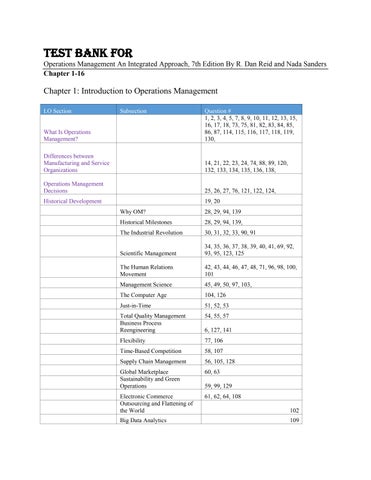
Chapter 1: Introduction to Operations Management LO Section
Subsection
What Is Operations Management?
Question # 1, 2, 3, 4, 5, 7, 8, 9, 10, 11, 12, 13, 15, 16, 17, 18, 73, 75, 81, 82, 83, 84, 85, 86, 87, 114, 115, 116, 117, 118, 119, 130,
Differences between Manufacturing and Service Organizations
14, 21, 22, 23, 24, 74, 88, 89, 120, 132, 133, 134, 135, 136, 138,
Operations Management Decisions
25, 26, 27, 76, 121, 122, 124,
Historical Development
19, 20 Why OM?
28, 29, 94, 139
Historical Milestones
28, 29, 94, 139,
The Industrial Revolution
30, 31, 32, 33, 90, 91
Scientific Management
34, 35, 36, 37, 38, 39, 40, 41, 69, 92, 93, 95, 123, 125
The Human Relations Movement
42, 43, 44, 46, 47, 48, 71, 96, 98, 100, 101
Management Science
45, 49, 50, 97, 103,
The Computer Age
104, 126
Just-in-Time
51, 52, 53
Total Quality Management Business Process Reengineering
54, 55, 57
Flexibility
77, 106
Time-Based Competition
58, 107
Supply Chain Management
56, 105, 128
Global Marketplace Sustainability and Green Operations
60, 63
Electronic Commerce Outsourcing and Flattening of the World
61, 62, 64, 108
Big Data Analytics
6, 127, 141
59, 99, 129
102 109
Today's OM Environment Operations Management in Practice
65, 66, 70, 78, 131, 140 67, 68, 110
OM across the Organization
72, 79, 80, 111, 112, 113, 137
© John Wiley & Sons, Inc. or the author. All rights reserved. Instructors who are authorized users of this course are permitted to download these materials and use them in connection with the course. Except as permitted herein or by law, no part of these materials should be reproduced, stored in a retrieval system, or transmitted, in any form or by any means, electronic, mechanical, photocopying, recording or otherwise.
Multiple Choice
1. Every business is managed through what three major functions? a) accounting, finance, and marketing b) engineering, finance, and operations management c) accounting, purchasing, and human resources d) accounting, engineering, and marketing e) finance, marketing, and operations management Ans: e Solution: Every business is managed through three major functions: finance, marketing, and operations management. Section Ref: What Is Operations Management? Sub Section Ref: n/a Level: Easy Bloom‘s: Knowledge Learning Objective 1: Define operations management. AACSB: Knowledge Time on Task: 1 min
2. Which business function is responsible for managing cash flow, current assets, and capital investments? a) accounting b) finance c) marketing d) operations management e) purchasing Ans: b
Solution: Finance is the function responsible for managing cash flow, current assets, and capital investments. Section Ref: What Is Operations Management? Sub Section Ref: n/a Level: Easy Bloom‘s: Knowledge Learning Objective 1: Define operations management. AACSB: Knowledge Time on Task: 1 min
3. The finance function is responsible for a) sales, generating customer demand, and understanding customer wants and needs. b) planning and coordinating all the resources needed to design, produce, and deliver the merchandise to its various retail locations. c) planning, coordinating, and controlling the resources needed to produce a company‘s products and services. d) managing cash flow, current assets, and capital investments. e) efficiency and costs. Ans: d Solution: The financial function is responsible for managing cash flow, current assets, and capital investments. Section Ref: What Is Operations Management? Sub Section Ref: n/a Level: Easy Bloom‘s: Knowledge Learning Objective 1: Define operations management. AACSB: Knowledge Time on Task: 1 min
4. Which business function is responsible for sales, generating customer demand, and understanding customer wants and needs? a) finance b) human resources c) marketing d) operations management e) purchasing Ans: c Solution: Marketing is responsible for sales, generating customer demand, and understanding customer wants and needs. Section Ref: What Is Operations Management? Sub Section Ref: n/a Level: Easy
Bloom‘s: Knowledge Learning Objective 1: Define operations management. AACSB: Knowledge Time on Task: 1 min 5. Which business function is responsible for planning, coordinating, and controlling the resources needed to produce a company‘s products and services? a) engineering b) finance c) human resources d) marketing e) operations management Ans: e Solution: Operations management is the business function that plans, organizes, coordinates, and controls the resources needed to produce a company‘s goods and services. Section Ref: What Is Operations Management? Sub Section Ref: n/a Level: Easy Bloom‘s: Knowledge Learning Objective 1: Define operations management. AACSB: Knowledge Time on Task: 1 min
6. All of the following are true for business process reengineering EXCEPT a) it can increase efficiency. b) it cannot be used to improve quality. c) it can reduce costs. d) it involves asking why things are done in a certain way. e) it involves redesigning processes. Ans: b Solution: Business process reengineering means redesigning a company‘s processes to increase efficiency, improving quality, and reducing costs. Reengineering requires asking why things are done in a certain way, questioning assumptions, and then redesigning the processes. Section Ref: Historical Development Sub Section Ref: Business Process Reengineering Level: Easy Bloom‘s: Comprehension Learning Objective 4: Identify major historical developments in operations management. AACSB: Knowledge Time on Task: 1 min
7. At the retailer The Gap, which function plans and coordinates all the resources needed to design, produce, and deliver the merchandise to its various retail locations? a) engineering b) human resources c) marketing d) operations management e) purchasing Ans: d Solution: The Gap sells casual apparel. It is the operations function that plans and coordinates all the resources needed to design, produce, and deliver the merchandise to the various retail locations. Section Ref: What Is Operations Management? Sub Section Ref: n/a Level: Easy Bloom‘s: Comprehension Learning Objective 1: Define operations management. AACSB: Knowledge Time on Task: 1 min
8. Operations management is responsible for increasing the organization‘s efficiency, which means the company will be able to a) add to the engineering process. b) take for granted current operations. c) increase the number of positions under the manager‘s position. d) eliminate activities that do not add value. e) increase purchasing opportunities. Ans: d Solution: An important role of operations is to analyze all activities, eliminate those that do no add value, the restructure processes and jobs to achieve greater efficiency. Section Ref: What Is Operations Management? Sub Section Ref: n/a Level: Easy Bloom‘s: Comprehension Learning Objective 1: Define operations management. AACSB: Knowledge Time on Task: 1 min 9. Which of the following is NOT an example of a value-added activity? a) having a haircut b) riding a train c) manufacturing a radio d) waiting to see a doctor e) having a surgery