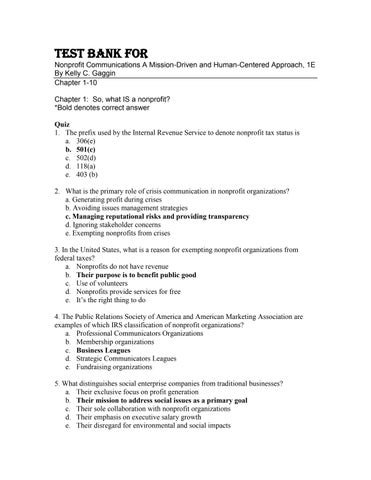
Test Bank For Nonprofit Communications A Mission-Driven and Human-Centered Approach, 1E By Kelly C. Gaggin Chapter 1-10 Chapter 1: So, what IS a nonprofit? *Bold denotes correct answer Quiz 1. The prefix used by the Internal Revenue Service to denote nonprofit tax status is a. 306(e) b. 501(c) c. 502(d) d. 118(a) e. 403 (b) 2. What is the primary role of crisis communication in nonprofit organizations? a. Generating profit during crises b. Avoiding issues management strategies c. Managing reputational risks and providing transparency d. Ignoring stakeholder concerns e. Exempting nonprofits from crises 3. In the United States, what is a reason for exempting nonprofit organizations from federal taxes? a. Nonprofits do not have revenue b. Their purpose is to benefit public good c. Use of volunteers d. Nonprofits provide services for free e. It’s the right thing to do 4. The Public Relations Society of America and American Marketing Association are examples of which IRS classification of nonprofit organizations? a. Professional Communicators Organizations b. Membership organizations c. Business Leagues d. Strategic Communicators Leagues e. Fundraising organizations 5. What distinguishes social enterprise companies from traditional businesses? a. Their exclusive focus on profit generation b. Their mission to address social issues as a primary goal c. Their sole collaboration with nonprofit organizations d. Their emphasis on executive salary growth e. Their disregard for environmental and social impacts
6. What is a key requirement for an organization to qualify for 501(c)(4) status? a. Benefit a specific group of people b. Engage primarily in profit generation c. Be exempt from lobbying activities d. Provide tax-deductible donations e. Promote the common good and general welfare 7. Entrepreneurs who develop businesses designed to advance a mission and make change for the public good are called a. Strategic entrepreneurs b. Sustainable entrepreneurs c. Social entrepreneurs d. Social enterprise 8. What role do nonprofits, particularly those focused on community development, play in fostering a thriving community? a. Exclusively providing entertainment and cultural events b. Concentrating solely on serving vulnerable populations c. Eliminating barriers to homeownership for residents d. Monitoring economic contributions from new residents and businesses e. Addressing social inequalities and stabilizing communities for overall vitality 9. A unique title for the top executive that is primarily used in nonprofit organizations is a. Executive director b. President c. Chief Executive Officer d. Chairperson of the board 10. The primary purpose of a nonprofit board of directors is a. Overseeing daily operations b. Implementing fundraising campaigns c. Representing the organization's best interests d. Making strategic decisions e. Conducting volunteer recruitment 11. How do many organizations with limited resources address the need for specialized roles in mission-driven activities? a. By hiring an employee for every possible role b. By outsourcing tasks to external agencies c. By forming committees or task forces d. By relying solely on board members for all tasks e. By reducing the scope of mission-driven activities 12. According to the text, “ESG” is an accepted abbreviation for a. Environmental, Social, and Green
b. Economic Sustainability Guidelines c. Environmental, Social, Governance d. Economic, Strategy, Growth
Chapter 2: Why and How Nonprofits Communicate *Bold denotes correct answer Quiz 1. What is the primary objective of fundraising professionals? a. Building relationships with stakeholders b. Securing financial support for an organization c. Educating and engaging a wider variety of stakeholders d. Focusing solely on media management e. Minimizing the impact of donor contributions 2. What is the primary responsibility of event planners in nonprofit organizations? a. Managing media relations b. Securing financial support from donors c. Running day-to-day operations of the organization d. Ensuring all logistical aspects of events are well-coordinated e. Solely focusing on menu planning 4. What is a common function of membership organizations and associations? a. Encouraging collaboration b. Offering professional development opportunities c. Bringing individuals with common interests together d. Actively participating in policy discussions and lobbying e. All of the above 5. What is a fundamental similarity between fundraising/development and communications within organizations? a. Avoiding relationship building with stakeholders b. Focusing solely on financial support c. Disregarding strategic thinking in favor of tactical execution d. Minimizing the importance of persuasive narratives e. Cultivating relationships with stakeholders and engaging them in the organization's work 6. What is a key role of strategic communications in nonprofit organizations? a. Managing day-to-day operations b. Ensuring financial sustainability c. Building strong brand identity and reputation d. Exclusively targeting donors for financial support e. Ignoring stakeholder feedback and concerns 7. What is a key objective of strategic communications campaigns in nonprofit organizations?
a. b. c. d. e.
Exclusively targeting donors for financial support Ignoring social issues and focusing on organizational achievements Promoting awareness about pressing social concerns Avoiding the use of digital platforms in campaigns Disregarding stakeholder testimonials in favor of data-driven messages
8. What role does communication play in supporting advocacy and activist groups, according to the paragraph? a. Deciding which policies to engage in collective action b. Disseminating misinformation to win favor c. Countering urgent information about advocacy opportunities d. Facilitating the exchange of information, ideas, and resources e. Avoiding the use of social and digital media in communication 9. What makes it challenging for nonprofit organizations to establish a unique identity in a competitive landscape? a. Exclusive focus on technology and business models b. Not enough competition c. Fragmented access to resources d. Overemphasis on branded merchandise e. A crowded market with many organizations competing for leadership in a specific cause 10. What is a significant communication challenge related to measuring impact in nonprofit organizations? a. Avoiding the use of complex or technical language b. Limited stakeholder engagement c. Difficulty quantifying the results of communication efforts d. Overemphasis on print media e. Ignoring the emotional intelligence of communicators Chapter 3: People, People, and More People *Bold denotes correct answer Quiz 1. According to the historical definition, what did the term "audience" in the 14th Century specifically refer to? a. People using social media b. All the people within hearing of something c. Fans sitting outside a concert venue d. People watching a concert on TikTok e. The group of people watching a play together in one place 2. How is the term "audience" used in the context of the text? a. People exclusively interested in the organization b. People who attend events or read the daily newspaper c. People who use communications channels and can receive messages