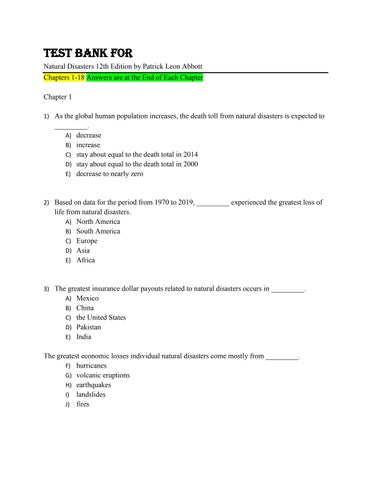
Test Bank For Natural Disasters 12th Edition by Patrick Leon Abbott Chapters 1-18 Answers are at the End of Each Chapter Chapter 1 1) As the global human population increases, the death toll from natural disasters is expected to
_________. A) decrease B) increase C) stay about equal to the death total in 2014 D) stay about equal to the death total in 2000 E) decrease to nearly zero
2) Based on data for the period from 1970 to 2019, _________ experienced the greatest loss of
life from natural disasters. A) North America B) South America C) Europe D) Asia E) Africa
3) The greatest insurance dollar payouts related to natural disasters occurs in _________. A) Mexico B) China C) the United States D) Pakistan E) India
The greatest economic losses individual natural disasters come mostly from _________. F) hurricanes G) volcanic eruptions H) earthquakes I) landslides J) fires
4) The return period of a disaster is the average number of years _________. A) before survivors return to their homes B) before the economy returns to pre-disaster levels C) required to exponentially decay to zero D) between same-sized events E) between events of the same type, regardless of size
5) Which of the following disasters has the highest probability of causing a "10-fatality event"
each year? A) an earthquake B) a volcanic eruption C) a hurricane D) a tornado E) a flood
6) Which of the following disasters has the highest probability of causing a "1,000-fatality
event" each year? A) an earthquake B) a volcanic eruption C) a flood D) a tornado E) a hurricane
7) The rapid increase in human population during the past several centuries is an example of
_________ growth. A) linear B) algebraic C) parabolic D) logarithmic E) exponential Using the rule of 70, money invested at 5% annual interest will double in _________ years.
F) 70 G) 65 H) 14 I) 5 J) 35
8) Using the rule of 70, a population growth rate of 7% annually will result in doubling a
population in _________ years. A) 70 B) 35 C) 10 D) 7 E) 2
9) The _________ century saw many of the intellectual advances that set the stage for the
present phase of cultural change, with the causes of many diseases being recognized, and the principles of public health being established. A) eighteenth B) sixteenth C) fifteenth D) seventeenth E) fourteenth
10) In the last two or three centuries birthrates _________. A) have changed little, while death rates have plunged B) and death rates have plunged C) and death rates have skyrocketed D) have skyrocketed, while death rates have plunged E) and death rates remained flat
In 2020 the human population of the world was about _________. F) 550 million G) 7.8 billion H) 4.6 billion I) 14.8 billion J) 945 million
11) The growth rate of the world population equals _________. A) the birthrate plus the death rate B) the birthrate minus the death rate C) the death rate minus the birthrate D) None of these choices are correct.
12) At present, the worldwide population of humans is growing at a rate of _________% per
year. A) B) C) D)
0.01 0.11 1.1 11
13) At present, after subtracting deaths from births, world population increases 1.1 percent per
year for a doubling time of _________. A) 63 years B) 14 years C) 140 years D) 70 years E) 280 years
14) At present, the world population of humans grows by about _________ million per year. A) 0.08 B) 0.8 C) 8 D) 80 E) 800
15) The growth of human population worldwide over the past 1,000 years has been _________. A) essentially zero B) exponential, with a constant growth rate C) exponential, with a generally increasing growth rate D) on a straight linear increase with time E) logarithmic
16) <p>In the last 50 years of the
century, world population grew from _________ billion to
over 6 billion. A) 5 B) 4 C) 3.5 D) 3 E) 2.5
17) Most of the more-developed countries have _________. A) low death rates and low birthrates B) low death rates and high birthrates C) high death rates and low birthrates D) high death rates and high birthrates
18) Today, the less-developed countries have _________. A) low death rates and high birthrates B) low death rates and low birthrates C) high death rates and low birthrates D) high death rates and high birthrates
19) What caused the collapse of the human population on Easter Island from its peak in 1550
CE? A) B) C) D) E)
Human activities overwhelmed the environment. Dutch sailors introduced a foreign virus in 1722. The society went through a demographic transition. A series of tsunami hit the island in 1551 CE. A volcanic eruption buried the island in ash in 1588 CE.
20) The introduction of the potato in Ireland in the 1500’s _________. A) decreased the carrying capacity of the island B) increased the carrying capacity of the island C) paused the demographic transition D) reversed the demographic transition E) decreased the birthrate