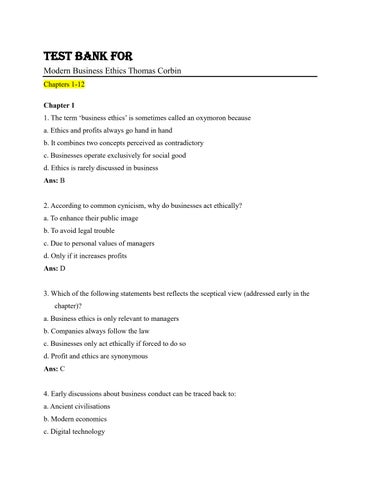
Test Bank For Modern Business Ethics Thomas Corbin Chapters 1-12 Chapter 1 1. The term ‘business ethics’ is sometimes called an oxymoron because a. Ethics and profits always go hand in hand b. It combines two concepts perceived as contradictory c. Businesses operate exclusively for social good d. Ethics is rarely discussed in business Ans: B 2. According to common cynicism, why do businesses act ethically? a. To enhance their public image b. To avoid legal trouble c. Due to personal values of managers d. Only if it increases profits Ans: D 3. Which of the following statements best reflects the sceptical view (addressed early in the chapter)? a. Business ethics is only relevant to managers b. Companies always follow the law c. Businesses only act ethically if forced to do so d. Profit and ethics are synonymous Ans: C 4. Early discussions about business conduct can be traced back to: a. Ancient civilisations b. Modern economics c. Digital technology
d. Industrial management Ans: A 5. Which development significantly contributed to the rise of business ethics as a recognised academic discipline? a. The invention of the printing press b. Growth of multinational corporations c. The popularity of social media d. Introduction of labour unions Ans: B 6. Why is understanding the historical context of business ethics important? a. It reveals the origins of accounting practices b. It helps explain current ethical standards and challenges c. It shows how profits increased over time d. It identifies the first business leaders Ans: B 7. Which is a key influence in shaping business ethics debates today? a. Ancient religious texts b. Shipping innovations c. New office design trends d. The legacy of high-profile corporate scandals Ans: D 8. The Enron scandal is significant to business ethics because it exemplifies: a. Effective corporate governance b. The consequences of ethical failure c. How to increase shareholder value d. The benefits of risk-taking Ans: B
9. What was the main outcome for employees and shareholders due to the Enron scandal? a. Increased job opportunities b. Improved corporate reputation c. Higher bonuses for executives d. Loss of jobs and savings Ans: D 10. Theranos is an example of: a. Transparent reporting b. Medical innovation success c. The dangers of fraudulent claims d. Effective leadership communication Ans: C 11. Which is a leading modern technological challenge in business ethics discussed in this chapter? a. Manual bookkeeping b. Algorithmic bias in digital systems c. Using paper forms d. Hiring based on intuition Ans: B 12. Environmental stewardship as a business ethics issue involves: a. Maximising quarterly profits in the context of environmental spending b. Managing data usage c. Taking responsibility for ecological impacts d. Focusing on product quality when they use natural materials Ans: C 13. Which of the following is a key ethical challenge for businesses in the digital age?
a. Ensuring workplace diversity b. Navigating data privacy and security c. Ensuring appropriate employee benefits d. All of these Ans: D 14. The outcome of recognising racial and gender equity in business ethics often appears as: a. An absence of workplace diversity b. Equal access to promotion and fair treatment c. A focus on improved productivity d. Outsourcing jobs internationally Ans: B 15. A stakeholder approach to business focuses mostly on: a. Increasing only shareholder wealth b. Environmental effects c. Employee participation d. Engaging with multiple parties affected by the business Ans: D 16. Which best describes the shift in modern business roles? a. From pure profit pursuit to multidimensional responsibility b. From ethical conduct to strict law compliance c. From community service to outsourcing d. From innovation to tradition Ans: A 17. Studying business ethics can help future leaders to: a. Understand ethical issues in decision-making b. Become better leaders c. Develop strong ethical reasoning skills
d. All of these Ans: D 18. For organisational success, ethics education is important primarily because: a. It offers a competitive advantage through trust and integrity b. It teaches how to avoid all risks c. It improves innovation d. It prohibits rule-breaking Ans: A 19. Why might business ethics be important for career development? a. It increases the chances of ethical leadership roles b. It ensures promotion c. It reduces the need for ongoing learning d. It directly improves communication skills Ans: A 20. Strong ethical understanding supports business success by: a. Impacting employee engagement b. Encouraging transparency and trust c. Restricting innovation d. Focusing on profit margins Ans: B
Chapter 2: Moral reasoning and ethical frameworks 1. What best defines moral reasoning? a. Making decisions based only on laws and legal precedents b. Considering the consequences of every action c. Systematically evaluating ethical choices using principles and values d. Making decisions which follow social traditions Ans: C