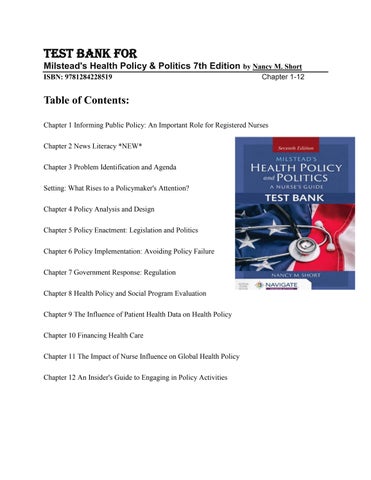
TEST BANK FOR Milstead's Health Policy & Politics 7th Edition by Nancy M. Short ISBN: 9781284228519
Chapter 1-12
Table of Contents: Chapter 1 Informing Public Policy: An Important Role for Registered Nurses Chapter 2 News Literacy *NEW* Chapter 3 Problem Identification and Agenda Setting: What Rises to a Policymaker's Attention? Chapter 4 Policy Analysis and Design Chapter 5 Policy Enactment: Legislation and Politics Chapter 6 Policy Implementation: Avoiding Policy Failure Chapter 7 Government Response: Regulation Chapter 8 Health Policy and Social Program Evaluation Chapter 9 The Influence of Patient Health Data on Health Policy Chapter 10 Financing Health Care Chapter 11 The Impact of Nurse Influence on Global Health Policy Chapter 12 An Insider's Guide to Engaging in Policy Activities
Chapter 1: Informing Public Policy: An Important Role for Registered Nurses ✅ Multiple Choice Questions (MCQs) 1. A nurse recognizes that clinical decisions are influenced by laws, regulations, and funding structures. Which concept best explains this influence? A. Clinical autonomy B. Political determinants of health C. Individual practice D. Organizational workflow Answer: B Rationale: Chapter 1 explains that political determinants of health include laws, regulations, and policies that shape healthcare delivery and outcomes. These factors directly influence clinical practice. Key words: political determinants, policy influence
2. Which statement best explains why nurses are essential in policymaking? A. Nurses avoid policy involvement B. Nurses are the largest and most trusted workforce C. Nurses only provide bedside care D. Nurses lack policy knowledge Answer: B Rationale: The textbook emphasizes that nurses are highly trusted and numerous, giving them a strong voice to influence healthcare policy. Key words: trust, workforce, advocacy
3. Which best describes “policy as a process”? A. A single decision B. A linear sequence C. A dynamic and iterative process D. A hospital-only activity Answer: C Rationale: The policy process is described as nonlinear and iterative, involving overlapping stages such as agenda setting, implementation, and evaluation. Key words: policy process, dynamic
4. A nurse collects incident data and presents recommendations to leadership. This is an example of: A. Documentation B. Evidence translation C. Administrative work D. Clinical care Answer: B Rationale: Chapter 1 highlights evidence translation as converting clinical observations into policyrelevant recommendations. Key words: evidence, translation
5. Which statement reflects the relationship between policy and practice? A. They are unrelated B. Policy drives practice and practice informs policy C. Practice is independent D. Policy has no impact Answer: B Rationale: The text emphasizes a bidirectional relationship between policy and practice. Key words: practice-policy relationship
6. What is a key purpose of public policy in healthcare? A. Increase profits B. Improve population health C. Reduce services D. Limit access Answer: B Rationale: Public policy aims to improve health outcomes at the population level. Key words: population health
7. Which is an example of a policy instrument? A. Patient care plan B. Regulations and laws C. Vital signs monitoring D. Nurse schedule Answer: B Rationale: Policy instruments include laws, regulations, and programs used to implement policy goals. Key words: policy instruments, regulation
8. A nurse joins a professional organization to influence policy. This reflects: A. Clinical care B. Organizational involvement C. Documentation D. Evaluation Answer: B Rationale: The chapter highlights organizational involvement as a key pathway for policy engagement. Key words: organization, involvement
9. Which best describes the nurse’s role in policy? A. Passive observer B. Active participant and advocate C. Administrative only D. No role Answer: B Rationale: Nurses are described as active contributors and advocates in policy processes. Key words: advocacy, participation
10. A nurse advocating for safer staffing ratios is engaging in: A. Clinical care B. Policy advocacy C. Evaluation D. Documentation Answer: B Rationale: Advocacy involves promoting policy changes to improve outcomes. Key words: advocacy, staffing
11. Which level of policy has the broadest impact? A. Local B. Organizational C. Federal D. Individual Answer: C Rationale: Federal policies affect large populations across the nation. Key words: federal policy