Name:
Class:
Date:
Solution Manual For All Chapters
Answers Are At The End Of Each Chapter chapter 1
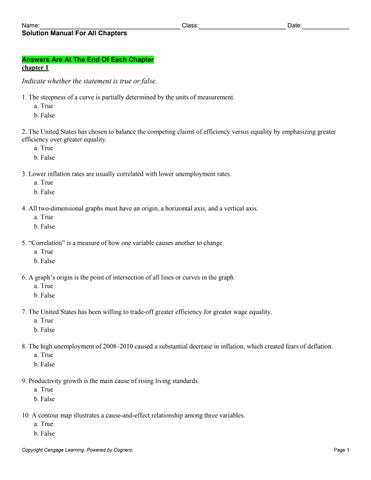
Indicate whether the statement is true or false. 1. The steepness of a curve is partially determined by the units of measurement. a. True b. False 2. The United States has chosen to balance the competing claims of efficiency versus equality by emphasizing greater efficiency over greater equality. a. True b. False 3. Lower inflation rates are usually correlated with lower unemployment rates. a. True b. False 4. All two-dimensional graphs must have an origin, a horizontal axis, and a vertical axis. a. True b. False 5. ―Correlation‖ is a measure of how one variable causes another to change. a. True b. False 6. A graph’s origin is the point of intersection of all lines or curves in the graph. a. True b. False 7. The United States has been willing to trade-off greater efficiency for greater wage equality. a. True b. False 8. The high unemployment of 2008–2010 caused a substantial decrease in inflation, which created fears of deflation. a. True b. False 9. Productivity growth is the main cause of rising living standards. a. True b. False 10. A contour map illustrates a cause-and-effect relationship among three variables. a. True b. False Copyright Cengage Learning. Powered by Cognero.
Page 1
Name:
Class:
Date:
Solution Manual For All Chapters 11. Economists are often required to make unrealistic assumptions concerning the problems they are investigating. a. True b. False 12. The Phillips curve illustrates the trade-off between inflation and economic growth. a. True b. False 13. Economic efficiency and income equality are often conflicting goals in an economy. a. True b. False 14. A model that is an oversimplification for one purpose will likely be an oversimplification for other purposes as well. a. True b. False 15. When controls over market prices are enacted, the consequences are always clear. a. True b. False 16. There is no trade-off between efficiency and equality. a. True b. False 17. Even though international trade is undertaken voluntarily, a country that engages in trade may not benefit from it. a. True b. False 18. One of the consequences of allowing wages to fall in the United States has been growing wage inequality. a. True b. False 19. Eliminating important details in economic analysis is necessary to understand the complexity of the economy. a. True b. False 20. Externalities can only involve the imposition of harm on a party not directly involved in an economic transaction. a. True b. False 21. Externalities are costs to society, which have an impact on parties not directly involved into a particular economic transaction. a. True b. False 22. In economic theorizing, common sense will always lead to the correct answer. Copyright Cengage Learning. Powered by Cognero.
Page 2
Name:
Class:
Date:
Solution Manual For All Chapters a. True b. False 23. When the economy experiences a bust, the government knows exactly which policies will spur an economic recovery. a. True b. False 24. Abstraction ignores many details in order to focus on the most important elements of a problem. a. True b. False 25. In the calculation of the cost of going to college, an economist would always include the cost of room and board. a. True b. False 26. The marginal cost of an airline ticket is the total cost of operating a flight divided by the number of passengers who buy tickets. a. True b. False 27. The optimal degree of abstraction depends on the objective of the analysis. a. True b. False 28. In scientific language, a theory is an untested assertion of alleged fact. a. True b. False 29. Graphs are valuable because they facilitate interpretation of data. a. True b. False 30. In her calculation of the cost of going to college, an economist would include the amount of forgone earnings over the years spent at college. a. True b. False 31. Comparative advantage explains how two nations can benefit from trade. a. True b. False 32. Statistical correlation always implies causation. a. True b. False 33. Government controls over market prices are often enacted to benefit a specific group. Copyright Cengage Learning. Powered by Cognero.
Page 3
Name:
Class:
Date:
Solution Manual For All Chapters a. True b. False 34. Individuals will have different value judgments about the appropriate rate of unemployment and the appropriate rate of inflation. a. True b. False 35. Economic problems are made manageable by stripping away some of the unnecessary details. a. True b. False 36. Abstraction is used in economics to omit unnecessary details and focus on the essence of the problem being studied. a. True b. False 37. A government has the ability to use fiscal and monetary policy to mitigate the effects of economic fluctuations. a. True b. False 38. Externalities are created when parties not involved in an economic transaction are affected by it. a. True b. False 39. The market price of a transaction always includes all of the costs and benefits associated with the transaction. a. True b. False 40. If Japan is twice as good at producing cameras and three times as good at producing TV sets as the United States, Japan is said to have a comparative advantage in TV sets and the United States has a comparative advantage in cameras. a. True b. False 41. The word ―theory‖ means the same to the scientist as it does to the man on the street. a. True b. False 42. Slope will vary along a curve (as opposed to a straight line). a. True b. False 43. A graph conveys information about a cause-and-effect relationship. a. True b. False 44. In both the 1970s and the 1990s, extreme economic events caused unemployment to move in the same direction as inflation. Copyright Cengage Learning. Powered by Cognero.
Page 4
Name:
Class:
Date:
Solution Manual For All Chapters a. True b. False 45. A theory is an untested assertion of alleged fact. a. True b. False 46. Economists probably agree more often than they disagree. a. True b. False 47. A theory is an explanation of the causal mechanism behind observed phenomena. a. True b. False 48. Inaccurate prediction generally invalidates the use of theory in economics. a. True b. False 49. Airlines can use marginal analysis to set ticket prices, which can increase profits for the company. a. True b. False 50. In international trade, one country’s gain is another country’s loss. a. True b. False 51. Abstraction is unnecessary when economic analysis is done properly. a. True b. False 52. Two variables that systematically change together are correlated. a. True b. False 53. A line that slopes downward from left to right has a positive slope. a. True b. False 54. With the technological developments in the twenty-first century, productivity growth is no longer an important factor in economic well-being. a. True b. False 55. Greater economic efficiency and income equality can usually both be achieved in an economy simultaneously. a. True Copyright Cengage Learning. Powered by Cognero.
Page 5