Exam Name___________________________________
MULTIPLE CHOICE. Choose the one alternative that best completes the statement or answers the question.
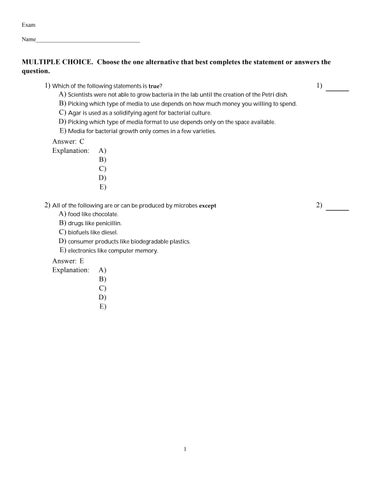
1) Which of the following statements is true? A) Scientists were not able to grow bacteria in the lab until the creation of the Petri dish. B) Picking which type of media to use depends on how much money you willing to spend. C) Agar is used as a solidifying agent for bacterial culture. D) Picking which type of media format to use depends only on the space available. E) Media for bacterial growth only comes in a few varieties. Answer: C Explanation:
A) B) C) D) E)
2) All of the following are or can be produced by microbes except A) food like chocolate. B) drugs like penicillin. C) biofuels like diesel. D) consumer products like biodegradable plastics. E) electronics like computer memory. Answer: E Explanation:
1)
A) B) C) D) E)
1
2)
3) Which of the following statements is true about the decolorizing step for the acid-fast stain? A) Over-decolorizing can lead to false-positive results. B) Non-acid-fast bacteria appear bright pink-red at the end of the procedure. C) The decolorizing step is the differentiating step. D) Because acid-fast bacteria have a waxy cell wall that resists decolorization by the
3)
acetone-alcohol rinse, they appear a deep blue at the end of the procedure. E) Acetone-alcohol solution is the decolorizing agent.
Answer: C Explanation:
A) B) C) D) E)
4) Carriers of the sickle-cell gene A) are more susceptible to contracting malaria. B) have a survival advantage in areas where malaria is common. C) are often found in high concentrations in U.S. cities. D) are more likely to die from a malaria infection. E) experience painful changes in nerve cell shape. Answer: B Explanation:
A) B) C) D) E)
5) Which of the following individuals does not correctly match with their contribution to
microbiology. A) Ignaz Semmelweis: First developed aseptic techniques to decrease mortality rates from childbed fever B) Louis Pasteur: Showed that biogenesis is responsible for the propagation of life
C) Florence Nightingale: Established the use of aseptic techniques in nursing practices D) Robert Koch: Developed criteria for determining the causative agent of an infectious disease E) Joseph Lister: Developed the first anesthetic solution for use in surgeries Answer: E Explanation:
4)
A) B) C) D) E)
2
5)
6) Which of the following statements is false? A) Transmission electron microscopy provides information about internal structures. B) Scanning electron microscopy provides information about surface structures. C) Immunofluorescence is when fluorochromes bind to a specific target and fluoresce after
6)
exposure to UV light. D) Fluorochromes can be natural or synthetic.
E) Fluorescence microscopy is when fluorochromes stain a sample so it will fluoresce when exposed to UV light.
Answer: C Explanation:
A) B) C) D) E)
7) ________ bacteria can create sticky communities called ________, which are made up of single or
7)
diverse microbial species. A) Plaque; hangouts
B) Planktonic; biofilms C) Pathogenic; quorums D) Matrix; cavities E) Infectious; flora Answer: B Explanation:
A) B) C) D) E)
8) Which of the following is true about bioremediation? A) The Environmental Protection Agency documents a handful of chemical spills per year in
the United States alone. B) Nitrogen, sulfur, phosphate, and sometimes iron supplements are added to the spill zone to encourage microbial growth. C) Bioremediation never harms the environment.
D) A mix of bacteria, archaea, and fungi species is used to seed the spill zone. E) Coagulators are used to condense the spill. Answer: B Explanation:
A) B) C) D) E)
3
8)
9) Why do electron microscopes have a better resolution versus light microscopes? A) The additional steps necessary to prepare the sample for viewing provide the improved
9)
resolution.
B) The lenses used to focus the electron beam are more adjustable than the ones in a light microscope.
C) The lenses, knobs, and strength of the electron beam can all be highly controlled, which also
explains why electron microscopes are so expensive. D) An electron beam has a wavelength of about 800 nm, and resolution improves with larger wavelengths. E) An electron beam has a wavelength of about 1 nm, and resolution improves with smaller wavelengths.
Answer: E Explanation:
A) B) C) D) E)
10) ________ predict what happens, while ________ explain how and why something occurs. A) Theories; laws B) Observations; conclusions C) Laws; theories D) Observations; hypotheses E) Hypotheses; conclusions Answer: C Explanation:
A) B) C) D) E)
11) All of the following can make interpreting the Gram stain difficult except A) the culture is between 24 and 48 hours old. B) testing bacteria with especially resistant cell walls. C) the culture is more than 48 hours old and contains damaged cells. D) testing bacteria that have a waxy cell wall. E) testing bacteria that are forming endospores. Answer: A Explanation:
10)
A) B) C) D) E)
4
11)
12) When practicing aseptic culturing techniques, it is important to keep all of the following in mind
12)
except A) gloves and other protecting clothing may be required depending on the specimen being used. B) all of the instruments and lab ware that directly touch the specimen is sterile.
C) the media used to grow the specimen is sterile. D) surrounding surfaces are decontaminated before and after handling cultures. E) as long as nothing unintended touches the media, there will be no contamination. Answer: E Explanation:
A) B) C) D) E)
13) Inference-observation confusion occurs when someone A) lies about what happened. B) jumps to a conclusion. C) cannot understand your accent. D) incorrectly assesses a patient. E) remembers events wrong. Answer: B Explanation:
A) B) C) D) E)
14) All of the following are reasons to classify a new strain of bacteria except A) take up genetic material from their environment. B) 50% different genetic material. C) genetic variant. D) mutations. E) gene transfers. Answer: B Explanation:
13)
A) B) C) D) E)
5
14)