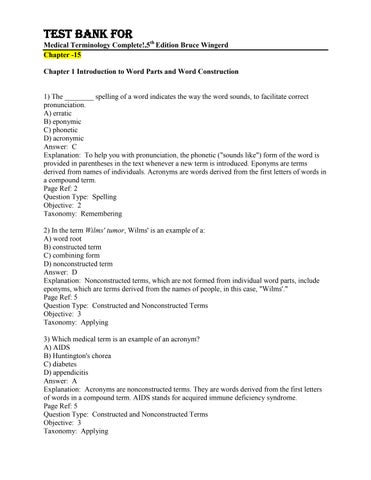
Test Bank For Medical Terminology Complete!,5th Edition Bruce Wingerd Chapter -15 Chapter 1 Introduction to Word Parts and Word Construction
1) The ________ spelling of a word indicates the way the word sounds, to facilitate correct pronunciation. A) erratic B) eponymic C) phonetic D) acronymic Answer: C Explanation: To help you with pronunciation, the phonetic ("sounds like") form of the word is provided in parentheses in the text whenever a new term is introduced. Eponyms are terms derived from names of individuals. Acronyms are words derived from the first letters of words in a compound term. Page Ref: 2 Question Type: Spelling Objective: 2 Taxonomy: Remembering 2) In the term Wilms' tumor, Wilms' is an example of a: A) word root B) constructed term C) combining form D) nonconstructed term Answer: D Explanation: Nonconstructed terms, which are not formed from individual word parts, include eponyms, which are terms derived from the names of people, in this case, "Wilms'." Page Ref: 5 Question Type: Constructed and Nonconstructed Terms Objective: 3 Taxonomy: Applying 3) Which medical term is an example of an acronym? A) AIDS B) Huntington's chorea C) diabetes D) appendicitis Answer: A Explanation: Acronyms are nonconstructed terms. They are words derived from the first letters of words in a compound term. AIDS stands for acquired immune deficiency syndrome. Page Ref: 5 Question Type: Constructed and Nonconstructed Terms Objective: 3 Taxonomy: Applying
4) Many medical terms are made of multiple word parts combined together. Such medical terms are called: A) abbreviations B) acronyms C) eponyms D) constructed terms Answer: D Explanation: Word parts—including prefixes, suffixes, and word roots—and combining forms create constructed terms. The key to learning constructed terms is to first learn the meaning of the various word parts. Eponyms are terms derived from names of individuals. Acronyms are words derived from the first letters of words in a compound term. Page Ref: 4 Question Type: Constructed and Nonconstructed Terms Objective: 3 Taxonomy: Remembering 5) Some medical terms are derived from the names of important people. Such medical terms are called: A) acronyms B) eponyms C) abbreviations D) constructed terms Answer: B Explanation: Nonconstructed terms, which are not formed from individual word parts, include eponyms, which are terms derived from the names of people. Word parts—including prefixes, suffixes, and word roots—and combining forms create constructed terms. Acronyms are words derived from the first letters of words in a compound term. Page Ref: 5 Question Type: Constructed and Nonconstructed Terms Objective: 3 Taxonomy: Remembering 6) The medical term LASIK, which stands for laser-assisted in situ keratomileusis, is an example of a(n): A) prefix B) acronym C) combining form D) eponym Answer: B Explanation: Acronyms are nonconstructed terms. They are words derived from the first letters of words in a compound term. LASIK stands for laser-assisted in situ keratomileusis. Page Ref: 5 Question Type: Constructed and Nonconstructed Terms Objective: 3 Taxonomy: Applying
7) This type of word part is attached to the beginning of a word. A) combining vowel B) prefix C) suffix D) root Answer: B Explanation: A prefix is placed at the beginning of a term and is used to expand or enhance the meaning of the word. You will know that a word part is a prefix in the text by the hyphen that immediately follows it (e.g., con-). Page Ref: 6 Question Type: Word Parts Objective: 4 Taxonomy: Remembering 8) Which two languages have the most impact on the formation and meanings of medical terms? A) Greek and French B) Greek and Latin C) English and German D) Latin and Spanish Answer: B Explanation: The ancient Greeks are considered the fathers of modern medicine. The Romans advanced medicine with their own experiments and observations. They added Latin terms to the growing body of medical language. Page Ref: 4 and 11 Question Type: Word Parts Objective: 4 Taxonomy: Remembering 9) This type of word part provides the primary meaning of the term. A) root B) combining vowel C) prefix D) suffix Answer: A Explanation: The word root provides the primary meaning for the term and is the part to which other word parts are attached. The prefix is at the beginning to enhance the meaning. The suffix is at the end to indicate the part of speech. Page Ref: 6 Question Type: Word Parts Objective: 4 Taxonomy: Remembering
10) This type of word part is attached to the end of a word. A) suffix B) root C) combining vowel D) prefix Answer: A Explanation: The suffix is at the end of the word to indicate the part of speech (noun, verb, adjective, adverb, etc.) or modify the word's meaning. You will know that a word part in the text is a suffix by the hyphen that immediately precedes it (e.g., -ion). Page Ref: 6 Question Type: Word Parts Objective: 4 Taxonomy: Remembering 11) Which of the following statements is false? A) All medical terms must have a prefix, root, and suffix. B) Some medical terms are made of just a prefix and a suffix. C) Some medical terms have more than one root. D) Some medical terms are made of just a root and a suffix Answer: A Explanation: Some medical terms are not constructed using word parts (prefix, root, suffix). Nonconstructed terms include eponyms and acronyms. Page Ref: 8 Question Type: Constructed and Nonconstructed Terms Objective: 4 Taxonomy: Evaluating 12) This word part is used to assist with pronunciation when combining a root with a suffix or another root. A) combining vowel B) prefix C) suffix D) root Answer: A Explanation: A combining vowel is used when a word root is connecting to a suffix that begins with a consonant, or when it is connecting to another word root. Page Ref: 8 Question Type: Word Parts Objective: 5 Taxonomy: Remembering
13) In most cases, the combining vowel is the letter: A) o B) a C) e D) i Answer: A Explanation: In most cases, the combining vowel is the letter o, and in some cases it is the letter i or e. Page Ref: 8 Question Type: Word Parts Objective: 5 Taxonomy: Remembering 14) A combining form is made up of: A) a suffix and a combining vowel B) a prefix and a root C) a root and a combining vowel D) a prefix and a suffix Answer: C Explanation: The word root plus its combining vowel creates the combining form used in term construction. The method for writing a combining form involves the use of a slash between the word root and the combining vowel, such as cardi/o. Page Ref: 10 Question Type: Word Parts Objective: 5 Taxonomy: Remembering 15) Identify the combining vowel in the term hepatology. A) hepat/o B) hepat C) o D) -logy Answer: C Explanation: The letter o is utilized as the combining vowel to connect the root hepat to the suffix -logy. The combining form (root plus vowel) is hepat/o. Page Ref: 10 Question Type: Word Parts Objective: 5 Taxonomy: Applying 16) Cardi is an example of what word part? A) word root B) suffix C) prefix D) combining form Answer: A Explanation: The word root provides the primary meaning of the term. In this example, the heart. Page Ref: 9 Question Type: Word Parts Objective: 4