Created By Solutions Certainly! Crafting a detailed analysis or overview of a comprehensive tax textbook like "Taxation of Individuals and Business Entities, 2025 Evergreen Release" by Brian Spilker et al., requires a structured approach to cover the breadth and depth of the material. Here’s a detailed breakdown you can use as a framework for a 5000-word discussion.---### Introduction#### Overview of the Textbook"Taxation of Individuals and Business Entities, 2025 Evergreen Release" is a widely recognized textbook authored by a team of esteemed tax professionals and educators: Brian Spilker, Benjamin Ayers, John Barrick, Troy Lewis, John Robinson, Connie Weaver, Ronald Worsham, and Edmund Outslay. This textbook provides an in-depth examination of the principles, applications, and complexities of taxation as it pertains to both individuals and business entities in the United States. The 2025 Evergreen Release continues the tradition of offering a comprehensive resource that reflects the latest changes in tax legislation, case law, and IRS regulations.### Part 1: Foundations of Taxation#### 1.1 Taxation Principles and FrameworkThe textbook begins by outlining the foundational principles of taxation. This includes the underlying philosophy of taxation, such as equity, efficiency, and simplicity. It discusses the historical development of the U.S. tax system, emphasizing key legislative milestones and their impact on current tax policy.#### 1.2 Structure of the U.S. Tax SystemA detailed analysis of the federal tax structure, including the roles of different tax authorities (IRS, Treasury Department) and the various types of taxes imposed (income, estate, gift, and excise taxes), is provided. The book also explores the relationship between federal and state tax systems, highlighting the interplay and conflicts that can arise.### Part 2: Individual Taxation#### 2.1 Gross Income and ExclusionsThis section dives into the concept of gross income, identifying what constitutes gross income under the Internal Revenue Code. It covers various inclusions and exclusions, such as wages, interest, dividends, and fringe benefits, and explains the principles behind each category.#### 2.2 Deductions and CreditsThe textbook provides a comprehensive review of deductions and credits available to individual taxpayers. This includes standard versus itemized deductions, personal exemptions, and the myriad of tax credits, such as education credits, earned income credit, and child ta x credits. The nuances and eligibility criteria for these deductions and credits are discussed in detail.#### 2.3 Tax Computation and LiabilityThe process of computing tax liability is covered, including the use of tax tables and tax rate schedules. The book explains the concept of marginal versus average tax rates and how they affect tax planning strategies.### Part 3: Business Taxation#### 3.1 Business Entity StructuresAn exploration of various business structures, including sole proprietorships, partnerships, corporations, and S-corporations. The text examines the tax implications of each structure, including formation, operation, and dissolution, as well as the advantages and disadvantages from a tax perspective.#### 3.2 Income Recognition and Expense DeductionThe recognition of business income and the deduction of business expenses are critical areas covered in this section. The textbook discusses the timing of income recognition, accrual versus cash accounting methods, and the rules governing the deductibility of business expenses.#### 3.3 Tax Compliance and ReportingThis section addresses the compliance requirements for businesses, including filing requirements, estimated tax payments, and record-keeping obligations. It also discusses the role of tax advisors and the importance of accurate reporting.### Part 4: Special Topics#### 4.1 International TaxationThe book explores the complexities of international taxation, including issues related to foreign income, tax treaties, and the foreign tax credit. It provides insights into how U.S. tax law interacts with international tax regulations and practices.#### 4.2 Tax Planning and StrategyStrategies for tax planning and optimization are discussed, including retirement planning, estate planning, and tax-efficient investment strategies.
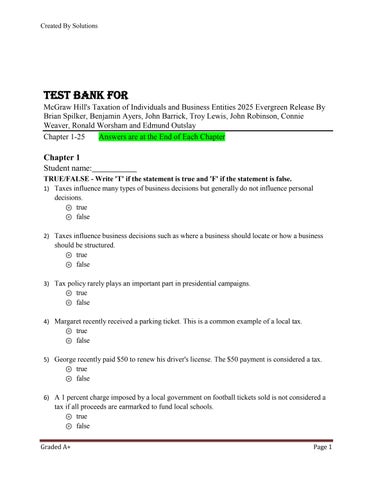
Test Bank For McGraw Hill's Taxation of Individuals and Business Entities 2025 Evergreen Release By Brian Spilker, Benjamin Ayers, John Barrick, Troy Lewis, John Robinson, Connie Weaver, Ronald Worsham and Edmund Outslay Chapter 1-25 Answers are at the End of Each Chapter
Chapter 1 Student name: TRUE/FALSE - Write 'T' if the statement is true and 'F' if the statement is false. 1) Taxes influence many types of business decisions but generally do not influence personal decisions. ⊚ true ⊚ false 2) Taxes influence business decisions such as where a business should locate or how a business
should be structured. ⊚ true ⊚ false 3) Tax policy rarely plays an important part in presidential campaigns. ⊚ true ⊚ false 4) Margaret recently received a parking ticket. This is a common example of a local tax. ⊚ true ⊚ false 5) George recently paid $50 to renew his driver's license. The $50 payment is considered a tax. ⊚ true ⊚ false 6) A 1 percent charge imposed by a local government on football tickets sold is not considered a
tax if all proceeds are earmarked to fund local schools. ⊚ true ⊚ false Graded A+
Page 1
Created By Solutions
7) One key characteristic of a tax is that it is a required payment to a governmental agency. ⊚ true ⊚ false 8) Common examples of sin taxes include the taxes imposed on airline tickets and gasoline. ⊚ true ⊚ false 9) One benefit of a sin tax (e.g., a tax on cigarettes) is that it should increase the demand for the
products being taxed. ⊚ true ⊚ false Certainly! Crafting a detailed analysis or overview of a comprehensive tax textbook like "Taxation of Individuals and Business Entities, 2025 Evergreen Release" by Brian Spilker et al., requires a structured approach to cover the breadth and depth of the material. Here’s a detailed breakdown you can use as a framework for a 5000-word discussion.---### Introduction#### Overview of the Textbook"Taxation of Individuals and Business Entities, 2025 Evergreen Release" is a widely recognized textbook authored by a team of esteemed tax professionals and educators: Brian Spilker, Benjamin Ayers, John Barrick, Troy Lewis, John Robinson, Connie Weaver, Ronald Worsham, and Edmund Outslay. This textbook provides an in-depth examination of the principles, applications, and complexities of taxation as it pertains to both individuals and business entities in the United States. The 2025 Evergreen Release continues the tradition of offering a comprehensive resource that reflects the latest changes in tax legislation, case law, and IRS regulations.### Part 1: Foundations of Taxation#### 1.1 Taxation Principles and FrameworkThe textbook begins by outlining the foundational principles of taxation. This includes the underlying philosophy of taxation, such as equity, efficiency, and simplicity. It discusses the historical development of the U.S. tax system, emphasizing key legislative milestones and their impact on current tax policy.#### 1.2 Structure of the U.S. Tax SystemA detailed analysis of the federal tax structure, including the roles of different tax authorities (IRS, Treasury Department) and the various types of taxes imposed (income, estate, gift, and excise taxes), is provided. The book also explores the relationship between federal and state tax systems, highlighting the interplay and conflicts that can arise.### Part 2: Individual Taxation#### 2.1 Gross Income and ExclusionsThis section dives into the concept of gross income, identifying what constitutes gross income under the Internal Revenue Code. It covers various inclusions and exclusions, such as wages, interest, dividends, and fringe benefits, and explains the principles behind each category.#### 2.2 Deductions and CreditsThe textbook provides a comprehensive review of deductions and credits available to individual taxpayers. This includes standard versus itemized deductions, personal exemptions, and the myriad of tax credits, such as education credits, earned income credit, and child tax credits. The nuances and eligibility criteria for these deductions and credits are discussed in detail.#### 2.3 Tax Computation and LiabilityThe process of computing tax liability is covered, including the use of tax tables and tax rate schedules. The book explains the concept of marginal versus average tax rates and how they affect tax planning strategies.### Part 3: Business Taxation#### 3.1 Business Entity StructuresAn exploration of various business structures, including sole proprietorships, partnerships, corporations, and S-corporations. The text examines the tax implications of each structure, including formation, operation, and dissolution, as well as the advantages and disadvantages from a tax perspective.#### 3.2 Income Recognition and Expense DeductionThe recognition of business income and the deduction of business expenses are critical areas covered in this section. The textbook discusses the timing of income recognition, accrual versus cash accounting methods, and the rules governing the deductibility of business expenses.#### 3.3 Tax Compliance and ReportingThis section addresses the compliance requirements for businesses, including filing requirements, estimated tax payments, and record-keeping obligations. It also discusses the role of tax advisors and the importance of accurate reporting.### Part 4: Special Topics#### 4.1 International TaxationThe book explores the complexities of international taxation, including issues related to foreign income, tax treaties, and the foreign tax credit. It provides insights into how U.S. tax law interacts with international tax regulations and practices.#### 4.2 Tax Planning and StrategyStrategies for tax planning and optimization are discussed, including retirement planning, estate planning, and tax-efficient investment strategies.
10) In addition to raising revenues, specific U.S. taxes may have other objectives (e.g., economic
or social objectives). ⊚ true ⊚ false 11) The two components of the tax calculation are the tax rate and the taxpayer's status. ⊚ true ⊚ false 12) The tax base for the federal income tax is taxable income. ⊚ true ⊚ false 13) A flat tax is an example of a graduated tax system. ⊚ true ⊚ false 14) The main difficulty in calculating an income tax is determining the correct amount of the tax
base. ⊚ true ⊚ false 15) A taxpayer's average tax rate is the most appropriate tax rate to use in tax planning. ⊚ true Graded A+
Page 2
Created By Solutions ⊚ false 16) The effective tax rate, in general, provides a better depiction of a taxpayer's tax burden than
the average tax rate. ⊚ true ⊚ false 17) The effective tax rate expresses the taxpayer's total tax as a percentage of the taxpayer's
taxable and nontaxable income. ⊚ true ⊚ false 18) In a proportional (flat) tax rate system, the marginal tax rate will always equal the average tax rate. ⊚ true ⊚ false 19) In a regressive tax rate system, the marginal tax rate will often be greater than the average tax
rate. ⊚ true ⊚ false 20) A sales tax is a common example of a progressive tax rate structure. ⊚ true ⊚ false 21) In terms of effective tax rates, the sales tax can be viewed as a regressive tax. ⊚ true ⊚ false 22) While sales taxes are quite common, currently the U.S. federal government does not impose
a sales tax. ⊚ true ⊚ false 23) The largest federal tax, in terms of revenue collected, is the Social Security tax. ⊚ true ⊚ false 24) The 9th Amendment to the U.S. Constitution removed all doubt that a federal income tax was
allowed under the U.S. Constitution. ⊚ true Graded A+
Page 3
Created By Solutions ⊚ false 25) A common example of an employment-related tax is the Medicare tax. ⊚ true ⊚ false 26) Self-employment taxes are charged on self-employment income in addition to any federal
income tax. ⊚ true ⊚ false 27) Excise taxes are typically levied on the value of a good purchased. ⊚ true ⊚ false 28) The estate tax is assessed based on the fair market values of transfers made during a
taxpayer's life. ⊚ true ⊚ false 29) A use tax is typically imposed by a state on goods purchased within the state. ⊚ true ⊚ false 30) Property taxes may be imposed on both real and personal property. ⊚ true ⊚ false 31) Relative to explicit taxes, implicit taxes are much easier to estimate. ⊚ true ⊚ false 32) Implicit taxes are indirect taxes on tax-favored assets. ⊚ true ⊚ false 33) Dynamic forecasting does not take into consideration taxpayers' responses to a tax change
when estimating tax revenues. ⊚ true ⊚ false 34) The income and substitution effects are two opposing effects that one could consider in static Graded A+
Page 4
Created By Solutions
forecasting. ⊚ true ⊚ false 35) Horizontal equity is defined in terms of taxpayers in similar situations whereas vertical
equity is defined in terms of taxpayers in different situations. ⊚ true ⊚ false Certainly! Crafting a detailed analysis or overview of a comprehensive tax textbook like "Taxation of Individuals and Business Entities, 2025 Evergreen Release" by Brian Spilker et al., requires a structured approach to cover the breadth and depth of the material. Here’s a detailed breakdown you can use as a framework for a 5000-word discussion.---### Introduction#### Overview of the Textbook"Taxation of Individuals and Business Entities, 2025 Evergreen Release" is a widely recognized textbook authored by a team of esteemed tax professionals and educators: Brian Spilker, Benjamin Ayers, John Barrick, Troy Lewis, John Robinson, Connie Weaver, Ronald Worsham, and Edmund Outslay. This textbook provides an in-depth examination of the principles, applications, and complexities of taxation as it pertains to both individuals and business entities in the United States. The 2025 Evergreen Release continues the tradition of offering a comprehensive resource that reflects the latest changes in tax legislation, case law, and IRS regulations.### Part 1: Foundations of Taxation#### 1.1 Taxation Principles and FrameworkThe textbook begins by outlining the foundational principles of taxation. This includes the underlying philosophy of taxation, such as equity, efficiency, and simplicity. It discusses the historical development of the U.S. tax system, emphasizing key legislative milestones and their impact on current tax policy.#### 1.2 Structure of the U.S. Tax SystemA detailed analysis of the federal tax structure, including the roles of different tax authorities (IRS, Treasury Department) and the various types of taxes imposed (income, estate, gift, and excise taxes), is provided. The book also explores the relationship between federal and state tax systems, highlighting the interplay and conflicts that can arise.### Part 2: Individual Taxation#### 2.1 Gross Income and ExclusionsThis section dives into the concept of gross income, identifying what constitutes gross income under the Internal Revenue Code. It covers various inclusions and exclusions, such as wages, interest, dividends, and fringe benefits, and explains the principles behind each category.#### 2.2 Deductions and CreditsThe textbook provides a comprehensive review of deductions and credits available to individual taxpayers. This includes standard versus itemized deductions, personal exemptions, and the myriad of tax credits, such as education credits, earned income credit, and child tax credits. T he nuances and eligibility criteria for these deductions and credits are discussed in detail.#### 2.3 Tax Computation and LiabilityThe process of computing tax liability is covered, including the use of tax tables and tax rate schedules. The book explains the concept of marginal versus average tax rates and how they affect tax planning strategies.### Part 3: Business Taxation#### 3.1 Business Entity StructuresAn exploration of various business structures, including sole proprietorships, partnerships, corporations, and S-corporations. The text examines the tax implications of each structure, including formation, operation, and dissolution, as well as the advantages and disadvantages from a tax perspective.#### 3.2 Income Recognition and Expense DeductionThe recognition of business income and the deduction of business expenses are critical areas covered in this section. The textbook discusses the timing of income recognition, accrual versus cash accounting methods, and the rules governing the dedu ctibility of business expenses.#### 3.3 Tax Compliance and ReportingThis section addresses the compliance requirements for businesses, including filing requirements, estimated tax payments, and record-keeping obligations. It also discusses the role of tax advisors and the importance of accurate reporting.### Part 4: Special Topics#### 4.1 International TaxationThe book explores the complexities of international taxation, including issues related to foreign income, tax treaties, and the foreign tax credit. It provides insights into how U.S. tax law interacts with international tax regulations and practices.#### 4.2 Tax Planning and StrategyStrategies for tax planning and optimization are discussed, including retirement planning, estate planning, and tax-efficient investment strategies. The textbook highlights the importance of proactive planning to minimize tax liabilities and maximize financial outcomes.#### 4.3 Recent Developments and Future TrendsThe 2025 Evergreen Release includes discussions on recent tax law changes and anticipated future developments. This might involve new legislation, evolving IRS regulations, and emerging trends in tax policy.### Conclusion#### Summary and ReflectionsThe textbook "Taxation of Individuals and Business Entities, 2025 Evergreen Release" provides a comprehensive and detailed exploration of tax principles and practices. It serves as an essential resource for students, educators, and professionals in the field of taxation. By offering insights into both foundational concepts and advanced topics, the book equips readers with the knowledge needed to navigate the complex landscape of tax law effectively.#### Implications for Practitioners and StudentsThe detailed analysis presented in the textbook underscores the importance of staying current with tax laws and regulations. For practitioners, it highlights the necessity of ongoing education and adaptability in the face of evolving tax policies. For students, it provides a thorough grounding in tax theory and application, preparing them for careers in tax advisory and compliance.---This structure provides a comprehensive framework for discussing the textbook. Each section can be expanded with detailed explanations, examples, and analyses to rea ch the 5000-word target.
36) Regressive tax rate structures are typically considered to be vertically equitable. ⊚ true ⊚ false 37) Estimated tax payments are one way the federal income tax system addresses the "certainty"
criterion in evaluating tax systems. ⊚ true ⊚ false 38) One must consider the "economy" criterion in evaluating tax systems from both the
taxpayer's and the government's perspective. ⊚ true ⊚ false MULTIPLE CHOICE - Choose the one alternative that best completes the statement or answers the question. 39) Taxes influence which of the following decisions? A) Business decisions B) Personal decisions C) Political decisions D) Investment decisions E) All of the choices are correct. 40) Margaret was issued a $150 speeding ticket. This is: A) a tax because payment is required by law. B) a tax because the payment is not related to any specific benefit received from the
government agency collecting the ticket. C) not a tax because it is considered a fine intended to punish illegal behavior. Graded A+
Page 5