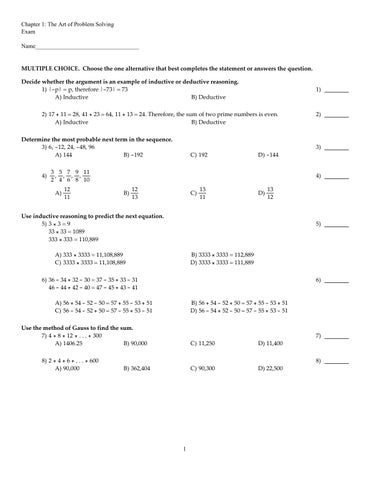
Chapter 1: The Art of Problem Solving Exam Name___________________________________
MULTIPLE CHOICE. Choose the one alternative that best completes the statement or answers the question. Decide whether the argument is an example of inductive or deductive reasoning. 1) |-p| = p, therefore |-73| = 73 A) Inductive B) Deductive
1)
2) 17 + 11 = 28, 41 + 23 = 64, 11 + 13 = 24. Therefore, the sum of two prime numbers is even. A) Inductive B) Deductive Determine the most probable next term in the sequence. 3) 6, -12, 24, -48, 96 A) 144 B) -192
4)
3) C) 192
D) -144
3 5 7 9 11 , , , , 2 4 6 8 10 A)
12 11
4) B)
12 13
C)
13 11
D)
13 12
Use inductive reasoning to predict the next equation. 5) 3 × 3 = 9 33 × 33 = 1089 333 × 333 = 110,889
5)
A) 333 × 3333 = 11,108,889 C) 3333 × 3333 = 11,108,889
B) 3333 × 3333 = 112,889 D) 3333 × 3333 = 111,889
6) 36 - 34 + 32 - 30 = 37 - 35 + 33 - 31 46 - 44 + 42 - 40 = 47 - 45 + 43 - 41
6)
B) 56 + 54 - 52 + 50 = 57 + 55 - 53 + 51 D) 56 - 54 + 52 - 50 = 57 - 55 + 53 - 51
A) 56 + 54 - 52 - 50 = 57 + 55 - 53 + 51 C) 56 - 54 - 52 + 50 = 57 - 55 + 53 - 51 Use the method of Gauss to find the sum. 7) 4 + 8 + 12 + . . . + 300 A) 1406.25 B) 90,000 8) 2 + 4 + 6 + . . . + 600 A) 90,000
2)
7) C) 11,250
D) 11,400
C) 90,300
D) 22,500
8) B) 362,404
1
Find a pattern and use it to solve the problem. 9) Draw the next figure in the pattern.
9)
A)
B)
C)
D)
10) Find the next term: 6, 12, 18, 30 A) 36 B) 66
10) C) 60
D) 42
SHORT ANSWER. Write the word or phrase that best completes each statement or answers the question. Solve the problem using inductive reasoning. 11) How many rectangles are there in the last two figures?
11)
→ 1 rectangle → 3 rectangles →
? rectangles →
? rectangles
12) How many line segments are determined by joining dots on the last two circles?
3 segments
6 segments
segments
2
segments
12)
MULTIPLE CHOICE. Choose the one alternative that best completes the statement or answers the question. Determine if the sequence is an arithmetic sequence, a geometric sequence, or neither. If it is either arithmetic or geometric, give the next term in the sequence. 13) 13) 9, 29, 49, 69, 89, . . . A) geometric; 109 B) neither C) arithmetic; 109 14) 5, 15, 45, 135, 405, . . . A) neither
14) B) geometric; 1215
C) arithmetic; 1215
Determine the indicated term in the given sequence. 3 15) The 7th term of 6, 3, , . . . 2 A)
3 16
B)
15)
3 128
C)
16) The 6th term of 2 , 8 , 32 , . . . A) 2048 B) 512
3 32
3 64 16)
C) 32,768
Use the appropriate formula to find the indicated figurate number. 17) the 6th pentagonal number A) P6 = 57 B) P6 = 51 C) P6 = 21 18) the 13th square number A) S13 = 91
D)
D) 1024
17) D) P6 = 36 18)
B) S13 = 196
C) S13 = 26
D) S13 = 169
Determine what the next equation would be, and verify that it is indeed a true statement. 19) 3 2 - 1 2 = 2 × 4
19)
42 - 22 = 2 × 6 52 - 32 = 2 × 8 A) 7 2 - 5 2 = 2 × 12
C) 6 2 - 4 2 = 4 × 5
B) 6 2 - 4 2 = 2 × 10
D) 6 2 - 4 = 2 × 16
20) 44 × 44 = 1936 404 × 404 = 163,216
20)
A) 4004 × 404 = 16,032,016 C) 4004 × 4004 = 1,603,202
B) 4004 × 4004 = 16,032,016 D) 4004 × 4004 = 1,617,616
Use the indicated formula to find the sum. n(n + 1) 21) Use S = to find the sum of 1 + 2 + 3 + . . . + 300. 2 A) 45,000
B) 45,150
22) Use S = n2 to find the sum of 1 + 3 + 5 + . . . + 701. A) 123,202 B) 123,200
21)
C) 4515
D) 44,850
C) 123,201
D) 122,500
22)
3
Use the method of successive differences to determine the next term in the sequence. 23) 5, 24, 91, 263, 619, 1260, . . . A) 2299 B) 2309 C) 2331 24) 14, 25, 66, 137, 238, . . . A) 398
23) D) 2287 24)
B) 339
C) 369
D) 399
SHORT ANSWER. Write the word or phrase that best completes each statement or answers the question. Use logic to solve the problem. 25) If it takes 6 minutes to hard-boil 3 goose eggs when dropped into boiling water, how long will it take to hard-boil 6 goose eggs?
25)
MULTIPLE CHOICE. Choose the one alternative that best completes the statement or answers the question. 26) A farmer had a stone weighing 40 pounds that he used to weigh pigs, but the stone broke into 4 pieces. The farmer found to his surprise that with the four pieces, he could weigh any whole number from 1 to 40. What did each of the 4 pieces weigh? A) 1, 3, 9, and 27 lb B) 1, 4, 9, and 26 lb C) 1, 3, 7, and 29 lb D) 1, 4, 8, and 27 lb Determine the number of figures (of any size) in the design. 27) Squares (of any size)
A) 18
27)
B) 17
C) 12
D) 13
28) Triangles (of any size)
A) 19
26)
28)
B) 16
C) 15
4
D) 13
Complete the magic (addition) square. A magic square has the property that the sum of the numbers in any row, column, or diagonal is the same. 29) Use each number 19, 20, 21, 22, 23, 24, 25, 26, and 27 once. 29) 22
20 23 25 19 B)
A) 22 24 20 21 23 25 26 19 27
22 27 20 21 23 25 26 19 24 D)
C) 22 27 20 21 23 25 24 19 26
22 26 20 21 23 25 24 19 27
30)
30) Use each number 16, 17, 18, 19, 20, 21, 22, 23, and 24 once. 19 18 20 23 16 21 B)
A) 19 22 24 18 20 17 23 16 21
19 24 22 18 20 17 23 16 21 D)
C) 19 22 17 18 20 24 23 16 21
19 24 17 18 20 22 23 16 21
Use problem solving strategies to solve the problem. 31) Iʹm thinking of a number between 4 and 10. If I square my number and find the difference of the digits, I will end up with the cube root of my number. What is my number? A) 7 B) 13 C) 8 D) 9 32) A rabbit grows so that every 2 months it doubles in weight. However, the rabbit will never go over 75 pounds. If a bunny is born on July 15th, weighing 2 pounds, in which month will it weigh 46 pounds? B) February C) April D) August A) June
5
31)
32)