Test Bank Marieb Human Anatomy & Physiology, 12e (Hoehn, Haynes, Abbott) Chapter 1-29 Chapter 1 The Human Body: An Orientation 1.1 Matching Questions
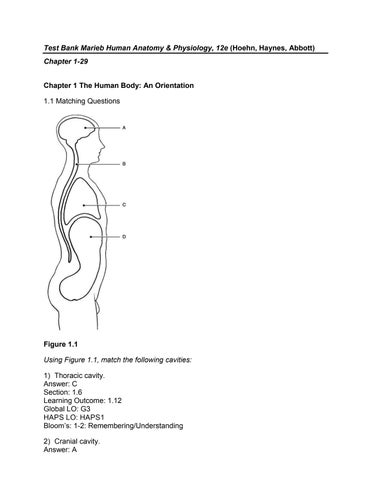
Figure 1.1 Using Figure 1.1, match the following cavities: 1) Thoracic cavity. Answer: C Section: 1.6 Learning Outcome: 1.12 Global LO: G3 HAPS LO: HAPS1 Bloom’s: 1-2: Remembering/Understanding 2) Cranial cavity. Answer: A
Section: 1.6 Learning Outcome: 1.12 Global LO: G3 HAPS LO: HAPS1 Bloom’s: 1-2: Remembering/Understanding 3) Abdominal cavity. Answer: D Section: 1.6 Learning Outcome: 1.12 Global LO: G3 HAPS LO: HAPS1 Bloom’s: 1-2: Remembering/Understanding 4) Vertebral cavity. Answer: B Section: 1.6 Learning Outcome: 1.12 Global LO: G3 HAPS LO: HAPS1 Bloom’s: 1-2: Remembering/Understanding
Figure 1.2 Using Figure 1.2, match the following descriptions to the most appropriate letter on the diagram: 5) Information about body temperature is sent through afferent pathways to the brain. Answer: C Section: 1.4 Learning Outcome: 1.7, 1.8 Global LO: G2, G3 HAPS LO: HAPS3
Bloom’s: 3-4: Applying/Analyzing 6) Free nerve endings in the skin detect changes in skin temperature (getting warmer). Answer: B Section: 1.4 Learning Outcome: 1.7, 1.8 Global LO: G2, G3 HAPS LO: HAPS3 Bloom’s: 3-4: Applying/Analyzing 7) Appropriate response information is sent through efferent pathways. Answer: D Section: 1.4 Learning Outcome: 1.7, 1.8 Global LO: G2, G3 HAPS LO: HAPS3 Bloom’s: 3-4: Applying/Analyzing 8) A change in the temperature of the external environment (getting warmer). Answer: A Section: 1.4 Learning Outcome: 1.7, 1.8 Global LO: G2, G3 HAPS LO: HAPS3 Bloom’s: 3-4: Applying/Analyzing 9) Sweat glands are stimulated as well as blood being distributed to the skin to allow cooling of the body to return the body's temperature to a physiological level. Answer: E Section: 1.4 Learning Outcome: 1.7, 1.8 Global LO: G2, G3 HAPS LO: HAPS3 Bloom’s: 3-4: Applying/Analyzing Match the following systems to their functions: A) Lymphatic B) Skeletal C) Nervous D) Muscular 10) Provides the force to move bones about their joints. Section: 1.2 Learning Outcome: 1.4 Global LO: G2, G7 HAPS LO: HAPS3 Bloom’s: 1-2: Remembering/Understanding 11) Responds to environmental changes by transmitting appropriate electrical impulses.
Section: 1.2 Learning Outcome: 1.4 Global LO: G2, G7 HAPS LO: HAPS3 Bloom’s: 1-2: Remembering/Understanding 12) Provides a ridged framework to support the body and stores minerals. Section: 1.2 Learning Outcome: 1.4 Global LO: G2, G7 HAPS LO: HAPS3 Bloom’s: 1-2: Remembering/Understanding 13) Picks up fluid leaked from blood vessels and houses white blood cells. Section: 1.2 Learning Outcome: 1.4 Global LO: G2, G7 HAPS LO: HAPS3 Bloom’s: 1-2: Remembering/Understanding Answers: 10) D 11) C 12) B 13) A Match the following systems to their functions: A) Immune B) Cardiovascular C) Endocrine D) Urinary 14) Controls the body with chemical molecules called hormones. Section: 1.2 Learning Outcome: 1.4 Global LO: G2, G7 HAPS LO: HAPS3 Bloom’s: 1-2: Remembering/Understanding 15) Delivers oxygen and nutrients to the tissues. Section: 1.2 Learning Outcome: 1.4 Global LO: G2, G7 HAPS LO: HAPS3 Bloom’s: 1-2: Remembering/Understanding 16) A functional organ system which provides a means of protecting us from foreign invaders. Section: 1.2 Learning Outcome: 1.4 Global LO: G2, G7 HAPS LO: HAPS3 Bloom’s: 1-2: Remembering/Understanding
17) Eliminates nitrogenous wastes from the body and regulates acid-base balance of the blood. Section: 1.2 Learning Outcome: 1.4 Global LO: G2, G7 HAPS LO: HAPS3 Bloom’s: 1-2: Remembering/Understanding Answers: 14) C 15) B 16) A 17) D Match the following examples of feedback mechanisms: A) Positive feedback B) Negative feedback 18) Used for changes in blood glucose levels. Section: 1.4 Learning Outcome: 1.7, 1.8 Global LO: G2, G3 HAPS LO: HAPS3, HAPS4 Bloom’s: 1-2: Remembering/Understanding 19) Used for changes in blood pressure. Section: 1.4 Learning Outcome: 1.7, 1.8 Global LO: G2, G3 HAPS LO: HAPS3, HAPS4 Bloom’s: 1-2: Remembering/Understanding 20) Used when activating the digestive system before an upcoming meal. Section: 1.4 Learning Outcome: 1.7, 1.8 Global LO: G2, G3 HAPS LO: HAPS3, HAPS4 Bloom’s: 1-2: Remembering/Understanding 21) Used for childbirth. Section: 1.4 Learning Outcome: 1.7, 1.8 Global LO: G2, G3 HAPS LO: HAPS3, HAPS4 Bloom’s: 1-2: Remembering/Understanding Answers: 18) B 19) B 20) A 21) A Match the following systems and organs: A) Digestive B) Respiratory C) Reproductive