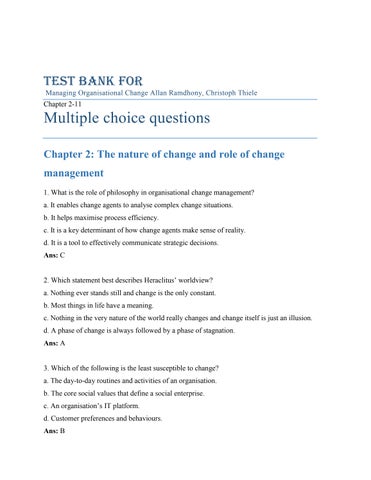
Test Bank For Managing Organisational Change Allan Ramdhony, Christoph Thiele Chapter 2-11
Multiple choice questions Chapter 2: The nature of change and role of change management 1. What is the role of philosophy in organisational change management? a. It enables change agents to analyse complex change situations. b. It helps maximise process efficiency. c. It is a key determinant of how change agents make sense of reality. d. It is a tool to effectively communicate strategic decisions. Ans: C
2. Which statement best describes Heraclitus’ worldview? a. Nothing ever stands still and change is the only constant. b. Most things in life have a meaning. c. Nothing in the very nature of the world really changes and change itself is just an illusion. d. A phase of change is always followed by a phase of stagnation. Ans: A
3. Which of the following is the least susceptible to change? a. The day-to-day routines and activities of an organisation. b. The core social values that define a social enterprise. c. An organisation’s IT platform. d. Customer preferences and behaviours. Ans: B
4. Which of the following is an example of ‘external flows’ that can have a significant impact on organisational functioning? a. Disruptions and shockwaves in an organisation’s operating context. b. The flow of goods along an assembly line. c. Communication patterns between functional departments. d. The value-adding activities that underpin finished products. Ans: A 5. Which of the statements below is associated with the common assumption that ‘change is the only constant’? a. Change agents have to battle the forces of change in an increasingly chaotic and unpredictable business context. b. Change agents have to learn how to live and let live. c. The on-going development of ICTs have brought about the Industrial Internet of Things. d. Change is not an end in itself but a lever for optimising organisational functioning. Ans: C
6. Which one of the following statements best explains the basic meaning of organisational change? a. A deliberate move towards some desired state in an attempt to ensure the survival and growth of the organization. b. A simple and straightforward process that aims to transform an organisation. c. A necessary but impossible task. d. A major shift in an organisation’s external environment. Ans: A
7. Which of the following is associated with operational change? a. An approach to change that involves long-range planning. b. A radical redesign of an organisation’s business model. c. Expanding business to new markets.
d. An attempt to improve the efficiency of business processes. Ans: D
8. Which of the following is not a dichotomous conception of organisational change? a. Localised v. organisation-wide change. b. Localised v. regionalised change. c. Continuous v. discontinuous change. d. Evolutionary v. revolutionary change. Ans: B
9. What are the main characteristics of transformational change? a. Low-intensity, localised and gradual. b. Rapid, prescribed and involving small-scale changes. c. High-intensity, organization-wide, radical and often irreversible. d. Broken down in smaller stages over a period of time. Ans: C
10. Which of the following is a true statement according to the theory of punctuated equilibrium? a. Relatively long periods of low-intensity, incremental change punctuated by shorter, compact periods of high-intensity, transformational change. b. There are short periods of relative stability punctuated by longer bursts of disruptive and rapid change. c. Significant evolution occurs during long periods of relative stability. d. Significant evolution occurs when organisations have good leaders. Ans: A
11. Which of the following does not account for an organisation’s deep structures? a. Strategic goals and objectives. b. Structural arrangements and work patterns. c. Mode of governance and power distribution.
d. An organisation’s network of external partners. Ans: D
12. What is the meaning of upward causation? a. When employees exert a causal influence on top management. b. When an organisation has a causal impact on its wider operating context. c. When external causal forces have a significant impact on the organisation’s strategy. d. When a complex web of causal forces impacts an organisation from above. Ans: B
13. Which of the following is not a benefit of causal modelling? a. It can be used to map out significant causes underlying change initiatives. b. It can enable accurate predictions regarding the effectiveness of change leaders. c. It allows change agents to track emergent causal influences throughout the change process. d. It can be used to plot evidence-based courses of action. Ans: B
14. What is the primary focus of organisational development (OD)? a. Optimisation of organisational well-being and performance. b. Successful completion of specific tasks. c. Monitoring the performance of individual employees. d. Ensuring that change interventions are broken down into clearly identifiable stages. Ans: A
15. Which of the following statements about project management (PM) is true? a. PM is always an ongoing process. b. PM is the sole responsibility of top management. c. Primary focus of PM is on the timely and successful completion of specific tasks. d. PM needs to be led by external consultants. Ans: C
Multiple choice questions Chapter 3: Strategic change 1. Which of the following statements is not true? a. Strategic change can involve different types of change. b. Strategic change is dependent upon a range of necessary resources. c. Strategic change is deployed to primarily achieve short-term goals. d. Strategic change is driven by a clear set of goals and objectives. Ans: C
2. What is the meaning of change agency? a. The causal power and intentional action of change agents in generating certain desired outcomes. b. A consultancy firm specialising in change management. c. The prerogative of change agents. d. The power relations between change leaders and their followers. Ans: A
3. Which of the following best describes determinism? a. Draws attention to how change agents determine what happens in their change context. b. Locks change agents in a rather passive and reactive mode of thought and behaviour. c. Posits that change agents are free and unrestrained in following chosen courses of action. d. Portrays change agents as having a leading role in shaping the external forces of change. Ans: B
4. Which philosophical concept posits that people are free and unrestrained in their ability to make their own decisions and follow chosen courses of action? a. Positivism.