Exam Name___________________________________
MULTIPLE CHOICE. Choose the one alternative that best completes the statement or answers the question. Use the information below to answer the following questions. Fact 1.3.1 Costco When Costco opened a gas bar just off Highway 401, the neighbourhood was swamped with cars as drivers lined up to get a discount of 10 cents a litre.
1) Refer to Fact 1.3.1. To control the crowd Costco hires traffic police. When Costco hires traffic police, it faces a tradeoff that could include all of the following except A) having a larger inventory of stock. B) having large seasonal displays. C) hiring more customer service representatives. D) expansion of the warehouse. E) taking business away from gas stations in the area.
1)
2) Which of the following would an economist classify as capital? A) a deposit of silver B) a computer C) entrepreneurship D) land E) natural resources
2)
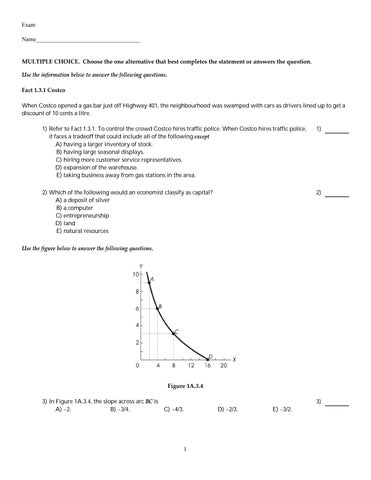
Use the figure below to answer the following questions.
Figure 1A.3.4
3) In Figure 1A.3.4, the slope across arc BC is A) -2. B) -3/4. C) -4/3.
1
D) -2/3.
E) -3/2.
3)
4) To make choices, people must A) be risk-takers. B) evaluate the values of alternative actions. C) have unlimited resources. D) be free from government constraint. E) have unlimited access to information at no cost.
4)
5) Which of the following is a positive statement? A) Government should control the rents that apartment owners charge. B) Low rents restrict the supply of housing. C) Owners of apartment buildings should be free to charge whatever rent they want. D) Low rents are better for a city than high rents. E) Housing costs too much.
5)
6) The problem of scarcity applies A) only to industrially developed countries because they create pollution. B) only to countries that are over-populated. C) only to countries that use natural resources in most of their production processes. D) only to developing countries because resources are scarce in these countries. E) to all countries, regardless of their level of development.
6)
7) Which of the following is not a factor of production? A) the water used to cool a nuclear power plant B) the management skill of a small business owner C) the effort of farmers raising cattle D) the land used by a farmer to grow wheat E) the wages paid to workers
7)
8) "There can be too much of a good thing." This statement suggests that A) certain goods and services such as education and health care are inherently desirable and should be produced regardless of costs and benefits. B) a good may be produced to the point where its marginal cost exceeds its marginal benefit. C) a good may be produced to the point where its marginal benefit exceeds its marginal cost. D) choices made in self-interest cannot be applied to many economic decisions. E) a good may be produced to the point where its marginal benefit is equal to its marginal cost.
8)
2
Use the figure below to answer the following question.
Figure 1A.4.1
9) Given the data in the following table, which one of the graphs in Figure 1A.4.1 correctly represents the relationship among x, y, and z? x y z
120 10 4
A) (a)
100 12 4
80 14 4
140 10 5
B) (b)
120 12 5
100 14 5
160 10 6
140 12 6
C) (c)
120 14 6
D) (d)
3
E) (b) and (c)
9)
10) Consider the following information on cola sales by number of cases for a typical university residence floor:
10)
Price (dollars per case) Temp. (°C) 15 20 25 30 35
10.00 50 60 70 80 90
12.50 40 50 60 70 80
15.00 30 40 50 60 70
17.50 20 30 40 50 60
Cola sales and temperature are A) not affected by the price. B) unrelated. C) inversely related. D) positively related. E) negatively related at low prices, but positively related at high prices. Use the figure below to answer the following questions.
Figure 1A.3.5
11) Refer to Figure 1A.3.5. Which one of the following statements is true? A) The slope is less between points A and B than between points B and C. B) The slope at C is 1. C) The slope at C is negative. D) The slope is greater between points B and C than between points A and B. E) The slope at C is 0.
4
11)
Use the figure below to answer the following questions.
Figure 1A.3.3
12) What is the slope across the arc between B and C in Figure 1A.3.3? A) 1 B) 3 C) 2/3 D) 1/2.
E) 2
13) You have the choice to go skiing during spring break, staying at the university to study, or spending the week visiting your family. If you decide to go skiing, the opportunity cost of the holiday is A) nothing because you enjoy skiing. B) staying at the university because your parents are paying your tuition. C) visiting your family because not visiting means that you will feel guilty. D) staying at the university or spending the week visiting your family, depending on what you would have done otherwise. E) staying at the university to study because you need to improve your grades.
5
12)
13)